Experts Predict Bitcoin Crash to $10,000 This Year. Is There a Rescue?

bitcoinistPublicado em 2025-12-17Última atualização em 2025-12-17

Resumo

Bitcoin's price decline below $90,000 has reignited fears of a potential drop to $10,000, driven by a shift in market sentiment away from riskier assets. Amid this uncertainty, attention is turning toward practical infrastructure solutions rather than speculative narratives. Bitcoin Layer 2 technologies, such as Bitcoin Hyper, are gaining traction as they address key limitations of the Bitcoin network—high fees, slow throughput, and limited programmability. Bitcoin Hyper, which integrates Solana Virtual Machine (SVM), aims to provide faster execution and lower latency, enabling DeFi, NFTs, and dApps on Bitcoin without compromising its security. The project has already raised over $29.5 million in its presale, indicating significant investor interest. As market cycles emphasize utility over hype, infrastructure projects like Bitcoin Hyper could play a crucial role in Bitcoin's next growth phase, even amid bearish predictions.

The market has switched again from "eternal growth" mode to "all is lost" mode. This week, $BTC fell below $90,000 amid deteriorating risk appetite: investors were frightened by signals that the AI spending boom might generate profits slower than expected, meaning pressure on risky assets is returning.

Against this backdrop, the most "toxic" price target in crypto has resurfaced: $10,000 for Bitcoin. It is actively promoted in the media by Mike McGlone from Bloomberg Intelligence — he links the risk of a significant drawdown to a deflationary scenario following a period of inflation. The idea is not that "tomorrow it will be $10k," but that when the cycle turns, the market can overshoot downward just as aggressively as it overshot upward.

But here's what many discussions miss: even if you believe in the long-term growth of $BTC, in the short term you still need infrastructure that makes Bitcoin a working tool, not just a "ticker on Twitter." High fees, limited throughput, and almost zero native programmability are a basic UX pain. And this time, "rescue" on the market is more often sought not in another meme story, but in Bitcoin Layer 2 and the infrastructure around it (yes, it sounds less exciting — but much more practical). Projects from this niche regularly make it into lists of the best coins for 2025.

This leads to a logical bridge to Bitcoin Hyper: if the next market phase is about efficiency, speed, and applications on Bitcoin, then projects that provide $BTC with a proper execution layer will gather attention — even if someone is simultaneously drawing horror stories about $10,000. In previous cycles, similar logic has already worked: when growth slows, the market begins to value what brings real utility.

BUY BITCOIN HYPER

How Layer 2s Become a Stress Test for $BTC

When volatility increases, capital becomes more selective. Investors stop buying narratives for the sake of narratives and start looking at where real activity will appear: transactions, fees, liquidity, developers. Reuters is just noting a shift towards more cautious strategies and the market's attempts to "mature" after sharp movements.

Right now, Bitcoin Layer 2 is a race for two goals simultaneously: scaling payments and launching a full-fledged on-chain economy (DeFi, NFTs, games) around Bitcoin, all without losing trust in the base asset. Solutions have different approaches: Lightning handles micropayments, rollup approaches promise computations "off L1," and the BitVM narrative pushes the market towards more complex constructions without changing the L1 consensus. But the user demand is the same: "give us speed and fees at the level of modern networks, without breaking trust in $BTC."

And this is where Bitcoin Hyper appears as one of the bets on "Bitcoin with normal speed and programmability" — without the need to convince people to abandon $BTC for another L1. It sounds reasonable. And it's precisely such utilitarian stories that usually start "preparing" the next rotation of the cycle.

Why Bitcoin Hyper Could Launch a New Cycle for All of Bitcoin

Bitcoin Hyper promotes a clear idea: a modular architecture where Bitcoin L1 remains the settlement and trust layer, and execution moves to a fast L2 with Solana Virtual Machine integration. SVM is a bet on high performance and a developer-friendly stack, especially if you need to quickly launch DeFi mechanics, NFT platforms, or gaming dApps.
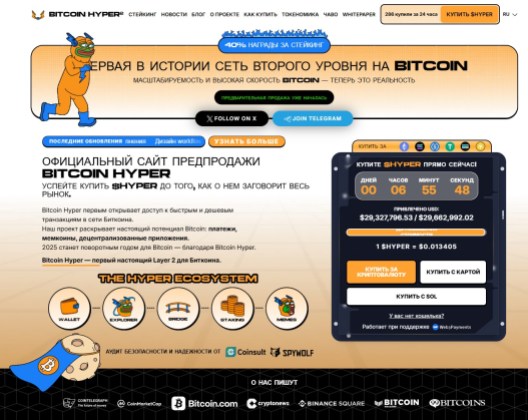
The project's key message is formulated very directly: "the first Bitcoin Layer 2 with SVM integration," which aims for ultra-low execution latency. This is important for a very practical reason: without fast smart contracts, the Bitcoin economy almost inevitably leaks to other ecosystems — to places where you can do swaps, lending, staking, and more complex strategies without waiting for blocks and without the pain of fees. And if the next market cycle is indeed about utility, then infrastructure often wins over noise — a boring thought, but a working one (and traders who track such shifts usually notice it first).

Interest in the story is also fueled by presale numbers: the project has already raised $29,556,732.75, with a token price of $0.013435. This is not a guarantee of success — it's just a marker of demand. The activity of large wallets also looks interesting: whale tracking has spotted two notable purchases totaling about $396k, with the largest transaction being approximately $53k from November 19, 2025.

The final touch is the staking mechanics after TGE: a high APY is announced (without disclosing the rate), instant launch, a 7-day vesting period for presale stakers, and a focus on rewards for community participation. The risk here is obvious: without specific yield parameters, the market will demand transparency, otherwise expectations can easily turn into disappointment. This is not a "project minus," but rather a test of communication maturity — how prepared the Bitcoin Hyper team is to disclose details on time.


Criptomoedas em alta

Perguntas relacionadas

QWhat is the main reason for the recent decline in Bitcoin's price below $90,000?

AThe decline is due to a shift in market sentiment from 'eternal growth' to 'all is lost,' driven by reduced risk appetite among investors. They were spooked by signals that the boom in AI spending might generate profits slower than expected, leading to renewed pressure on risky assets.

QWho is promoting the $10,000 Bitcoin price target and what is their reasoning?

AMike McGlone from Bloomberg Intelligence is promoting the $10,000 Bitcoin price target. He links the risk of a deep decline to a deflationary scenario following a period of inflation, suggesting that the market could aggressively overcorrect downward when the cycle turns, just as it overcorrected upward.

QWhat is Bitcoin Hyper and what problem does it aim to solve?

ABitcoin Hyper is a Bitcoin Layer 2 solution that aims to address the UX pain points of high fees, limited throughput, and near-zero native programmability on the Bitcoin network. It provides a fast execution layer with Solana Virtual Machine (SVM) integration to enable speed, low fees, and programmable functionality like DeFi, NFTs, and dApps without sacrificing trust in Bitcoin.

QHow much funding has Bitcoin Hyper raised in its presale and what is the current price of its token?

ABitcoin Hyper has raised $29,556,732.75 in its presale, and the current token price is $0.013435.

QWhat is the key message of the Bitcoin Hyper project and why is it significant?

AThe key message of Bitcoin Hyper is that it is 'the first Bitcoin Layer 2 with SVM integration,' targeting ultra-low execution latency. This is significant because without fast smart contract capabilities, Bitcoin's economy risks leaking to other ecosystems that offer faster transactions, lower fees, and more complex financial strategies, making this infrastructure crucial for Bitcoin's utility in the next market cycle.

Leituras Relacionadas

U.S. Bonds, AI, Inflation: You Can't Have All Three – What's Bitcoin Betting On?

Title: U.S. Treasury Bonds, AI, and Inflation: A Trilemma Facing Washington, and Where BTC Fits In Core Thesis: The U.S. government faces a trilemma: stabilizing the Treasury market, sustaining the AI investment cycle, and controlling inflation. The likely political choice is to prioritize the first two, accepting higher inflation for longer. This creates a sustained tailwind for both gold and Bitcoin by injecting liquidity and shifting duration risk away from the private sector. Key Pressures on Treasuries: * Long-term yields (e.g., 10-year ~4.70%) are near multi-decade highs due to persistent inflation risks, high fiscal supply, weaker demand for long duration, and new competition from AI infrastructure financing. * AI investment, requiring massive capital (estimated ~$300B in investment-grade bond issuance), is now competing directly with the Treasury in long-duration debt markets. * Geopolitical tensions (e.g., Iran conflict) add upward pressure on oil prices and defense spending. Policy Response: The Treasury, under Secretary Besant, is focusing on market stability through measures like supporting the Yen (to prevent forced Japanese Treasury sales), increasing repo operations for long-dated bonds, and potentially shifting issuance toward the short end. This "aggressive Treasury issuance" can function like "stealth QE," easing financial conditions. Impact on Assets: * **Gold** has already benefited (up ~90% from Aug 2024 to Aug 2026), driven by declining trust in the USD, inflation fears, and a "monetary debasement" narrative. * **Bitcoin** is now showing stronger correlation with this theme. Recent outperformance vs. gold (BTC +22.2% vs. Gold +5.9% in late Aug) coincided with Treasury's enhanced repo actions, suggesting the market may be pricing it as a liquidity/ debasement hedge, not just a speculative tech asset. Conclusion: If high inflation, large deficits, and AI capital demands persist, the cost of stabilizing bonds and growth will be shorter debt maturity, constant liquidity support, and tolerance for higher inflation—a favorable environment for gold and BTC. This view would be challenged only by a return to ~2% inflation, credible fiscal consolidation, or AI becoming self-funding.

marsbitHá 20m

U.S. Bonds, AI, Inflation: You Can't Have All Three – What's Bitcoin Betting On?

marsbitHá 20m

HBM is Being Redefined

HBM is being redefined as AI-driven demand for computing power shifts the performance bottleneck from processing units to memory bandwidth, making High Bandwidth Memory the critical component for advanced AI hardware. At HotChips 2026, Samsung and SK Hynix unveiled new technical roadmaps for HBM4, moving away from the traditional approach of simply increasing DRAM speed and stacking layers. The focus for HBM4 has shifted from DRAM optimization to a comprehensive system-level redesign of the Base Die. Key innovations include upgrading the Base Die to advanced logic processes (e.g., Samsung's 4nm), adopting hybrid bonding for 3D stacking, and exploring heterogeneous packaging solutions like Intel's EMIB alongside the established CoWoS. This marks HBM's evolution from a simple memory component into an integrated system involving "memory + logic + packaging + IP + EDA." This transition brings benefits like better signal integrity, higher I/O bandwidth (up to 2048-bit), and potential for in-memory computing. However, it also introduces significant complexity. DRAM manufacturers now must deeply collaborate with logic foundries, extending design cycles and increasing supply chain challenges. Furthermore, the industry is moving towards multiple advanced packaging paths, with EMIB emerging as an alternative to CoWoS to alleviate capacity constraints, while hybrid bonding is being developed for future ultra-high (16+ layer) stacks. New core barriers have emerged beyond manufacturing. High-speed PHY/SERDES IP, crucial for HBM4's higher data rates, is concentrated among a few established players, creating an entry barrier for smaller firms. Similarly, the industry lacks mature 3D heterogeneous EDA toolchains capable of co-simulating the coupled electrical, thermal, and mechanical effects across the logic base, memory stacks, and interposer. These "soft" capabilities in IP and EDA are now critical determinants of HBM4's performance and yield. In summary, the HBM industry is entering a new era of systemic competition. The standardized approach is giving way to divergent vendor roadmaps, with multiple technologies coexisting. Success will depend on integrated architecture, packaging, process, and ecosystem capabilities, fundamentally reshaping the competitive landscape for AI memory.

marsbitHá 25m

HBM is Being Redefined

marsbitHá 25m

The Era of Earning 200,000 from a 3,000 Investment Is Over; AI Comic Dramas Are Not a Get-Rich-Quick Trend

The era of turning 3,000 yuan into 200,000 yuan is over. AI-generated comic dramas are no longer a low-barrier gold rush. A wave of sudden account suspensions has hit creators in AI comic dramas, AI art, and AI tutorials, primarily triggered by new content and copyright compliance rules implemented by Tomato Novel on August 17. This "last straw" exposed the underlying issues: tightening platform rules, rising copyright requirements, increasing costs, and severe content homogenization. The business model was fundamentally unsustainable for most creators. One creator detailed the math: producing five minutes of content daily cost around 510 yuan in AI computing and editing, while a video with 60,000 views might only earn 45 yuan. While a few early viral hits like "Huo Qubing" and "Zombie Cleaner" achieved high returns with minimal investment, they were exceptions. The reality for most solo creators was barely covering costs or operating at a loss. The new regulations mandate formal authorization from original authors for adaptations, limit video length and the amount of原著 content used, and ban terms like "Episode 1" in titles. This directly dismantled the previous "produce first, authorize later" model. Faced with the inability to afford版权 costs and the threat of penalty, many creators chose to halt updates. While some fans expressed frustration, the rules protect original authors who often faced侵权 with little recourse. The shutdowns signal not the failure of AI technology, but an inevitable industry shift from wild growth to regulated refinement. The previous model prioritized quick cash over quality content, leading to formulaic, "AI-face" saturated dramas that audiences grew tired of. The future belongs to creators who use AI as a tool to serve solid storytelling, not replace it. Some are now seeking formal licenses, a slower but necessary process. Upcoming national regulations further underscore this move towards standardization, weeding out those seeking only fast money and making space for genuine creators.

marsbitHá 25m

The Era of Earning 200,000 from a 3,000 Investment Is Over; AI Comic Dramas Are Not a Get-Rich-Quick Trend

marsbitHá 25m

Trading

Spot

Artigos em Destaque

Como comprar PURR

Bem-vindo à HTX.com!Tornámos a compra de Hyperliquid Strategies Inc. (PURR) simples e conveniente.Segue o nosso guia passo a passo para iniciar a tua jornada no mundo das criptos.Passo 1: cria a tua conta HTXUtiliza o teu e-mail ou número de telefone para te inscreveres numa conta gratuita na HTX.Desfruta de um processo de inscrição sem complicações e desbloqueia todas as funcionalidades.Obter a minha contaPasso 2: vai para Comprar Cripto e escolhe o teu método de pagamentoCartão de crédito/débito: usa o teu visa ou mastercard para comprar Hyperliquid Strategies Inc. (PURR) instantaneamente.Saldo: usa os fundos da tua conta HTX para transacionar sem problemas.Terceiros: adicionamos métodos de pagamento populares, como Google Pay e Apple Pay, para aumentar a conveniência.P2P: transaciona diretamente com outros utilizadores na HTX.Mercado de balcão (OTC): oferecemos serviços personalizados e taxas de câmbio competitivas para os traders.Passo 3: armazena teu Hyperliquid Strategies Inc. (PURR)Depois de comprar o teu Hyperliquid Strategies Inc. (PURR), armazena-o na tua conta HTX.Alternativamente, podes enviá-lo para outro lugar através de transferência blockchain ou usá-lo para transacionar outras criptomoedas.Passo 4: transaciona Hyperliquid Strategies Inc. (PURR)Transaciona facilmente Hyperliquid Strategies Inc. (PURR) no mercado à vista da HTX.Acede simplesmente à tua conta, seleciona o teu par de trading, executa as tuas transações e monitoriza em tempo real.Oferecemos uma experiência de fácil utilização tanto para principiantes como para traders experientes.

136 Visualizações TotaisPublicado em {updateTime}Atualizado em 2026.08.21

Como comprar PURR

Como comprar PDD

Bem-vindo à HTX.com!Tornámos a compra de PDD Holdings, Inc. (PDD) simples e conveniente.Segue o nosso guia passo a passo para iniciar a tua jornada no mundo das criptos.Passo 1: cria a tua conta HTXUtiliza o teu e-mail ou número de telefone para te inscreveres numa conta gratuita na HTX.Desfruta de um processo de inscrição sem complicações e desbloqueia todas as funcionalidades.Obter a minha contaPasso 2: vai para Comprar Cripto e escolhe o teu método de pagamentoCartão de crédito/débito: usa o teu visa ou mastercard para comprar PDD Holdings, Inc. (PDD) instantaneamente.Saldo: usa os fundos da tua conta HTX para transacionar sem problemas.Terceiros: adicionamos métodos de pagamento populares, como Google Pay e Apple Pay, para aumentar a conveniência.P2P: transaciona diretamente com outros utilizadores na HTX.Mercado de balcão (OTC): oferecemos serviços personalizados e taxas de câmbio competitivas para os traders.Passo 3: armazena teu PDD Holdings, Inc. (PDD)Depois de comprar o teu PDD Holdings, Inc. (PDD), armazena-o na tua conta HTX.Alternativamente, podes enviá-lo para outro lugar através de transferência blockchain ou usá-lo para transacionar outras criptomoedas.Passo 4: transaciona PDD Holdings, Inc. (PDD)Transaciona facilmente PDD Holdings, Inc. (PDD) no mercado à vista da HTX.Acede simplesmente à tua conta, seleciona o teu par de trading, executa as tuas transações e monitoriza em tempo real.Oferecemos uma experiência de fácil utilização tanto para principiantes como para traders experientes.

48 Visualizações TotaisPublicado em {updateTime}Atualizado em 2026.08.24

Como comprar PDD

O que é JP225

O índice de ações mais representativo do Japão, composto por 225 ações de primeira linha listadas na Bolsa de Valores de Tóquio, abrange principais indústrias como a manufatura, tecnologia e finanças. Tem sido publicado continuamente desde 1950 e serve como um benchmark central para medir o desempenho geral do mercado de ações japonês.

24 Visualizações TotaisPublicado em {updateTime}Atualizado em 2026.08.25

O que é JP225

Discussões

Bem-vindo à Comunidade HTX. Aqui, pode manter-se informado sobre os mais recentes desenvolvimentos da plataforma e obter acesso a análises profissionais de mercado. As opiniões dos utilizadores sobre o preço de A (A) são apresentadas abaixo.

活动图片