Experts Predict Bitcoin Crash to $10,000 This Year. Is There a Rescue?

bitcoinistPublicado em 2025-12-17Última atualização em 2025-12-17

Resumo

Bitcoin's price decline below $90,000 has reignited fears of a potential drop to $10,000, driven by a shift in market sentiment away from riskier assets. Amid this uncertainty, attention is turning toward practical infrastructure solutions rather than speculative narratives. Bitcoin Layer 2 technologies, such as Bitcoin Hyper, are gaining traction as they address key limitations of the Bitcoin network—high fees, slow throughput, and limited programmability. Bitcoin Hyper, which integrates Solana Virtual Machine (SVM), aims to provide faster execution and lower latency, enabling DeFi, NFTs, and dApps on Bitcoin without compromising its security. The project has already raised over $29.5 million in its presale, indicating significant investor interest. As market cycles emphasize utility over hype, infrastructure projects like Bitcoin Hyper could play a crucial role in Bitcoin's next growth phase, even amid bearish predictions.

The market has switched again from "eternal growth" mode to "all is lost" mode. This week, $BTC fell below $90,000 amid deteriorating risk appetite: investors were frightened by signals that the AI spending boom might generate profits slower than expected, meaning pressure on risky assets is returning.

Against this backdrop, the most "toxic" price target in crypto has resurfaced: $10,000 for Bitcoin. It is actively promoted in the media by Mike McGlone from Bloomberg Intelligence — he links the risk of a significant drawdown to a deflationary scenario following a period of inflation. The idea is not that "tomorrow it will be $10k," but that when the cycle turns, the market can overshoot downward just as aggressively as it overshot upward.

But here's what many discussions miss: even if you believe in the long-term growth of $BTC, in the short term you still need infrastructure that makes Bitcoin a working tool, not just a "ticker on Twitter." High fees, limited throughput, and almost zero native programmability are a basic UX pain. And this time, "rescue" on the market is more often sought not in another meme story, but in Bitcoin Layer 2 and the infrastructure around it (yes, it sounds less exciting — but much more practical). Projects from this niche regularly make it into lists of the best coins for 2025.

This leads to a logical bridge to Bitcoin Hyper: if the next market phase is about efficiency, speed, and applications on Bitcoin, then projects that provide $BTC with a proper execution layer will gather attention — even if someone is simultaneously drawing horror stories about $10,000. In previous cycles, similar logic has already worked: when growth slows, the market begins to value what brings real utility.

BUY BITCOIN HYPER

How Layer 2s Become a Stress Test for $BTC

When volatility increases, capital becomes more selective. Investors stop buying narratives for the sake of narratives and start looking at where real activity will appear: transactions, fees, liquidity, developers. Reuters is just noting a shift towards more cautious strategies and the market's attempts to "mature" after sharp movements.

Right now, Bitcoin Layer 2 is a race for two goals simultaneously: scaling payments and launching a full-fledged on-chain economy (DeFi, NFTs, games) around Bitcoin, all without losing trust in the base asset. Solutions have different approaches: Lightning handles micropayments, rollup approaches promise computations "off L1," and the BitVM narrative pushes the market towards more complex constructions without changing the L1 consensus. But the user demand is the same: "give us speed and fees at the level of modern networks, without breaking trust in $BTC."

And this is where Bitcoin Hyper appears as one of the bets on "Bitcoin with normal speed and programmability" — without the need to convince people to abandon $BTC for another L1. It sounds reasonable. And it's precisely such utilitarian stories that usually start "preparing" the next rotation of the cycle.

Why Bitcoin Hyper Could Launch a New Cycle for All of Bitcoin

Bitcoin Hyper promotes a clear idea: a modular architecture where Bitcoin L1 remains the settlement and trust layer, and execution moves to a fast L2 with Solana Virtual Machine integration. SVM is a bet on high performance and a developer-friendly stack, especially if you need to quickly launch DeFi mechanics, NFT platforms, or gaming dApps.
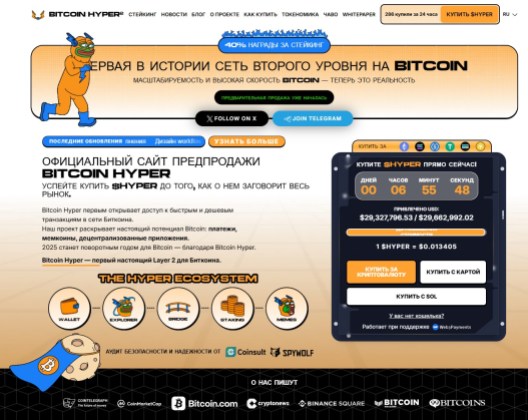
The project's key message is formulated very directly: "the first Bitcoin Layer 2 with SVM integration," which aims for ultra-low execution latency. This is important for a very practical reason: without fast smart contracts, the Bitcoin economy almost inevitably leaks to other ecosystems — to places where you can do swaps, lending, staking, and more complex strategies without waiting for blocks and without the pain of fees. And if the next market cycle is indeed about utility, then infrastructure often wins over noise — a boring thought, but a working one (and traders who track such shifts usually notice it first).

Interest in the story is also fueled by presale numbers: the project has already raised $29,556,732.75, with a token price of $0.013435. This is not a guarantee of success — it's just a marker of demand. The activity of large wallets also looks interesting: whale tracking has spotted two notable purchases totaling about $396k, with the largest transaction being approximately $53k from November 19, 2025.

The final touch is the staking mechanics after TGE: a high APY is announced (without disclosing the rate), instant launch, a 7-day vesting period for presale stakers, and a focus on rewards for community participation. The risk here is obvious: without specific yield parameters, the market will demand transparency, otherwise expectations can easily turn into disappointment. This is not a "project minus," but rather a test of communication maturity — how prepared the Bitcoin Hyper team is to disclose details on time.


Criptomoedas em alta

Perguntas relacionadas

QWhat is the main reason for the recent decline in Bitcoin's price below $90,000?

AThe decline is due to a shift in market sentiment from 'eternal growth' to 'all is lost,' driven by reduced risk appetite among investors. They were spooked by signals that the boom in AI spending might generate profits slower than expected, leading to renewed pressure on risky assets.

QWho is promoting the $10,000 Bitcoin price target and what is their reasoning?

AMike McGlone from Bloomberg Intelligence is promoting the $10,000 Bitcoin price target. He links the risk of a deep decline to a deflationary scenario following a period of inflation, suggesting that the market could aggressively overcorrect downward when the cycle turns, just as it overcorrected upward.

QWhat is Bitcoin Hyper and what problem does it aim to solve?

ABitcoin Hyper is a Bitcoin Layer 2 solution that aims to address the UX pain points of high fees, limited throughput, and near-zero native programmability on the Bitcoin network. It provides a fast execution layer with Solana Virtual Machine (SVM) integration to enable speed, low fees, and programmable functionality like DeFi, NFTs, and dApps without sacrificing trust in Bitcoin.

QHow much funding has Bitcoin Hyper raised in its presale and what is the current price of its token?

ABitcoin Hyper has raised $29,556,732.75 in its presale, and the current token price is $0.013435.

QWhat is the key message of the Bitcoin Hyper project and why is it significant?

AThe key message of Bitcoin Hyper is that it is 'the first Bitcoin Layer 2 with SVM integration,' targeting ultra-low execution latency. This is significant because without fast smart contract capabilities, Bitcoin's economy risks leaking to other ecosystems that offer faster transactions, lower fees, and more complex financial strategies, making this infrastructure crucial for Bitcoin's utility in the next market cycle.

Leituras Relacionadas

7 Months After the Collapse of Huiwang, Southeast Asia's Escrow Platforms Undergo a Major Reshuffle

Following the collapse of Huione Pay—dubbed the "Alipay of Southeast Asia"—seven months ago, the region's underground financial guarantee platform sector is undergoing a significant reshuffle. This power vacuum has been swiftly filled by emerging platforms such as XinBi, Tiger/Navigator, JinBei (renamed JinBo), Dali/Tiancheng, and FullyLight. These platforms, operating largely via Telegram and offering services like escrow for illicit transactions, have absorbed the vast user base and markets left behind by Huione. While positioning themselves as "trust intermediaries," their primary clientele consists of networks involved in online scams, money laundering, illegal gambling, and even human trafficking. For instance, the Tiger/Navigator platform explicitly provides "escrow" services for kidnapping-for-ransom operations ("强押车交易"). Data underscores the immense scale: Huione alone processed over $103 billion in cryptocurrency payments and facilitated over $31 billion through its escrow market before its downfall, linking it to Cambodia's notorious Prince Group. Since its collapse, competitors have seen explosive growth. For example, the XinBi platform has accumulated over $1.6 billion in total USDT revenue, while platforms like NewPay, OkPay (under Dali), and FullyLight Wallet collectively processed over $4.8 billion in USDT in a single year. This ecosystem thrives in regions like Cambodia and Myanmar, where regulatory gaps allow these platforms to act as critical financial infrastructure for sprawling cybercrime industries, from scam compounds to online casinos. The article concludes that the moniker "Southeast Asian Alipay" is a misnomer, obscuring the platforms' fundamental role in enabling serious criminal enterprises rather than representing legitimate financial innovation.

Odaily星球日报Há 36m

7 Months After the Collapse of Huiwang, Southeast Asia's Escrow Platforms Undergo a Major Reshuffle

Odaily星球日报Há 36m

The Changing Landscape: What Are Crypto VCs Experiencing?

Title: The Shifting Landscape of Crypto Venture Capital The era of dedicated crypto venture capital funds is undergoing a significant transformation. Once essential for navigating the sector's complexity and high risk, these specialized funds are now facing an identity crisis as the market matures. This shift mirrors historical patterns in other specialized investment classes like cleantech and SPACs, where initial information advantages dissipate as technologies become mainstream and integrated into existing industry frameworks. The article argues that crypto is reaching a critical inflection point, transitioning from a "building phase" to an "integration phase." Major players like Stripe, BlackRock, and Visa now engage with crypto not for its novel mechanics but as a foundational financial infrastructure. Their needs—regulatory compliance, banking partnerships, distribution channels—align with traditional fintech, a domain easily understood by large, generalist funds like Sequoia and Founders Fund. This evolution creates a "barbell effect" within the VC landscape. On one end are massive, diversified platforms that can incorporate crypto as one vertical among many. On the other are small, nimble funds focused on niche, experimental projects. The middle ground—medium-sized dedicated crypto funds—is being squeezed out. Their typical fund size makes it impossible to generate sufficient returns solely from early-stage crypto bets, yet they cannot compete with giants for later-stage deals. Consequently, leading crypto-native firms like Paradigm and Framework Ventures are expanding into AI, robotics, and other sectors, driven partly by LP pressure for better returns amid a broader VC DPI crisis. Others, like Dragonfly and a16z, have narrowed their crypto focus predominantly to financial infrastructure like stablecoins, reframing the sector's core narrative. For crypto entrepreneurs, this consolidation presents challenges. While generalist funds offer larger checks and broader resources, crypto projects now compete fiercely with AI for attention and capital within these firms. Furthermore, the long-term, non-commercial foundational work that built the ecosystem—funded by dedicated crypto VCs—is less likely to attract generalist capital focused on direct returns. The conclusion is that "crypto investor" as a standalone category is becoming obsolete, akin to "internet investor." Crypto is becoming a baseline infrastructure layer. The future will see a barbell structure: large-scale growth financing handled by generalist funds, while pioneering, speculative projects are funded by small, specialized vehicles. The dedicated crypto funds of the 2017-2021 boom, which incubated core infrastructure, are giving way to this new, bifurcated reality.

Foresight NewsHá 53m

The Changing Landscape: What Are Crypto VCs Experiencing?

Foresight NewsHá 53m

As Consensus Accelerates, What Are Young Investors Betting On?

Title: As Consensus Forms Faster, What Are Young Investors Betting On? In the rapid evolution of tech investment, a new generation of young investors is navigating a landscape where AI, robotics, commercial aerospace, and quantum computing are advancing simultaneously. Traditional investment logic based on financial models is giving way to a need for deep technical understanding and the ability to act before industry consensus forms. An analysis of trends from the "WAIC FUTURE TECH" list of young investment leaders reveals key shifts in focus. The first major trend is the movement of AI from the digital screen into the physical world. Investment is shifting from large language models and chatbots towards embodied AI, robotics, AI hardware, and edge computing. While demonstrations generate excitement, the real challenge lies in achieving scalable, reliable, and cost-effective delivery in complex real-world environments like factories and logistics. Success depends not just on algorithms but on the integration of sensors, actuators, and control systems. Second, the competitive focus for large models is moving beyond raw capability toward building an "intelligence flywheel." The goal is to create self-reinforcing systems where user interaction generates data, improving the model, which in turn enhances the user experience and attracts more engagement. Companies that successfully embed AI into workflows to create these closed-loop systems can build lasting value that isn't easily erased by the next model upgrade. Third, facing a potential bottleneck in high-quality human-generated data, investors are looking at new underlying technologies. Reinforcement learning and self-play, as demonstrated by AlphaGo Zero, offer paths for AI to generate its own experience. Scientific foundation models, which aim to build general AI capabilities for fields like life sciences and materials discovery, represent a non-consensus direction that could unlock new frontiers of knowledge and data. Finally, in deep-tech areas like quantum computing, commercial aerospace, and space-based infrastructure, patient capital is essential. These fields have long, uncertain development and validation cycles involving complex engineering, supply chains, and regulations. Investment here requires a long-term view, focusing on foundational team capabilities and the eventual emergence of market demand, even if commercial returns are distant. Collectively, these trends illustrate how young investors are adapting to a new era. They are learning to make earlier, technically-informed judgments, balance hype with real-world viability, and provide the patient capital needed to build the deep-tech foundations of the future.

marsbitHá 1h

As Consensus Accelerates, What Are Young Investors Betting On?

marsbitHá 1h

Trading

Spot

Artigos em Destaque

Como comprar O

Bem-vindo à HTX.com!Tornámos a compra de O1 exchange (O) simples e conveniente.Segue o nosso guia passo a passo para iniciar a tua jornada no mundo das criptos.Passo 1: cria a tua conta HTXUtiliza o teu e-mail ou número de telefone para te inscreveres numa conta gratuita na HTX.Desfruta de um processo de inscrição sem complicações e desbloqueia todas as funcionalidades.Obter a minha contaPasso 2: vai para Comprar Cripto e escolhe o teu método de pagamentoCartão de crédito/débito: usa o teu visa ou mastercard para comprar O1 exchange (O) instantaneamente.Saldo: usa os fundos da tua conta HTX para transacionar sem problemas.Terceiros: adicionamos métodos de pagamento populares, como Google Pay e Apple Pay, para aumentar a conveniência.P2P: transaciona diretamente com outros utilizadores na HTX.Mercado de balcão (OTC): oferecemos serviços personalizados e taxas de câmbio competitivas para os traders.Passo 3: armazena teu O1 exchange (O)Depois de comprar o teu O1 exchange (O), armazena-o na tua conta HTX.Alternativamente, podes enviá-lo para outro lugar através de transferência blockchain ou usá-lo para transacionar outras criptomoedas.Passo 4: transaciona O1 exchange (O)Transaciona facilmente O1 exchange (O) no mercado à vista da HTX.Acede simplesmente à tua conta, seleciona o teu par de trading, executa as tuas transações e monitoriza em tempo real.Oferecemos uma experiência de fácil utilização tanto para principiantes como para traders experientes.

167 Visualizações TotaisPublicado em {updateTime}Atualizado em 2026.06.29

Como comprar O

Como comprar PROS

Bem-vindo à HTX.com!Tornámos a compra de Pharos (PROS) simples e conveniente.Segue o nosso guia passo a passo para iniciar a tua jornada no mundo das criptos.Passo 1: cria a tua conta HTXUtiliza o teu e-mail ou número de telefone para te inscreveres numa conta gratuita na HTX.Desfruta de um processo de inscrição sem complicações e desbloqueia todas as funcionalidades.Obter a minha contaPasso 2: vai para Comprar Cripto e escolhe o teu método de pagamentoCartão de crédito/débito: usa o teu visa ou mastercard para comprar Pharos (PROS) instantaneamente.Saldo: usa os fundos da tua conta HTX para transacionar sem problemas.Terceiros: adicionamos métodos de pagamento populares, como Google Pay e Apple Pay, para aumentar a conveniência.P2P: transaciona diretamente com outros utilizadores na HTX.Mercado de balcão (OTC): oferecemos serviços personalizados e taxas de câmbio competitivas para os traders.Passo 3: armazena teu Pharos (PROS)Depois de comprar o teu Pharos (PROS), armazena-o na tua conta HTX.Alternativamente, podes enviá-lo para outro lugar através de transferência blockchain ou usá-lo para transacionar outras criptomoedas.Passo 4: transaciona Pharos (PROS)Transaciona facilmente Pharos (PROS) no mercado à vista da HTX.Acede simplesmente à tua conta, seleciona o teu par de trading, executa as tuas transações e monitoriza em tempo real.Oferecemos uma experiência de fácil utilização tanto para principiantes como para traders experientes.

160 Visualizações TotaisPublicado em {updateTime}Atualizado em 2026.06.29

Como comprar PROS

O que é VERONA

I. Introdução ao Projeto VERONA é uma blockchain construída para todos, em todo o lado, através da abstração da cadeia. Utilizando a sua camada de Abstração Generalizada, a VERONA distingue-se por integrar funcionalidades complexas de blockchain, como contas, assinaturas e interoperabilidade, diretamente ao nível do protocolo. Esta abordagem permite a interação com aplicações de blockchain sem a necessidade de compreender as tecnologias subjacentes.1) Informação Básica Nome: VERONA (VERONA)III. Links Relacionados Link do site oficial: https://xion.burnt.com/ Whitepaper: https://xion.burnt.com/whitepaper.pdf Exploradores: https://explorer.burnt.com/ Mídias Sociais: https://x.com/burnt_xion Nota: A introdução ao projeto provém dos materiais publicados ou fornecidos pela equipa oficial do projeto, que é apenas para referência e não constitui aconselhamento de investimento. A HTX não se responsabiliza por quaisquer perdas diretas ou indiretas resultantes.

778 Visualizações TotaisPublicado em {updateTime}Atualizado em 2026.06.22

O que é VERONA

Discussões

Bem-vindo à Comunidade HTX. Aqui, pode manter-se informado sobre os mais recentes desenvolvimentos da plataforma e obter acesso a análises profissionais de mercado. As opiniões dos utilizadores sobre o preço de A (A) são apresentadas abaixo.

活动图片













