"Exit from Closed Systems": What Will Change in the Digital Financial Assets (DFA) Market from September 1

cryptonews.ruPublicado em 2026-08-27Última atualização em 2026-08-27

Resumo

From September 1st, a new law in Russia will fundamentally change the rules for handling Digital Financial Assets (DFA). Previously traded mostly within closed systems, DFAs will now be transferable between platforms and onto public blockchains. This shift aims to increase market liquidity, expand use cases (like smart contracts and collateral), and make assets more accessible to investors. Key changes include allowing DFA issuance directly onto standard blockchain addresses, enabling partial on-chain accounting, and mandating interoperability. Operators must now allow other platforms to open nominee accounts, and a digital depository will administer addresses. While offering more freedom than closed systems, the framework maintains controls like mandatory investor identification and investment limits for non-qualified investors. Experts note this bridges the gap between DFAs, cryptocurrencies, and traditional finance, potentially creating a proper secondary market. However, full implementation depends on upcoming regulatory bylaws. Existing operators have until September 2027-2028 to comply with the new requirements.

Starting September 1, a law containing new rules for the circulation of digital financial assets (DFA) comes into force. Previously, DFAs were mainly traded within closed systems, which hindered market growth. Now it will be possible to transfer them between platforms, which will expand use cases and make the assets more accessible to investors.

The provisions of the law "On Digital Currencies and Digital Rights" concerning DFAs are aimed at increasing market liquidity and overall efficiency, experts note. They told "RBC-Crypto" how this will work and what opportunities will open up for digital financial assets.

What the New Law Allows

DFAs are exiting the closed information systems of operators, where they have been "sitting" for over five years, says Alexander Nikolaev, expert of the "Digital Assets" practice at "Rexoft Consulting." He explained that the new law permits placing the issuance of digital rights, including DFAs, utility (UDP), and hybrid rights, directly on address-identifiers, i.e., on ordinary blockchain addresses.

It is even possible to split a single issuance, where one part is accounted for on accounts within the operator's system, and the other lives on-chain, the expert added. He clarified that the very concept of placement is now described through making entries on digital accounts or on address-identifiers.

Network identification by the hash of the genesis block is a way to precisely determine a specific blockchain by the unique digital signature (hash) of its very first block (genesis block). This verification is performed by blockchain nodes when connecting to the network: if the hash matches the one programmed, it means the connection has been made to the correct network.

The law also outlines the mechanism for transferring DFAs from one system to another. The operator who placed the digital rights opens a special digital account within its system, where the quantity of rights transferred to blockchain addresses is mirrored, and they can only be returned to a regular account by terminating on-chain accounting (conducting a token redemption/burning procedure), the expert explained.

The addresses are administered by a digital depository, which must also segregate client assets within the network itself, and buyer identification under "anti-money laundering" Law 115-FZ is mandatory already at the placement stage, Nikolaev added.

The second part of exiting closed systems, according to him, is that the operator no longer has the right to refuse a digital depository or another operator to open a nominee holder account in its system. For existing platforms, this rule comes into effect on September 1, 2027.

What the Changes in the DFA Market Will Lead To

The chosen approach is aimed at bringing together the markets of various types of digital assets (cryptocurrency, DFAs, utility digital rights UDP) and the traditional financial market, noted Roman Kozhura, Managing Director of the Investment Business Development Department at Sberbank. He explained that this approach will allow for a unified customer journey and unified interaction with different asset classes for clients.

The new law establishes mechanisms for future platform interoperability, which is practically absent today, the expert says. He pointed out that this will work both through the institution of nominee holding (holding an asset on an account with a broker or depository) and through the use of public blockchains.

An asset can be moved between platforms via nominee holding or withdrawn into the network, where it becomes visible to smart contracts, collateral, and settlement scenarios, which a closed operator system simply did not allow, Nikolaev explained, adding that this is why "DFAs have a chance for a normal secondary market."

"At the same time, there is less freedom than in public crypto—addresses are administered, the buyer is identified, and for non-qualified investors, testing and the annual limit of 300 thousand rubles remain," said the expert. According to Nikolaev, the restructuring will take time; existing operators must submit documents to the register of digital depositories by September 1, 2027, and bring their activities into compliance with the law by September 1, 2028.

Kozhura added that the full implementation of all the innovations provided for by the law requires the adoption of the relevant regulatory framework by the regulator. It is currently in the preparation stage.

end-content

Perguntas relacionadas

QWhat is the main change coming into force on September 1st regarding Digital Financial Assets (DFAs) in Russia?

AA new law comes into force that allows Digital Financial Assets (DFAs) to be moved between different platforms and onto public blockchains, moving them out of the previously closed systems of individual operators.

QAccording to the article, what is one specific technical method defined in the law for identifying a blockchain network?

AThe law defines identification of a network by the hash of its genesis block, which allows nodes to verify they are connecting to the correct blockchain network.

QWhat is the purpose of the new regulations, as stated by Sberbank's Roman Kozhura?

AAccording to Roman Kozhura, the regulations aim to bring the markets for various digital assets (cryptocurrency, DFAs, utility digital rights) and the traditional financial market closer together, providing clients with a unified experience.

QWhat key limitation for non-qualified investors in the DFA market remains in place despite the new law?

AFor non-qualified investors, testing requirements and an annual investment limit of 300,000 rubles remain in place.

QWhat are the deadlines for existing DFA platform operators to comply with the new law?

AExisting operators must submit documents to the register of digital depositories by September 1, 2027, and bring their activities into full compliance with the law by September 1, 2028.

Leituras Relacionadas

Solana Proposals Could Lead to Reduction in Staking Yields to 2.25% and Cut Emissions by $1.5 Billion

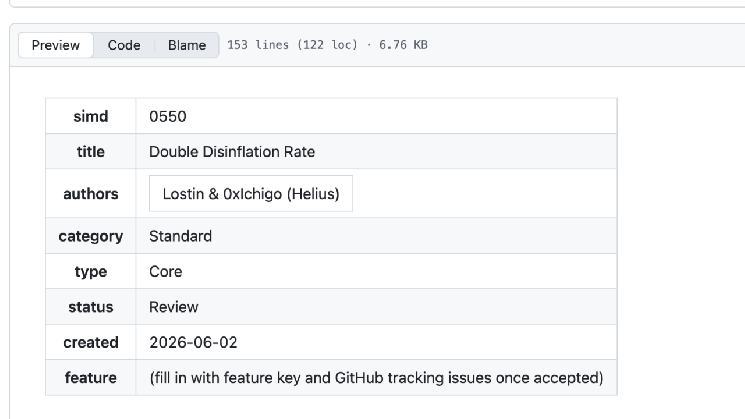
Solana is moving towards a stricter monetary model that could lead to a SOL deficit and significantly reduce staking rewards for holders. Two governance proposals drive these changes. SIMD-550, currently under vote, would double Solana's annual disinflation rate from 15% to 30%, accelerating the timeline to reach a final inflation rate of ~1.5% to the first half of 2029. The second, SIMD-553 (already approved), introduces additional token burning tied to computational units used on the network. Together, these measures could reduce SOL emission by an estimated $1.4-$1.5 billion over six years. The immediate impact would be lower staking yields, potentially falling from the current ~5.25% to approximately 4.34% in year one, 3% in year two, and 2.25% by year three. Analyst Matt Mena from 21Shares suggests inflation should be tied to economic metrics to help offset this decline. The changes also raise concerns for validator economics, with some potentially becoming unprofitable as inflation rewards decrease and voting costs may rise. However, the lower passive yield might push a significant portion of the 67.9% staked SOL into Solana's DeFi ecosystem for activities like lending and trading. This shift could boost network fee revenue to compensate for lower inflation rewards. The proposals aim to trade lower yield today for less dilution tomorrow, betting that network growth and usage will make this a worthwhile trade-off for SOL holders.

cryptonews.ruHá 1h

Solana Proposals Could Lead to Reduction in Staking Yields to 2.25% and Cut Emissions by $1.5 Billion

cryptonews.ruHá 1h

Trading

Spot
活动图片