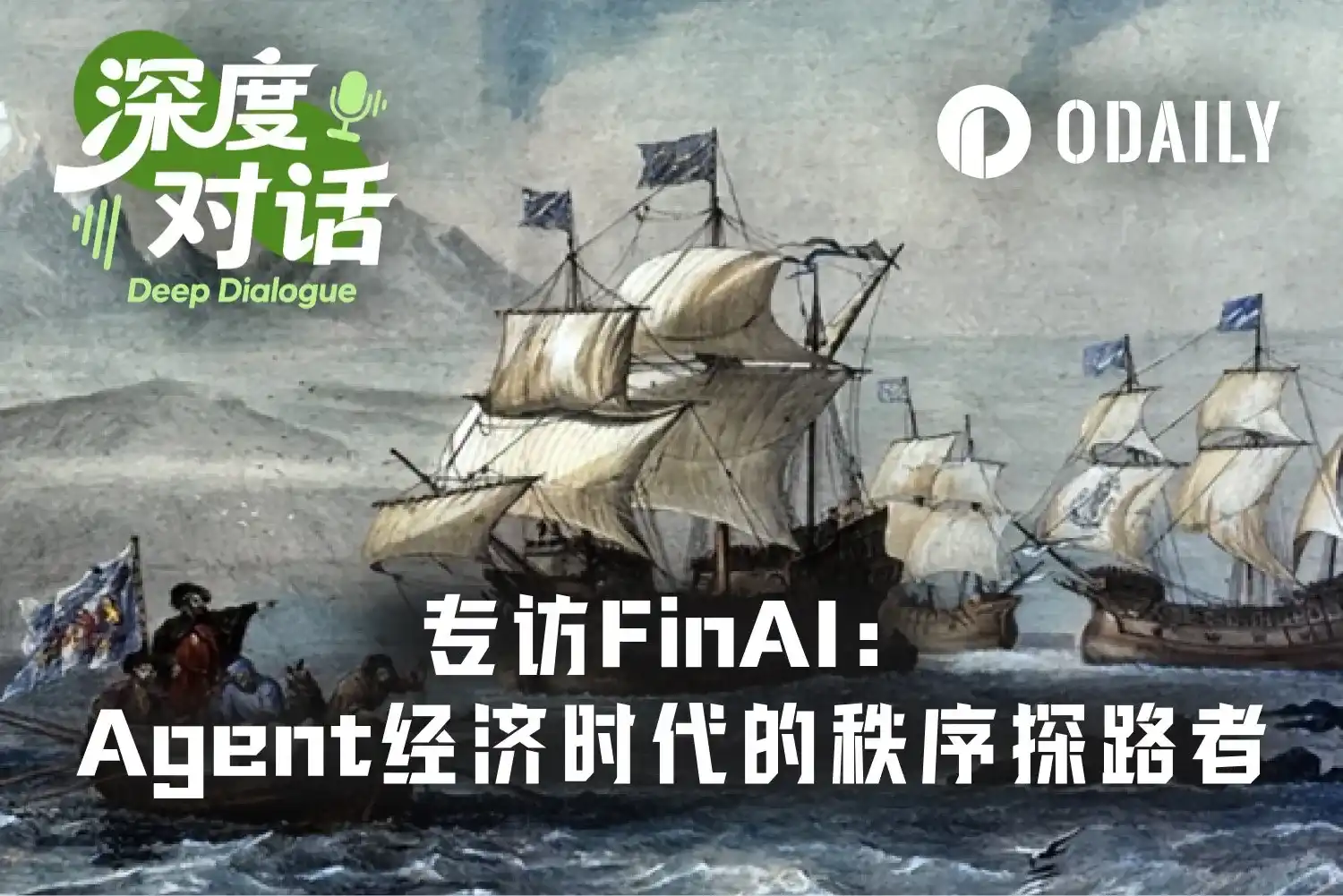
Exclusive Interview with FinAI: Pioneering Order in the Era of Agent Economy

marsbitPublicado em 2026-03-12Última atualização em 2026-03-12

Resumo

Interview with FinAI: Pioneering Order in the Age of Agent Economy AI is rapidly evolving from "tool-based intelligence" to "autonomous intelligence." While tools like ChatGPT amazed us just two years ago, agents like OpenClaw can now independently perform complex real-world tasks. As AI transitions from a "human assistant" to an "autonomous participant" in economic activities, a new challenge arises: how to establish economic rules among AI agents. FinAI, a startup founded by veterans from top tech firms, is addressing this by building financial infrastructure for AI agents based on Web3 technologies like x402 and ERC-8004. Their solution focuses on three core pillars: - **Payment Capability**: Enabling microsecond-level payments between agents via the x402 protocol to complete economic transactions autonomously. - **Identity System**: Introducing KYA (Know Your Agent), a verifiable identity framework similar to KYC, to ensure compliance and security. - **Credit System**: Establishing a trust-based reputation system using historical data like transaction quality and refund records. FinAI aims to offer these capabilities via APIs/Skills for both Web2 agent developers (via subscriptions) and Web3 users (through链上 integrations). The platform prioritizes Agent-friendly design, optimizing interfaces for seamless integration. With its first autonomous payment already processed in 2026, FinAI expects profitability within the year. By leveraging blockchain’s effici...

Original | Odaily Planet Daily (@OdailyChina)

Author | Azuma (@azuma_eth)
The narrative of AI development is rapidly shifting from "tool-based intelligence" to "autonomous intelligence." Two years ago, we were marveling at the fluent responses of LLMs like ChatGPT; today, agents represented by "Lobster" OpenClaw can already independently perform relatively complex real-world tasks to some extent.

The outline of the future world is becoming increasingly clear — AI's role in economic activities will gradually change from "human assistant" to "autonomous participant." In the near future, humans will become accustomed to the following scenarios: assistant-type Agents can help you complete daily chores like booking flights and ordering meals; research-type Agents can actively seek opportunities in financial markets; commercial Agents can automatically compare quotes from global vendors and complete orders... and their counterparts will also be other Agents.

But as AI Agents gradually gain economic behavioral capabilities, a new question arises — how should the economic order between AI Agents be established?

"AI can already perform tasks, but it lacks payment capabilities, identity systems, and credit systems. Without these infrastructures, AI's autonomous economy can hardly operate truly."

The above statement comes from FinAI, an AI startup that Odaily Planet Daily recently encountered. The company's core team mainly comes from top-tier internet companies and is currently actively embracing Web3 technology stacks like x402 and ERC-8004, attempting to address the aforementioned "order" issue based on three dimensions: payment, identity, and reputation.

Rechard, founder of FinAI, revealed that FinAI is currently in the seed funding stage and has already received investment commitments from some leading blockchain industry players.

Pioneering Order in the Agent Economy Era

To put it in one sentence, what FinAI wants to do is — build a set of financial infrastructure for AI Agents, providing the underlying order for the future Agent-to-Agent economy.

In FinAI's vision, the AI Agent economy requires three core foundational capabilities: payment capability, identity system, and credit system.

  • First is payment capability. Currently, the vast majority of AI Agents do not have independent payment capabilities; they can only perform tasks but cannot complete actual transactions. For example, an AI agent can help users search for flights, but the final payment still requires manual completion. FinAI hopes to achieve microsecond-level payment settlements between Agents based on the x402 protocol, enabling service calls between Agents to form a complete economic closed loop.
  • Second is the identity system. While introducing the ERC-8004 protocol, FinAI proposed the KYA (Know Your Agent) concept, analogous to KYC, i.e., establishing a verifiable identity system for AI Agents. Unlike KYC in traditional finance, KYA focuses on Agent identity verification and behavioral boundaries, enabling AI Agents to have compliant and secure identity attributes when performing tasks.
  • Third is the credit system. FinAI believes that large-scale transactions between Agents in the future will inevitably rely on a reputation system. An Agent's historical transactions, task execution quality, refund records, and other information can all become important bases for credit assessment. This credit system will become the trust foundation for future AI economic activities.

Rechard added that FinAI hopes to package and integrate the above three foundational capabilities and open them up in the form of API/Skill for Agents to freely call, so that every Agent can easily obtain payment, identity, and credit capabilities, promoting the gradual formation of an Agent trading market.

Regarding target customers and revenue models, Rechard revealed that FinAI mainly targets two groups. One is Agent application developers in the Web2 world; such B-end users need to obtain FinAI's services through API subscriptions, which will also be FinAI's main source of income. The other is on-chain users in the Web3 ecosystem; FinAI is exploring the design of various financial application scenarios with mainstream public chains, providing services to Web3 users through Agent Skill access. FinAI may consider charging a certain proportion of transaction shares in task transactions between Agents in the future, but Rechard revealed that FinAI aims to incubate a mature Agent trading market and is happy to see Agents making money independently. It does not intend to profit from the C-end, so the transaction commission rate is expected to be very low and friendly.

In 2026, FinAI completed its first autonomous payment order and is expected to achieve formal service revenue within the first quarter. Rechard stated regarding this: "What FinAI is doing is not exactly a money-burning business, so it is expected to achieve positive profitability within the year."

Embracing Web3 is an Inevitable Trend

FinAI has actively embraced protocols and standards born in the Web3 world, such as x402 and ERC-8004, in its technology stack, and has planned to integrate the latest ERC-8138 protocol launched by the Ethereum Foundation as a supplement into its services. In Rechard's view, this is not merely a technical choice but a result driven by practical needs.

Readers familiar with "Lobster" may have noticed some security controversies it recently caused, such as accidentally deleting data or sending emails by mistake. Assuming AI Agents could immediately access your financial accounts, the risks would only be harder to control — which is why many companies are currently unwilling to directly open credit card or bank accounts to Agents.

Rechard stated on this matter that Agents need a new payment and identity system, not directly inheriting human financial accounts. The on-chain stablecoin payment and settlement system is currently the best option on the market.

Cost and efficiency advantages are the core elements. In the traditional cross-border payment system, fund settlement usually takes T+3 to T+5 days, with high costs and complex processes, making this path completely incompatible with the Agent economy, which has huge micro-payment demands. In contrast, the payment and settlement system based on stablecoins can complete transactions within seconds and significantly reduce costs. FinAI revealed that its system can currently achieve real-time payments in the range of $0.01 to $1000, completing settlement within 2 to 3 seconds, with on-chain settlement costs being about 1/300 of traditional systems.

Rechard pointed out that the proportion of stablecoins in global payments is continuously rising. Once funds move from the traditional banking system into the stablecoin system, they often do not flow back. This trend is forcing traditional institutions to actively embrace on-chain finance.

However, Rechard also mentioned that traditional market customers still have concerns about compliance and security when接触 (contacting) on-chain financial systems, but this is precisely FinAI's current advantage. On the one hand, FinAI possesses full-stack technology and engineering capabilities and related patents for identity gateways, payment systems, quantum encryption wallets, etc., and can build a digital banking-level security environment for economic activities between Agents; on the other hand, with the identity and credit system based on KYA, FinAI can further ensure the compliance and security of Agent economic activities in the design of the transaction architecture.

First-Mover Advantage Means Everything

FinAI was first conceived in August 2025. Although the development time is not long, the progress has been remarkably efficient. In November 2025, FinAI was initially launched; on January 13, 2026, it completed access to the Base chain; on February 5, it completed the Agent's MCP; on March 6, it completed the PoC for DID and reputation system......

Rechard mentioned that at this early stage of Agent economic activities, the biggest competitive advantage lies in who can first successfully run a complete system. There are indeed some point solutions in the market today, such as projects focusing on payment, identity, or reputation scoring, but there are still few infrastructures that truly integrate all three.

Once the Agent economy begins to accelerate and explode in the future, when AI Agents need payment capabilities, identity authentication, or credit systems, if FinAI is the earliest platform to complete a full closed loop, then Agents will prioritize calling its services.

Rechard also mentioned a secret to this — to provide services that are more friendly to Agents. Specifically, the entity selecting services in the future will be the Agent, and the Agent's behavioral logic is different from that of humans; they will automatically seek the most cost-effective and easiest-to-integrate services. Therefore, FinAI particularly emphasizes "Agent-friendly" in its system design. Its code interfaces and API structures are optimized for Agents, making it easier for Agents to access and call.

From historical experience, every evolution of market paradigms requires new infrastructure and order. The e-commerce era gave birth to third-party payments, the mobile internet gave birth to digital wallets, and the rise of AI Agents may give birth to a new economic system. FinAI's goal is to act as a pioneer to try and lead the order construction under the new system.


Criptomoedas em alta

Perguntas relacionadas

QWhat is the core mission of FinAI as described in the article?

AFinAI's core mission is to build a financial infrastructure for AI Agents, providing the underlying order for the future Agent-to-Agent economy by focusing on three key capabilities: payment ability, identity systems, and credit systems.

QWhat are the three core foundational capabilities that FinAI believes are essential for an AI Agent economy?

AThe three core capabilities are: 1. Payment ability (enabling microsecond-level payments between Agents), 2. An identity system (implementing a KYA - Know Your Agent - verifiable identity framework), and 3. A credit system (establishing a trust foundation based on an Agent's transaction history and performance).

QWhich Web3 protocols and standards is FinAI integrating into its technology stack?

AFinAI is actively integrating the x402 and ERC-8004 protocols and standards, and has plans to incorporate the ERC-8138 protocol recently introduced by the Ethereum Foundation.

QWhat is the primary revenue model for FinAI?

AFinAI's primary revenue model is through API subscriptions for Web2 Agent application developers. It also plans to earn a small, friendly transaction commission from Agent-to-Agent task transactions in the future, but does not intend to profit heavily from end-users.

QAccording to the founder, what is FinAI's key competitive advantage in the current market?

AFinAI's key competitive advantage is being the first to build and run a complete, integrated system that combines payment, identity, and credit capabilities. This first-mover advantage is crucial as Agents will prioritize services that are easiest to integrate with and offer the best value, a principle FinAI calls being 'Agent-friendly'.

Leituras Relacionadas

7 Months After the Collapse of Huiwang, Southeast Asia's Escrow Platforms Undergo a Major Reshuffle

Following the collapse of Huione Pay—dubbed the "Alipay of Southeast Asia"—seven months ago, the region's underground financial guarantee platform sector is undergoing a significant reshuffle. This power vacuum has been swiftly filled by emerging platforms such as XinBi, Tiger/Navigator, JinBei (renamed JinBo), Dali/Tiancheng, and FullyLight. These platforms, operating largely via Telegram and offering services like escrow for illicit transactions, have absorbed the vast user base and markets left behind by Huione. While positioning themselves as "trust intermediaries," their primary clientele consists of networks involved in online scams, money laundering, illegal gambling, and even human trafficking. For instance, the Tiger/Navigator platform explicitly provides "escrow" services for kidnapping-for-ransom operations ("强押车交易"). Data underscores the immense scale: Huione alone processed over $103 billion in cryptocurrency payments and facilitated over $31 billion through its escrow market before its downfall, linking it to Cambodia's notorious Prince Group. Since its collapse, competitors have seen explosive growth. For example, the XinBi platform has accumulated over $1.6 billion in total USDT revenue, while platforms like NewPay, OkPay (under Dali), and FullyLight Wallet collectively processed over $4.8 billion in USDT in a single year. This ecosystem thrives in regions like Cambodia and Myanmar, where regulatory gaps allow these platforms to act as critical financial infrastructure for sprawling cybercrime industries, from scam compounds to online casinos. The article concludes that the moniker "Southeast Asian Alipay" is a misnomer, obscuring the platforms' fundamental role in enabling serious criminal enterprises rather than representing legitimate financial innovation.

Odaily星球日报Há 42m

7 Months After the Collapse of Huiwang, Southeast Asia's Escrow Platforms Undergo a Major Reshuffle

Odaily星球日报Há 42m

The Changing Landscape: What Are Crypto VCs Experiencing?

Title: The Shifting Landscape of Crypto Venture Capital The era of dedicated crypto venture capital funds is undergoing a significant transformation. Once essential for navigating the sector's complexity and high risk, these specialized funds are now facing an identity crisis as the market matures. This shift mirrors historical patterns in other specialized investment classes like cleantech and SPACs, where initial information advantages dissipate as technologies become mainstream and integrated into existing industry frameworks. The article argues that crypto is reaching a critical inflection point, transitioning from a "building phase" to an "integration phase." Major players like Stripe, BlackRock, and Visa now engage with crypto not for its novel mechanics but as a foundational financial infrastructure. Their needs—regulatory compliance, banking partnerships, distribution channels—align with traditional fintech, a domain easily understood by large, generalist funds like Sequoia and Founders Fund. This evolution creates a "barbell effect" within the VC landscape. On one end are massive, diversified platforms that can incorporate crypto as one vertical among many. On the other are small, nimble funds focused on niche, experimental projects. The middle ground—medium-sized dedicated crypto funds—is being squeezed out. Their typical fund size makes it impossible to generate sufficient returns solely from early-stage crypto bets, yet they cannot compete with giants for later-stage deals. Consequently, leading crypto-native firms like Paradigm and Framework Ventures are expanding into AI, robotics, and other sectors, driven partly by LP pressure for better returns amid a broader VC DPI crisis. Others, like Dragonfly and a16z, have narrowed their crypto focus predominantly to financial infrastructure like stablecoins, reframing the sector's core narrative. For crypto entrepreneurs, this consolidation presents challenges. While generalist funds offer larger checks and broader resources, crypto projects now compete fiercely with AI for attention and capital within these firms. Furthermore, the long-term, non-commercial foundational work that built the ecosystem—funded by dedicated crypto VCs—is less likely to attract generalist capital focused on direct returns. The conclusion is that "crypto investor" as a standalone category is becoming obsolete, akin to "internet investor." Crypto is becoming a baseline infrastructure layer. The future will see a barbell structure: large-scale growth financing handled by generalist funds, while pioneering, speculative projects are funded by small, specialized vehicles. The dedicated crypto funds of the 2017-2021 boom, which incubated core infrastructure, are giving way to this new, bifurcated reality.

Foresight NewsHá 1h

The Changing Landscape: What Are Crypto VCs Experiencing?

Foresight NewsHá 1h

As Consensus Accelerates, What Are Young Investors Betting On?

Title: As Consensus Forms Faster, What Are Young Investors Betting On? In the rapid evolution of tech investment, a new generation of young investors is navigating a landscape where AI, robotics, commercial aerospace, and quantum computing are advancing simultaneously. Traditional investment logic based on financial models is giving way to a need for deep technical understanding and the ability to act before industry consensus forms. An analysis of trends from the "WAIC FUTURE TECH" list of young investment leaders reveals key shifts in focus. The first major trend is the movement of AI from the digital screen into the physical world. Investment is shifting from large language models and chatbots towards embodied AI, robotics, AI hardware, and edge computing. While demonstrations generate excitement, the real challenge lies in achieving scalable, reliable, and cost-effective delivery in complex real-world environments like factories and logistics. Success depends not just on algorithms but on the integration of sensors, actuators, and control systems. Second, the competitive focus for large models is moving beyond raw capability toward building an "intelligence flywheel." The goal is to create self-reinforcing systems where user interaction generates data, improving the model, which in turn enhances the user experience and attracts more engagement. Companies that successfully embed AI into workflows to create these closed-loop systems can build lasting value that isn't easily erased by the next model upgrade. Third, facing a potential bottleneck in high-quality human-generated data, investors are looking at new underlying technologies. Reinforcement learning and self-play, as demonstrated by AlphaGo Zero, offer paths for AI to generate its own experience. Scientific foundation models, which aim to build general AI capabilities for fields like life sciences and materials discovery, represent a non-consensus direction that could unlock new frontiers of knowledge and data. Finally, in deep-tech areas like quantum computing, commercial aerospace, and space-based infrastructure, patient capital is essential. These fields have long, uncertain development and validation cycles involving complex engineering, supply chains, and regulations. Investment here requires a long-term view, focusing on foundational team capabilities and the eventual emergence of market demand, even if commercial returns are distant. Collectively, these trends illustrate how young investors are adapting to a new era. They are learning to make earlier, technically-informed judgments, balance hype with real-world viability, and provide the patient capital needed to build the deep-tech foundations of the future.

marsbitHá 1h

As Consensus Accelerates, What Are Young Investors Betting On?

marsbitHá 1h

Trading

Spot

Artigos em Destaque

Como comprar ORDER

Bem-vindo à HTX.com!Tornámos a compra de Orderly (ORDER) simples e conveniente.Segue o nosso guia passo a passo para iniciar a tua jornada no mundo das criptos.Passo 1: cria a tua conta HTXUtiliza o teu e-mail ou número de telefone para te inscreveres numa conta gratuita na HTX.Desfruta de um processo de inscrição sem complicações e desbloqueia todas as funcionalidades.Obter a minha contaPasso 2: vai para Comprar Cripto e escolhe o teu método de pagamentoCartão de crédito/débito: usa o teu visa ou mastercard para comprar Orderly (ORDER) instantaneamente.Saldo: usa os fundos da tua conta HTX para transacionar sem problemas.Terceiros: adicionamos métodos de pagamento populares, como Google Pay e Apple Pay, para aumentar a conveniência.P2P: transaciona diretamente com outros utilizadores na HTX.Mercado de balcão (OTC): oferecemos serviços personalizados e taxas de câmbio competitivas para os traders.Passo 3: armazena teu Orderly (ORDER)Depois de comprar o teu Orderly (ORDER), armazena-o na tua conta HTX.Alternativamente, podes enviá-lo para outro lugar através de transferência blockchain ou usá-lo para transacionar outras criptomoedas.Passo 4: transaciona Orderly (ORDER)Transaciona facilmente Orderly (ORDER) no mercado à vista da HTX.Acede simplesmente à tua conta, seleciona o teu par de trading, executa as tuas transações e monitoriza em tempo real.Oferecemos uma experiência de fácil utilização tanto para principiantes como para traders experientes.

271 Visualizações TotaisPublicado em {updateTime}Atualizado em 2026.06.02

Como comprar ORDER

Discussões

Bem-vindo à Comunidade HTX. Aqui, pode manter-se informado sobre os mais recentes desenvolvimentos da plataforma e obter acesso a análises profissionais de mercado. As opiniões dos utilizadores sobre o preço de ORDER (ORDER) são apresentadas abaixo.

活动图片












