Exchange 'Listing Curse' Investigation: Why 89% of New Tokens Ultimately Become Retail Investor Traps?

marsbitPublicado em 2026-03-26Última atualização em 2026-03-26

Resumo

A 2025 analysis reveals a stark reality: 89% of new tokens listed on Binance ended the year with negative returns, debunking the myth that an exchange listing guarantees profits. These tokens experienced an average price decline of 71-80%, often through a slow, steady bleed rather than a sudden crash. Listings are now widely seen as liquidity events for insiders and early investors to exit, earning the term "retail exit liquidity." Key factors driving this trend include excessive selling pressure from teams and airdrop hunters, overinflated valuations with minimal real users, weak capital flows into new altcoins, a market saturated with over 11 million new tokens in 2025, and a focus on narrative over actual product development. Projects in trend-driven sectors like Memes and RWA were particularly vulnerable due to lacking substance. Binance has also become less tolerant of underperformers, delisting tokens like A2Z, FORTH, and HOOK. The report concludes that only projects with genuine products and strong communities can survive long-term, as a Binance listing is no longer a shortcut to success but a test of sustainability.

Author: Gilmo

Compilation: Yuliya, PANews

Why have many tokens listed on Binance failed?

Recently, while browsing X or cryptocurrency communities, you might be familiar with the phenomenon of "listing on an exchange and then crashing." The days when a Binance listing meant "skyrocketing" seem to be a thing of the past. Instead, a "listing curse" has spread within the community, with many investors watching their account funds evaporate day by day, heartbroken.

So, what exactly is happening behind the scenes?

I. Overview

2025 revealed a harsh reality. Most tokens listed on Binance Spot struggled to maintain their value.
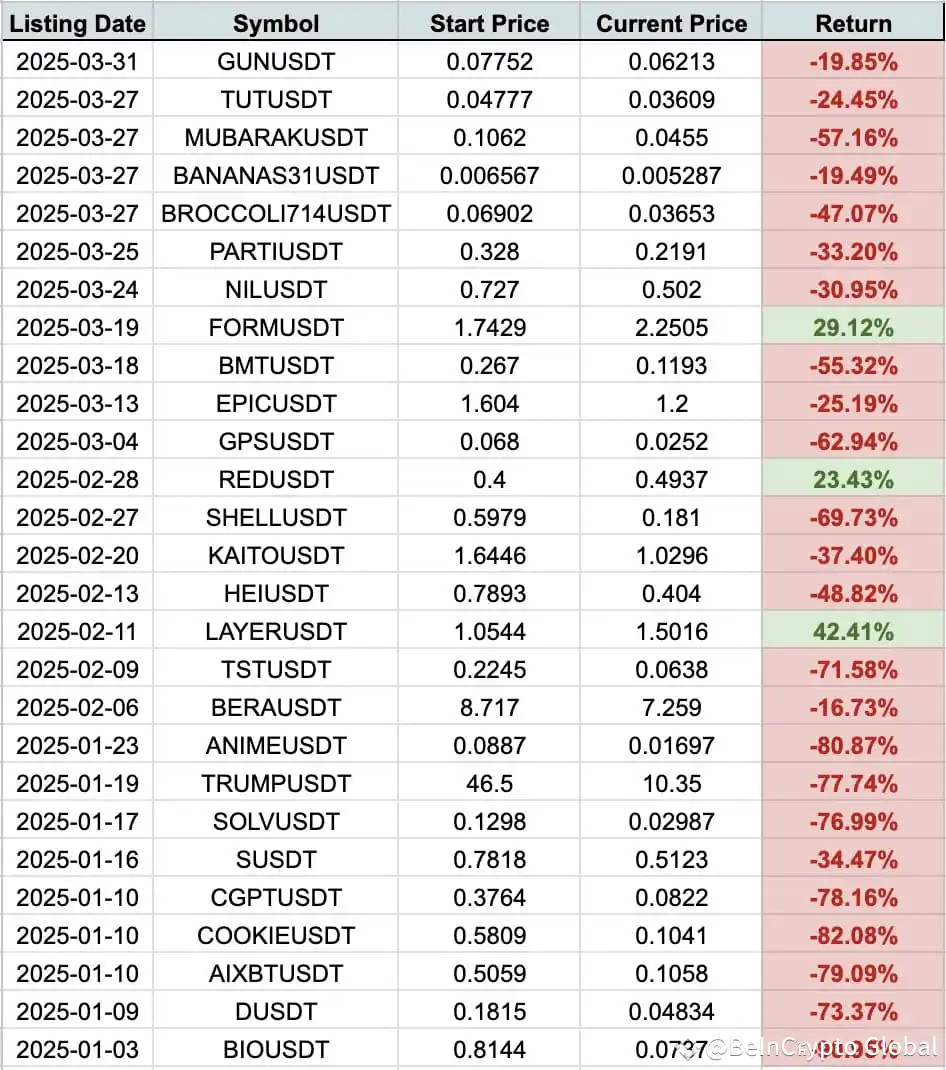
89% of tokens listed on Binance in 2025 had negative returns.

+ Price Performance

Approximately 89% to 94% of listed tokens are in severe loss. The average drawdown after listing ranges from 71% to 80%. Many tokens did not experience a sharp crash but rather a slow decline pattern, with prices gradually falling over time, quietly draining funds.

+ Reputation

A Binance listing was once a significant milestone. Now, it is often seen as a liquidity event for early investors to take profits. Due to the massive selling pressure after listing, many traders even refer to it as the "retail exit zone."

+ Attention Cycle

Most projects gain extremely high attention in the first few days. But after that, interest quickly declines. Without real products or user demand, this momentum soon fades.

+ Operations

Some projects slow down their development after reaching the listing. Subsequently, weak activity and low liquidity lead to their delisting from exchanges.

For example: A2Z, FORTH, HOOK, IDEX, LRC, NTRN, RDNT, SXP

In early 2026: ACA, CHESS, DATA were also delisted

Clearly, Binance no longer supports underperforming projects.

II. Listing Categories

In 2025, Binance listed 87 projects, covering 16 sectors.

+ Networks

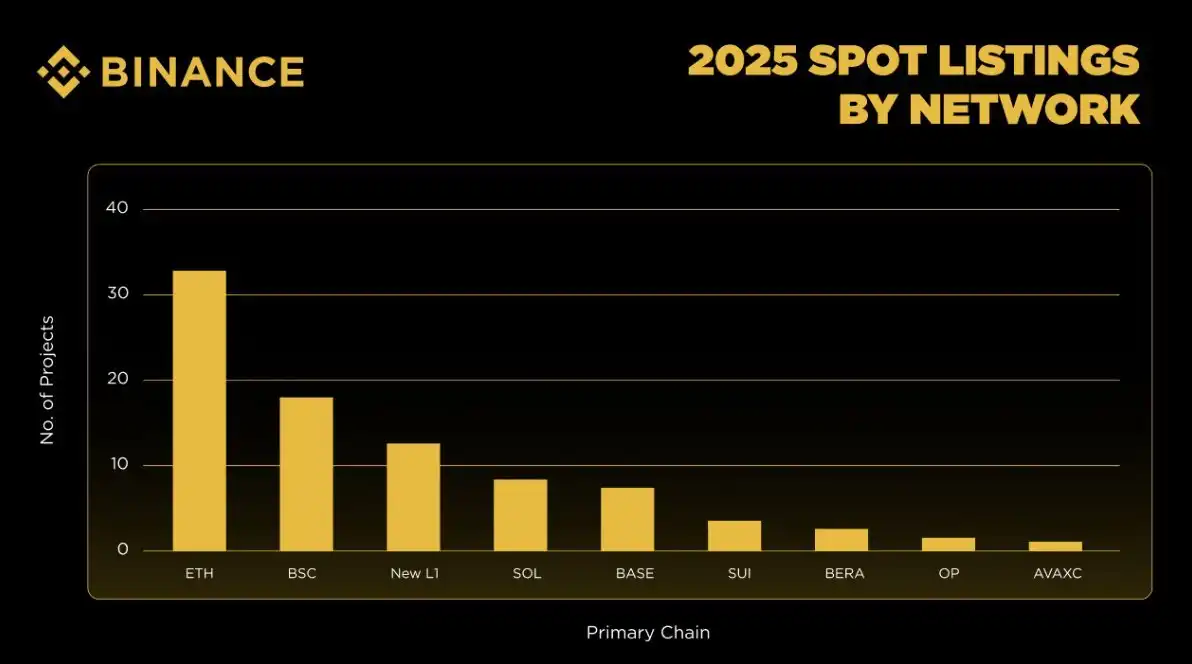
Ethereum dominated with about 36%, followed by BNB Chain and Solana.

Notably, Binance has started supporting extremely nascent ecosystems like Nillion and 0G Labs, but due to the lack of real users, this is also a high-risk group.
+ Sectors

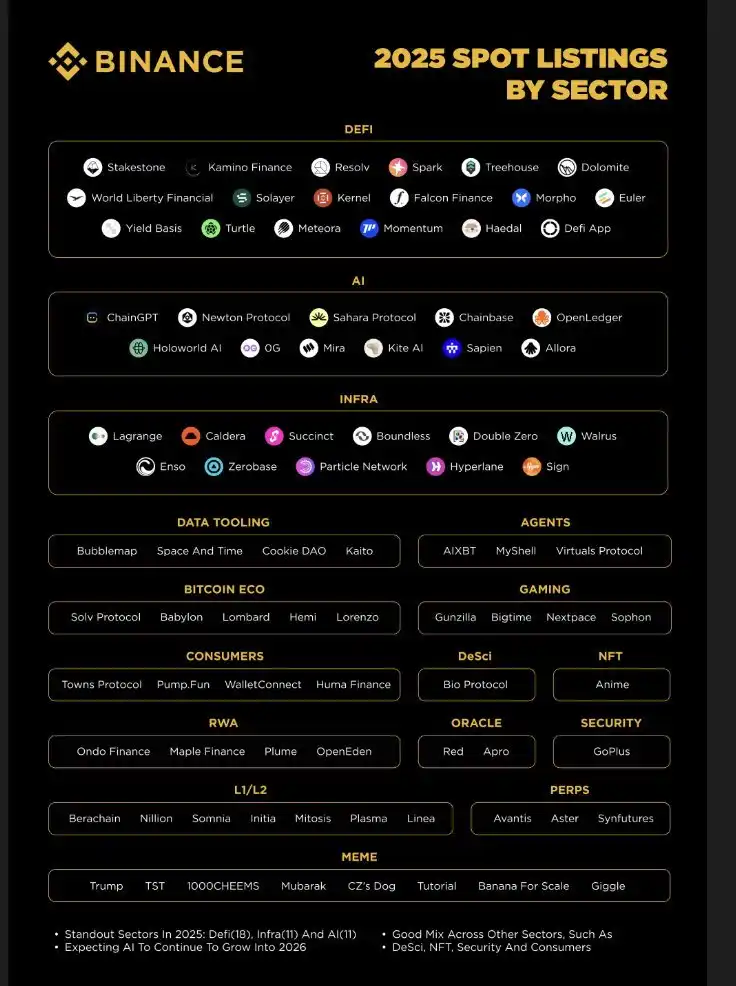
DeFi led with 18 projects, followed by AI and Infrastructure.

Trend-driven sectors like Memes and RWA can quickly gain listing opportunities, but due to the lack of core products, their failure rates are higher.
III. So Why Do These Tokens Fail?

Several key factors explain this pattern.

1. Liquidity Events for Insiders

Listings create deep liquidity. This allows teams and early investors to realize profits. Airdrop hunters also add selling pressure immediately after listing.

2. Overvaluation

Some projects launched with valuations in the billions but had small user bases. The gap between valuation and actual usage puts heavy pressure on prices.

3. Weak Market Capital Flows

During 2025, capital was largely concentrated around BTC and ETH. New altcoins received limited and short-lived capital.

4. Emphasis on Narrative Over Product

Many teams invested heavily in storytelling and marketing. Actual product development progressed slowly. Once the initial hype faded, user interest plummeted.

5. Market Saturation

Over 11 million tokens were launched in 2025. Supply increased rapidly, while user attention remained limited. Listing alone no longer drives sustainable growth.

IV. Conclusion

From 2025 to 2026, token listings on Binance will more resemble a final round for project insiders to dump their holdings rather than an opportunity for retail investors to get rich.

Only projects with real products and strong communities have a chance to survive.

You can refer to @defikadic's list to understand which are the truly quality projects:
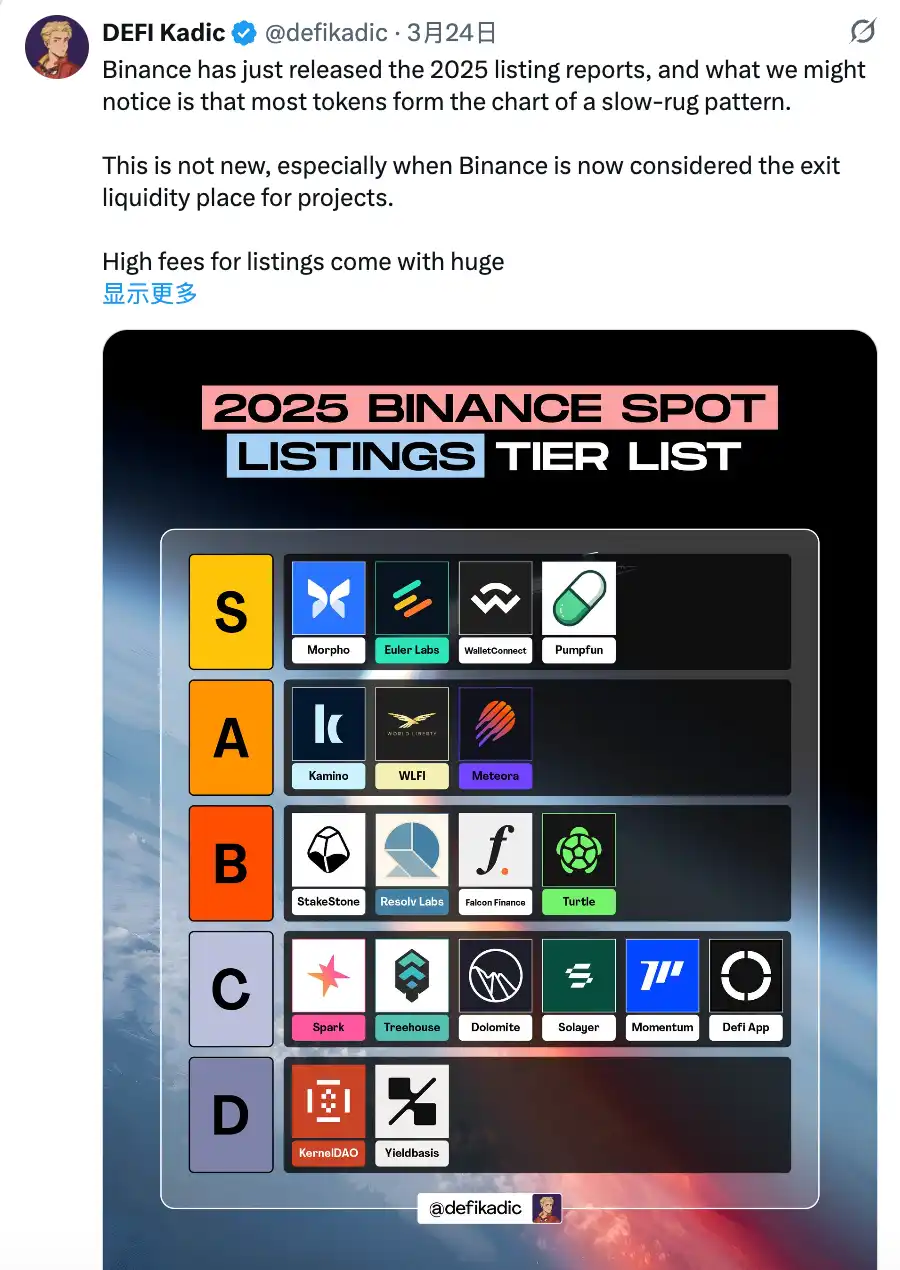
Perguntas relacionadas

QWhat percentage of tokens listed on Binance in 2025 had a negative return?

AApproximately 89% of tokens listed on Binance in 2025 had a negative return.

QWhat is the average price drawdown for tokens after being listed on Binance?

AThe average price drawdown after listing ranges between 71% and 80%.

QWhich blockchain network dominated the token listings on Binance in 2025?

AEthereum dominated the token listings, accounting for approximately 36% of the projects.

QWhat are the main reasons cited for the failure of newly listed tokens?

AThe main reasons include liquidity events for insiders, overvaluation, weak market capital flows, prioritizing narrative over product, and market saturation.

QWhich sector had the most token listings on Binance in 2025?

AThe DeFi sector had the most token listings with 18 projects, followed by AI and Infrastructure.

Leituras Relacionadas

In Jinjiang, Fujian, a Storage Super Unicorn Lies Quiet

In Fujian's Jinjiang, a city known for sportswear, lies a quiet semiconductor giant: Fujian Jinhua Integrated Circuit Co. (JHICC). Once a promising domestic DRAM manufacturer alongside Yangtze Memory and ChangXin Memory Technologies (CXMT), its journey was derailed in 2018 when the U.S. placed it on an Entity List and filed criminal charges for alleged trade secret theft. This halted production for years. A turning point came in February 2024 when a U.S. federal court found JHICC not guilty. However, it had lost crucial time. While CXMT soared to become a top-valued A-share company in 2024, JHICC, with an estimated valuation of 80 billion RMB, was just restarting. Its current output is primarily customized DDR4 chips, not the advanced DDR5/HBM demanded for AI, but it still benefits from the broader memory chip upcycle. JHICC's story is tied to Chen Zhengkun, a veteran engineer who left Micron to lead the venture. Founded in 2016 with state-backed funding, JHICC partnered with Taiwan's UMC to develop DRAM technology. Rapid progress was cut short by the U.S. actions, which Micron initiated, partly due to its heavy reliance on the Chinese market. Post-sanctions, Chen's team worked to rebuild the production line with reduced reliance on U.S. technology. According to its records, JHICC achieved small-scale production and revenue growth under immense pressure. It now focuses on the stable "niche" DRAM market (e.g., TVs, routers) with a monthly capacity of ~40,000 wafers, aiming for 60,000 by 2026. It holds over 1,000 patents but remains on the Entity List. For Jinjiang, investing in JHICC was a bold industrial leap. The local government provided unwavering financial and logistical support during the crisis, helping the company survive. JHICC has become the anchor for a growing local semiconductor cluster. Though its scale lags behind domestic peers, JHICC's persistence symbolizes a hard-won foothold in a global market long dominated by Samsung, SK Hynix, and Micron. Having missed one boom, it seeks a place in the new AI-driven memory supercycle.

marsbitHá 17m

In Jinjiang, Fujian, a Storage Super Unicorn Lies Quiet

marsbitHá 17m

Must-Watch Events Next Week|CLARITY Act Could Face Senate Vote; SpaceX, Circle to Report Earnings (8.3-8.9)

**Summary: Key Events and Developments to Watch (August 3-9)** The upcoming week is marked by significant financial disclosures, key legislative deadlines, and notable product updates. **Major Financial Events:** Several companies are scheduled to release their Q2 2026 earnings. American Bitcoin (ABTC) will report on August 3, followed by SpaceX and Hut 8 Mining Corp. on August 4, and Circle on August 5. Notably, a significant portion of SpaceX shares (up to 12% of total shares) will be unlocked on August 6 following their earnings release. **Key Legislative Deadline:** The U.S. Senate faces an August 7 deadline to secure 60 votes for the CLARITY Act, a bipartisan bill aiming to establish a federal regulatory framework for cryptocurrencies. The Senate may hold a full vote on the bill during the week. **Economic Data:** The U.S. July Non-Farm Payrolls report will be released on August 7, providing crucial labor market data. **Technology & Product Updates:** * **Shutdowns:** DeFi portfolio tracker Zapper and wallet app Ctrl Wallet will cease operations on August 3. * **Upgrades:** LayerZero will deprecate its v1 relayers on August 3. XRP Ledger's new version 3.3.0, featuring five new functions, is expected next week. * **AI:** Elon Musk announced that the advanced Grok 4.6 AI model is set for release around August 7. * **Bitcoin:** The BIP-110 forced signaling for a potential Bitcoin network change is scheduled to begin around August 8. **Other Notable Events:** Chinese robotics firm Unitree Tech has set its preliminary price inquiry for its IPO for August 5. South Korean exchange Upbit will delist AQT and AERGO tokens on August 3.

marsbitHá 2h

Must-Watch Events Next Week|CLARITY Act Could Face Senate Vote; SpaceX, Circle to Report Earnings (8.3-8.9)

marsbitHá 2h

Trading

Spot
活动图片





