Even Satoshi Nakamoto Would Kowtow to the God of Wealth

深潮Publicado em 2025-12-25Última atualização em 2025-12-25

Resumo

On the fifth day of the Lunar New Year, the author visits a temple in Hangzhou and observes a surprising number of cryptocurrency insiders—KOLs, community builders, and tech elites—praying for wealth, abandoning algorithmic consensus for incense and devotion. The piece notes the rising influence of metaphysics in crypto circles, where traditional analysis is increasingly supplanted by astrology, face-reading, and feng shui. A trader’s astrological prediction warns of Bitcoin’s “darkest hour” in 2026, while a VC partner admits that assessing founders’ facial traits is now part of due diligence. Anecdotes illustrate this trend: a listed company CEO’s devotion to feng shui reportedly led to massive Bitcoin gains, while a frog-avatar KOL ignored his advisor’s warning and lost everything trading futures. The author frames this not as mere superstition but as a psychological response to extreme volatility. Just as maritime cultures turned to deities like Mazu for safety in uncertain seas, crypto participants seek spiritual anchors amid market chaos. When tweets from figures like Musk or Trump can swing prices 50% in a day, belief systems—whether in code or cosmology—become a necessary comfort. The question isn’t whether the God of Wealth understands blockchain, but whether faith helps traders sleep at night.

Author: Xiaobing, Deep Tide TechFlow

Every year on the fifth day of the Lunar New Year, Xiaobing wakes up early to visit the Number One Temple of Wealth at Beigao Peak in Hangzhou.

I thought I would be jostling with aunties and uncles, but when I arrived, the scene was filled with familiar faces amidst the swirling incense smoke.

To the left was a well-known爆料KOL, to the right someone involved in community schemes, and a few tech elites who usually preach "decentralization" were devoutly kowtowing with loud thuds. In that moment, algorithmic consensus and Federal Reserve moves were no match for the three sticks of incense in their hands.

Over the past two years, mysticism has become the "mainstream study" in the crypto world. If you’re still looking at K-line charts, you’re a classical rookie; the real OGs are now reading birth charts.

A crypto trader familiar with various macro indicators eventually turned to mysticism, recently calculating Bitcoin’s八字 (Bazi). The result was alarming: Fire clashes with the wealth vault, making 2026 (Bingwu Year) Bitcoin’s darkest hour. I quickly checked my wallet—good thing there were no coins in it anyway.
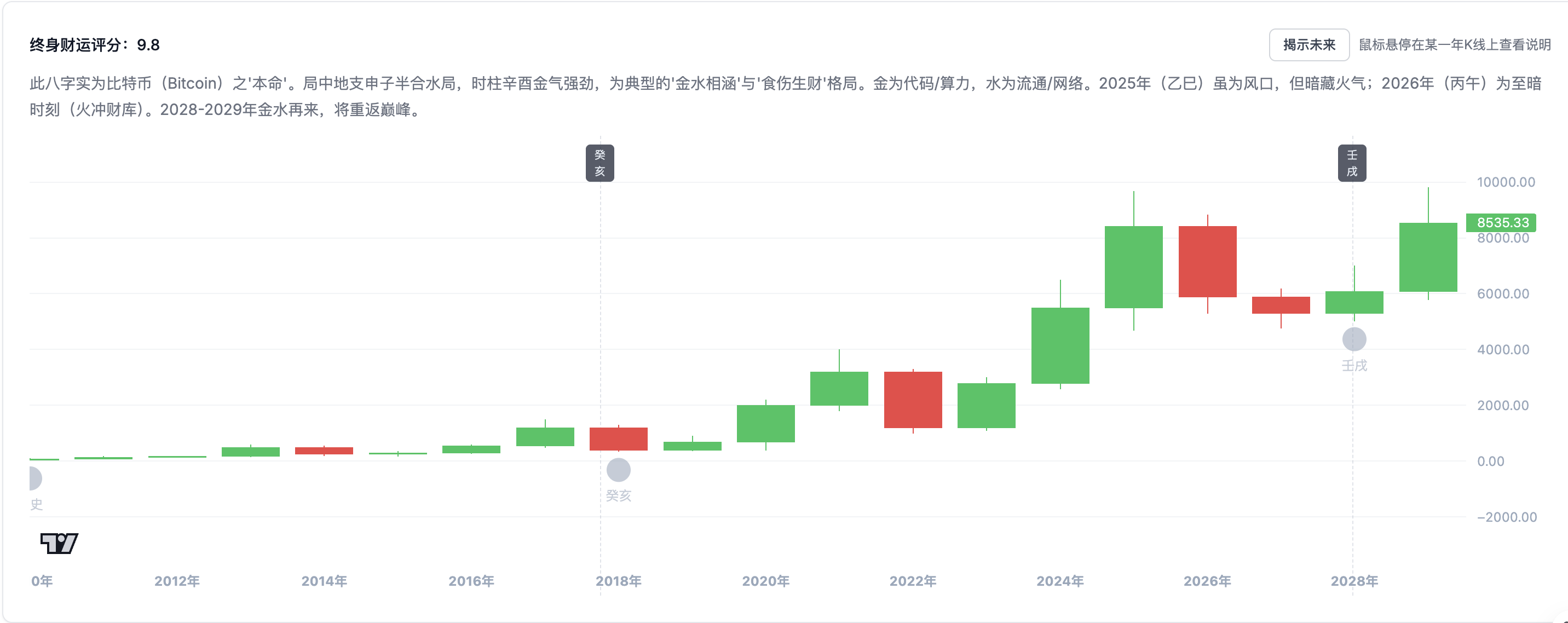
Remember when Alen, a crypto VC at y2z Ventures, bluntly stated that one of their fund’s core competitive edges was "reading面相" (face reading)? Due diligence (DD) used to involve code audits and business models, but now it’s different. First, check if the founder has a "wealth-draining face," then see if the project’s name clashes with风水 (Feng Shui).

On a recent trip to Shenzhen, I noticed that traders and KOLs’ standard setup isn’t data terminals—they all have a "Feng Shui consultant" backing them.

Don’t laugh; this actually works in the crypto world. Xiaobing knows a listed company boss in Hong Kong who is a devout believer in Feng Shui, donating real money to temples—possibly more than the company’s R&D budget.

And the result? Call it Feng Shui bringing noble help, but starting in 2023, he began buying Bitcoin, made hundreds of millions from hoarding, and later caught the wave of the DAT (Crypto Treasury Reserve) narrative, doubling the company’s stock price... Although everyone knows this is "survivorship bias," you can’t argue with the fact that he really made a fortune.

There are counterexamples too. A frog-avatar爆料KOL also had a Feng Shui consultant who advised him not to trade recently, but he couldn’t resist playing with contracts and ended up getting liquidated.

This isn’t entirely superstition.

Our traditional land-based civilization emphasizes farming—sow one seed in spring, reap ten thousand in autumn—focusing on certainty. But what does maritime civilization face? Storms and unknown waters.

Why do people in the southeastern coastal areas worship Mazu? Not out of ignorance, but because on the vast, unpredictable ocean, besides experience and technology, you need something else.

The crypto world is essentially a modern version of the "Age of Exploration." It faces deep, unfathomable waters and sudden storms. Humans are like this: the greater the randomness and volatility, the more we seek supernatural spiritual anchors.

When K-line charts fail, and a single tweet from Musk, Trump, or CZ can sway the market, Feng Shui becomes the last psychological defense. This isn’t ignorance; it’s an instinctive stress response to massive wealth fluctuations.

After all, when your assets can swing 50% in a day, you have to believe in something to sleep at night. As for whether the God of Wealth understands blockchain—does it really matter?


Perguntas relacionadas

QWhat is the main theme of the article regarding the crypto community's behavior?

AThe article highlights that mysticism and fortune-seeking practices, like worshipping the God of Wealth and using feng shui, have become prevalent in the crypto community as a psychological anchor amidst extreme market volatility and uncertainty.

QHow does the article describe the crypto space in comparison to historical contexts?

AIt compares the crypto space to the 'Age of Exploration' or maritime civilizations, where people face vast unknowns and storms, leading them to seek supernatural beliefs for stability and mental comfort.

QWhat example does the article give to show the effectiveness of feng shui in crypto success?

AIt mentions a Hong Kong-listed company boss who devoutly donated to temples and followed feng shui, leading to massive profits from Bitcoin investments and a surge in his company's stock price during the DAT narrative wave.

QWhat counterexample is provided about ignoring mystical advice in the crypto world?

AA frog-avatar KOL ignored his feng shui advisor's warning to avoid trading, engaged in contracts, and ended up getting liquidated.

QWhy does the article suggest crypto traders turn to mysticism instead of traditional analysis?

ABecause extreme market randomness, influenced by factors like tweets from figures such as Musk or Trump, makes traditional analysis like K-line charts less reliable, leading traders to seek psychological comfort through superstition.

Leituras Relacionadas

As Consensus Accelerates, What Are Young Investors Betting On?

Title: As Consensus Forms Faster, What Are Young Investors Betting On? In the rapid evolution of tech investment, a new generation of young investors is navigating a landscape where AI, robotics, commercial aerospace, and quantum computing are advancing simultaneously. Traditional investment logic based on financial models is giving way to a need for deep technical understanding and the ability to act before industry consensus forms. An analysis of trends from the "WAIC FUTURE TECH" list of young investment leaders reveals key shifts in focus. The first major trend is the movement of AI from the digital screen into the physical world. Investment is shifting from large language models and chatbots towards embodied AI, robotics, AI hardware, and edge computing. While demonstrations generate excitement, the real challenge lies in achieving scalable, reliable, and cost-effective delivery in complex real-world environments like factories and logistics. Success depends not just on algorithms but on the integration of sensors, actuators, and control systems. Second, the competitive focus for large models is moving beyond raw capability toward building an "intelligence flywheel." The goal is to create self-reinforcing systems where user interaction generates data, improving the model, which in turn enhances the user experience and attracts more engagement. Companies that successfully embed AI into workflows to create these closed-loop systems can build lasting value that isn't easily erased by the next model upgrade. Third, facing a potential bottleneck in high-quality human-generated data, investors are looking at new underlying technologies. Reinforcement learning and self-play, as demonstrated by AlphaGo Zero, offer paths for AI to generate its own experience. Scientific foundation models, which aim to build general AI capabilities for fields like life sciences and materials discovery, represent a non-consensus direction that could unlock new frontiers of knowledge and data. Finally, in deep-tech areas like quantum computing, commercial aerospace, and space-based infrastructure, patient capital is essential. These fields have long, uncertain development and validation cycles involving complex engineering, supply chains, and regulations. Investment here requires a long-term view, focusing on foundational team capabilities and the eventual emergence of market demand, even if commercial returns are distant. Collectively, these trends illustrate how young investors are adapting to a new era. They are learning to make earlier, technically-informed judgments, balance hype with real-world viability, and provide the patient capital needed to build the deep-tech foundations of the future.

marsbitHá 15m

As Consensus Accelerates, What Are Young Investors Betting On?

marsbitHá 15m

Can Japan Buy Growth with AI? Will the Bond Market Believe It?

Japan's cabinet has introduced the 2026 Basic Policy on Economic and Fiscal Management and Reform, shifting its primary fiscal target. The new framework moves away from the traditional annual primary balance goal and instead prioritizes a stable reduction of the debt-to-GDP ratio. This change is tied to a strategy of increased "responsible proactive fiscal" spending, aiming to boost long-term growth through investments in strategic sectors like AI, semiconductors, energy, and robotics. The government estimates total public and private investment in 62 key technologies could exceed 370 trillion yen by 2040. The market reaction has been mixed and cautious. While equity markets may respond to policy signals, bond markets are focused on fiscal credibility. Concerns center on whether the weakening of the clear primary balance anchor could lead to looser fiscal discipline. If investors doubt that these strategic investments will generate sufficient productivity gains, tax revenue, and nominal growth to outpace rising interest costs, they may demand higher yields on Japanese Government Bonds (JGBs). Recent volatility in the yen and JGB yields, with the 10-year yield briefly reaching 2.9%, reflects this skepticism. The success of this new framework hinges on two factors: whether Japan can achieve a nominal growth rate consistently higher than its long-term interest rates, and whether future budgets demonstrate disciplined control over bond issuance. The government's narrative is that strategic investment is essential to break Japan's cycle of low growth, aging, and labor shortages. However, the bond market will continuously assess the credibility of this plan, pricing the risk that it may represent fiscal expansion rather than a viable growth strategy.

marsbitHá 52m

Can Japan Buy Growth with AI? Will the Bond Market Believe It?

marsbitHá 52m

Misjudged A-Shares: Resilience, Expectations, and Confidence

China's A-share market recently faced selling pressure, especially in tech sectors, initially triggered by a global tech sell-off that began in South Korea. However, the article argues this is a case of "mistaken injury" and highlights the market's underlying resilience. This resilience stems from three main pillars: **1) Tech Sector Fundamentals:** Unlike Korea's market dominated by a few memory chip stocks, China's tech sector is diversified across computing, communications, electronics, and semiconductors, supported by dual narratives of global AI supply chains and domestic substitution. Core areas like optical modules and fiber optics continue to show strong earnings growth. **2) "National Team" Support:** State-backed institutions and large corporations have made significant market purchases and announced buybacks, providing liquidity and signaling confidence. This is seen as a stabilizing policy signal, often associated with market bottoms. **3) Broader Market Pillars:** Other major sectors are showing endogenous recovery momentum. Consumer stocks benefit from stabilizing CPI and signs of sector recovery (e.g., liquor price hikes). Cyclical sectors like aluminum have high earnings, potential price increases due to tight supply, and low valuations. The financial sector offers stable dividends and low valuations. The conclusion is that the sell-off was driven by external contagion, not a collapse in fundamentals. With strong policy support and recovering momentum across key sectors, the A-share market possesses the toughness to regain stability.

marsbitHá 1h

Misjudged A-Shares: Resilience, Expectations, and Confidence

marsbitHá 1h

Trading

Spot
活动图片




