Even Satoshi Nakamoto Would Kowtow to the God of Wealth

marsbitPublicado em 2025-12-25Última atualização em 2025-12-25

Resumo

The article humorously explores the growing trend of integrating traditional Chinese mysticism, such as fortune-telling and feng shui, into the cryptocurrency world. It begins with the author’s visit to a temple during the Chinese New Year, where they observe well-known crypto influencers and traders—often vocal about decentralization—engaging in superstitious rituals like burning incense and praying for wealth. The piece highlights how practices like astrological analysis of Bitcoin (e.g., predicting a difficult period in 2026 based on elemental cycles) and judging founders by their facial features have become part of crypto culture. Examples include a venture capital firm considering "face reading" as due diligence and a listed company CEO whose devotion to feng shui reportedly contributed to massive Bitcoin gains. The author argues that this turn to mysticism isn’t merely superstition but a psychological response to extreme market volatility. Like ancient maritime cultures relying on deities for safety in unpredictable seas, crypto participants use these beliefs as mental anchors amid chaotic price swings influenced by tweets and macros. Ultimately, when assets can swing 50% in a day, faith in something beyond charts becomes a way to cope.

Author: Xiaobing, Deep Tide TechFlow

Every year on the fifth day of the Lunar New Year, Xiaobing wakes up early to visit the Temple of the God of Wealth at Beigao Peak in Hangzhou.

I thought I would be jostling with aunties and uncles, but when I arrived, the scene was filled with familiar faces amidst the swirling incense smoke.

To my left was a well-known爆料KOL, to my right were community builders of pyramid schemes, and a few tech elites who usually preach "decentralization" were devoutly kowtowing with loud thuds. At that moment, no algorithmic consensus or Federal Reserve moves could compare to the three sticks of incense in their hands.

Over the past two years, mysticism has become the "mainstream" in the crypto world. If you’re still looking at K-line charts, you’re a classical韭菜 (dumb money). The real veterans are now reading八字 (fortune-telling based on birth dates).

A crypto trader familiar with various indicators eventually turned to mysticism and recently calculated Bitcoin’s八字. The result was grim: Fire clashes with the wealth vault, making 2026 (the Year of the Fire Horse) Bitcoin’s darkest hour. I quickly checked my wallet—thankfully, it was already empty.
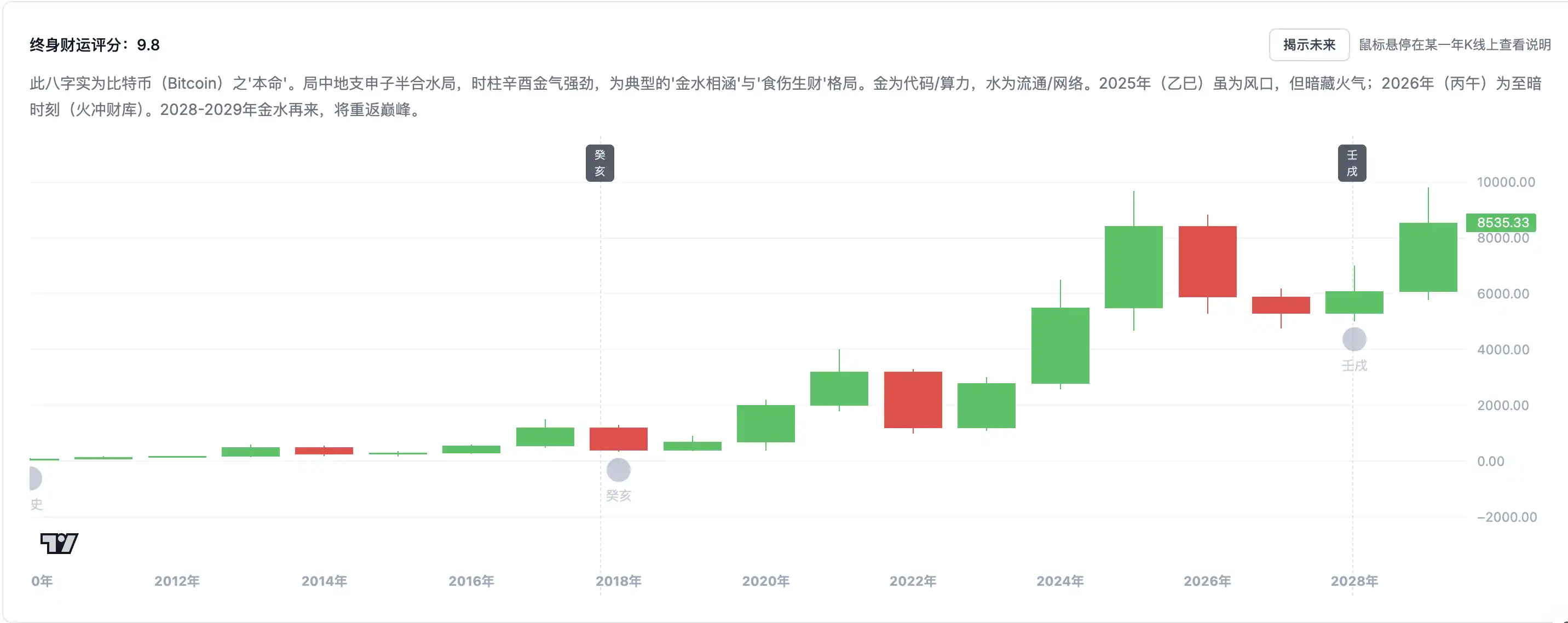
As Alen, a partner at crypto VC y2z Ventures, once bluntly stated, one of their fund’s core competencies is "reading faces." Due diligence used to focus on code audits and business models, but now it’s different. First, they check if the founder has a "wealth-draining face," then they assess whether the project’s name clashes with风水 (geomancy).

During a recent trip to Shenzhen, I noticed that traders and KOLs’ standard accessory isn’t a data terminal—it’s a "feng shui consultant" standing behind them.

Don’t laugh—this approach actually works in the crypto world. Xiaobing knows a listed company boss in Hong Kong who is a devout believer in feng shui, donating more to temples than his company spends on R&D.

And the result? Feng shui brought him noble support. He started buying Bitcoin in 2023, made hundreds of millions by hoarding it, and later rode the wave of DAT (Crypto Treasury Reserve) narratives, doubling his company’s stock price... While everyone knows this is "survivorship bias," you can’t argue with the fact that he got rich.

There are counterexamples too. A爆料KOL with a frog avatar also had a feng shui consultant who advised him not to trade recently, but he couldn’t resist playing with contracts and got liquidated neatly.

This isn’t entirely superstition.

Our traditional land-based civilization emphasizes farming—"sow one seed in spring, reap ten thousand grains in autumn"—all about certainty. But what do ocean-based civilizations face? Storms and unknown waters.

Why do people in southeastern coastal areas worship Mazu? Not because they’re ignorant, but because on the vast, unpredictable sea, besides experience and technology, you need something else.

The crypto world is essentially a modern version of the "Age of Exploration." It faces bottomless depths and sudden storms. Humans are like this: the greater the randomness and volatility, the more we seek supernatural anchors.

When K-line charts fail, and a single tweet from Elon Musk, Donald Trump, or CZ can sway the market, feng shui becomes the last psychological防线. This isn’t ignorance—it’s an instinctive应激反应 to massive wealth fluctuations.

After all, when your assets can swing 50% in a day, you need to believe in something to sleep at night. Does it matter if the God of Wealth understands blockchain?


Perguntas relacionadas

QWhat is the main theme of the article regarding the crypto community's behavior?

AThe article highlights that mysticism and fortune-telling, such as consulting feng shui masters and analyzing birth charts, have become prevalent in the crypto community as a psychological coping mechanism against extreme market volatility and uncertainty.

QHow does the article contrast traditional land-based civilizations with maritime civilizations in the context of belief systems?

AIt explains that land-based civilizations emphasize certainty and predictability (like farming cycles), while maritime civilizations, facing unpredictable storms and unknowns, turn to supernatural beliefs (e.g., worshipping Mazu) for psychological anchoring—similar to how crypto traders use mysticism amid market chaos.

QWhat example does the article give to show the effectiveness of feng shui in crypto success?

AIt cites a Hong Kong-listed company boss who devoutly donated to temples and followed feng shui advice, leading to massive profits from Bitcoin investments and a surge in his company's stock during the DAT narrative wave, though it acknowledges survivorship bias.

QWhat negative example is provided about ignoring mystical advice in the crypto space?

AA frog-avatar KOL ignored his feng shui advisor's warning to avoid trading and subsequently lost everything through contract trading, illustrating the consequences of disregarding such guidance.

QWhy does the article argue that crypto participants turn to superstition despite technological expertise?

ABecause the crypto market's extreme randomness, influenced by factors like celebrity tweets and unpredictable events, renders traditional analysis (e.g., charts) ineffective, leading people to seek supernatural beliefs as a mental safeguard to cope with stress and sleep better.

Leituras Relacionadas

When AI Traffic Surpasses Humans, How Do You Prove You're Human?

As AI-generated web traffic now surpasses human activity, the internet's foundational business models—built on human attention, browsing, and advertising—face severe disruption. AI agents crawl websites at immense scale without generating ad revenue, while AI summaries divert traffic from original content sites. In response, over 2.5 million sites are blocking AI crawlers, and protections like Cloudflare's "honeypot" traps have emerged, though advanced AI can bypass these. The collapse of traditional CAPTCHAs, which assumed machines were weaker than humans, has led to a shift toward behavioral biometrics for human verification. Companies like IBM and BioCatch now analyze unique human patterns—cursor movements, typing rhythms, keystroke dynamics, and even cognitive delays like the Stroop effect—to distinguish real users from bots. These biometric signatures are difficult to fake or alter, offering a new layer of security but raising significant privacy concerns. Two competing visions for a reliable human verification system are emerging. One, exemplified by Sam Altman’s World (formerly Worldcoin), uses centralized iris scanning to generate unique credentials, though it faces bans and criticism over unauthorized data collection. The other employs cryptographic zero-knowledge proofs, allowing users to prove they are human without revealing identity or biometric data, as advocated by Vitalik Buterin. However, decentralized approaches risk exploitation through identity renting in economically unequal regions. The central dilemma is between a scalable but privacy-invasive centralized system that permanently controls users' biometric data, and a privacy-preserving cryptographic system vulnerable to real-world economic manipulation. The author expresses a preference for the cryptographic path, arguing that despite its flaws, it avoids the irreversible biometric surveillance inherent in centralized alternatives.

Foresight NewsHá 7m

When AI Traffic Surpasses Humans, How Do You Prove You're Human?

Foresight NewsHá 7m

Crypto Primary Market Investment and Financing Forward-Looking Weekly Report | Stablecoin Regulation Nears Implementation, ETF Funds Continue to Withdraw, Capital Begins Betting on Payment and Cash Flow

Crypto Market Weekly Report (Jun 1-7, 2026): Capital Shifts Focus to Payments & Cash Flow Market data indicates a significant divergence: while traditional institutional funds continue exiting via BTC and ETH ETFs (recording net outflows of $1.72B and $168M this week, respectively), stablecoin supply continues growing. This suggests capital is shifting from speculative asset allocation toward defensive positioning within on-chain liquidity, awaiting new, concrete opportunities. This trend is reflected in venture capital focus. Weekly fundraising fell 27% to $302M, with investments concentrating on infrastructure with tangible revenue potential: 1. **Stablecoin Infrastructure (28% of funding):** Projects like M0 Protocol ($35M raise) are gaining attention as regulatory clarity (e.g., the GENIUS Act) nears, shifting the focus from legitimacy to building payment and settlement networks. 2. **AI Agent Infrastructure (26%):** Investments are moving from conceptual AI Agents towards the execution and economic layers required for a functional "Agent economy." Key raises include OpenRouter ($40M) and Halliday ($20M). 3. **Real World Assets (RWA) (18%):** The search for on-chain yield and cash flow drives continued interest in RWA platforms like Ondo Finance. Security threats are evolving from smart contract exploits toward key management failures, permission control issues, and regulatory execution risks (e.g., court-ordered asset freezes). **Key Takeaways:** The investment thesis is shifting from narrative-driven bets to revenue and cash-flow-generating protocols. Future attention should be on the progression of stablecoin regulations, the commercial validation of AI Agent economies, and the performance of high-revenue protocols like derivatives platforms.

marsbitHá 14m

Crypto Primary Market Investment and Financing Forward-Looking Weekly Report | Stablecoin Regulation Nears Implementation, ETF Funds Continue to Withdraw, Capital Begins Betting on Payment and Cash Flow

marsbitHá 14m

Buy an NFT First to Get a Ticket? The Largest World Cup Ticket Slump in History

"Ticketing Woes for 2026 World Cup: NFT 'Right-to-Buy' and High Prices Dampen Sales" Despite anticipation for the 2026 FIFA World Cup, with 48 teams and 104 matches across North America, the tournament faces significant unsold tickets, with approximately 180,000 group-stage tickets still available for resale just before kick-off. This unexpected shortfall is attributed to FIFA's controversial new ticketing strategy, which includes an NFT-based "Right-to-Buy" (RTB) system and opaque, dynamic pricing. FIFA introduced RTBs as digital collectibles (NFTs) sold on its FIFA Collect platform. An RTB grants the holder only the right to purchase a ticket for a specific match later, not the ticket itself. This two-step process, criticized for selling "scarcity" first, saw RTBs priced from tens to hundreds of dollars, generating millions in revenue for FIFA. With many tickets remaining available on official channels, the value of these prepaid purchase rights is now being questioned. Compounding the issue are ticket prices, reported to be 2 to 4 times higher than the 2022 Qatar World Cup, and up to 7 times more for marquee matches. FIFA employed dynamic pricing, common in U.S. sports, but lacked transparency on seat availability and exact locations during sales, frustrating global fans facing high travel costs. This has drawn scrutiny from regulators in New York and New Jersey. FIFA's official resale platform also drew criticism for imposing high fees—roughly 10% on sellers and 17% on buyers, allowing FIFA to profit further from secondary market transactions. While FIFA President Gianni Infantino states over 6 million tickets have been sold, the situation highlights a potential disconnect between fan enthusiasm and willingness to pay under an aggressive commercial model.

marsbitHá 21m

Buy an NFT First to Get a Ticket? The Largest World Cup Ticket Slump in History

marsbitHá 21m

Trading

Spot
Futuros
活动图片




