ETHZilla moves into onchain housing finance with 15% Zippy acquisition

cointelegraphPublicado em 2025-12-10Última atualização em 2025-12-10

Resumo

ETHZilla (ETHZ) has acquired a 15% stake in digital housing lender Zippy for $5 million in cash and $16.1 million in stock, marking its second acquisition in a week as part of a broader move into real-world asset (RWA) markets. The partnership aims to integrate Zippy’s loan-origination and AI-powered systems with ETHZilla’s tokenization platform to bring manufactured-home loans onchain. As part of the deal, ETHZilla gains a board seat and a 36-month exclusivity agreement with Zippy. Despite this expansion, ETHZilla’s stock has declined roughly 10% following the announcement, continuing a downward trend seen across several Ether treasury companies amid falling ETH prices.

Former biotech company ETHZilla (ETHZ) is doubling down on its push into real-world asset markets, taking a 15% stake in digital housing lender Zippy to bring manufactured-home loans onchain. The deal marks the company’s second acquisition in a week.

According to Wednesday’s announcement, ETHZilla will pay $5 million in cash and $16.1 million in stock for a 15% stake in Zippy, a US-based lender founded in 2021 that originates manufactured-home loans through a digital platform.

The companies plan to link Zippy’s loan-origination and AI-powered systems with ETHZilla’s tokenization stack for onchain distribution of manufactured-home chattel loans, including potential forward-flow sales to institutional investors.

As part of the transaction, ETHZilla will gain a board seat at Zippy and secure a 36-month exclusivity period requiring Zippy to conduct all blockchain infrastructure, digital asset issuance and tokenization through ETHZilla’s platforms.

ETHZilla, the sixth-largest Ether (ETH) treasury company according to CoinGecko data, said the investment builds on its broader push into real-world asset (RWA) markets.
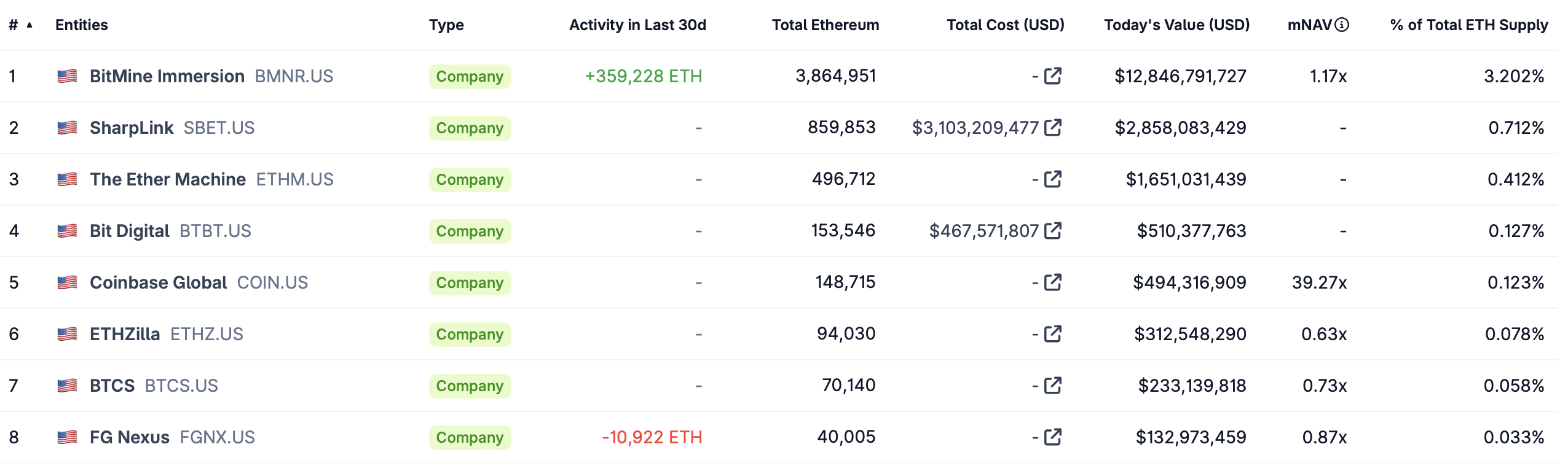
Top Ethereum treasury companies. Source: CoinGecko

The announcement comes one week after ETHZilla acquired a 20% fully diluted stake in auto-finance startup Karus for $10 million in cash and stock.

ETHZilla’s stock price was down around 10% at the time of writing, according to Yahoo Finance data.
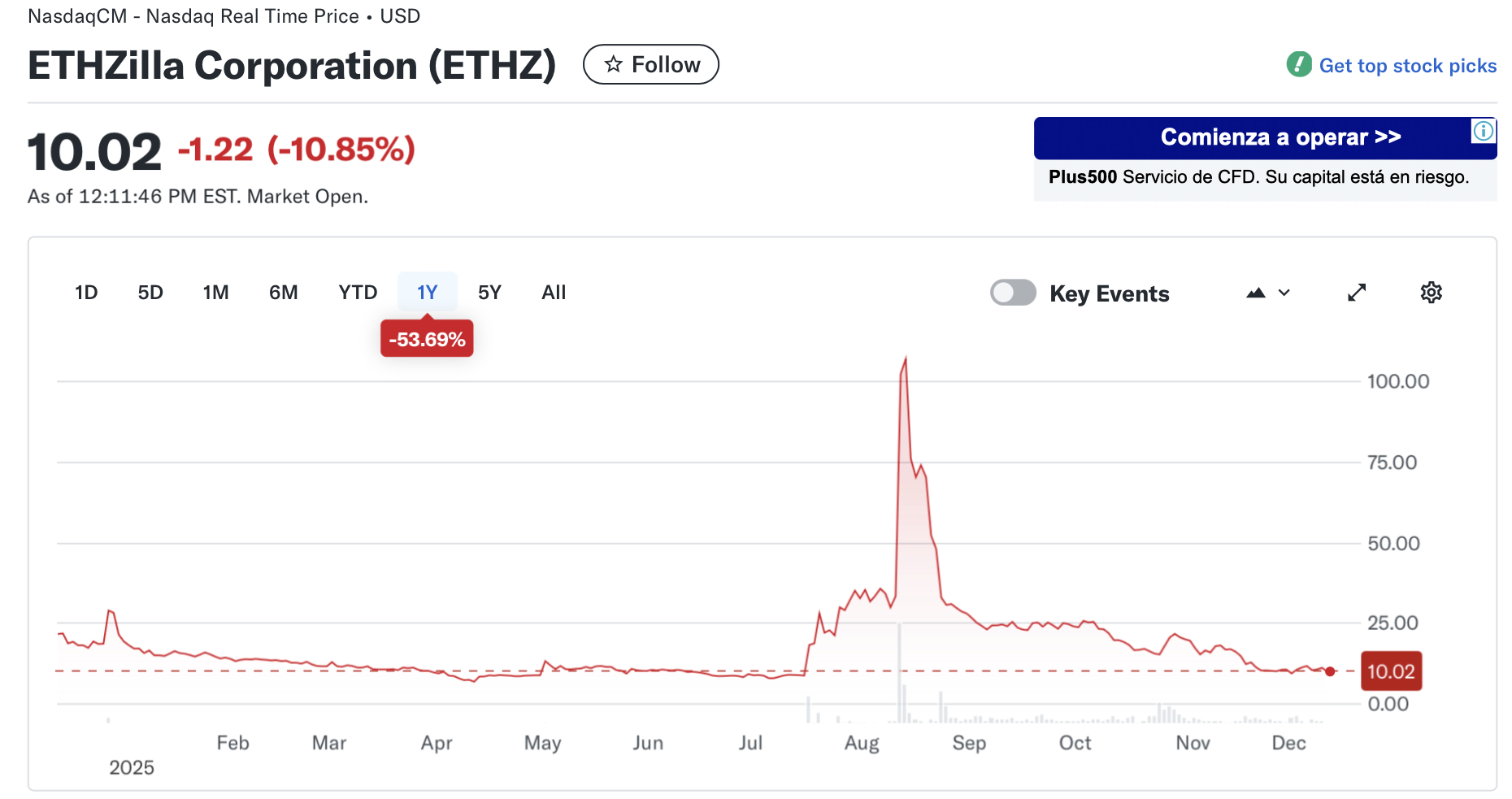
Source: Yahoo Finance

Related: Ethereum rising to $3.3K proves bottom is in: Is 100% ETH rally next?

Ether treasury stocks face steep declines

Several public companies that adopted Ether as a balance-sheet asset this year have seen sharp share-price reversals as the token price has fallen from its peak, ETHZilla among them.

ETHZilla, formerly 180 Life Sciences Corp, announced its pivot to an Ether treasury company on July 29. Its stock climbed from a $45 open that day to a $107 close by Aug. 13. However, the stock has declined roughly 91% since then, trading around $10 at this writing.

SharpLink Gaming launched an Ethereum treasury strategy in May, alongside a $425 million private placement that included Consensys as an investor and coincided with the nomination of Ethereum co-founder Joseph Lubin as chairman.

The company’s stock climbed more than 130% on the news to $79.21 on May 29, but has since dropped sharply to trade around $11.77 on Wednesday, according to Yahoo Finance data.
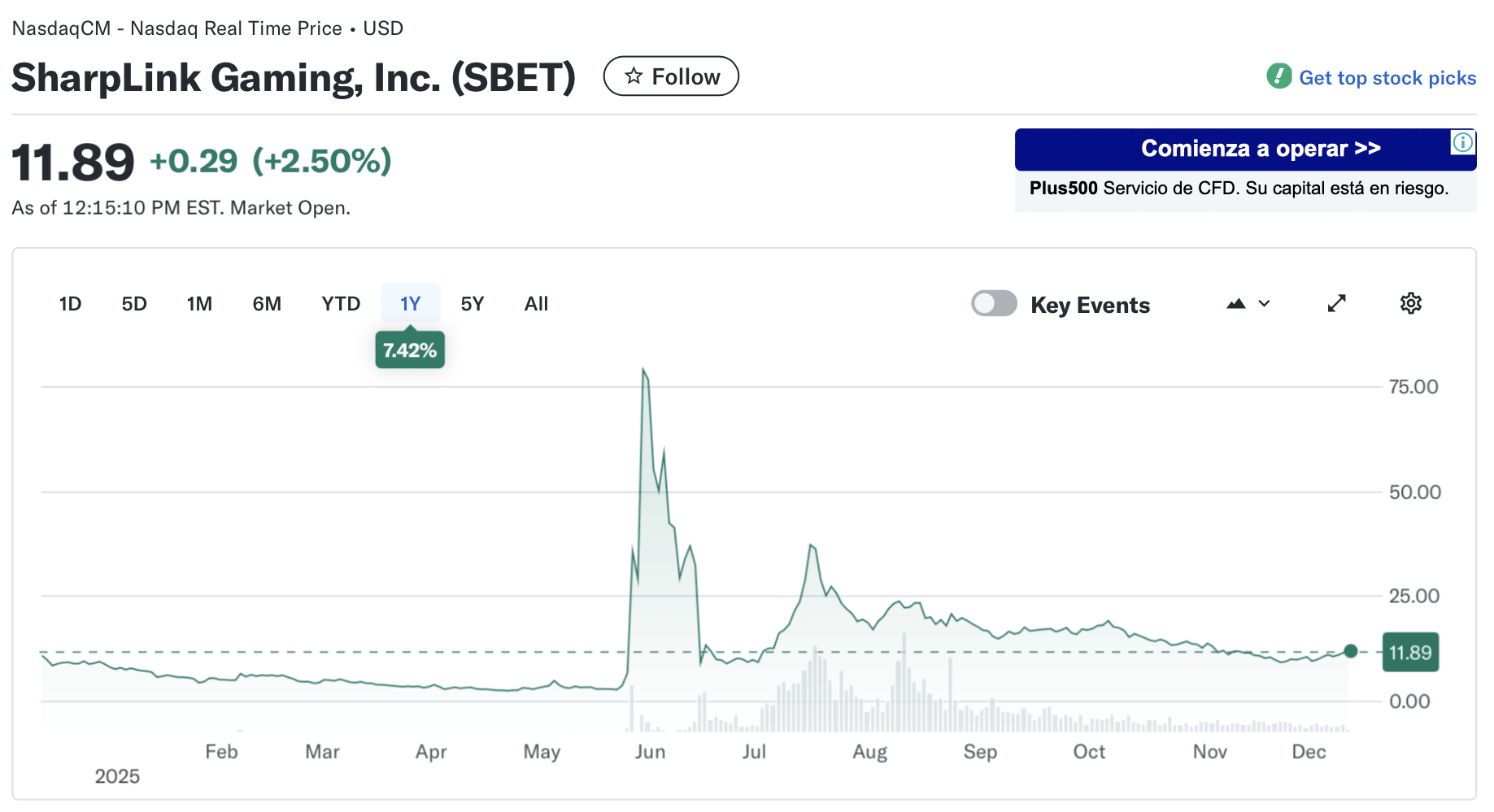
Source: Yahoo Finance

Bitmine Immersion, an Ether treasury company led by Fundstrat’s co-founder Tom Lee, has also struggled in recent months. Its stock hit an all-time high of $135 in July, but has since fallen to around $40 at this writing.
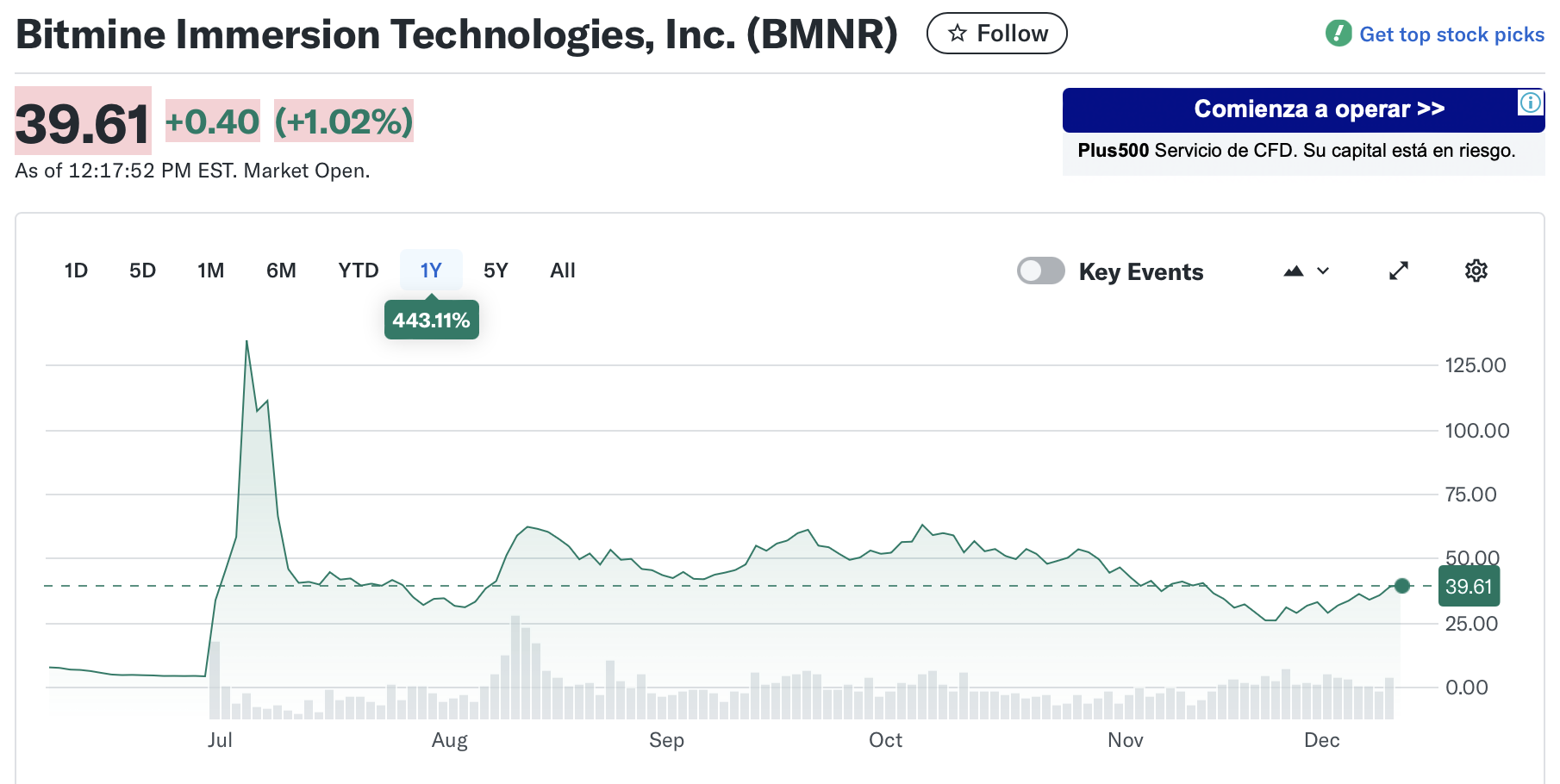
Source: Yahoo Finance

In August, Komodo Platform chief technology officer Kadan Stadelmann told Cointelegraph that companies adopting ETH treasury strategies face structural risks, and warned that a downturn in the market could force liquidations and amplify selling pressure on the token.

Ether has fallen since its all-time high of $4,946.05 on Aug. 24 and now trades at $3,365, according to CoinGecko data.

Magazine: Meet the onchain crypto detectives fighting crime better than the cops



Leituras Relacionadas

ECB's Schnabel says central bank money 'should move to blockchain'

ECB Executive Board member Isabel Schnabel stated that central bank money "must move onto the blockchain." She argued that stablecoins lack the independent ability to scale liquidity during financial stress—a gap only a central bank can fill. Her proposed solution involves tokenization, which she says can make transactions faster, safer, and more programmable, but only if the safest asset (central bank money) is on the same "rails" as other tokenized assets. This marks a notable shift for the Eurosystem, which had previously viewed Distributed Ledger Technology (DLT) mainly as a tool for regulating stablecoins and crypto, not as infrastructure to adopt directly. The first step is Project Pontes, launching in September. It will initially synchronize the ECB’s existing TARGET services with private DLT platforms. Eventually, it aims to enable settlement finality on a Eurosystem-managed DLT platform with smart contract functionality and 24/7 operation. The long-term strategy is Project Appia, tasked with developing the architecture, standards, and legal framework for a genuine European tokenized asset market by 2028. Trials have already processed around €1.6 billion, and since March 2026, the ECB accepts DLT-based assets as collateral. While not directly impacting Bitcoin's price, these developments signal that a major G7 central bank is preparing to settle transactions on-chain, lending legitimacy to the underlying infrastructure of crypto markets. The ECB's move to avoid "disintermediation" by private tokenization shows that debates in central bank boardrooms are now aligning with discussions long followed in the crypto space.

cryptonews.ruHá 22m

ECB's Schnabel says central bank money 'should move to blockchain'

cryptonews.ruHá 22m

Ripple Labs Warns of a New Challenge for Blockchains

Ripple Labs is preparing the XRP Ledger for quantum threats but now emphasizes a broader challenge: ensuring financial infrastructure can adapt simultaneously to quantum computing and artificial intelligence. Senior Director of Engineering Ayo Akinyele states the goal is not merely anticipating a "Q-Day" but building infrastructure capable of preemptively adopting new security mechanisms without network disruption. The shift to post-quantum cryptography involves more than swapping algorithms; it requires flexible infrastructure, improved key management, and clear upgrade paths. Financial systems were not designed with quantum computers in mind, necessitating a rethink of transaction, identity, asset, and data protection. This is underscored by significant investments, such as the $2 billion U.S.-IBM quantum factory initiative and a 2030 U.S. government mandate for post-quantum cryptography adoption. AI introduces distinct risks by driving automation and autonomous economic activity, increasing demand for an always-on, internet-oriented payment infrastructure. AI agents could soon conduct transactions independently, creating new security requirements. Ripple Labs advocates for proactive, orderly preparation rather than a crisis-driven transition, having outlined a four-phase strategy aiming for a full XRP Ledger transition by 2028, now expanded to address both quantum and AI-driven challenges.

cryptonews.ruHá 23m

Ripple Labs Warns of a New Challenge for Blockchains

cryptonews.ruHá 23m

Trading

Spot
活动图片