Ethereum Anomaly: Full Activity, Dirt-Cheap Fees—What's the Catch Behind It?

比推Publicado em 2026-01-22Última atualização em 2026-01-22

Resumo

Ethereum is experiencing a paradoxical surge in network activity, with daily transactions reaching a record 2.9 million and active addresses doubling, all while maintaining extremely low transaction fees of $0.1-$0.2. This follows major network upgrades like Pectra, Fusaka, and a subsequent blob parameter fork, which significantly increased data capacity and reduced costs. However, security researchers warn this record activity is not driven by organic growth but is largely fueled by industrial-scale "address poisoning" scams. Attackers exploit the low fees to send millions of micro-transactions (dusting) to new wallets, creating fake addresses that mimic a victim's real one in their transaction history. The goal is to trick users into accidentally sending funds to the fraudulent address. Analysis shows that 67% of new addresses received their first transaction as a sub-$1 stablecoin transfer from these poisoning contracts. Despite a success rate of only about 0.01%, the scheme is economically viable due to the low cost of transactions, with identified victims losing around $740,000. This artificial activity inflates on-chain metrics, masking a darker reality where low fees enable large-scale fraud disguised as legitimate adoption.

Author: Oluwapelumi Adejumo

Compiled by: Luffy, Foresight News

Original title: Ethereum Anomaly: Full Activity, Dirt-Cheap Fees—What's the Catch Behind It?


Ethereum's current daily network growth data has hit an all-time high. On the surface, this surge in statistics signals a massive return of user activity.

According to data from Token Terminal, the Ethereum mainnet processed 2.9 million transactions in the past week, setting a new historical record.

At the same time, the number of daily active addresses also saw a significant increase, rising from around 600,000 in late December to approximately 1.3 million.

The key point is that this explosion in throughput occurred while transaction costs remained extremely low. Despite record-high transaction demand, the average fee consistently stayed within the range of $0.1 to $0.2.
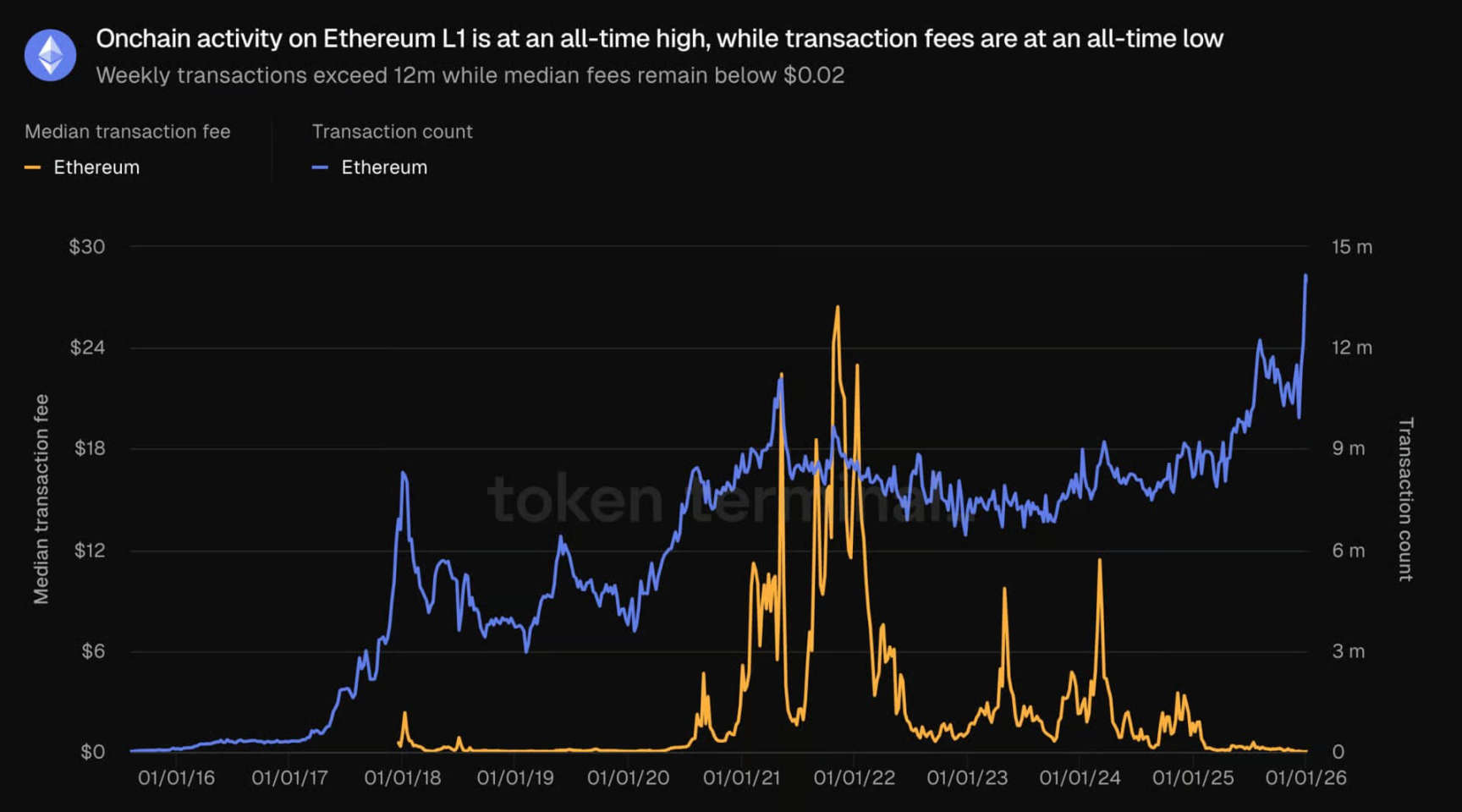
Ethereum On-Chain Activity, Data Source: Token Terminal

For a network like Ethereum, where fees soared to $50 to $200 during the 2021-2022 NFT boom, this change represents a fundamental shift in its transaction accessibility.

However, analysis shows that this growth is not entirely organic. Although surface indicators seem to herald a bull market recovery, security researchers warn that a significant portion of the network's traffic is actually driven by malicious actors.

These attackers are leveraging Ethereum's significantly reduced fees to launch industrial-scale "address poisoning" attack campaigns, disguising automated scam patterns as legitimate transactions to carry out targeted fraud against users.

Context of Network Scaling

To understand this sudden surge in transaction volume, one must focus on the recent structural changes to the Ethereum protocol. For years, the Ethereum network, while powerful, had transaction costs that were prohibitively high for most people.

Leon Waidmann, Head of Research at the Onchain Foundation, pointed out that since he entered the crypto industry, Ethereum mainnet fees have been outrageously high for the average user.

He stated that Ethereum was not only too expensive for retail users but also too costly for building consumer applications.

This situation began to change about a year ago: the Ethereum development team systematically optimized the network's scalability while striving to maintain decentralization and network security.

A series of protocol upgrades were implemented, advancing Ethereum's scaling roadmap, with three core upgrades.

The first was the Pectra upgrade in May 2025, which increased the target Blob data per block from 3 to 6 and the maximum from 6 to 9, directly doubling the expected processing capacity for Blob data.

Subsequently, in December 2025, Ethereum completed the Fusaka upgrade, introducing Peer Data Availability Sampling (PeerDAS). This technology allows validators to verify the availability of Blob data through sampling rather than downloading the full dataset, achieving a further improvement in network processing capacity while ensuring reasonable node operation requirements.

The latest upgrade was the Blob-Only Parameter Fork in January 2026, which increased the target Blob data per block from 10 to 14 and the maximum to 21. These upgrades aimed to unlock significant network processing power for Ethereum.

The economic effects of the upgrades quickly became apparent: Ethereum mainnet fees plummeted, and simple transactions returned to a low-cost state.

Leon Waidmann noted that it is now feasible to develop at scale directly on the Ethereum mainnet, which has also driven prediction markets, real-world asset trading, and payment businesses back to the mainnet.

Meanwhile, the scale of stablecoin transfers on the Ethereum network reached about $8 trillion in the fourth quarter of last year.

Ethereum's Record Activity Lacks Real Value Support

Although the record activity seems to mark Ethereum's rise, on-chain data shows that these transactions are not creating real value for the network.

Data from Alphractal shows that the Metcalfe Ratio, which measures the ratio of market capitalization to the square of the number of active users, is continuously declining. This means Ethereum's valuation growth has failed to keep pace with actual network adoption.
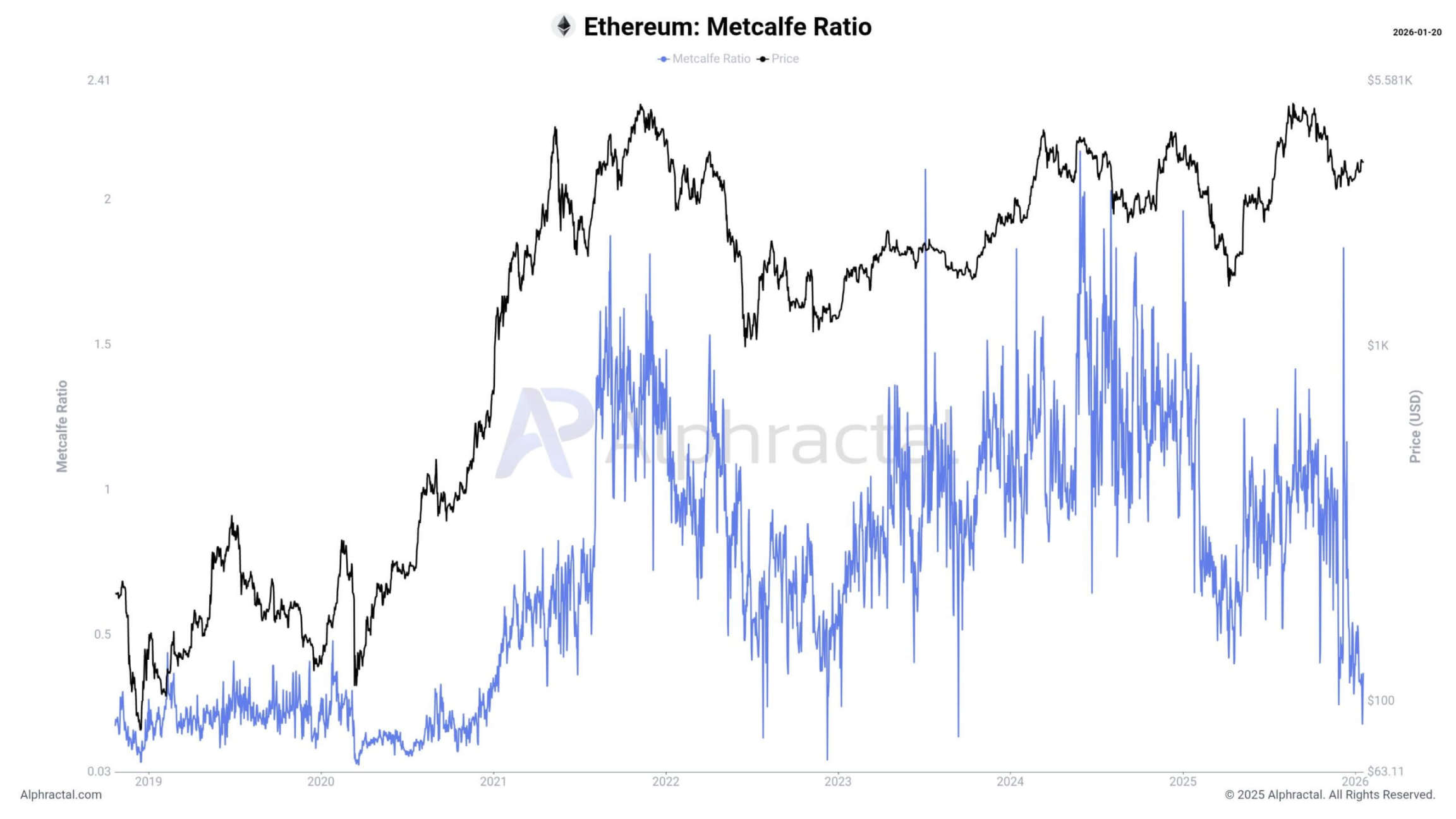
Ethereum's Metcalfe Ratio, Source: Alphracta

Furthermore, Ethereum's Network Adoption Score is currently at Level 1, its lowest historical tier. This data reflects the current market chill, with network valuation being low relative to on-chain activity.

Based on this, Matthias Seidl, co-founder of GrowThePie, believes that Ethereum's current activity surge is not organic.

He cited the example of a single address: this address received 190,000 ETH transfers from 190,000 unique wallets in a single day.

Matthias Seidl pointed out that the number of wallets receiving ETH transfers is relatively stable, but the number of wallets initiating transfers has grown significantly. He also emphasized that a large number of ETH transfers consume only 21,000 Gas, the cheapest transaction type in the Ethereum Virtual Machine (EVM).
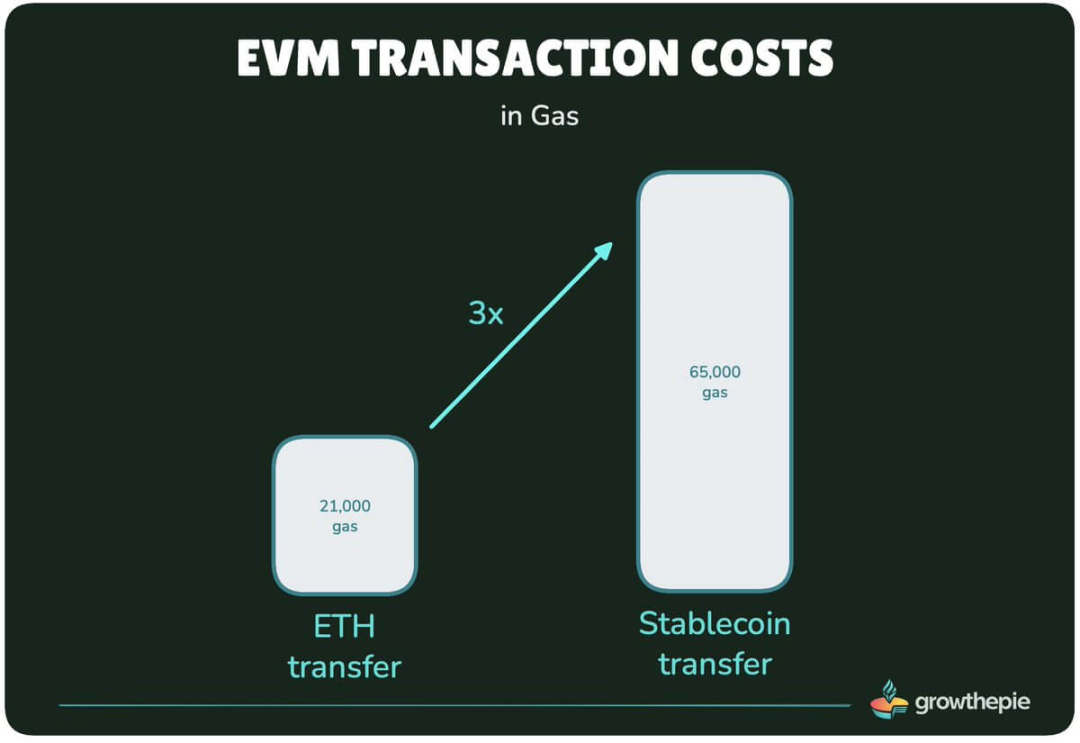
Ethereum EVM Transaction Costs, Data Source: GrowThePie

Currently, these low-cost native transfers account for nearly 50% of all Ethereum transactions. In comparison, sending an ERC20 token requires about 65,000 Gas, and the Gas cost of a stablecoin transfer is equivalent to three ETH transfers.

Address Poisoning: The Scam Makes a Comeback

Meanwhile, the surge in Ethereum's on-chain activity stems from an old scam that has made a comeback in this era of low fees.

Security researcher Andrey Sergeenkov pointed out that since last December, a wave of address poisoning attack campaigns has been spreading wildly by exploiting Ethereum's low Gas fees: while inflating various network metrics, they implant fake addresses into users' transaction histories,诱导 users to transfer real assets to the attackers.

The operation method of this type of attack is very simple: scammers generate "poisoned addresses" that share the same starting and ending characters as the target user's legitimate wallet address; after the victim completes a normal transfer, the attacker sends a small "dust transaction" to them, causing the fake address to appear in the victim's recent transaction history.

They bet that users will later copy this seemingly familiar address directly from their transaction history when making a transfer, without verifying the full address string.

Based on this, Andrey Sergeenkov linked the surge in new Ethereum addresses to this scam technique. He estimated that the current rate of new address creation on Ethereum is about 2.7 times the average level of 2025, with new address creation in the week of January 12th soaring to about 2.7 million.
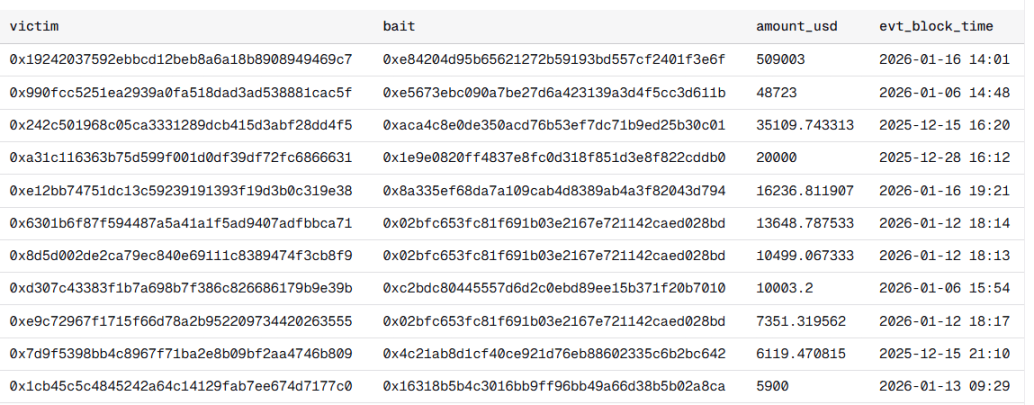
Address Poisoning Attack Victim Data, Data Source: Andrey Sergeenkov

After dissecting the fund flows behind this growth, he concluded that about 80% of the transaction activity is driven by stablecoin transactions, not organic user demand.

To verify if this growth was caused by address poisoning, Andrey Sergeenkov looked for a telltale sign: addresses whose first transaction was receiving a stablecoin transfer of less than $1.

Statistics showed that 67% of new addresses fit this characteristic. Specifically, out of 5.78 million new addresses, 3.86 million addresses had their first stablecoin transaction be receiving a "dust transfer."

Subsequently, he turned his research focus to the initiators of these transfers: counting accounts that sent less than $1 worth of USDT and USDC between December 15, 2025, and January 18, 2026.

Andrey Sergeenkov counted the number of unique recipient addresses for each initiating account and filtered for accounts that initiated transfers to at least 10,000 addresses. He found that behind these accounts were smart contracts specifically designed for the industrial implementation of address poisoning. This type of code can fund and coordinate the operations of hundreds of poisoning addresses in a single transaction.

One contract he studied contained a function labeled `fundPoisoners`, which, according to its description, can distribute stablecoin dust to large batches of poisoning addresses at once, along with a small amount of ETH to pay for Gas fees.

These poisoning addresses then disperse to send dust transfers to millions of potential targets, creating misleading entries in their wallets' transaction histories.

The core of this scam model lies in operating at scale: although most recipients will not fall for it, the entire scheme becomes economically viable as long as a tiny fraction of users are deceived.

Andrey Sergeenkov estimated the actual success rate of this scam to be about 0.01%, meaning its business model is fundamentally built on tolerating an extremely high failure rate. In the dataset he analyzed, 116 victims lost a total of approximately $740,000, with the single largest loss reaching $509,000.

Previously, the biggest constraint for such scams was cost. Address poisoning requires initiating millions of on-chain transactions, which themselves do not directly generate revenue unless a victim sends funds to the wrong address.

Andrey Sergeenkov believes that until late 2025, Ethereum's network fees made this large-scale transfer scam strategy unprofitable. But now, transaction costs have decreased by about 6 times, causing a drastic reversal in the risk-reward ratio, making the scam highly attractive to attackers.

Thus, he pointed out that while Ethereum has increased its transaction processing capacity, if user security protections are not strengthened, it creates a distorted environment: the network's "record-level" activity is indistinguishable from automated malicious behavior.

In his view, the crypto industry's excessive focus on network metrics may掩盖 a darker reality: low-cost block space easily allows scams targeting large-scale users to be whitewashed as legitimate network adoption, and the ultimate losses will be borne by users.


Twitter:https://twitter.com/BitpushNewsCN

BitPush TG Discussion Group:https://t.me/BitPushCommunity

BitPush TG Subscription: https://t.me/bitpush

Original link:https://www.bitpush.news/articles/7605224

Perguntas relacionadas

QWhat is the main reason behind the recent surge in Ethereum's daily active addresses and transaction volume?

AThe surge is largely driven by malicious actors conducting industrial-scale address poisoning attacks, which exploit Ethereum's significantly reduced transaction fees to send automated scam transactions disguised as legitimate ones.

QHow have Ethereum's recent protocol upgrades contributed to the decrease in transaction fees?

AKey upgrades like Pectra (increasing blob data capacity), Fusaka (introducing PeerDAS for efficient data verification), and the blob parameter fork (further increasing blob targets) have systematically expanded network capacity, making transactions much cheaper.

QWhat is an 'address poisoning' attack and how does it work?

AAddress poisoning is a scam where attackers generate fake wallet addresses that mimic the first and last characters of a victim's legitimate address. After a victim makes a genuine transaction, the attacker sends a small 'dust transaction' to the victim, making the fake address appear in their recent transaction history. The victim might later mistakenly copy this fake address and send funds to the attacker.

QWhat evidence suggests that the increased network activity is not due to organic user adoption?

AAnalysis shows a declining Metcalfe Ratio (indicating valuation isn't keeping pace with user growth), a low network adoption score, and that nearly 50% of transactions are minimal-cost native ETH transfers. Furthermore, 67% of new addresses received their first transaction as a dust stablecoin transfer under $1, characteristic of poisoning attacks.

QWhy have address poisoning attacks become economically viable for scammers recently?

AEthereum's transaction fees have decreased by approximately 6 times due to network upgrades, making it affordable for scammers to launch millions of low-cost transactions. The attack model tolerates an extremely high failure rate (~0.01% success rate) but becomes profitable if even a tiny fraction of victims fall for the scam.

Leituras Relacionadas

North Korean Hackers Loot $500 Million in a Single Month, Becoming the Top Threat to Crypto Security

North Korean hackers, particularly the notorious Lazarus Group and its subgroup TraderTraitor, have stolen over $500 million from cryptocurrency DeFi platforms in less than three weeks, bringing their total theft for the year to over $700 million. Recent major attacks on Drift Protocol and KelpDAO, resulting in losses of approximately $286 million and $290 million respectively, highlight a strategic shift: instead of targeting core smart contracts, attackers are now exploiting vulnerabilities in peripheral infrastructure. For instance, the KelpDAO attack involved compromising downstream RPC infrastructure used by LayerZero's decentralized validation network (DVN), allowing manipulation without breaching core cryptography. This sophisticated approach mirrors advanced corporate cyber-espionage. Additionally, North Korea has systematically infiltrated the global crypto workforce, with an estimated 100 operatives using fake identities to gain employment at blockchain companies, enabling long-term access to sensitive systems and facilitating large-scale thefts. According to Chainalysis, North Korean-linked hackers stole a record $2 billion in 2025, accounting for 60% of all global crypto theft that year. Their total historical crypto theft has reached $6.75 billion. Post-theft, they employ specialized money laundering methods, heavily relying on Chinese OTC brokers and cross-chain mixing services rather than standard decentralized exchanges. Security experts, while acknowledging the increased sophistication, emphasize that many attacks still exploit fundamental weaknesses like poor access controls and centralized operational risks. Strengthening private key management, limiting privileged access, and enhancing coordination among exchanges, analysts, and law enforcement immediately after an attack are critical to improving defense and fund recovery chances. The industry's challenge now extends beyond secure smart contracts to safeguarding operational security at the infrastructure level.

marsbitHá 2m

North Korean Hackers Loot $500 Million in a Single Month, Becoming the Top Threat to Crypto Security

marsbitHá 2m

Circle CEO's Seoul Visit: No Korean Won Stablecoin Issuance, But Met All Major Korean Banks

Circle CEO Jeremy Allaire's recent activities in Seoul indicate a strategic shift for the company, moving away from issuing a Korean won-backed stablecoin and instead focusing on embedding itself as a key infrastructure provider within Korea’s financial and crypto ecosystem. Despite Korea accounting for nearly 30% of global crypto trading volume—with a market characterized by high retail participation and altcoin dominance—Circle has chosen not to compete for the role of stablecoin issuer. Instead, Allaire met with major Korean banks (including Shinhan, KB, and Woori), financial groups, leading exchanges (Upbit, Bithumb, Coinone), and tech firms like Kakao. This approach reflects a broader industry transition: the core of stablecoin competition is shifting from issuance rights to systemic positioning. With Korean regulators still debating whether banks or tech companies should issue stablecoins, Circle is avoiding regulatory uncertainty by strengthening its role as a service and technology partner. The company is deepening integration with trading platforms, building connections, and promoting stablecoin infrastructure. This positions Circle to benefit regardless of which entity eventually issues a won stablecoin. Allaire also noted the potential for a Chinese yuan stablecoin in the next 3–5 years, underscoring a regional trend of stablecoins becoming more regulated and integrated with traditional finance. Ultimately, Circle’s strategy highlights that future influence in the stablecoin market will belong not necessarily to the issuers, but to the foundational infrastructure layers that enable cross-system transactions.

marsbitHá 30m

Circle CEO's Seoul Visit: No Korean Won Stablecoin Issuance, But Met All Major Korean Banks

marsbitHá 30m

SpaceX Ties Up with Cursor: A High-Stakes AI Gambit of 'Lock First, Acquire Later'

SpaceX has secured an option to acquire AI programming company Cursor for $60 billion, with an alternative clause requiring a $10 billion collaboration fee if the acquisition does not proceed. This structure is not merely a potential acquisition but a strategic move to control core access points in the AI era. The deal is designed as a flexible, dual-path arrangement, allowing SpaceX to either fully acquire Cursor or maintain a binding partnership through high-cost collaboration. This "option-style" approach minimizes immediate regulatory and integration risks while ensuring long-term alignment between the two companies. At its core, the transaction exchanges critical AI-era resources: SpaceX provides its Colossus supercomputing cluster—one of the world’s most powerful AI training infrastructures—while Cursor contributes its AI-native developer environment and strong product adoption. This synergy connects compute power, models, and application layers, forming a closed-loop AI capability stack. Cursor, founded in 2022, has achieved rapid growth with over $1 billion in annual revenue and widespread enterprise adoption. Its value lies in transforming software development through AI agents capable of coding, debugging, and system design—positioning it as a gateway to future software production. For SpaceX, this move is part of a broader strategy to evolve from a aerospace company into an AI infrastructure empire, integrating xAI, supercomputing, and chip manufacturing. Controlling Cursor fills a gap in its developer tooling layer, strengthening its AI narrative ahead of a potential IPO. The deal reflects a shift in AI competition from model superiority to ecosystem and entry-point control. With programming tools as a key battleground, securing developer loyalty becomes crucial for dominating the software production landscape. Risks include questions around Cursor’s valuation, technical integration challenges, and potential regulatory scrutiny. Nevertheless, the deal underscores a strategic bet: controlling both compute and software development access may redefine power dynamics in the AI-driven future.

marsbitHá 1h

SpaceX Ties Up with Cursor: A High-Stakes AI Gambit of 'Lock First, Acquire Later'

marsbitHá 1h

Trading

Spot
Futuros

Artigos em Destaque

O que é ETH 2.0

ETH 2.0: Uma Nova Era para o Ethereum Introdução ETH 2.0, amplamente conhecido como Ethereum 2.0, marca uma atualização monumental à blockchain do Ethereum. Esta transição não é meramente uma mudança estética; visa melhorar fundamentalmente a escalabilidade, segurança e sustentabilidade da rede. Com uma mudança do mecanismo de consenso em Proof of Work (PoW), intensivo em energia, para um Proof of Stake (PoS) mais eficiente, o ETH 2.0 promete uma abordagem transformadora ao ecossistema blockchain. O que é ETH 2.0? ETH 2.0 é um conjunto de atualizações distintas e interconectadas focadas na otimização das capacidades e desempenho do Ethereum. Esta reformulação foi projetada para abordar desafios críticos que o mecanismo atual do Ethereum enfrentou, particularmente em relação à velocidade das transações e à congestão da rede. Objetivos do ETH 2.0 Os principais objetivos do ETH 2.0 giram em torno da melhoria de três aspectos centrais: Escalabilidade: Com o objetivo de melhorar significativamente o número de transações que a rede pode manejar por segundo, o ETH 2.0 procura ultrapassar a limitação atual de aproximadamente 15 transações por segundo, alcançando potencialmente milhares. Segurança: Medidas de segurança melhoradas são integrais ao ETH 2.0, especialmente através da resistência aprimorada contra ciberataques e da preservação do ethos descentralizado do Ethereum. Sustentabilidade: O novo mecanismo PoS foi projetado não apenas para melhorar a eficiência, mas também para reduzir drasticamente o consumo de energia, alinhando a estrutura operacional do Ethereum com considerações ambientais. Quem é o Criador do ETH 2.0? A criação do ETH 2.0 pode ser atribuída à Ethereum Foundation. Esta organização sem fins lucrativos, que desempenha um papel crucial no apoio ao desenvolvimento do Ethereum, é liderada pelo co-fundador notável Vitalik Buterin. A sua visão de um Ethereum mais escalável e sustentável tem sido a força motriz por trás desta atualização, envolvendo contribuições de uma comunidade global de desenvolvedores e entusiastas dedicados a melhorar o protocolo. Quem são os Investidores do ETH 2.0? Embora os detalhes sobre os investidores do ETH 2.0 não tenham sido tornados públicos, é sabido que a Ethereum Foundation recebe apoio de várias organizações e indivíduos no espaço da blockchain e tecnologia. Esses parceiros incluem firmas de capital de risco, empresas de tecnologia e organizações filantrópicas que compartilham um interesse mútuo em apoiar o desenvolvimento de tecnologias descentralizadas e infraestrutura de blockchain. Como Funciona o ETH 2.0? ETH 2.0 é notável por introduzir uma série de características chave que o diferenciam do seu predecessor. Proof of Stake (PoS) A transição para um mecanismo de consenso PoS é uma das mudanças de destaque do ETH 2.0. Ao contrário do PoW, que depende da mineração intensiva em energia para a verificação de transações, o PoS permite que os utilizadores validem transações e criem novos blocos de acordo com a quantidade de ETH que apostam na rede. Isso leva a uma maior eficiência energética, reduzindo o consumo em aproximadamente 99,95%, tornando o Ethereum 2.0 uma alternativa consideravelmente mais ecológica. Shard Chains As shard chains são outra inovação crítica do ETH 2.0. Estas cadeias menores operam em paralelo com a cadeia principal do Ethereum, permitindo que várias transações sejam processadas simultaneamente. Esta abordagem melhora a capacidade geral da rede, abordando preocupações de escalabilidade que têm atormentado o Ethereum. Beacon Chain No coração do ETH 2.0 está a Beacon Chain, que coordena a rede e gere o protocolo PoS. Ela atua como uma espécie de organizador: supervisiona os validadores, garante que as shards permaneçam conectadas à rede e monitora a saúde geral do ecossistema blockchain. Linha do Tempo do ETH 2.0 A jornada do ETH 2.0 tem sido marcada por vários marcos chave que traçam a evolução desta atualização significativa: Dezembro de 2020: O lançamento da Beacon Chain marcou a introdução do PoS, preparando o caminho para a migração para o ETH 2.0. Setembro de 2022: A conclusão de “The Merge” representa um momento crucial em que a rede Ethereum fez a transição com sucesso de um quadro PoW para um PoS, anunciando uma nova era para o Ethereum. 2023: O lançamento esperado das shard chains visa melhorar ainda mais a escalabilidade da rede Ethereum, solidificando o ETH 2.0 como uma plataforma robusta para aplicações e serviços descentralizados. Características Chave e Benefícios Escalabilidade Melhorada Uma das vantagens mais significativas do ETH 2.0 é a sua escalabilidade melhorada. A combinação de PoS e shard chains permite que a rede expanda a sua capacidade, permitindo que acomode um volume de transações muito maior em comparação com o sistema legado. Eficiência Energética A implementação do PoS representa um enorme passo em direção à eficiência energética na tecnologia blockchain. Ao reduzir drasticamente o consumo de energia, o ETH 2.0 não só reduz os custos operacionais, mas também se alinha mais estreitamente com os objetivos globais de sustentabilidade. Segurança Aprimorada Os mecanismos atualizados do ETH 2.0 contribuem para uma segurança melhorada em toda a rede. O uso do PoS, juntamente com medidas de controle inovadoras estabelecidas através das shard chains e da Beacon Chain, assegura um maior grau de proteção contra potenciais ameaças. Custos Mais Baixos para os Utilizadores À medida que a escalabilidade melhora, os efeitos sobre os custos de transação também serão evidentes. Aumentada a capacidade e reduzida a congestão, espera-se que isso se traduza em taxas mais baixas para os utilizadores, tornando o Ethereum mais acessível para transações do dia a dia. Conclusão ETH 2.0 marca uma evolução significativa no ecossistema da blockchain do Ethereum. Ao abordar questões fundamentais como a escalabilidade, o consumo de energia, a eficiência das transações e a segurança geral, a importância desta atualização não pode ser subestimada. A transição para o Proof of Stake, a introdução das shard chains e o trabalho fundamental da Beacon Chain são indicativos de um futuro em que o Ethereum pode atender à crescente demanda do mercado descentralizado. Em uma indústria movida pela inovação e progresso, o ETH 2.0 representa um testemunho das capacidades da tecnologia blockchain em pavimentar o caminho para uma economia digital mais sustentável e eficiente.

100 Visualizações TotaisPublicado em {updateTime}Atualizado em 2024.12.03

O que é ETH 2.0

O que é ETH 3.0

ETH3.0 e $eth 3.0: Uma Análise Profunda do Futuro do Ethereum Introdução No ambiente em rápida evolução da criptomoeda e da tecnologia blockchain, o ETH3.0, frequentemente denotado como $eth 3.0, emergiu como um tema de considerável interesse e especulação. O termo abrange dois conceitos principais que merecem esclarecimento: Ethereum 3.0: Esta representa uma potencial atualização futura destinada a aumentar as capacidades da atual blockchain do Ethereum, focando especialmente na melhoria da escalabilidade e desempenho. ETH3.0 Meme Token: Este distinto projeto de criptomoeda procura aproveitar a blockchain do Ethereum na criação de um ecossistema centrado em memes, promovendo o envolvimento na comunidade de criptomoedas. Compreender esses aspectos do ETH3.0 é essencial não apenas para entusiastas de criptomoedas, mas também para aqueles que observam as tendências tecnológicas mais amplas no espaço digital. O que é ETH3.0? Ethereum 3.0 Ethereum 3.0 é promovido como uma atualização proposta para a rede Ethereum já estabelecida, que tem sido a espinha dorsal de muitas aplicações descentralizadas (dApps) e contratos inteligentes desde a sua criação. As melhorias vislumbradas concentram-se principalmente na escalabilidade—integrando tecnologias avançadas como sharding e provas de conhecimento zero (zk-proofs). Essas inovações tecnológicas visam facilitar um número sem precedentes de transações por segundo (TPS), potencialmente alcançando milhões, abordando assim uma das limitações mais significativas enfrentadas pela tecnologia blockchain atual. A melhoria não é meramente técnica, mas também estratégica; visa preparar a rede Ethereum para uma adoção generalizada e utilidade em um futuro marcado por uma maior demanda por soluções descentralizadas. ETH3.0 Meme Token Em contraste com o Ethereum 3.0, o ETH3.0 Meme Token aventura-se por um domínio mais leve e divertido, combinando a cultura dos memes da internet com a dinâmica das criptomoedas. Este projeto permite que os usuários comprem, vendam e negociem memes na blockchain do Ethereum, proporcionando uma plataforma que fomenta o envolvimento da comunidade através da criatividade e interesses compartilhados. O ETH3.0 Meme Token visa demonstrar como a tecnologia blockchain pode interseccionar com a cultura digital, criando casos de uso que são tanto divertidos quanto financeiramente viáveis. Quem é o Criador do ETH3.0? Ethereum 3.0 A iniciativa em direção ao Ethereum 3.0 é impulsionada principalmente por um consórcio de desenvolvedores e pesquisadores dentro da comunidade Ethereum, notavelmente incluindo Justin Drake. Conhecido por suas percepções e contribuições para a evolução do Ethereum, Drake tem sido uma figura proeminente nas discussões sobre a transição do Ethereum para uma nova camada de consenso, referida como “Beam Chain”. Esta abordagem colaborativa ao desenvolvimento significa que o Ethereum 3.0 não é fruto de um único criador, mas sim uma manifestação da engenhosidade coletiva focada no avanço da tecnologia blockchain. ETH3.0 Meme Token Os detalhes sobre o criador do ETH3.0 Meme Token são atualmente indetectáveis. A natureza dos tokens de meme frequentemente leva a uma estrutura mais descentralizada e impulsionada pela comunidade, o que poderia explicar a falta de atribuição específica. Isso alinha-se com a ethos da comunidade de criptomoedas mais ampla, onde a inovação geralmente surge de esforços colaborativos em vez de esforços individuais. Quem são os Investidores do ETH3.0? Ethereum 3.0 O apoio ao Ethereum 3.0 provém principalmente da Fundação Ethereum, juntamente com uma comunidade entusiástica de desenvolvedores e investidores. Esta associação fundacional proporciona um grau significativo de legitimidade e melhora as perspectivas de uma implementação bem-sucedida, uma vez que aproveita a confiança e credibilidade construída ao longo de anos de operações de rede. Em um clima em rápida mudança no mundo das criptomoedas, o apoio da comunidade desempenha um papel crucial no impulso ao desenvolvimento e adoção, posicionando o Ethereum 3.0 como um sério candidato a futuros avanços na blockchain. ETH3.0 Meme Token Embora as fontes atualmente disponíveis não forneçam informações explícitas sobre as fundações ou organizações de investimento que apoiam o ETH3.0 Meme Token, é indicativo do modelo típico de financiamento para tokens de meme, que frequentemente depende de apoio base e engajamento da comunidade. Os investidores em tais projetos costumam consistir em indivíduos motivados pelo potencial de inovação impulsionada pela comunidade e pelo espírito de cooperação encontrado dentro da comunidade cripto. Como Funciona o ETH3.0? Ethereum 3.0 As características distintivas do Ethereum 3.0 residem em sua proposta de implementação de sharding e tecnologia zk-proof. Sharding é um método de partição da blockchain em partes menores e gerenciáveis ou “shards”, que podem processar transações simultaneamente em vez de sequencialmente. Esta descentralização do processamento ajuda a prevenir congestionamentos e garante que a rede permaneça responsiva mesmo sob carga pesada. A tecnologia de prova de conhecimento zero (zk-proof) contribui com outra camada de sofisticação ao permitir a validação de transações sem revelar os dados subjacentes envolvidos. Este aspecto não apenas melhora a privacidade, mas também aumenta a eficiência geral da rede. Há também conversas sobre a incorporação de uma Máquina Virtual Ethereum de conhecimento zero (zkEVM) nesta atualização, amplificando ainda mais as capacidades e utilidade da rede. ETH3.0 Meme Token O ETH3.0 Meme Token distingue-se ao capitalizar sobre a popularidade da cultura dos memes. Estabelece um mercado para que os usuários participem da negociação de memes, não apenas para entretenimento, mas também para potencial ganho econômico. Ao integrar recursos como staking, provisão de liquidez e mecanismos de governança, o projeto fomenta um ambiente que incentiva a interação e participação da comunidade. Ao oferecer uma mistura única de entretenimento e oportunidade econômica, o ETH3.0 Meme Token visa atrair um público diversificado, variando de entusiastas de criptomoedas a conhecedores casuais de memes. Cronologia do ETH3.0 Ethereum 3.0 11 de novembro de 2024: Justin Drake sugere a próxima atualização do ETH 3.0, centrada nas melhorias de escalabilidade. Este anúncio sinaliza o início de discussões formais sobre a futura arquitetura do Ethereum. 12 de novembro de 2024: A proposta antecipada para Ethereum 3.0 deve ser revelada no Devcon em Bangkok, preparando o cenário para um feedback mais amplo da comunidade e potenciais próximos passos no desenvolvimento. ETH3.0 Meme Token 21 de março de 2024: O ETH3.0 Meme Token é oficialmente listado no CoinMarketCap, marcando sua entrada no domínio público das criptomoedas e aumentando a visibilidade de seu ecossistema baseado em memes. Pontos Chave Em conclusão, Ethereum 3.0 representa uma evolução significativa dentro da rede Ethereum, focando em superar limitações quanto à escalabilidade e desempenho através de tecnologias avançadas. As atualizações propostas refletem uma abordagem proativa às futuras demandas e usabilidade. Por outro lado, o ETH3.0 Meme Token encapsula a essência da cultura impulsionada pela comunidade no espaço das criptomoedas, aproveitando a cultura dos memes para criar plataformas envolventes que incentivam a criatividade e participação dos usuários. Compreender os distintos propósitos e funcionalidades do ETH3.0 e $eth 3.0 é fundamental para qualquer pessoa interessada nos desenvolvimentos contínuos dentro do espaço cripto. Com ambas as iniciativas a pavimentar caminhos únicos, elas sublinham coletivamente a natureza dinâmica e multifacetada da inovação em blockchain.

98 Visualizações TotaisPublicado em {updateTime}Atualizado em 2024.12.03

O que é ETH 3.0

Como comprar ETH

Bem-vindo à HTX.com!Tornámos a compra de Ethereum (ETH) simples e conveniente.Segue o nosso guia passo a passo para iniciar a tua jornada no mundo das criptos.Passo 1: cria a tua conta HTXUtiliza o teu e-mail ou número de telefone para te inscreveres numa conta gratuita na HTX.Desfruta de um processo de inscrição sem complicações e desbloqueia todas as funcionalidades.Obter a minha contaPasso 2: vai para Comprar Cripto e escolhe o teu método de pagamentoCartão de crédito/débito: usa o teu visa ou mastercard para comprar Ethereum (ETH) instantaneamente.Saldo: usa os fundos da tua conta HTX para transacionar sem problemas.Terceiros: adicionamos métodos de pagamento populares, como Google Pay e Apple Pay, para aumentar a conveniência.P2P: transaciona diretamente com outros utilizadores na HTX.Mercado de balcão (OTC): oferecemos serviços personalizados e taxas de câmbio competitivas para os traders.Passo 3: armazena teu Ethereum (ETH)Depois de comprar o teu Ethereum (ETH), armazena-o na tua conta HTX.Alternativamente, podes enviá-lo para outro lugar através de transferência blockchain ou usá-lo para transacionar outras criptomoedas.Passo 4: transaciona Ethereum (ETH)Transaciona facilmente Ethereum (ETH) no mercado à vista da HTX.Acede simplesmente à tua conta, seleciona o teu par de trading, executa as tuas transações e monitoriza em tempo real.Oferecemos uma experiência de fácil utilização tanto para principiantes como para traders experientes.

2.9k Visualizações TotaisPublicado em {updateTime}Atualizado em 2025.03.21

Como comprar ETH

Discussões

Bem-vindo à Comunidade HTX. Aqui, pode manter-se informado sobre os mais recentes desenvolvimentos da plataforma e obter acesso a análises profissionais de mercado. As opiniões dos utilizadores sobre o preço de ETH (ETH) são apresentadas abaixo.

活动图片