ETH Price Holds Near $3,000 as ETF Outflows Offset Market Gains

TheNewsCryptoPublicado em 2026-01-28Última atualização em 2026-01-28

Resumo

Ethereum (ETH) is trading near $3,004, showing modest gains while remaining range-bound between key support and resistance levels. Despite a 24-hour trading volume of $26.56 billion, ETH faces subdued medium-term momentum, trading below key moving averages. Institutional flows show a net outflow of $63.53 million from Ethereum ETFs, with BlackRock’s fund contributing significantly. While some products saw minor inflows, they weren’t enough to offset outflows, though cumulative net inflows since launch stand at $12.36 billion. Technical indicators like RSI and MACD suggest balanced buying and selling pressure, with near-term movement likely confined between $2,900 support and $3,150–$3,200 resistance.

Ethereum (ETH) is trading near $3,004, showing a modest gain over the past day as price action remains around the $3,000 level. Over the last 24 hours, ETH moved between an intraday low of $2,916.22 and a high of $3,040.72, while its market capitalization stands at $362.66 billion and trading volume is around $26.56 billion. This reflects ongoing interest in the asset even as broader market dynamics evolve.

Meanwhile, institutional flows into Ethereum’s exchange-traded products remain a key focus. According to the latest data SoSoValue, the total net flow for January 27 showed a net outflow of about $63.53 million, with BlackRock’s ETHA fund accounting for the largest portion of that outflow.
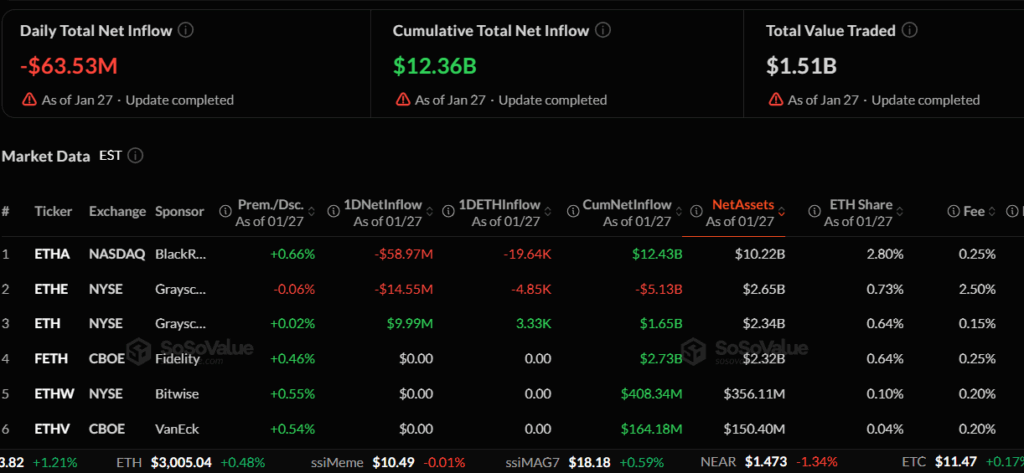
At the same time, some other products, such as the Grayscale Ethereum Mini Trust ETF, recorded smaller net inflows, but they were not large enough to offset the overall outflow figure. The cumulative total net inflow into Ethereum spot ETFs now stands near $12.36 billion since these products launched.

Ethereum Trades Near $3,000 as Price Action Remains Range-Bound

On the weekly chart, Ethereum is still trading below its 9-week moving average (near $3,050) and below the 21-week moving average (around $3,515). This suggests that medium-term trend momentum remains subdued. Weekly price action has seen lower highs after peaks near $3,800, indicating that sellers have been active at higher levels and the broader structure has not yet turned decisively upward. The lack of a fresh bullish crossover keeps upside momentum restrained for now.

The RSI (14) on the weekly timeframe sits around 44–45, below neutral levels. This highlights a lack of strong momentum in either direction, with buying and selling pressures broadly balanced. Meanwhile, the MACD indicator remains below its signal line with the histogram in negative territory, pointing to continued range-bound conditions rather than a firm trend reversal.

Zooming in, The Bull Bear Power Trend (BBPT) shows reduced bearish pressure, but bullish strength is still limited. This aligns with the current sideways movement.

Looking at short-term price action, daily charts show ETH consolidating above $2,900, with buyers defending dips and sellers stepping in near resistance levels. From a longer-term perspective, Ethereum remains above several key support bands but below major resistance zones formed earlier in the year, reflecting a period of correction and consolidation following earlier gains.

In the near term, support is seen near $2,900, while resistance is located around $3,150–$3,200. Until price clears these levels with conviction, ETH’s movement is likely to remain range-bound, shaped by both technical levels and broader market flows.


TagsAltcoinCrypto MarketETHETHEREUM

Perguntas relacionadas

QWhat is the current trading price of Ethereum (ETH) and what is its market capitalization?

AEthereum (ETH) is trading near $3,004, and its market capitalization stands at $362.66 billion.

QWhat was the total net flow for Ethereum exchange-traded products on January 27, and which fund had the largest outflow?

AThe total net flow for January 27 showed a net outflow of about $63.53 million, with BlackRock's ETHA fund accounting for the largest portion of that outflow.

QWhat do the weekly RSI and MACD indicators suggest about Ethereum's current market momentum?

AThe weekly RSI (14) sits around 44–45, below neutral levels, indicating a lack of strong momentum in either direction. The MACD remains below its signal line with the histogram in negative territory, pointing to continued range-bound conditions rather than a firm trend reversal.

QWhat are the key near-term support and resistance levels for Ethereum's price?

AIn the near term, support is seen at $2,900, while resistance is located around $3,150–$3,200.

QWhat is the cumulative total net inflow into Ethereum spot ETFs since their launch?

AThe cumulative total net inflow into Ethereum spot ETFs now stands near $12.36 billion since these products launched.

Leituras Relacionadas

The Cost of an 11.5% Annualized Return: Will MicroStrategy's STRC Face a Moment of Reckoning?

This article analyzes the potential risks associated with MicroStrategy's (MSTR) use of structured financial products like STRC to leverage its BTC exposure. While these tools have enabled impressive returns (e.g., 11.5% annualized) and fueled significant capital inflows ($13.5B outstanding), they also create substantial annual dividend obligations (~$400M). The author argues that this structure, while effective in a bull market, could become a liability if BTC price stagnates or declines. The core risk is a potential negative feedback loop: the growing dividend burden from continued STRC issuance may eventually outweigh the benefits of increased BTC holdings. To meet these obligations, MicroStrategy might need to use new issuance proceeds for dividends instead of buying more BTC, which could disappoint equity investors. If the market capitalization (mNAV) falls below the value of its BTC holdings, the company could be forced to sell BTC instead of issuing new shares, potentially triggering a panic. The author estimates a potential inflection point in 6 months, where annual dividend costs reach $3-4B. At that stage, CEO Michael Saylor might face a difficult choice: sell BTC to meet obligations or sacrifice the credibility of the preferred shares by halting dividends. The article concludes that this financial engineering, while powerful, could ultimately "backfire" on MicroStrategy if market conditions turn.

marsbitHá 1h

The Cost of an 11.5% Annualized Return: Will MicroStrategy's STRC Face a Moment of Reckoning?

marsbitHá 1h

Trading

Spot
Futuros
活动图片