ETFs Attract $100 Million, DAT Included in Russell 3000: Hyperliquid's "Wall Street Moment"

marsbitPublicado em 2026-05-29Última atualização em 2026-05-29

Resumo

ICE CEO Jeff Sprecher publicly praised Hyperliquid, calling it "larger than Nasdaq" and expressing admiration for its team. This praise comes just 12 days after ICE and CME reportedly lobbied the CFTC to scrutinize the platform. Sprecher clarified the lobbying was aimed at securing a level regulatory playing field for traditional exchanges, not shutting Hyperliquid down. He highlighted Hyperliquid's role as a potential "shadow pricing" venue for SpaceX's upcoming IPO, noting its pre-IPO derivatives trading. Meanwhile, Hyperliquid is experiencing significant mainstream adoption. Two U.S. spot HYPE ETFs launched in mid-May have attracted over $1 billion in inflows within 10 days. Furthermore, Hyperliquid Strategies (PURR), a major HYPE holder, is set to join the Russell 3000 index in June. Facing regulatory pressure, Hyperliquid founder Jeff Yan and the platform's policy arm are engaging directly with policymakers in Washington to advocate for a clear regulatory path for on-chain derivatives. HYPE token recently hit a new all-time high above $64.

Author: Claude, TechFlow News

TechFlow Insights: ICE (parent company of NYSE) founder and CEO Jeff Sprecher publicly praised Hyperliquid at the Bernstein Investor Conference on May 27, saying it is "bigger than Nasdaq" and "I wish I was younger to get involved personally." This statement came just 12 days after ICE and CME jointly lobbied the CFTC to "crack down" on Hyperliquid. Sprecher also revealed that the NYSE has secretly integrated a blockchain settlement system. HYPE token hit a new all-time high of $64 this week, with two spot ETFs raising over $100 million in 10 days after launch, and its DAT company PURR was included in the Russell 3000 index.

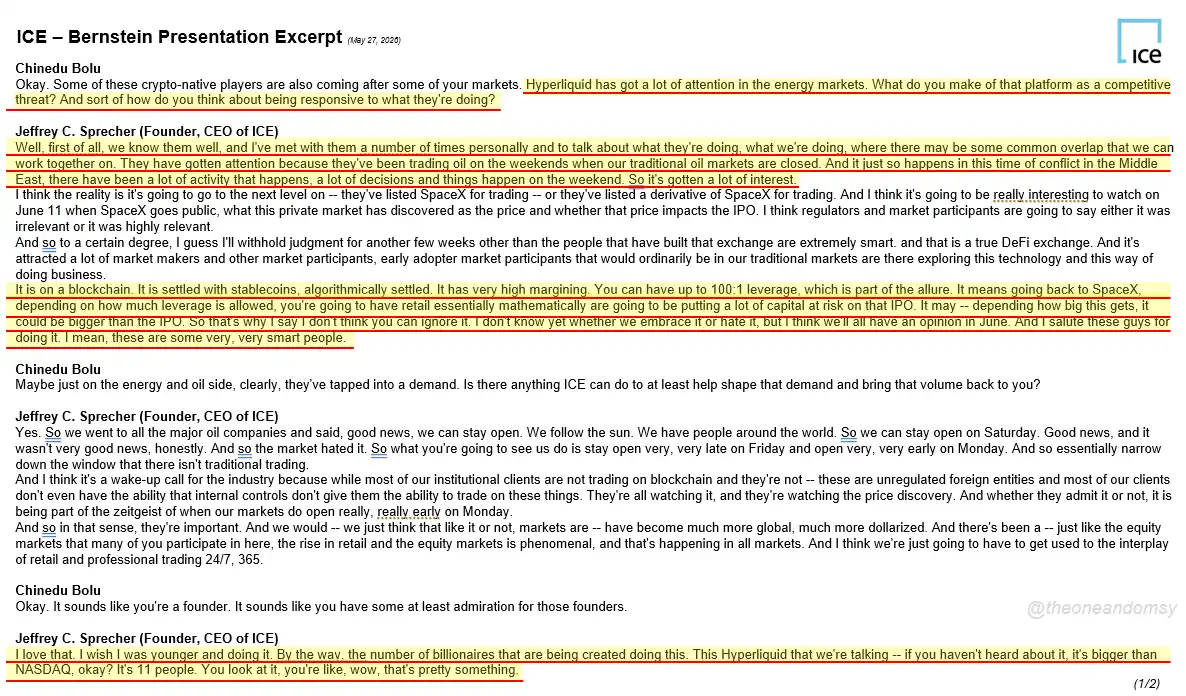
On May 27, Intercontinental Exchange (ICE) founder and CEO Jeff Sprecher gave a rare and explicitly personal appraisal of Hyperliquid during an interview at the Bernstein Annual Strategic Decisions Conference.

"This thing we're talking about, Hyperliquid, if you haven't heard about it, it's bigger than Nasdaq, OK? Eleven people. You look at this, you say, wow, that's amazing," Sprecher said. He added immediately: "I love this. I wish I was younger so I could go do this personally. By the way, the people doing this are becoming billionaires in droves."

ICE is the parent company of the New York Stock Exchange and also operates one of the world's largest energy futures markets. Sprecher's comments represent the most direct public endorsement of Hyperliquid by the highest levels of traditional finance to date.
From Joint Lobbying for a "Crackdown" 12 Days Ago to CEO's Change of Tone

The reason Sprecher's praise caused a stir is the timeline.

On May 15, Bloomberg reported that CME and ICE executives had warned CFTC and Capitol Hill officials, arguing that Hyperliquid's decentralized perpetual contract trading could pose risks of market manipulation and sanctions evasion, and demanding it be brought under traditional financial regulation. After the news broke, HYPE fell nearly 9%.

Just 12 days later, the head of ICE expressed admiration publicly at one of Wall Street's most important investor conferences.

At the Bernstein conference, Sprecher directly addressed this contradiction: "There was a headline of a story that made it sound like we were freaked out. We're not freaked out. We're actually in dialogue with these people, learning what they're doing. They're learning our world, we're learning their world. In that sense, it's a mutual admiration society."

But he quickly turned to the core regulatory demand: "What we said to regulators is, can we do that, too? Why are you telling us we can't do it when this is happening? Can we have a level playing field? This administration is very pro-digital. If you think it's legal, let us do it; if you think it's illegal, why aren't they getting the nasty letters you're sending us?"

This statement reveals the real logic behind ICE's lobbying of the CFTC: not to shut down Hyperliquid, but to ask regulators to loosen restrictions on themselves, allowing traditional exchanges to participate in the on-chain derivatives market as well.

On the Eve of SpaceX's IPO: Hyperliquid Becomes a "Shadow Pricing Market"

Sprecher's interest in Hyperliquid isn't casual; he has a very specific observation window: SpaceX is set to list on Nasdaq on June 12 with a valuation of about $1.75 trillion, and Hyperliquid is already trading SpaceX derivatives contracts.

"I think what really puts it on the map is SpaceX. They've already listed SpaceX derivatives for trading. It's going to be very interesting on June 11th when SpaceX is officially priced, to see what price this private market discovers, and whether that price will influence the IPO itself," Sprecher said. "Regulators and market participants will say, this is either completely irrelevant or highly relevant."

He then calculated an extreme scenario: Considering Hyperliquid allows up to 100:1 leverage, if retail investors flood into SpaceX derivatives, the notional exposure size on-chain "could be larger than the IPO itself."

"So I say you can't ignore it. I don't know yet whether we should embrace it or hate it, but I think by June we'll all have the answer."

HYPE ETFs Raise $100 Million in 10 Days, PURR Included in Russell 3000

Sprecher's comments came as Hyperliquid experienced a wave of intensive mainstreaming catalysts.

On May 12 and 15, 21Shares and Bitwise launched the first US spot HYPE ETFs (tickers THYP and BHYP) on Nasdaq and NYSE, respectively. According to bitcoin.com, the two funds saw cumulative net inflows exceeding $100 million in the first 10 trading days, absorbing 1.04% of HYPE's total market cap. On a market cap proportion basis, this outperformed the initial launch performance of Bitcoin and Ethereum ETFs over the same period. Bitwise recorded a single-day net inflow of $19.05 million on May 27, becoming the world's largest HYPE ETF.

On May 22, FTSE Russell announced the preliminary list for the 2026 Russell US Indexes reconstitution. Hyperliquid Strategies (Nasdaq ticker PURR) appeared on the addition list for the Russell 3000 Index, expected to take effect on June 26.
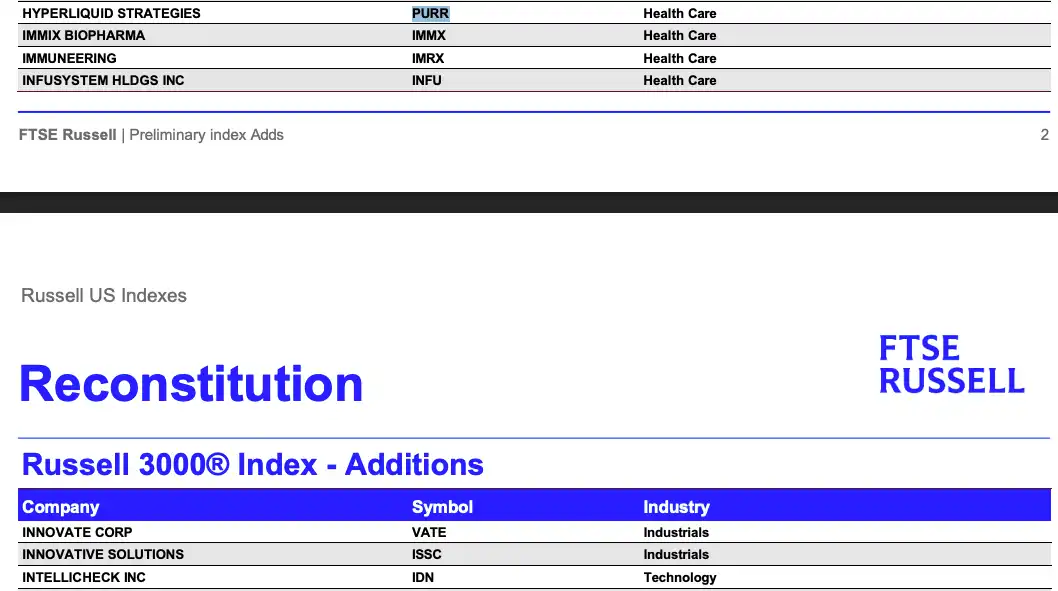
PURR is currently the largest HYPE token treasury company, holding approximately 20 million HYPE (valued at about $799 million as of April 29) and an additional $103 million in cash, with no debt. Inclusion in the Russell 3000 means passive funds tracking the index will be forced to buy PURR, further opening a transmission channel for HYPE into traditional capital markets.

The HYPE token briefly surpassed $64 this week to reach a new all-time high, with a year-to-date gain of about 150%, far outpacing Bitcoin's performance over the same period. According to CoinGecko data, HYPE's current market cap is approximately $12.7 billion, ranking 10th among crypto assets.

Jeff Yan Goes to Washington, Hyperliquid Policy Center Meets the Challenge Head-On

Faced with lobbying pressure from CME and ICE, Hyperliquid chose to respond directly.

Hyperliquid founder Jeff Yan revealed on May 15 that he and the Hyperliquid Policy Center (HPC) had met with policymakers in Washington. HPC is an independent research and advocacy institute established in February 2026, led by Jake Chervinsky, former Head of Policy at the Blockchain Association and former Chief Legal Officer at Variant. It was launched with funding of 1 million HYPE allocated by the Hyper Foundation.

On platform X, Yan stated that the meetings discussed "how on-chain trading, as a financial innovation, has a clear global user demand" and "regulatory pathways for bringing on-chain derivatives markets to the US."

Responding to Bloomberg's report on CME and ICE lobbying, HPC stated that the market provided by Hyperliquid is "more beneficial and less risky than traditional centralized exchanges" and expects the CFTC to establish a specialized regulatory framework for on-chain derivatives platforms.

An interesting detail: CME and ICE themselves are currently facing parallel investigations by the CFTC and the Justice Department due to "perfectly timed" oil futures trades on their respective platforms ahead of federal policy announcements.


Perguntas relacionadas

QWhat was the remarkable comment made by ICE founder and CEO Jeff Sprecher about Hyperliquid at the Bernstein conference?

AHe stated that Hyperliquid is 'bigger than Nasdaq' and expressed admiration, saying 'I love this. I wish I was younger so I could go do it myself.'

QHow much capital did the two HYPE spot ETFs raise within 10 days of their launch, and how does this compare to the performance of other crypto ETFs?

AThe two HYPE ETFs raised over $100 million in 10 trading days. This capital inflow accounted for 1.04% of HYPE's total market cap, a rate that exceeded the debut performance of Bitcoin and Ethereum ETFs on a proportional basis.

QWhy is the upcoming SpaceX IPO a significant event for observing Hyperliquid's market influence according to Jeff Sprecher?

ASprecher noted that Hyperliquid is already trading SpaceX derivatives. He is interested to see if the price discovered on this private market will influence the official IPO price on June 12, especially considering the high leverage (up to 100:1) on Hyperliquid could create enormous notional exposure.

QWhich Hyperliquid-associated company is set to be added to the Russell 3000 Index, and what is its primary asset?

AHyperliquid Strategies, with the Nasdaq ticker PURR, is on the preliminary addition list for the Russell 3000. Its primary asset is approximately 20 million HYPE tokens, valued at around $799 million as of April 29, alongside $103 million in cash.

QWhat was the apparent contradiction in ICE's actions regarding Hyperliquid within a 12-day period in May, and how did Jeff Sprecher explain it?

AOn May 15, ICE and CME reportedly lobbied the CFTC about potential risks from Hyperliquid. Twelve days later, on May 27, Sprecher publicly praised it. He explained that the lobbying was not out of fear but to request a 'level playing field' where traditional exchanges like ICE could also operate under the same rules if the activity is deemed legal.

Leituras Relacionadas

AI Trading Cools, South Korean Stocks Plunge 1.8%, Spot Gold Rises 1%, Bitcoin Dives

A sell-off in AI-related stocks, triggered by Broadcom's disappointing earnings forecast, sent shockwaves through global markets. South Korea's KOSPI led Asia's decline, plunging 1.8% as the risks from concentrated chip stock gains and surging leveraged investments came to the fore. The tech-heavy Nasdaq 100 futures fell 0.5% following Broadcom's 14% after-hours plunge, which signaled a slower-than-expected transition to AI clients. This pullback extended Wall Street's weakness, halting the S&P 500's nine-day rally amid hawkish Fed signals and renewed Middle East tensions. South Korean authorities convened an emergency meeting, pledging "immediate measures" against market volatility and warning of record-high stock margin debt. The adjustment rippled across assets: Bitcoin fell to around $64,000, its lowest since February, while safe-haven gold rose 1% on bargain hunting. Oil prices dipped on Middle East ceasefire news. Market analysts noted the sell-off was driven by profit-taking after massive gains, particularly in chip stocks like Samsung and SK Hynix, which now dominate the KOSPI. Wall Street banks are divided on Korea's outlook, with Goldman Sachs raising its target while Citigroup and others warn of overvaluation and a potential bubble. Bridgewater's Ray Dalio noted that great technological shifts often create bubbles. Meanwhile, Fed officials' hints at potential future rate hikes added to the cautious mood ahead of key U.S. jobs data.

华尔街日报Há 6m

AI Trading Cools, South Korean Stocks Plunge 1.8%, Spot Gold Rises 1%, Bitcoin Dives

华尔街日报Há 6m

Seeking Alpha's Hot Article: Why Might the U.S. Stock Market Crash in June?

In a recent Seeking Alpha article, financial professor and analyst Damir Tokic argues that the US stock market may be poised for a significant crash in June 2026. The core thesis centers on a "mega-bubble" in equities, particularly within the technology sector, which has driven the S&P 500 to near-record valuations, with a Shiller P/E ratio exceeding 40—a level comparable to the 2000 dot-com bubble. Tokic identifies two primary catalysts for a potential collapse. First, he points to unsustainable market exuberance fueled by what he terms the "Trump Stimulus"—massive AI capital expenditure by tech giants, which he believes is politically driven and cannot last. Second, and more urgently, he highlights the escalating Iran war as a critical threat. The ongoing closure of the Strait of Hormuz has created a severe global energy supply crunch. Strategic petroleum reserves are projected to hit critically low operational levels by June, potentially causing oil prices to spike above $200 per barrel and triggering a severe, supply-driven inflationary shock. This scenario, Tokic warns, would force the Federal Reserve's hand. Despite currently maintaining a dovish bias, the Fed would likely be compelled to officially pivot to a hawkish stance at its June FOMC meeting to combat soaring inflation and bond yields. He contends that such a shift—or even a failure to act, which would destroy Fed credibility—could be the trigger that punctures the market bubble. The resulting downturn, he concludes, could rival the bear markets of 2000 and 2008, advising investors to prepare for a major correction.

marsbitHá 29m

Seeking Alpha's Hot Article: Why Might the U.S. Stock Market Crash in June?

marsbitHá 29m

AI PC Battle: Bet on the Toll Booth, Not the Camp

**Title:** The AI PC Battle: Don't Bet on Sides, Bet on the Tollbooth **Summary:** The AI PC competition is moving beyond simple "x86 vs. Arm" narratives. The core investment thesis should focus on identifying which players can sustain margins, cash flow, and pricing power throughout the upgrade cycle, rather than backing a particular architecture. The opportunity is analyzed in three layers: 1. **The Advanced Foundry Tollbooth:** TSMC is positioned to collect "tolls" regardless of which chip designer wins, due to its dominant ~70% share in advanced semiconductor manufacturing, which is essential for high-end AI PC chips. 2. **Compute & Platform Spillover:** AMD represents an offensive in the x86 CPU+GPU space, while NVIDIA leverages its GPU and CUDA software stack dominance. Both benefit from the demand for increased local AI compute. 3. **Architecture Diffusion & Turnaround Plays:** ARM and Intel offer potential for significant upside (elasticity), but investments here require stricter discipline due to higher execution risks and competitive challenges. The industry is transitioning from concept to shipment validation. While short-term forecasts for AI PC adoption have been revised down slightly due to tariffs and procurement delays, the long-term trend towards AI becoming a standard PC feature remains intact. The key driver for upgrade cycles will be whether compelling enterprise applications (e.g., privacy-sensitive computing, low-latency inference) emerge beyond consumer-focused features like meeting summarization. Investment strategy should prioritize companies with platform-level advantages and recurring revenue streams. TSMC offers high certainty as the foundational tollbooth. AMD presents a strong offensive play within the established ecosystem. ARM and Intel are higher-risk, higher-potential-reward turnaround bets. The report cautions against chasing short-term hype and emphasizes a disciplined, long-term approach focused on buying ecosystem strength and cash-flow certainty after market enthusiasm subsides. **Key Risks:** Underwhelming AI PC applications slowing upgrade cycles; slow improvement in Windows on Arm compatibility; macro/tariff impacts on PC demand; potential advanced node supply-demand mismatches affecting TSMC; high overall AI sector valuations making stocks vulnerable to a risk-off shift in markets.

marsbitHá 43m

AI PC Battle: Bet on the Toll Booth, Not the Camp

marsbitHá 43m

Ten-Thousand-Word Analysis: From $10 to $290, MRVL Wins the Entire AI Era by 'Not Making GPUs'

Marvell Technology's stock price surged from under $10 in 2016 to a record $290 in June 2026, fueled not by making GPUs, but by dominating AI infrastructure connectivity. This analysis argues the market misvalues MRVL as merely a smaller Broadcom in custom AI chips, overlooking its true, unique position. Marvell's core strength lies in enabling high-speed data flow for AI clusters through three interconnected businesses. First, it holds a commanding ~70% market share in high-speed optical DSPs (essential for data center light modules), a deep-moat business with accelerating growth. Second, its custom AI chip design business serves hyperscalers like AWS, Microsoft, and Google, with a significant revenue pipeline despite lower margins. Third, stable cash flows come from Ethernet switch chips and enterprise storage controllers. Together, they form a full-stack "AI data movement" platform. CEO Matt Murphy's transformative leadership since 2016, involving strategic divestments, key acquisitions (like Inphi for optical DSPs), and securing long-term agreements with major cloud providers, repositioned the company. A pivotal $2 billion strategic investment from NVIDIA in 2026 underscored Marvell's critical role in the AI ecosystem, particularly through collaborations like NVLink Fusion. While Marvell faces risks—including client concentration (losing the Amazon Trainium3 design), lower-margin business mix, competitive threats, insider selling, and complex supply chains—its fundamentals remain strong. The optical interconnect moat is widening with the acquisition of Celestial AI (photonics fabric), and financial metrics show accelerating revenue growth and operating leverage. With a PEG ratio suggesting undervaluation relative to its growth, the thesis is that the market undervalues Marvell's monopolistic position in AI "plumbing" while overemphasizing its competitive custom chip segment. The story transcends investing, symbolizing how in any complex system—from the internet to AI—the value of "connection" ultimately surpasses that of individual "nodes."

marsbitHá 1h

Ten-Thousand-Word Analysis: From $10 to $290, MRVL Wins the Entire AI Era by 'Not Making GPUs'

marsbitHá 1h

Trading

Spot
Futuros
活动图片