ETFs Attract $100 Million, DAT Included in Russell 3000: Hyperliquid's "Wall Street Moment"

marsbitPublicado em 2026-05-29Última atualização em 2026-05-29

Resumo

ICE CEO Jeff Sprecher publicly praised Hyperliquid, calling it "larger than Nasdaq" and expressing admiration for its team. This praise comes just 12 days after ICE and CME reportedly lobbied the CFTC to scrutinize the platform. Sprecher clarified the lobbying was aimed at securing a level regulatory playing field for traditional exchanges, not shutting Hyperliquid down. He highlighted Hyperliquid's role as a potential "shadow pricing" venue for SpaceX's upcoming IPO, noting its pre-IPO derivatives trading. Meanwhile, Hyperliquid is experiencing significant mainstream adoption. Two U.S. spot HYPE ETFs launched in mid-May have attracted over $1 billion in inflows within 10 days. Furthermore, Hyperliquid Strategies (PURR), a major HYPE holder, is set to join the Russell 3000 index in June. Facing regulatory pressure, Hyperliquid founder Jeff Yan and the platform's policy arm are engaging directly with policymakers in Washington to advocate for a clear regulatory path for on-chain derivatives. HYPE token recently hit a new all-time high above $64.

Author: Claude, TechFlow News

TechFlow Insights: ICE (parent company of NYSE) founder and CEO Jeff Sprecher publicly praised Hyperliquid at the Bernstein Investor Conference on May 27, saying it is "bigger than Nasdaq" and "I wish I was younger to get involved personally." This statement came just 12 days after ICE and CME jointly lobbied the CFTC to "crack down" on Hyperliquid. Sprecher also revealed that the NYSE has secretly integrated a blockchain settlement system. HYPE token hit a new all-time high of $64 this week, with two spot ETFs raising over $100 million in 10 days after launch, and its DAT company PURR was included in the Russell 3000 index.

On May 27, Intercontinental Exchange (ICE) founder and CEO Jeff Sprecher gave a rare and explicitly personal appraisal of Hyperliquid during an interview at the Bernstein Annual Strategic Decisions Conference.

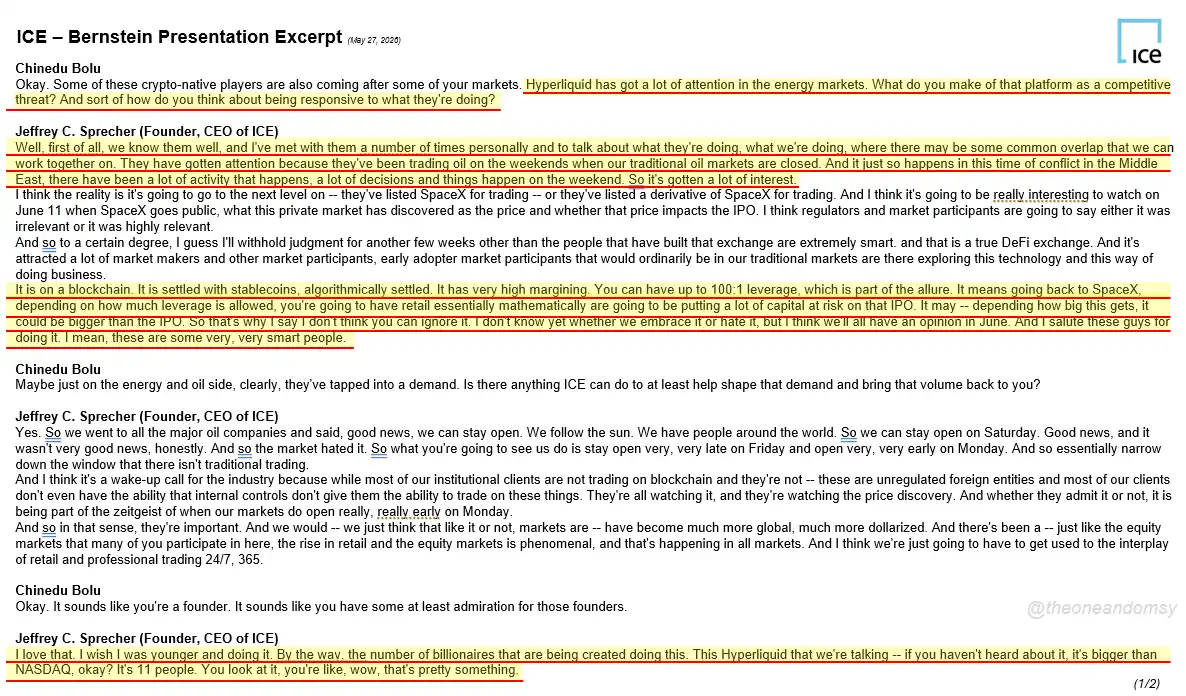
"This thing we're talking about, Hyperliquid, if you haven't heard about it, it's bigger than Nasdaq, OK? Eleven people. You look at this, you say, wow, that's amazing," Sprecher said. He added immediately: "I love this. I wish I was younger so I could go do this personally. By the way, the people doing this are becoming billionaires in droves."

ICE is the parent company of the New York Stock Exchange and also operates one of the world's largest energy futures markets. Sprecher's comments represent the most direct public endorsement of Hyperliquid by the highest levels of traditional finance to date.
From Joint Lobbying for a "Crackdown" 12 Days Ago to CEO's Change of Tone

The reason Sprecher's praise caused a stir is the timeline.

On May 15, Bloomberg reported that CME and ICE executives had warned CFTC and Capitol Hill officials, arguing that Hyperliquid's decentralized perpetual contract trading could pose risks of market manipulation and sanctions evasion, and demanding it be brought under traditional financial regulation. After the news broke, HYPE fell nearly 9%.

Just 12 days later, the head of ICE expressed admiration publicly at one of Wall Street's most important investor conferences.

At the Bernstein conference, Sprecher directly addressed this contradiction: "There was a headline of a story that made it sound like we were freaked out. We're not freaked out. We're actually in dialogue with these people, learning what they're doing. They're learning our world, we're learning their world. In that sense, it's a mutual admiration society."

But he quickly turned to the core regulatory demand: "What we said to regulators is, can we do that, too? Why are you telling us we can't do it when this is happening? Can we have a level playing field? This administration is very pro-digital. If you think it's legal, let us do it; if you think it's illegal, why aren't they getting the nasty letters you're sending us?"

This statement reveals the real logic behind ICE's lobbying of the CFTC: not to shut down Hyperliquid, but to ask regulators to loosen restrictions on themselves, allowing traditional exchanges to participate in the on-chain derivatives market as well.

On the Eve of SpaceX's IPO: Hyperliquid Becomes a "Shadow Pricing Market"

Sprecher's interest in Hyperliquid isn't casual; he has a very specific observation window: SpaceX is set to list on Nasdaq on June 12 with a valuation of about $1.75 trillion, and Hyperliquid is already trading SpaceX derivatives contracts.

"I think what really puts it on the map is SpaceX. They've already listed SpaceX derivatives for trading. It's going to be very interesting on June 11th when SpaceX is officially priced, to see what price this private market discovers, and whether that price will influence the IPO itself," Sprecher said. "Regulators and market participants will say, this is either completely irrelevant or highly relevant."

He then calculated an extreme scenario: Considering Hyperliquid allows up to 100:1 leverage, if retail investors flood into SpaceX derivatives, the notional exposure size on-chain "could be larger than the IPO itself."

"So I say you can't ignore it. I don't know yet whether we should embrace it or hate it, but I think by June we'll all have the answer."

HYPE ETFs Raise $100 Million in 10 Days, PURR Included in Russell 3000

Sprecher's comments came as Hyperliquid experienced a wave of intensive mainstreaming catalysts.

On May 12 and 15, 21Shares and Bitwise launched the first US spot HYPE ETFs (tickers THYP and BHYP) on Nasdaq and NYSE, respectively. According to bitcoin.com, the two funds saw cumulative net inflows exceeding $100 million in the first 10 trading days, absorbing 1.04% of HYPE's total market cap. On a market cap proportion basis, this outperformed the initial launch performance of Bitcoin and Ethereum ETFs over the same period. Bitwise recorded a single-day net inflow of $19.05 million on May 27, becoming the world's largest HYPE ETF.

On May 22, FTSE Russell announced the preliminary list for the 2026 Russell US Indexes reconstitution. Hyperliquid Strategies (Nasdaq ticker PURR) appeared on the addition list for the Russell 3000 Index, expected to take effect on June 26.
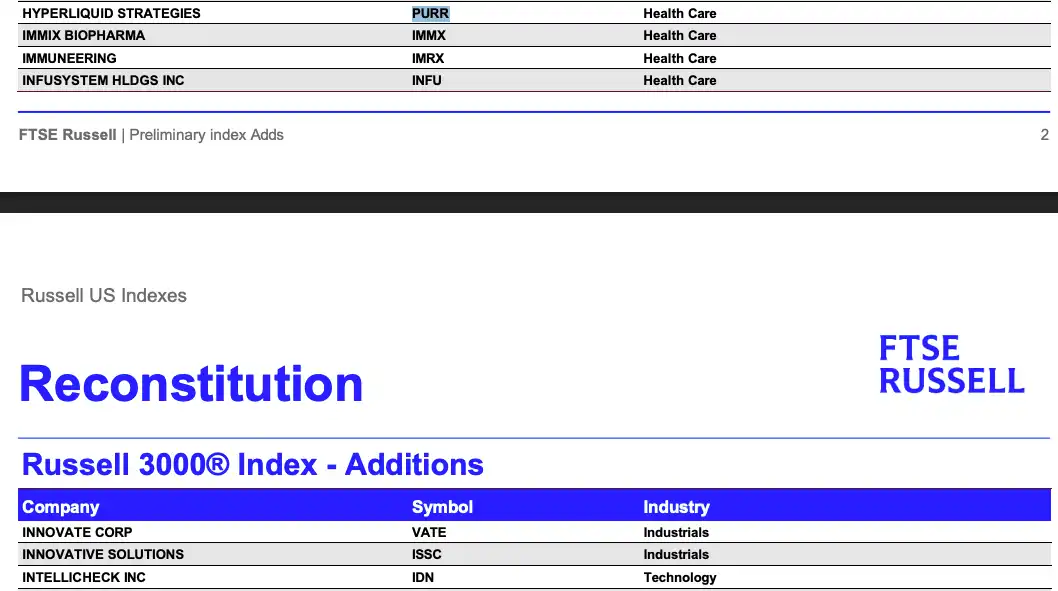
PURR is currently the largest HYPE token treasury company, holding approximately 20 million HYPE (valued at about $799 million as of April 29) and an additional $103 million in cash, with no debt. Inclusion in the Russell 3000 means passive funds tracking the index will be forced to buy PURR, further opening a transmission channel for HYPE into traditional capital markets.

The HYPE token briefly surpassed $64 this week to reach a new all-time high, with a year-to-date gain of about 150%, far outpacing Bitcoin's performance over the same period. According to CoinGecko data, HYPE's current market cap is approximately $12.7 billion, ranking 10th among crypto assets.

Jeff Yan Goes to Washington, Hyperliquid Policy Center Meets the Challenge Head-On

Faced with lobbying pressure from CME and ICE, Hyperliquid chose to respond directly.

Hyperliquid founder Jeff Yan revealed on May 15 that he and the Hyperliquid Policy Center (HPC) had met with policymakers in Washington. HPC is an independent research and advocacy institute established in February 2026, led by Jake Chervinsky, former Head of Policy at the Blockchain Association and former Chief Legal Officer at Variant. It was launched with funding of 1 million HYPE allocated by the Hyper Foundation.

On platform X, Yan stated that the meetings discussed "how on-chain trading, as a financial innovation, has a clear global user demand" and "regulatory pathways for bringing on-chain derivatives markets to the US."

Responding to Bloomberg's report on CME and ICE lobbying, HPC stated that the market provided by Hyperliquid is "more beneficial and less risky than traditional centralized exchanges" and expects the CFTC to establish a specialized regulatory framework for on-chain derivatives platforms.

An interesting detail: CME and ICE themselves are currently facing parallel investigations by the CFTC and the Justice Department due to "perfectly timed" oil futures trades on their respective platforms ahead of federal policy announcements.


Perguntas relacionadas

QWhat was the remarkable comment made by ICE founder and CEO Jeff Sprecher about Hyperliquid at the Bernstein conference?

AHe stated that Hyperliquid is 'bigger than Nasdaq' and expressed admiration, saying 'I love this. I wish I was younger so I could go do it myself.'

QHow much capital did the two HYPE spot ETFs raise within 10 days of their launch, and how does this compare to the performance of other crypto ETFs?

AThe two HYPE ETFs raised over $100 million in 10 trading days. This capital inflow accounted for 1.04% of HYPE's total market cap, a rate that exceeded the debut performance of Bitcoin and Ethereum ETFs on a proportional basis.

QWhy is the upcoming SpaceX IPO a significant event for observing Hyperliquid's market influence according to Jeff Sprecher?

ASprecher noted that Hyperliquid is already trading SpaceX derivatives. He is interested to see if the price discovered on this private market will influence the official IPO price on June 12, especially considering the high leverage (up to 100:1) on Hyperliquid could create enormous notional exposure.

QWhich Hyperliquid-associated company is set to be added to the Russell 3000 Index, and what is its primary asset?

AHyperliquid Strategies, with the Nasdaq ticker PURR, is on the preliminary addition list for the Russell 3000. Its primary asset is approximately 20 million HYPE tokens, valued at around $799 million as of April 29, alongside $103 million in cash.

QWhat was the apparent contradiction in ICE's actions regarding Hyperliquid within a 12-day period in May, and how did Jeff Sprecher explain it?

AOn May 15, ICE and CME reportedly lobbied the CFTC about potential risks from Hyperliquid. Twelve days later, on May 27, Sprecher publicly praised it. He explained that the lobbying was not out of fear but to request a 'level playing field' where traditional exchanges like ICE could also operate under the same rules if the activity is deemed legal.

Leituras Relacionadas

human.tech Launches Clean SDK for Privacy-First Web3 Apps

human.tech has launched the Clean SDK, a toolkit enabling developers to build privacy-first Web3 applications with transparent accountability. Released alongside Aztec's version 5, the SDK provides components for integrating zero-knowledge identity verification, sanctions screening, and private transactions, without developers handling sensitive user data or building compliance infrastructure from scratch. It uses zero-knowledge proofs and programmable verification to allow apps to confirm user legitimacy and sanctions compliance while keeping identities confidential. The first application built on the SDK, Shield, a privacy bridge to Aztec, also launched. It allows users to transfer assets privately while proving a unique human is behind each transfer and that funds have passed sanctions checks, as verified by a May 2026 audit. The SDK offers three core verification techniques: Proof of Innocence (sanctions screening against 23 sources), Proof of Personhood (simpler verification via Human Passport), and Proof of Clean Hands (higher-assurance zero-knowledge government ID checks). This allows apps to authenticate users and transactions without exposing personal data. Designed for Aztec builders, the SDK lets developers add programmable privacy to decentralized apps, eliminating the need to create their own verification and ZK infrastructure. Shield demonstrates its practical use for private bridges, but the SDK aims to enable a wider ecosystem of private, accountable financial apps and services. The launch addresses growing demand for infrastructure that balances privacy and accountability. The SDK avoids traditional identity databases, storing encrypted data off-chain, screening at both entry and exit points, and including a gated disclosure mechanism for legal requests. human.tech's products, including the Clean SDK, focus on using zero-knowledge technology to enable verifiable personhood and privacy in digital systems.

TheNewsCryptoHá 31m

human.tech Launches Clean SDK for Privacy-First Web3 Apps

TheNewsCryptoHá 31m

Unlocking $100 Million in Liquidity? Pump.fun's New Policy Tests the 5-Minute Pump Technique

Pump.fun, a popular meme coin launchpad, has introduced a new standard mechanism called BOOST. It aims to address a significant capital efficiency issue: when a newly launched token graduates from its initial bonding curve to a liquidity pool (LP), roughly 20% of its liquidity becomes permanently locked as "dead liquidity," estimated to waste over $100 million annually. Instead of locking these funds permanently, BOOST repurposes them. Upon a token's migration, approximately 20% of the settlement funds (e.g., 17.6 SOL or ~$2516 USDC) are used to buy back the token on the open market over a 5-minute period via a Time-Weighted Average Price (TWAP) mechanism. All purchased tokens are immediately burned. This creates a brief, systematic buy pressure immediately after migration, potentially generating a short-term price surge ("pump") while permanently reducing the token's circulating supply. The goal is to enhance the immediate post-launch trading experience, potentially increasing trader retention and sustainable protocol revenue, which funds ongoing token buybacks. However, concerns exist that this artificial 5-minute boost could lower the barrier for launching low-quality tokens and lead to steeper price crashes once the buy pressure stops, if followed by large sell-offs. The feature automatically applies to tokens migrating after July 21, 2024, but not to previously migrated tokens or those launched via the Mayhem AI Agent lab.

marsbitHá 39m

Unlocking $100 Million in Liquidity? Pump.fun's New Policy Tests the 5-Minute Pump Technique

marsbitHá 39m

Podcast Notes | Conversation with GSR Asset Management Head: To Determine if This Crypto Rally is Real, Just Watch the Lending Rates on Aave

Podcast Summary: Dialogue with GSR's Head of Asset Management: To Determine if This Crypto Rally is Real, Just Check Lending Rates on Aave Andy Baehr, Managing Director of Asset Management at GSR, discusses the current crypto market, characterizing it as stuck in a state of "ambivalence" with short-lived, unsustainable rallies. He outlines a simple framework: the market moves between "ambivalence" and "conviction" (sustained upward momentum). Currently, every rally resembles a single-stage rocket booster that quickly fizzles out. Baehr identifies three key signals to watch: 1) DeFi lending rates, 2) the potential passage of the CLARITY Act, and 3) the market forming a consensus on the "Fed hawkish peak." He emphasizes that the most immediate indicator for the sustainability of the recent CPI-triggered rally is the USDC borrowing rate on Aave, currently around 3.75%—close to U.S. Treasury yields. The absence of a credit spread indicates low leverage demand and a lack of market energy. He explains that a healthy, sustained rally requires layered buying pressure. Last year's rally progressed from an ETH short squeeze to crypto-native trader influx and finally to ETF inflows. Currently, this structure is missing. Other potential structural buyers like Digital Asset Treasury (DAT) companies are absent, and ETF flows have proven transient. Baehr notes that while small-cap crypto tokens outperformed large caps in Q2—a potential sign of capitation in major assets—capital is also flowing to more exciting opportunities like AI stocks and tech IPOs, leaving crypto sidelined. Regarding DeFi, he highlights that platforms like Aave provide a clear, real-time signal of leverage demand through their supply/demand-driven interest rates. A significant, sustained rate increase would signal genuine market conviction. He also observes the quiet emergence of fixed-income-like products and vaults in DeFi. On regulation, the probability of the CLARITY Act passing before the August 7th deadline has dropped linearly from 75% to below 40% on Polymarket. Baehr suggests its passage would be treated as a bullish surprise, a potent driver for price movement. However, political hurdles, including ethical clause debates and disclosures about the First Family's crypto profits, remain significant obstacles. Ultimately, the market awaits clarity on the Fed's terminal rate under Chair Warsh. Until the "Fed Solstice"—the point where the market collectively understands the peak of hawkish policy—sustained conviction will be difficult to achieve.

marsbitHá 1h

Podcast Notes | Conversation with GSR Asset Management Head: To Determine if This Crypto Rally is Real, Just Watch the Lending Rates on Aave

marsbitHá 1h

Trading

Spot
活动图片




