ETFs Are Just the Ticket: The True Institutionalization of Bitcoin Is Happening Where You Can't See It

marsbitPublicado em 2026-06-15Última atualização em 2026-06-15

Resumo

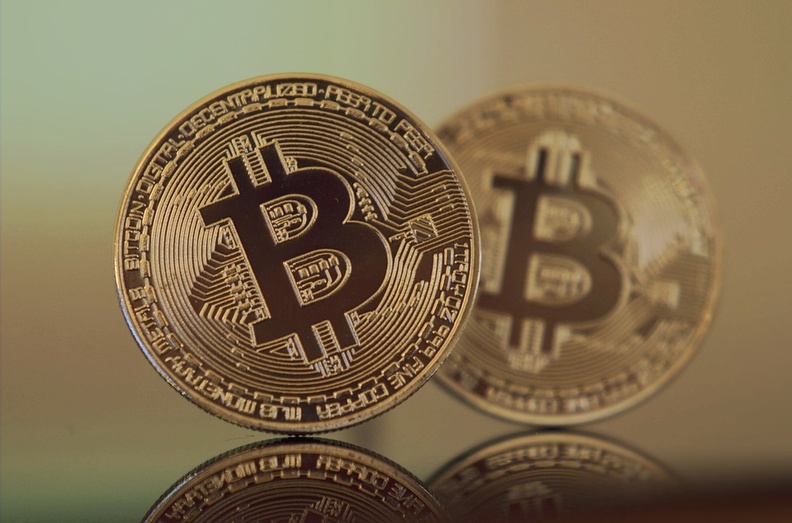
Beyond the Bitcoin ETF spotlight, a deeper institutionalization is underway, leveraging Bitcoin as a foundational financial primitive. Institutions are using Bitcoin for purposes long reserved for assets like U.S. Treasuries and gold: as collateral for loans, insurance reserves, and the backbone of rated bonds. Examples include a Barbados-based insurer capitalizing with $40M in Bitcoin reserves and Ledn's $188M securitization of Bitcoin-backed loans, which received the first-ever investment-grade rating (BBB-) from S&P for a digital asset-backed security. This structure was stress-tested during a 27% price drop in early 2026, triggering automatic liquidations that functioned as designed but revealed the systemic risk of synchronized selling across leveraged positions. Infrastructure is evolving to support this, with platforms like Anchorage Digital's Atlas network enabling secure, institutional-grade settlement and collateral management. Strategies like basis trades and corporate treasuries (exemplified by companies like MicroStrategy issuing billions in equity and debt to fund Bitcoin acquisitions) further integrate Bitcoin into financial mechanics. While ETFs solved "how to own" Bitcoin, these developments answer "what to do with it," embedding the asset into the working machinery of finance—as collateral upon which loans, derivatives, and structured products are built. The real, enduring institutional shift is happening in these largely invisible plumbing and financing ...

Author: Andjela Radmilac

Compiled by: Deep Tide TechFlow

Deep Tide TechFlow Introduction: ETFs only solve "how to buy Bitcoin," but few have noticed that Wall Street is already using it to do what U.S. Treasuries and gold have done for years: collateralizing loans, insurance reserves, and rating bonds. The liquidation wave in February proved this system can withstand pressure but also exposed the fatal flaw of a collective stampede in the leverage chain.

Everyone knows about ETFs, but almost no one knows that while ETFs are capturing all the attention, dozens of institutional products built around Bitcoin are quietly emerging—from a $40 million insurance reserve in Barbados to S&P-rated bonds being sold to Wall Street investors by Jefferies.

ETFs answered only one question: how ordinary investors and institutions can hold Bitcoin within a regulated wrapper. The products in this article answer a different, arguably more important question: once you own Bitcoin, what can you do with it?

The answer: exactly what the financial industry has always done with U.S. Treasuries and gold. You can use it as collateral to borrow money, post it as margin for trades, backstop insurance policies as reserves, or build a corporate balance sheet on top of it.

Assets capable of doing all these things simultaneously are sometimes called financial primitives, a fancy term for "building blocks": things that are widely accepted and easily valued, upon which the rest of the financial system can stack loans, bonds, and derivatives. Treasuries earned this status because everyone agrees on their value and how to seize them if a trade goes wrong.

Bitcoin is now undergoing the same test. Early results explain why some of the biggest players in this market genuinely don't care whether the price goes up or down.

Insurance Reserves, Consumer Credit, and the First Rated Bitcoin Bond

In March 2025, Tabit Insurance, a Barbados-licensed insurer founded by former Bittrex executives, capitalized a property and casualty insurance entity with $40 million funded entirely by Bitcoin.

Essentially, Bitcoin holders surrendered their holdings to back real insurance policies covering storm damage and lawsuits against company directors. In return, they earned a near 10% dollar-denominated yield. Policies and premiums remained in dollars, so clients never touched cryptocurrency, while Bitcoin served as the reserve to pay claims if problems arose.

Tabit holds a Class 2 license from the Barbados Financial Services Commission and is structured as a segregated accounts company. This means each investor fund pool is legally isolated from others, so losses in one account don't drain capital from another.

Regulators and auditors can also check the reserves on the blockchain in real-time, providing more transparency than traditional insurers offer in their quarterly reports. CEO Stephen Stonberg noted that the entire global reinsurance industry runs on roughly $800 billion in capital, while Bitcoin is a multi-trillion-dollar asset class. Thus, even a small portion of this wealth flowing into underwriting would be felt across the entire industry.

While insurance reserves are indeed an unexpected use case for Bitcoin, lending is where things get serious. Bitcoin-collateralized loans work in a straightforward way: you pledge your coins to a lender, receive dollars, and when you repay, you get your coins back.

Holders do this because selling triggers taxable gains and ends their exposure to future price appreciation, while borrowing against coins gives them cash without relinquishing any holdings.

Transaction volume across platforms reached about $2 billion in 2025. Toronto-based Ledn alone reported issuing over $9.5 billion since 2018. Major banks like JPMorgan Chase have also launched similar products for their own clients.

In February 2026, this lending business entered the mainstream bond market. Ledn completed a $188 million securitization, meaning it bundled 5,441 loans into a pool and sold bonds whose interest payments come from borrower repayments.

The bonds were split into two tranches: $160 million in senior notes that get paid first, rated BBB- by S&P Global Ratings (an investment-grade rating, the first ever assigned to a digital asset-backed security), and $28 million in riskier subordinate notes rated B-, which absorb first losses in exchange for higher yields.

By crypto standards, the underlying numbers are conservative. The 2,914 U.S. borrowers in the pool owe $199.1 million but have pledged around 4,079 BTC, worth $356.9 million. This translates to a loan-to-value ratio of 55.8%, meaning they pledged nearly $2 worth of Bitcoin for every $1 borrowed.

Ledn CEO Adam Reeds stated that this structure creates a "direct pipeline" between Bitcoin holders seeking liquidity and the world's deepest pools of institutional capital. Bitwise's European Head of Research, Andre Dragosch, added that the deal proves traditional finance now views Bitcoin as legitimate, even pristine, collateral.

The structure was almost immediately stress-tested, revealing both the model's strength and its fragility. Bitcoin fell about 27% from mid-January to February 2026, pushing up the loan-to-value ratio across the pool and triggering margin calls—automatic demands for borrowers to either add more collateral or watch the lender sell it.

Ledn eventually liquidated roughly a quarter of the loans originally intended for the deal. The sale still went through, partly because these automatic liquidations worked exactly as designed, and Ledn never suffered a loss when selling collateral due to default.

The perverse consequence to remember: when many lenders run the same triggers on the same volatile asset, a sharp price drop forces them to sell simultaneously, and this selling further depresses the price, triggering more sales. The system passed its first real test, but it also revealed where it would break under sufficient stress.

Collateral Networks, Carry Trades, and Corporate Balance Sheets

Beneath these products, the market's fundamental mechanics are being rebuilt to resemble currency and bond markets more closely, where the entity holding your assets, the platform you trade on, and the system settling the trades are three separate things.

Anchorage Digital, which operates the only federally chartered crypto bank in the U.S., launched its Atlas settlement network in April 2024. This allows institutions to settle trades directly with each other without parking funds in custody accounts or pre-funding exchanges.

By March 2026, Atlas had connected nearly 600 participants, four times the number from a year earlier, processed hundreds of billions in settlements, and expanded to managing collateral. This means the bank now monitors loan positions, issues margin calls, and handles liquidations on behalf of lenders.

Cantor Fitzgerald chose Anchorage and Copper.co to play this role for its global Bitcoin financing business in March 2025. Copper's ClearLoop system lets trading firms lock their coins in custody while still trading across multiple exchanges, so a repeat of the FTX collapse wouldn't take client assets.

All of this makes posting Bitcoin as margin as routine and safe as posting Treasuries—a prerequisite for the expansion of everything else mentioned in this article.

A significant portion of the institutional capital flowing through these mechanisms has absolutely no view on Bitcoin's price. The basis trade has been one of the most popular institutional strategies since the ETF launch, exploiting the fact that Bitcoin futures typically trade slightly above the spot price: funds buy spot Bitcoin or ETF shares while simultaneously selling futures contracts at a higher price, profiting from the spread regardless of where the price goes next, as gains on one leg offset losses on the other.

After ETFs gave funds an easy way to hold the spot side, hedge funds built record short positions in CME futures, where open interest climbed from around 30,000 contracts in early 2024 to a peak near 45,000 in November of that year.

This trade became large enough that its unwinding can now move the market on its own. CME open interest fell below $10 billion in April 2026 as these paired positions closed, mechanically selling pressure and depressing prices regardless of anyone's sentiment.

CME continues to build for this crowd, adding 24/7 trading in May 2026 and launching Bitcoin volatility index futures in June, allowing institutions to bet on or hedge the severity of price swings rather than its direction.

Corporate treasuries take this idea the furthest. As of late May 2026, MicroStrategy holds 843,738 BTC. The company has issued $6.7 billion in convertible notes (bonds convertible to stock if the share price rises), plus $15.5 billion in preferred stock across five different instruments—securities paying fixed dividends that sit between debt and common stock—to fund its aggressive BTC purchases.

In 2025 alone, it raised $25.3 billion, making it the largest U.S. equity issuer that year, accounting for about 8% of all issuance. It markets its preferred securities as "digital credit," a full-fledged fixed-income product line whose dividends are ultimately serviced by the Bitcoin balance sheet.

Shareholders effectively get leveraged Bitcoin exposure through the stock; dividend investors get double-digit yields backed by the coins. From Tokyo-listed Metaplanet to Semler Scientific, imitators are copying Michael Saylor's risk playbook.

Private banks run parallel assembly lines for wealthy clients, packaging structured notes that cap the downside of Bitcoin exposure in exchange for giving up some upside, allowing conservative portfolios to hold an asset that would otherwise be too volatile for them.
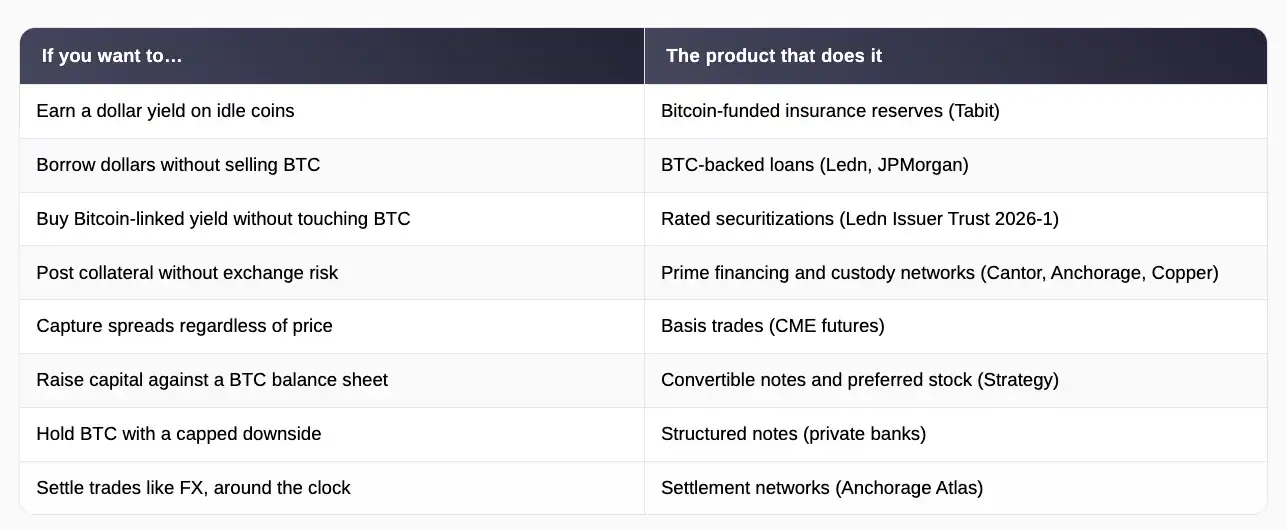
This brings us full circle to the opening paradox.

ETFs answered how institutions can own Bitcoin. The products described in this article answer what they own it for. An asset that simultaneously capitalizes Caribbean reinsurers, backs investment-grade bonds, posts margin for CME derivatives, and services preferred stock dividends has moved far beyond speculative adoption and into the working machinery of finance.

Historians of this market may ultimately see ETFs as the visible first layer of institutionalization, while the lasting change happened in the plumbing of funding and settlement systems, where Bitcoin is doing the work Treasuries and gold have done for generations: serving as collateral upon which everything else is built.

The risks are real, as proven by the February liquidation wave, and they grow with leverage. But the direction seems set. Bitcoin's most important institutional role may never appear on a fund flows chart because it is becoming part of the machinery itself.


Criptomoedas em alta

Perguntas relacionadas

QAccording to the article, what is a key limitation of Bitcoin ETFs, and what more fundamental change is occurring behind the scenes?

AThe key limitation of Bitcoin ETFs is that they only solve the problem of 'how to buy Bitcoin' in a regulated wrapper for institutions and ordinary investors. The more fundamental change happening behind the scenes is Bitcoin's evolution into a 'financial primitive,' where it is increasingly used within the financial system's plumbing for purposes like collateral for loans, insurance reserves, and backing rated bonds, similar to the roles of U.S. Treasuries and gold.

QWhat was the significance of the $188 million securitization deal led by Ledn in February 2026, as mentioned in the article?

AThe $188 million securitization deal led by Ledn was significant because it packaged 5,441 Bitcoin-backed loans into bonds that were sold to institutional investors. Crucially, S&P Global Ratings assigned an investment-grade rating of BBB- to the senior tranche of these bonds. This marked the first time a security backed by digital assets ever received an investment-grade rating, signaling traditional finance's growing acceptance of Bitcoin as legitimate collateral.

QThe article describes how Bitcoin's use as collateral poses a systemic risk. What specific event in February 2026 highlighted this vulnerability, and how did it manifest?

AThe vulnerability was highlighted in February 2026 when Bitcoin's price fell by approximately 27%. This drop increased the loan-to-value ratios across many lending platforms, triggering widespread margin calls. The systemic risk manifested as a 'collective stampede,' where many lenders were forced to liquidate collateral (sell Bitcoin) simultaneously to cover loans. These automated sales further depressed the price, potentially triggering more liquidations in a vicious cycle, exposing the fragility of highly leveraged systems built on volatile collateral.

QBeyond lending and bonds, what are two other institutional use cases for Bitcoin described in the article, and how do they function?

ATwo other institutional use cases described are: 1) Insurance Reserves: Companies like Tabit Insurance use a pool of Bitcoin as capital to back traditional property and casualty insurance policies. Policyholders pay premiums in dollars, and Bitcoin acts as the reserve to pay claims if needed, offering investors a yield. 2) Corporate Treasury Strategy: Companies like Strategy (and followers like Metaplanet) use their balance sheets to hold Bitcoin, financing purchases by issuing corporate debt (e.g., convertible notes, preferred shares). This allows shareholders to get leveraged Bitcoin exposure and fixed-income investors to earn yields ultimately serviced by the Bitcoin holdings.

QWhat infrastructure development, mentioned in the article, is crucial for enabling Bitcoin to be used as routine collateral like U.S. Treasuries?

AThe development of new settlement and collateral management networks is crucial. Specifically, the article highlights Anchorage Digital's Atlas network and Copper's ClearLoop system. These platforms allow institutions to settle trades directly with each other and manage collateral (like monitoring loans and issuing margin calls) without having to pre-fund exchange accounts. This separation of custody, trading, and settlement makes using Bitcoin as collateral safer and more routine, mirroring the infrastructure of traditional bond and money markets.

Leituras Relacionadas

MSTR Discloses Sale of 3,588 Bitcoins, Stock Price Drops Over 5% at One Point During Trading

MicroStrategy, the world's largest corporate holder of Bitcoin, has significantly shifted its business model. Between June 29 and July 5, the company sold 3,588 bitcoins for approximately $216 million to fund quarterly dividends for its preferred stock. This marks its largest-ever Bitcoin sale and signals a strategic pivot: Bitcoin is transitioning from a "buy-and-hold" reserve asset to a liquidity management tool for the company. This move follows a recent authorization allowing Bitcoin sales when equity fundraising is less attractive. The announcement contributed to a more than 5% intraday drop in MicroStrategy's stock price, while Bitcoin fell to around $61,800—below the company's average holding cost of roughly $75,700. The sale represents a major departure from MicroStrategy's long-standing "never sell" commitment, which saw its first minor breach in May with a $2.5 million sale. The latest, hundred-times-larger transaction underscores growing financial pressures. Analysts note the company faces about $1.5 billion in annual preferred dividend obligations, far exceeding cash flow from its software business. As of July 5, MicroStrategy holds 843,775 bitcoins. Its current operational logic involves buying Bitcoin during favorable financing conditions and selling portions to cover dividends when needed, creating a flexible capital management cycle amidst a challenging market environment.

华尔街日报Há 3h

MSTR Discloses Sale of 3,588 Bitcoins, Stock Price Drops Over 5% at One Point During Trading

华尔街日报Há 3h

Q-Day Countdown: Will Quantum Computing End Cryptocurrencies?

Quantum Computing's Threat to Cryptocurrency: A Countdown to Q-Day Quantum computing, specifically Shor's algorithm, poses a fundamental threat to the public-key cryptography (e.g., ECDSA, RSA) that secures blockchain networks like Bitcoin and Ethereum. This critical juncture, known as Q-Day, is estimated to occur potentially within the next 5-15 years. The core vulnerability stems from the public and immutable nature of blockchains. Assets in addresses where the public key is already exposed on-chain (e.g., spent outputs) are at direct risk, as a sufficiently powerful quantum computer could derive the private key. This threatens the very trust model of cryptocurrencies. The response lies in Post-Quantum Cryptography (PQC)—algorithms like lattice-based ML-DSA and hash-based SLH-DSA, which are resistant to quantum attacks. NIST has standardized key PQC algorithms (FIPS 203, 204, 205), providing a migration path. However, the primary challenge is not technical but socio-economic and involves complex governance: * **Bitcoin's** path is constrained by its conservative ethos. Migrating requires a soft-fork to new address types, facing hurdles like significantly larger signature sizes and, most critically, the divisive governance question of how to handle at-risk legacy UTXOs without violating core principles. * **Ethereum** is pursuing a "cryptographic agility" strategy, with a multi-layered roadmap. It leverages account abstraction for user accounts and is developing compressed hash-based signatures (e.g., leanXMSS) for its consensus layer, aiming for a full-stack upgrade over time. In conclusion, quantum computing does not spell an instant end for cryptocurrency but initiates a critical countdown. The industry has a limited "engineering comfort window" to orchestrate a coordinated, ecosystem-wide migration to PQC. The ultimate bottlenecks are the immense coordination efforts and governance decisions required for this foundational transition.

marsbitHá 4h

Q-Day Countdown: Will Quantum Computing End Cryptocurrencies?

marsbitHá 4h

Trump, the President Who Knows Best How to 'Trade Stocks'

Former US President Donald Trump reported a record-breaking $2.2 billion in personal income for 2025, the highest annual income ever disclosed by a sitting president. This figure, from a 927-page government ethics filing, represented a 3.5-fold increase from his $600 million income in 2024 and boosted his net worth to $6.5 billion. The primary drivers were cryptocurrency (64% of income, approximately $1.4 billion) and real estate (26%, approximately $575 million). His crypto earnings stemmed largely from the launch of his personal meme coin, $TRUMP, generating over $600 million in licensing fees, and substantial profits from the WLFI token and its parent company. Despite a sluggish property market, his Mar-a-Lago resort and associated golf clubs saw revenue surges of 50% and 27%, respectively, attributed to their use as venues for presidential events. Trump's financial disclosure also revealed an unprecedented level of stock market activity, with over 22,000 trades executed in 2025, averaging 87 trades per market day. Media analyses noted several instances where significant trading coincided with major policy announcements, such as proposed tariffs, raising questions about potential conflicts of interest. While the White House stated these trades were handled by a family-managed trust fund and not Trump directly, critics highlighted this as a departure from the blind trusts traditionally used by presidents post-Watergate. The report has intensified debate over the commercialization of the presidency. Supporters view it as a success story of a businessman-president, while critics argue it demonstrates an unprecedented conversion of public influence into private wealth, with policy decisions potentially linked to personal financial gains. The controversy centers on whether Trump's earnings represent innovative entrepreneurship or a fundamental conflict of interest, sparking renewed calls for stricter ethics reforms in US governance.

marsbitHá 5h

Trump, the President Who Knows Best How to 'Trade Stocks'

marsbitHá 5h

Countdown to Q-Day: Will Quantum Computing End Cryptocurrencies?

The article explores the existential threat quantum computing poses to cryptocurrencies and the urgent need for "post-quantum" migration. It outlines that quantum computers, through Shor's algorithm, could break the elliptic-curve cryptography (ECC) underlying blockchain security, potentially allowing private keys to be derived from public keys. The core challenge is not a lack of post-quantum cryptography (PQC) standards—like NIST's ML-KEM and ML-DSA—but the immense complexity of upgrading entire ecosystems before "Q-Day" (when quantum computers become capable of such attacks, estimated around 2035-2045). Key points include: * **Bitcoin's** risk is concentrated in legacy UTXOs with exposed public keys (e.g., early P2PK outputs). Migration faces massive hurdles: PQC signatures are much larger, increasing transaction size and cost, and the governance dilemma of handling un-migrated assets threatens its "code is law" ethos. * **Ethereum's** strategy focuses on "cryptographic agility," using Account Abstraction for user accounts and developing compressed hash-based signatures (like leanXMSS with SNARK aggregation) for consensus. Its migration is a complex, full-stack overhaul of execution, consensus, and data layers. * The "security debt" is enormous. The comfortable engineering window for a coordinated, ecosystem-wide upgrade is only 5-8 years. High-value infrastructure (exchanges, bridges) may face pressure before mainnet protocols. In conclusion, quantum computing is not an instant "doomsday" event but a forcing function for systemic change. Bitcoin's ultimate test is social consensus and property rights governance, while Ethereum's is technical complexity. Failure to migrate in time could lead to a fundamental re-pricing of crypto assets.

链捕手Há 5h

Countdown to Q-Day: Will Quantum Computing End Cryptocurrencies?

链捕手Há 5h

Trading

Spot

Artigos em Destaque

O que é BITCOIN

Compreender o HarryPotterObamaSonic10Inu (ERC-20) e a Sua Posição no Espaço Cripto Nos últimos anos, o mercado de criptomoedas assistiu a um aumento na popularidade das moedas meme, cativando não apenas os traders, mas também aqueles que procuram envolvimento comunitário e valor de entretenimento. Entre estes tokens únicos está o HarryPotterObamaSonic10Inu (ERC-20), um projeto intrigante que mistura referências culturais no tecido das criptomoedas. Este artigo explora os principais aspetos do HarryPotterObamaSonic10Inu, examinando os seus mecanismos, a sua ética orientada pela comunidade e o seu envolvimento com o vasto panorama cripto. O que é o HarryPotterObamaSonic10Inu (ERC-20)? Como o nome sugere, o HarryPotterObamaSonic10Inu é uma moeda meme construída na blockchain Ethereum, classificada sob o padrão ERC-20. Ao contrário das criptomoedas tradicionais, que podem enfatizar a utilidade prática ou o potencial de investimento, este token prospera no valor de entretenimento e na força da sua comunidade. O projeto visa promover um ambiente onde utilizadores envolvidos possam reunir-se, partilhar ideias e participar em atividades inspiradas por diversos fenómenos culturais. Uma característica notável do HarryPotterObamaSonic10Inu é a zero taxa sobre transações. Este elemento atraente visa encorajar a negociação e o envolvimento da comunidade, isento de encargos adicionais que podem desencorajar os traders de pequena escala. A oferta total da moeda está fixada em mil milhões de tokens, uma cifra que marca a sua intenção de manter uma circulação substancial dentro da comunidade. Criador do HarryPotterObamaSonic10Inu (ERC-20) As origens do HarryPotterObamaSonic10Inu estão um pouco envoltas em mistério; os detalhes sobre o criador permanecem desconhecidos. O desenvolvimento deste token carece de uma equipa identificável ou de um plano explícito, o que não é raro no setor das moedas meme. Em vez disso, o projeto surgiu de forma orgânica, com o seu progresso a depender fortemente do entusiasmo e da participação da sua comunidade. Investidores do HarryPotterObamaSonic10Inu (ERC-20) No que diz respeito a investimentos externos e apoios, o HarryPotterObamaSonic10Inu também permanece ambíguo. O token não lista quaisquer fundações de investimento conhecidas ou apoio organizacional significativo. Em vez disso, o “sangue vital” do projeto é a sua comunidade de base, que informa o seu crescimento e sustentabilidade através da ação coletiva e do envolvimento no espaço cripto. Como Funciona o HarryPotterObamaSonic10Inu (ERC-20)? Como uma moeda meme, o HarryPotterObamaSonic10Inu opera principalmente fora dos quadros tradicionais que muitas vezes governam o valor dos ativos. Existem vários aspetos distintivos que definem como o projeto funciona: Transações Sem Taxas: Sem taxas sobre transações, os utilizadores podem comprar e vender o token livremente, sem a preocupação de custos ocultos. Envolvimento da Comunidade: O projeto prospera na interação da comunidade, aproveitando plataformas de redes sociais para criar entusiasmo e facilitar a participação. Discussões, partilha de conteúdo e envolvimento são elementos cruciais que ajudam a expandir o seu alcance e a fomentar a lealdade entre os apoiantes. Sem Utilidade Prática: Deve ser notado que o HarryPotterObamaSonic10Inu não oferece utilidade concreta dentro do ecossistema financeiro. Em vez disso, é classificado como um token principalmente para entretenimento e atividades comunitárias. Referência Cultural: O token incorpora de forma inteligente elementos da cultura popular para atrair interesse, conectando-se tanto com entusiastas de memes como com seguidores de criptomoedas. HarryPotterObamaSonic10Inu exemplifica como as moedas meme operam de forma diferente de projetos de criptomoedas mais tradicionais, entrando no mercado como construções sociais inovadoras em vez de ativos utilitários. Linha do Tempo do HarryPotterObamaSonic10Inu (ERC-20) A história do HarryPotterObamaSonic10Inu é marcada por vários marcos notáveis: Criação: O token surgiu de um meme viral, capturando a imaginação de muitos entusiastas de criptomoedas. Datas específicas de criação não estão disponíveis, sublinhando a sua ascensão orgânica. Listagem em Exchanges: O HarryPotterObamaSonic10Inu conseguiu entrar em várias exchanges, permitindo um acesso e negociação mais fáceis pela comunidade. Iniciativas de Envolvimento da Comunidade: Atividades contínuas direcionadas a melhorar a interação comunitária, incluindo concursos, campanhas em redes sociais e geração de conteúdo por fãs e defensores. Planos de Expansão Futura: O roteiro do projeto inclui o lançamento de uma coleção de NFTs, mercadorias e um site de eCommerce relacionado aos seus temas culturais, envolvendo ainda mais a comunidade e tentando adicionar mais dimensões ao seu ecossistema. Pontos-Chave sobre o HarryPotterObamaSonic10Inu (ERC-20) Natureza Orientada pela Comunidade: O projeto prioriza a contribuição coletiva e a criatividade, assegurando que o envolvimento dos utilizadores está na vanguarda do seu desenvolvimento. Classificação como Moeda Meme: Representa o epítome da criptomoeda baseada em entretenimento, destacando-se dos veículos de investimento tradicionais. Sem Afiliação Direta com o Bitcoin: Apesar da semelhança no nome do ticker, o HarryPotterObamaSonic10Inu é distinto e não tem qualquer relação com o Bitcoin ou outras criptomoedas estabelecidas. Foco na Colaboração: O HarryPotterObamaSonic10Inu é projetado para criar um espaço de colaboração e partilha de histórias entre os seus detentores, proporcionando uma via para a criatividade e o fortalecimento da comunidade. Perspectivas Futuras: A ambição de expandir além da sua premissa inicial para NFTs e mercadorias delineia um caminho para o projeto potencialmente entrar em avenidas mais mainstream dentro da cultura digital. À medida que as moedas meme continuam a capturar a imaginação da comunidade cripto, HarryPotterObamaSonic10Inu (ERC-20) destaca-se devido aos seus laços culturais e abordagem centrada na comunidade. Embora possa não se encaixar no molde típico de um token orientado para utilidade, a sua essência reside na alegria e camaradagem fomentadas entre os seus apoiantes, destacando a natureza em evolução das criptomoedas em uma era cada vez mais digital. À medida que o projeto continua a desenvolver-se, será importante observar como as dinâmicas comunitárias influenciam a sua trajetória no panorama em constante mudança da tecnologia blockchain.

1.7k Visualizações TotaisPublicado em {updateTime}Atualizado em 2024.12.03

O que é BITCOIN

Como comprar BTC

Bem-vindo à HTX.com!Tornámos a compra de Bitcoin (BTC) simples e conveniente.Segue o nosso guia passo a passo para iniciar a tua jornada no mundo das criptos.Passo 1: cria a tua conta HTXUtiliza o teu e-mail ou número de telefone para te inscreveres numa conta gratuita na HTX.Desfruta de um processo de inscrição sem complicações e desbloqueia todas as funcionalidades.Obter a minha contaPasso 2: vai para Comprar Cripto e escolhe o teu método de pagamentoCartão de crédito/débito: usa o teu visa ou mastercard para comprar Bitcoin (BTC) instantaneamente.Saldo: usa os fundos da tua conta HTX para transacionar sem problemas.Terceiros: adicionamos métodos de pagamento populares, como Google Pay e Apple Pay, para aumentar a conveniência.P2P: transaciona diretamente com outros utilizadores na HTX.Mercado de balcão (OTC): oferecemos serviços personalizados e taxas de câmbio competitivas para os traders.Passo 3: armazena teu Bitcoin (BTC)Depois de comprar o teu Bitcoin (BTC), armazena-o na tua conta HTX.Alternativamente, podes enviá-lo para outro lugar através de transferência blockchain ou usá-lo para transacionar outras criptomoedas.Passo 4: transaciona Bitcoin (BTC)Transaciona facilmente Bitcoin (BTC) no mercado à vista da HTX.Acede simplesmente à tua conta, seleciona o teu par de trading, executa as tuas transações e monitoriza em tempo real.Oferecemos uma experiência de fácil utilização tanto para principiantes como para traders experientes.

4.2k Visualizações TotaisPublicado em {updateTime}Atualizado em 2026.06.02

Como comprar BTC

O que é $BITCOIN

OURO DIGITAL ($BITCOIN): Uma Análise Abrangente Introdução ao OURO DIGITAL ($BITCOIN) OURO DIGITAL ($BITCOIN) é um projeto baseado em blockchain que opera na rede Solana, com o objetivo de combinar as características dos metais preciosos tradicionais com a inovação das tecnologias descentralizadas. Embora partilhe um nome com o Bitcoin, frequentemente referido como “ouro digital” devido à sua percepção como uma reserva de valor, o OURO DIGITAL é um token separado projetado para criar um ecossistema único dentro da paisagem Web3. O seu objetivo é posicionar-se como um ativo digital alternativo viável, embora os detalhes sobre as suas aplicações e funcionalidades ainda estejam em desenvolvimento. O que é o OURO DIGITAL ($BITCOIN)? OURO DIGITAL ($BITCOIN) é um token de criptomoeda explicitamente projetado para uso na blockchain Solana. Em contraste com o Bitcoin, que fornece um papel amplamente reconhecido como armazenamento de valor, este token parece focar em aplicações e características mais amplas. Aspectos notáveis incluem: Infraestrutura Blockchain: O token é construído na blockchain Solana, conhecida pela sua capacidade de lidar com transações de alta velocidade e baixo custo. Dinâmicas de Oferta: O OURO DIGITAL tem um fornecimento máximo limitado a 100 quatrilhões de tokens (100P $BITCOIN), embora os detalhes sobre o seu fornecimento circulante ainda não tenham sido divulgados. Utilidade: Embora as funcionalidades precisas não estejam explicitamente delineadas, existem indicações de que o token poderia ser utilizado para várias aplicações, potencialmente envolvendo aplicações descentralizadas (dApps) ou estratégias de tokenização de ativos. Quem é o Criador do OURO DIGITAL ($BITCOIN)? Neste momento, a identidade dos criadores e da equipa de desenvolvimento por trás do OURO DIGITAL ($BITCOIN) permanece desconhecida. Esta situação é típica entre muitos projetos inovadores no espaço da blockchain, particularmente aqueles alinhados com finanças descentralizadas e fenómenos de moedas meme. Embora tal anonimato possa fomentar uma cultura orientada pela comunidade, intensifica as preocupações sobre governança e responsabilidade. Quem são os Investidores do OURO DIGITAL ($BITCOIN)? As informações disponíveis indicam que o OURO DIGITAL ($BITCOIN) não tem apoiantes institucionais conhecidos ou investimentos proeminentes de capital de risco. O projeto parece operar num modelo peer-to-peer focado no apoio e adoção da comunidade, em vez de rotas de financiamento tradicionais. A sua atividade e liquidez estão principalmente situadas em exchanges descentralizadas (DEXs), como a PumpSwap, em vez de plataformas de negociação centralizadas estabelecidas, destacando ainda mais a sua abordagem de base. Como Funciona o OURO DIGITAL ($BITCOIN) A mecânica operacional do OURO DIGITAL ($BITCOIN) pode ser elaborada com base no seu design de blockchain e nas características da rede: Mecanismo de Consenso: Ao aproveitar o exclusivo proof-of-history (PoH) da Solana combinado com um modelo de proof-of-stake (PoS), o projeto assegura uma validação eficiente das transações, contribuindo para o alto desempenho da rede. Tokenomics: Embora mecanismos deflacionários específicos não tenham sido extensivamente detalhados, o vasto fornecimento máximo de tokens implica que pode atender a microtransações ou casos de uso de nicho que ainda estão por definir. Interoperabilidade: Existe o potencial para integração com o ecossistema mais amplo da Solana, incluindo várias plataformas de finanças descentralizadas (DeFi). No entanto, os detalhes sobre integrações específicas permanecem não especificados. Cronologia de Eventos Chave Aqui está uma cronologia que destaca marcos significativos relacionados ao OURO DIGITAL ($BITCOIN): 2023: O lançamento inicial do token ocorre na blockchain Solana, marcado pelo seu endereço de contrato. 2024: O OURO DIGITAL ganha visibilidade ao tornar-se disponível para negociação em exchanges descentralizadas como a PumpSwap, permitindo que os utilizadores o negociem contra SOL. 2025: O projeto testemunha atividade de negociação esporádica e potencial interesse em envolvimentos liderados pela comunidade, embora não tenham sido documentadas parcerias ou avanços técnicos notáveis até ao momento. Análise Crítica Forças Escalabilidade: A infraestrutura subjacente da Solana suporta altos volumes de transações, o que pode aumentar a utilidade do $BITCOIN em vários cenários de transação. Acessibilidade: O potencial preço de negociação baixo por token pode atrair investidores de retalho, facilitando uma participação mais ampla devido a oportunidades de propriedade fracionada. Riscos Falta de Transparência: A ausência de apoiantes, desenvolvedores ou um processo de auditoria publicamente conhecidos pode gerar ceticismo em relação à sustentabilidade e confiabilidade do projeto. Volatilidade do Mercado: A atividade de negociação depende fortemente do comportamento especulativo, o que pode resultar em volatilidade significativa dos preços e incerteza para os investidores. Conclusão O OURO DIGITAL ($BITCOIN) surge como um projeto intrigante, mas ambíguo, dentro do ecossistema em rápida evolução da Solana. Embora tente aproveitar a narrativa do “ouro digital”, a sua divergência do papel estabelecido do Bitcoin como reserva de valor sublinha a necessidade de uma diferenciação mais clara da sua utilidade pretendida e estrutura de governança. A aceitação e adoção futuras dependerão provavelmente da abordagem da atual opacidade e da definição mais explícita das suas estratégias operacionais e económicas. Nota: Este relatório abrange informações sintetizadas disponíveis até outubro de 2023, e desenvolvimentos podem ter ocorrido além do período de pesquisa.

121 Visualizações TotaisPublicado em {updateTime}Atualizado em 2025.05.13

O que é $BITCOIN

Discussões

Bem-vindo à Comunidade HTX. Aqui, pode manter-se informado sobre os mais recentes desenvolvimentos da plataforma e obter acesso a análises profissionais de mercado. As opiniões dos utilizadores sobre o preço de BTC (BTC) são apresentadas abaixo.

活动图片