Encrypted Super Apps Arrive: Coinbase and Others Are Reconstructing an All-in-One Financial Ecosystem

深潮Publicado em 2025-12-22Última atualização em 2025-12-22

Resumo

Coinbase has launched a new all-in-one financial application enabling 24/7 stock trading, crypto exchange, futures, perpetual contracts, and AI-powered financial analysis—all accessible via a single account. Similarly, Robinhood has expanded into tokenized stocks, crypto yield, and plans to introduce social trading. This shift signals a move away from fragmented financial apps toward integrated "super apps" that unify access to multiple asset classes. Key drivers include tokenization (enabling 24/7 stock trading), clearer regulations (e.g., Bitcoin ETFs, stablecoin laws), and improved mobile wallet infrastructure. By consolidating liquidity, these platforms reduce transfer delays, minimize idle capital, and improve execution efficiency. However, this recentralization raises concerns: users must trust platforms with custody and private keys, tokenized assets may not represent real ownership, and gamified interfaces could encourage impulsive trading. While these apps offer convenience and higher yields, they also reintroduce counterparty risk and may simply replace traditional banks with new centralized gatekeepers. The core question remains: Is this true financial democratization or a more efficient form of financial enclosure?

Written by: Nishil Jain

Compiled by: Luffy, Foresight News

Last week, Coinbase launched a new product touted as the "Future of Finance." A single app now offers five major functions: 24/5 stock trading, centralized exchange and on-chain cryptocurrency trading, futures and perpetual contract trading, prediction markets, and is even equipped with an AI financial analyst. All functions are accessible via mobile, and a user's single account balance can be instantly switched between different asset classes for use.

Not long ago, Robinhood had already made a preemptive move: launching tokenized stock trading in Europe, 24/5 futures trading, cryptocurrency interest-earning services, and plans to launch the social trading feature Robinhood Social in 2026.

The mainstream discourse on platform X interprets this trend as the evolution of "super apps," but a key point is being overlooked: this is far from a simple stacking of functions; it's breaking down the boundaries between financial asset categories that were created due to regulatory and technological limitations.
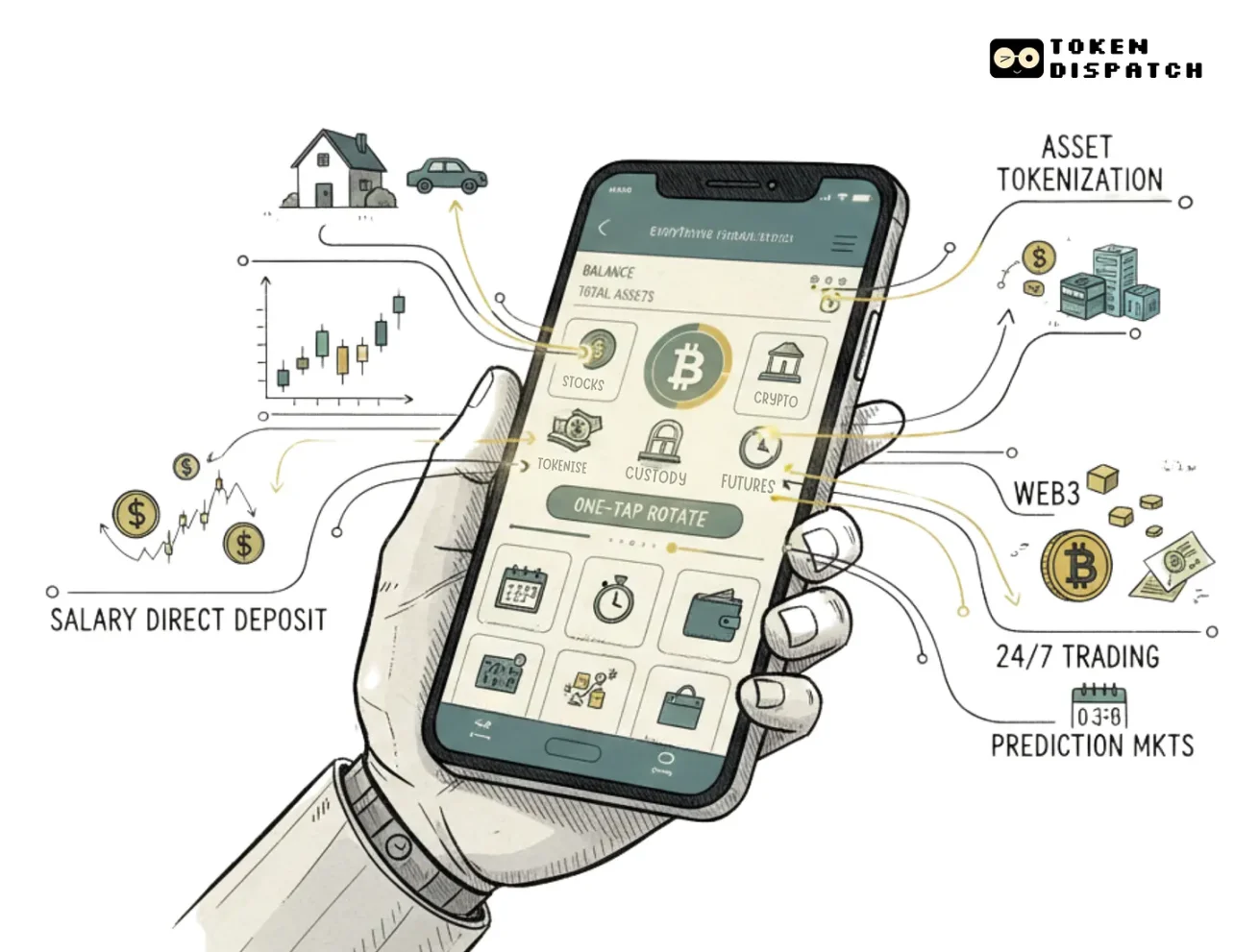
Why, after a decade of fragmented development, are financial applications now experiencing a wave of consolidation? What does this mean for the users and platforms involved? Let's now delve into the main topic.

The Pain Points of Fragmentation

Over the past decade, numerous fintech applications have emerged, yet most only cover a single aspect of financial services, with functions like stock trading, cryptocurrency, payments, and savings scattered across different apps.

While this model provided users with more choices and allowed companies to focus on refining single solutions, it proved problematic in practice.

Want to sell stocks and buy cryptocurrency? The stock trade needs to be executed on Monday, with T+1 settlement not completing until Tuesday; then initiating a withdrawal takes 2-3 days for the funds to reach your bank account; transferring the funds to Coinbase then takes another 1-2 days. From "deciding to reallocate funds" to "funds actually being available," the entire process takes about 5 days. And during those 5 days, the investment opportunity you originally spotted has likely vanished, while your capital sits idle in a cumbersome process.

For example, you might want to buy Bitcoin at $86,000 on December 18th, but end up buying it 5 days later at $90,000 due to process delays. For more volatile investment opportunities like meme coins, Initial Coin Offerings (ICOs), or Initial Public Offerings (IPOs), the losses from such delays can be even more severe.

The problem of fragmentation isn't limited to a single region. An Indian investor wanting to buy NVIDIA stock would need to complete KYC verification multiple times, open an account with a broker that supports Indian users investing in US stocks, and deposit additional funds, all just to buy this one stock.

We've all felt this operational friction, but it's only recently that the infrastructure capable of solving this problem has begun to take shape.

The Cornerstones of Change: Infrastructure Matures

Three structural changes have made the birth of integrated financial platforms possible.

Tokenization Breaks Time Barriers

Traditional stocks can only be traded during New York Stock Exchange (NYSE) hours (9:30 AM to 4:00 PM ET, 5 days a week), while cryptocurrencies enable 24/7 trading. By achieving stock tokenization on Layer 2 networks, it has been proven that, with the right technical mechanisms, stocks can theoretically be traded around the clock.

Today, Robinhood's tokenized stocks launched in Europe support 24/5 trading, and Coinbase is set to follow this model.

Regulatory Frameworks Become Clearer

In recent years, Bitcoin spot ETFs have successfully launched, stablecoin legalization has progressed, tokenization regulatory frameworks have entered deliberation stages, and prediction markets have gained approval from the U.S. Commodity Futures Trading Commission (CFTC). Although the regulatory environment isn't perfect, it is clear enough for platforms to confidently develop multi-asset products without fear of being completely shut down.

Mobile Wallet Infrastructure Matures

Embedded wallets can now seamlessly handle complex cross-chain operations. Privy, acquired by Stripe, allows users to create a wallet using an existing email address without touching seed phrases; the recently launched crypto trading app Fomo enables non-crypto users to trade tokens on Ethereum, Solana, Base, Arbitrum, and other chains without manually selecting networks, and supports Apple Pay deposits. The backend automatically handles all complex processes—the user simply clicks "Buy Token" to complete the operation.

The Core Logic of Liquidity Integration

The core driver behind this change is: funds scattered across different applications are essentially idle capital.

In an integrated model, a user only needs to maintain one account balance: after selling stocks, the funds can be instantly used to buy cryptocurrency, eliminating the wait for settlement windows, withdrawal review periods, and intermediaries like banks. The 5-day opportunity cost vanishes entirely.

Platforms that integrate liquidity are more efficient. With deeper liquidity pools, they can offer better execution speeds; since all trading pairs share the same underlying liquidity, they can support more pairs; they can provide yield on idle capital, much like banks; furthermore, reduced friction leads to increased user trading volume, generating more fee income for them.

Coinbase's Integration Blueprint

Coinbase is the most typical case study in this wave of financial integration. The company was founded in 2012, starting as a simple cryptocurrency exchange supporting only Bitcoin and Ethereum buying and selling. In the following years, Coinbase gradually added institutional custody, staking services, and cryptocurrency lending/interest-earning products, evolving into a full-service crypto platform by 2021.

Its expansion didn't stop there: it launched the Coinbase Card for crypto spending, the Coinbase Commerce payment solution for merchants, and built its own Layer 2 blockchain, Base.

The new product launch on December 17th marked the full realization of Coinbase's "super app" vision. Today, Coinbase supports 24/5 stock trading, plans to launch Coinbase Tokenize—a tokenization service for real-world assets for institutions—early next year, has integrated prediction markets through a partnership with Kalshi, launched futures and perpetual contract trading, and integrated Solana ecosystem decentralized exchange (DEX) trading functionality within the app. Additionally, the Base app has expanded to 140 countries and enhanced the social trading experience.
Coinbase is gradually becoming the operating system for on-chain finance. Through a single interface and a single account balance, it covers trading needs for all asset classes, aiming to allow users to complete all financial operations without leaving the platform.

Robinhood is following a similar development path: starting with commission-free stock trading, gradually adding cryptocurrency trading, a Gold subscription service offering 3% cashback and 3.5% deposit interest, futures trading, and subsequently launching tokenized stocks in Europe.

Both platforms are betting on the same core logic: users don't want to download different apps for stocks, crypto, and derivatives; they need a single account balance, a unified interface, and the ability to instantly reallocate funds.

Social Trading: An Emerging Differentiator

Asset integration solves the liquidity problem, but it doesn't solve the user's asset discovery challenge.

When there are millions of assets available in the market, how should users filter potential trades? How should they build their investment portfolio?

This is where social features add value. Coinbase's Base app includes a dynamic feed where users can see others' buy actions; Robinhood plans to launch Robinhood Social in 2026; eToro has offered social trading since 2007, paying copy traders a 1.5% commission on the assets they hold.

A wave of apps exploring social trading features has also emerged in the on-chain space, such as Fomo, 0xPPL, and Farcaster. These apps allow users to see what their friends are investing in, follow them, and copy their trades.

Fomo's leaderboard page

Social trading allows users to see others' trading behavior in real-time and copy it with one click. This significantly reduces decision-making friction: no need for independent research, just follow trusted trading strategies. Once a platform forms a stable community ecosystem—where users follow trading influencers and build personal reputations—it becomes very difficult for users to migrate to other platforms, creating a strong competitive moat and user stickiness for the trading app.

Centralized exchanges have offered copy trading since 2022, but usage rates have consistently remained below 2%. Mobile app platforms are betting that optimizing the user experience will increase the adoption of this feature. Whether their judgment is correct will determine if social trading becomes a true differentiator or just another commonplace feature.

A Pessimistic View: Potential Risks and Controversies

Let's be frank about the current state: the original intention of cryptocurrency was to achieve financial decentralization, remove intermediaries, and let users control their own assets.

And now, we are rebuilding centralized platforms: Coinbase controls asset custody, trade execution, and social graphs; Robinhood holds the private keys for embedded wallets; users need to trust the platform's solvency, security, and ongoing operational capability. All of this carries underlying counterparty risk.

Robinhood's tokenized stocks are essentially derivatives that track stock prices, not actual shares. If the platform collapses, what users hold is merely an IOU.

The problems caused by gamification are also becoming more severe: 24/7 trading means you might make impulsive trades at 3 AM; social feeds can induce FOMO when you see others profiting; push notifications alert you to every market swing in real-time. This is essentially scaled-up casino psychology, meticulously optimized by designers who understand how to trigger dopamine responses.

Is this progress in financial democratization, or just a repackaged system of exploitation? This is a philosophical question worth pondering.

The Essence Behind the Phenomenon

We spent a decade unbundling financial services, operating under the assumption that fragmentation would foster competition and bring more choice.

But it turned out that fragmentation also caused inefficiency: idle funds, dispersed liquidity, and users forced to hold more idle capital due to cumbersome fund transfer processes. The new era is changing this reality.

Coinbase and Robinhood are gradually becoming the new banks: they hold your salary, savings, investments, and spending patterns; they control trade execution, asset custody, and access; they intermediate every transaction. The only difference compared to traditional banks is: a prettier interface, 24/7 trading markets, and deposit rates 50 basis points higher.

Whether we are achieving financial democratization by lowering barriers and increasing efficiency, or merely changing the gatekeepers while keeping the barriers themselves, the era of fragmentation is over. In the coming years, we will witness whether financial integration based on open underlying technology can deliver better outcomes than the traditional banks we fled from, or if it just changes the logo that locks users in.


Criptomoedas em alta

Perguntas relacionadas

QWhat are the three main structural changes that have enabled the emergence of integrated financial platforms like Coinbase's new product?

AThe three main structural changes are: 1) Tokenization breaking time barriers, enabling 24/7 trading of assets like stocks. 2) A clearer regulatory framework, with approvals for Bitcoin ETFs, stablecoins, and prediction markets. 3) Mature mobile wallet infrastructure, allowing seamless cross-chain operations and simplified user onboarding.

QAccording to the article, what was the core problem with the fragmented fintech landscape of the past decade?

AThe core problem was inefficiency and opportunity cost. Moving money between different apps for different asset classes (e.g., selling stocks to buy crypto) could take up to 5 days due to T+1 settlement, bank transfer delays, and platform processing times. This delay often caused users to miss out on volatile investment opportunities.

QHow does the 'super app' model fundamentally change the user experience compared to using separate apps for different financial services?

AThe 'super app' model provides a single interface and a single account balance. This allows users to instantly switch and allocate funds between different asset classes (stocks, crypto, derivatives) without waiting for transfers or settlements, eliminating the friction and opportunity cost of the fragmented model.

QWhat role does 'social trading' play in the strategy of these new integrated platforms?

ASocial trading addresses the 'asset discovery' problem by allowing users to see what others are buying and to copy their trades. This reduces decision-making friction, builds community, and creates powerful user stickiness and competitive barriers for the platforms that successfully implement it.

QWhat are some of the potential risks and philosophical concerns raised about these new integrated financial platforms?

AThe risks include reintroducing centralization and counterparty risk (users must trust the platform's solvency and security), the fact that tokenized assets may not represent real ownership, and the use of gamification and 24/7 trading that can exploit psychological triggers and encourage impulsive behavior, akin to a 'scaled-up casino psychology'.

Leituras Relacionadas

U.S. Tech Momentum Stocks Post Largest Single-Day Gain Ever, But Is the Plunge Over?

US tech momentum stocks staged a sharp rebound on Tuesday (July 21st). Morgan Stanley's TMT Momentum Factor surged over 12%, marking its largest single-day gain on record, exceeding even peaks from the 2000 dot-com bubble. Key momentum indices from Goldman Sachs also posted their strongest daily performances in years. The rally was led by semiconductors, with the Philadelphia Semiconductor Index jumping 4.6%. This rebound followed three consecutive down days and a cumulative 33% plunge in momentum stocks, one of the steepest drawdowns since the dot-com era. Analysts attribute the surge largely to a short squeeze. Heavy selling had pushed high-beta momentum stocks into deeply oversold territory, forcing many short sellers, particularly in Asia, to cover their positions, creating a self-reinforcing buying spiral. However, the rebound's internals appear weak. Trading volume was notably low, and advancing stocks still lagged decliners on the S&P 500, indicating a narrow, concentrated rally rather than broad market participation. Diverging views emerge on the outlook. BTIG warns the bounce has hit key resistance and recommends selling into strength, citing extreme volatility and historical parallels to past market tops. Conversely, Goldman Sachs and UBS believe the momentum unwind is nearing its end, suggesting it may be time to gradually add exposure, as positioning has been significantly reduced. They caution, however, that high volatility warrants a measured approach, potentially using defined-risk strategies. The upcoming earnings season, particularly reports from major tech firms like Alphabet, is seen as a critical test for the rally's sustainability. Simultaneously, bond markets flashed a warning, with yields rising partly due to spiking oil prices. Analysts note that if long-term Treasury yields break decisively higher, it could pose a significant headwind for equities, especially growth stocks.

marsbitHá 7m

U.S. Tech Momentum Stocks Post Largest Single-Day Gain Ever, But Is the Plunge Over?

marsbitHá 7m

U.S. Tech Momentum Stocks Record Largest Single-Day Gain Ever, but Has the Rout Ended?

U.S. tech momentum stocks staged a dramatic rebound on Tuesday, July 21st. Key momentum indices like the Morgan Stanley TMT Momentum Factor and Goldman Sachs' High Beta Momentum Long Index posted historic or near-historic single-day gains, fueled largely by semiconductor stocks. This sharp rally followed a severe three-day sell-off that saw momentum stocks plunge 33%, marking one of the steepest pullbacks since the dot-com bubble. Analysts attribute the bounce primarily to a short squeeze, as forced covering from over-leveraged traders, particularly in Asia, created a buying spiral. However, the rally's health is questioned due to weak market breadth—overall trading volume was low, and decliners outnumbered advancers in the S&P 500 despite the index's gain—suggesting a narrow, concentrated surge rather than broad recovery. Opinions on the sustainability diverge. BTIG strategists warn the rebound has hit key resistance levels, citing extreme volatility and historic stock dispersion as signs of an ongoing broader correction, and recommend selling into strength. Conversely, Goldman Sachs and UBS view the aggressive momentum unwinding as nearing its end, noting reduced positioning and a lack of new fundamental catalysts. They suggest the sell-off presents a selective opportunity to add exposure, albeit cautiously and gradually using defined-risk strategies. The immediate trajectory hinges on the ongoing earnings season, with market focus on Alphabet's capital expenditure guidance for AI investment clarity. Meanwhile, bond markets present a risk, with rising Treasury yields—potentially heading toward 5.5%—and widening credit spreads for mega-cap tech companies posing a threat to equity valuations. The combination of technical factors, earnings results, and macro conditions leaves the durability of the rebound in doubt.

链捕手Há 9m

U.S. Tech Momentum Stocks Record Largest Single-Day Gain Ever, but Has the Rout Ended?

链捕手Há 9m

Long-Divided Must Unite, Long-United Must Divide: When L1 Becomes Its Own Rollup, What Is Ethereum's Endgame?

"The Inevitable Cycle: When L1 Becomes Its Own Rollup – What is Ethereum's Endgame?" For years, the Ethereum community grappled with concerns that L2s were fragmenting the ecosystem and eroding L1's value. While L2s provided cheaper execution, they also splintered liquidity and the unified user experience of a single chain. This has prompted a fundamental reassessment of the relationship between L1 and L2. Ethereum's roadmap is evolving. The "Scale" initiative merges L1 and L2 expansion into a holistic framework. L1 itself is advancing with higher gas limits, statelessness, and zkEVM verification, no longer content to be just a low-throughput settlement layer. Consequently, the primary value proposition of L2s is shifting from merely providing cheap blockspace to offering L1 cannot easily provide: application-specific optimizations, privacy features, and flexible governance models. L2s are becoming a spectrum of execution environments with varying degrees of security inheritance from Ethereum. A critical challenge in this multi-chain future is interoperability. The vision is to make Ethereum "feel like one chain again." This relies on advancements in native account abstraction (like EIP-7702) and intent-based architectures (Open Intents Framework), where users declare desired outcomes, and solvers handle the complex cross-chain execution. Furthermore, shortening Ethereum's finality time from minutes to seconds is crucial, as it underpins trust between chains for bridges, stablecoins, and cross-chain applications. Perhaps the most provocative idea is that Ethereum L1 itself could become a form of "its own Rollup." As zkEVM and proof systems mature, high-performance nodes could execute transactions and generate validity proofs. Regular validators would then verify these proofs instead of re-executing all transactions. This blurs the traditional L1/L2 hierarchy, making "Rollup" more of a general execution-verification architecture. Native Rollup aims to integrate L2 validation more directly into the Ethereum protocol, allowing L2s to inherit L1's security more fully and move away from reliance on security councils. In the end, L2s are not destined to replace L1 or be made obsolete by it. The likely future is a unified system where diverse execution environments—each optimized for specific use cases like DeFi, gaming, or privacy—coexist. They will share a common foundation of security, liquidity, and verifiable state, seamlessly connected to restore a cohesive user experience. The next phase for Ethereum is not just about scaling through separation, but about intelligently reintegrating what was separated back into a coherent whole.

链捕手Há 26m

Long-Divided Must Unite, Long-United Must Divide: When L1 Becomes Its Own Rollup, What Is Ethereum's Endgame?

链捕手Há 26m

Agent Race Ends, Super Workbench Takes Over

The era of fragmented AI agents is ending. Over the past month, China's tech giants—Tencent, Alibaba, and ByteDance—have simultaneously shifted strategy: instead of launching new, standalone AI agents, they are consolidating their various agent projects into unified "super workbenches." Tencent integrated its QClaw teams into WorkBuddy, a strategic product hailed as a potential third flagship after QQ and WeChat. Alibaba is merging its QoderWork, Wukong, and MuleRun agents into a new "Qianwen Office" platform under DingTalk's leadership. ByteDance rebranded its TRAE SOLO coding agent to TRAE Work, signaling a broader focus on workflow collaboration. This convergence marks a pivotal industry consensus. The initial exploration phase, where companies rapidly built numerous overlapping agents for different scenarios, proved costly and inefficient. With open-source tools eroding technical barriers, competition has shifted from agent creation to resource consolidation and cost control. Historically, platform wars are won not by creating more products, but by simplifying them—as seen with browsers unifying web access and super-apps consolidating services. Now, the "super workbench" aims to become the unified AI entry point for work. This reflects a deeper market realization: the primary audience for AI is no longer just programmers (a market in the tens of millions) but all knowledge workers (a market of billions). The real opportunity lies in augmenting everyday tasks—managing emails, documents, data, and meetings—across the entire workday. The core battleground is becoming control over the primary AI entry point that employees use daily. Tencent's WorkBuddy leverages WeChat and Tencent Docs; Alibaba's Qianwen Office taps into DingTalk's organizational data; ByteDance's TRAE Work integrates with Feishu's workflows. Whoever owns this "super workbench" gains strategic control over orchestrating enterprise data and APIs. This shift is redefining enterprise software. Traditional SaaS applications, valued for their user interfaces, will recede into the background. Their core functionalities will be exposed as standardized "Skills" or APIs for the super workbench's agents to invoke. Software value will shift from selling user seats to charging based on API calls and outcomes delivered. The evolution of agents is moving through clear stages: first as novel standalone products, then as consolidated primary work entry points, and finally as pervasive, invisible capabilities embedded into the digital fabric. The recent moves by major tech firms signal the transition from the first stage into the second, accelerating toward the third. In the end, the most successful agent technology may become invisible—like electricity or the HTTP protocol—a fundamental, unnamed infrastructure powering work itself.

marsbitHá 53m

Agent Race Ends, Super Workbench Takes Over

marsbitHá 53m

Trading

Spot

Artigos em Destaque

Como comprar SUPER

Bem-vindo à HTX.com!Tornámos a compra de SuperFarm (SUPER) simples e conveniente.Segue o nosso guia passo a passo para iniciar a tua jornada no mundo das criptos.Passo 1: cria a tua conta HTXUtiliza o teu e-mail ou número de telefone para te inscreveres numa conta gratuita na HTX.Desfruta de um processo de inscrição sem complicações e desbloqueia todas as funcionalidades.Obter a minha contaPasso 2: vai para Comprar Cripto e escolhe o teu método de pagamentoCartão de crédito/débito: usa o teu visa ou mastercard para comprar SuperFarm (SUPER) instantaneamente.Saldo: usa os fundos da tua conta HTX para transacionar sem problemas.Terceiros: adicionamos métodos de pagamento populares, como Google Pay e Apple Pay, para aumentar a conveniência.P2P: transaciona diretamente com outros utilizadores na HTX.Mercado de balcão (OTC): oferecemos serviços personalizados e taxas de câmbio competitivas para os traders.Passo 3: armazena teu SuperFarm (SUPER)Depois de comprar o teu SuperFarm (SUPER), armazena-o na tua conta HTX.Alternativamente, podes enviá-lo para outro lugar através de transferência blockchain ou usá-lo para transacionar outras criptomoedas.Passo 4: transaciona SuperFarm (SUPER)Transaciona facilmente SuperFarm (SUPER) no mercado à vista da HTX.Acede simplesmente à tua conta, seleciona o teu par de trading, executa as tuas transações e monitoriza em tempo real.Oferecemos uma experiência de fácil utilização tanto para principiantes como para traders experientes.

239 Visualizações TotaisPublicado em {updateTime}Atualizado em 2026.06.02

Como comprar SUPER

Discussões

Bem-vindo à Comunidade HTX. Aqui, pode manter-se informado sobre os mais recentes desenvolvimentos da plataforma e obter acesso a análises profissionais de mercado. As opiniões dos utilizadores sobre o preço de SUPER (SUPER) são apresentadas abaixo.

活动图片












