Ena Rebounds Sharply Following Ethena Foundation's Reorganization Plans

cryptonews.ruPublicado em 2026-09-04Última atualização em 2026-09-04

Resumo

The cryptocurrency ENA (Ethena's token) experienced a sharp rebound following reorganization plans announced by the Ethena Foundation. The token gained over 110% from the start of Q3, with an 86% market cap surge in August, recovering from a prolonged bearish period that saw its price drop to around $0.07. The primary catalysts for the rally were the Foundation's restructuring proposals, which included: canceling monthly token unlocks (with a major unlock scheduled for early October), buying out shares from early investors like Galaxy Digital and Dragonfly Capital, and launching a "Fee Switch" mechanism directing 95% of protocol revenue to buy back ENA tokens. These measures are expected to reduce selling pressure and create additional buy-side demand. The beta launch of the Ethena Pay payment application in 48 countries also provided positive sentiment. Technically, if the upward trend continues, the next targets for buyers are the Fibonacci 23.6% retracement level near $0.26, followed by a potential move toward the $0.37 zone. A key bullish signal would be a sustained break above the 200-day moving average. The article clarifies that in the crypto context, ENA is a token ticker, not related to other entities like the Emergency Nurses Association. The recent growth is attributed to reduced unlock pressure, planned token buybacks, and new product launches, though future price action depends on breaking key resistance levels.

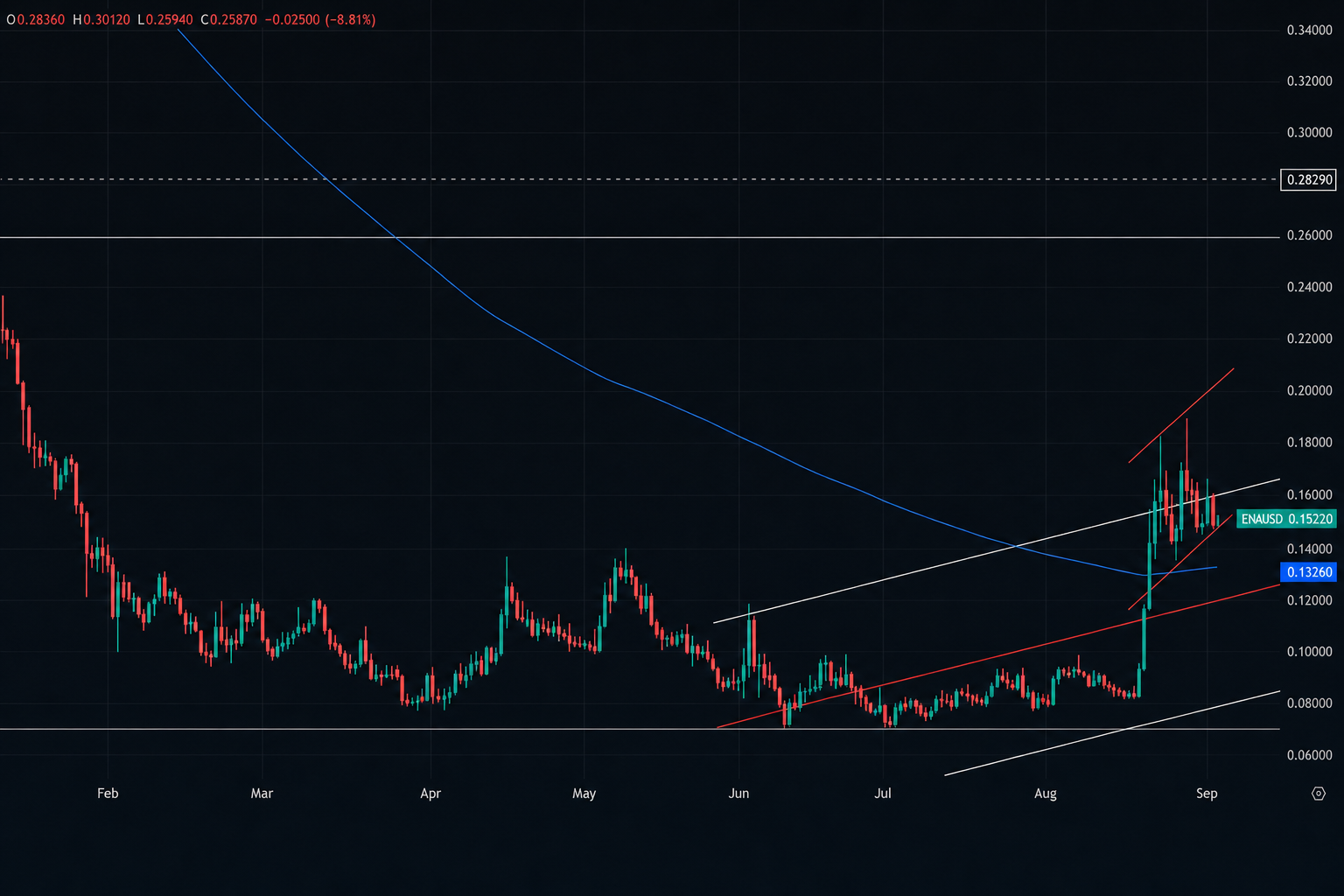
$ENA has notably recovered after a prolonged decline: since the beginning of Q3, the token has gained over 110%, with the bulk of the movement occurring in August when its market capitalization increased by 86%.

What Supported the Token's Growth

After an extended bearish period and the price dropping to the $0.07 mark, the market began to recover upwards. The main catalyst for buying was plans by the Ethena Foundation to conduct a major restructuring of the project. The Ethena Foundation is associated with the development of the Ethena ecosystem, so its decisions directly impact $ENA as the token of this project.

Key changes the team is discussing:

  • Change: Cancellation of monthly unlocks. Description: The main unlock, except for team tokens, should occur in early October. Expected effect: Reduced selling pressure that previously weighed the price down.
  • Change: Buyback of shares from early investors. Description: Among such participants are mentioned Galaxy Digital and Dragonfly Capital. Expected effect: Reduction of early investors' influence on the ownership structure.
  • Change: Launch of the Fee Switch mechanism. Description: Under the new model, 95% of the protocol's revenue is planned to be directed towards buying back $ENA. Expected effect: Additional demand for the token through buybacks.

An additional positive was the launch of the Ethena Labs payment application, Ethena Pay. The service is already available in 48 countries and allows for free transfers of US dollars, euros, and British pounds. While the app is currently in beta mode, the very fact of its launch could have increased interest in the token.

Technical Picture for $ENA

If the upward movement continues, the nearest target for buyers could be the 23.6% Fibonacci retracement level around $0.26. Upon a confident breakout above, the market may attempt to return the price to the $0.37 zone, which corresponds to the Q4 2025 level.

For bulls, an important signal remains an upward breakout of the 200-day moving average. Furthermore, the angle of the regression price channel has changed, and the local trend currently maintains an upward character.
Why It's Important Not to Confuse Contexts for $ENA

In the crypto context, $ENA is the ticker for the Ethena token, not a person or character, so it has no gender. The token also has no membership in the conventional sense: participation is related to the crypto project itself and market mechanics, including the discussed Fee Switch and possible $ENA buybacks.

The thesis that $ENA is disliked by anyone is not supported: interest in the token increased in August, and its market capitalization grew by 86%. Negativity could have been related to previous unlock pressure and the prolonged bearish period.

The meaning of $ENA depends on context. In the crypto market, it is the ticker for the Ethena project token. In the English-speaking world, $ENA can also mean the Emergency Nurses Association, where topics such as the following are covered:

  • Emergency nursing
  • Nursing
  • Emergency department work
  • Emergency medicine
  • Health care
  • The role of the Patient in the care system

Such topics may appear on YouTube, in professional publications, and even in international agendas like the United Nations General Assembly. News and podcasts about the token are more conveniently searched for using combinations like $ENA Ethena, Ethena Pay, or Ethena Foundation; for the medical context — using Emergency Nurses Association. Queries about membership, educational programs, events, or $ENA Wiki should also be clarified by the relevant field to avoid mixing the crypto market with medical topics.

The strong August growth of $ENA is primarily linked to expectations of reduced unlock pressure, plans to buy back the token using protocol revenue, and the launch of Ethena Pay. While the technical picture currently supports buyers, further movement will depend on whether the price can consolidate above the nearest resistance levels.

Criptomoedas em alta

Perguntas relacionadas

QWhat were the key factors that supported the significant recovery of the $ENA token's price, according to the article?

AThe main factors supporting $ENA's price recovery were the reorganization plans from the Ethena Foundation, including the cancellation of monthly token unlocks, the buyout of early investors' stakes, and the planned launch of the 'Fee Switch' mechanism to direct 95% of protocol income to buy back $ENA. The beta launch of the Ethena Pay payment application also provided additional positive momentum.

QWhat are the next potential price targets for $ENA if the upward trend continues, as mentioned in the technical analysis?

AIf the upward movement continues, the nearest target for buyers is the 23.6% Fibonacci retracement level around $0.26. A confident break above that could allow the market to attempt a return to the $0.37 zone, which corresponds to the level from the 4th quarter of 2025.

QIn the context of the Ethena project, what is the 'Fee Switch' mechanism expected to do?

AAccording to the new model, the 'Fee Switch' mechanism is expected to direct 95% of the protocol's income towards buying back the $ENA token, creating additional demand for the token.

QWhy does the article caution against confusing the contexts of '$ENA'?

AThe article cautions that in the crypto context, $ENA is the ticker for the Ethena project's token, not a person. It also notes that '$ENA' can refer to the Emergency Nurses Association in other contexts, which covers topics like emergency nursing and healthcare. Mixing these contexts could lead to confusion when searching for information.

QWhat change in tokenomics is expected to reduce selling pressure on $ENA in the near future?

AThe cancellation of monthly token unlocks, with the main unlock (excluding team tokens) scheduled for early October, is expected to reduce selling pressure that previously weighed the price down.

Leituras Relacionadas

DATA Network joins Sui and Walrus to scale the supply chain for AI training data

The DATA Network, which operates the Trace onchain registry for rights-cleared AI training data with over 250 million verifiable receipts, is joining the Sui blockchain ecosystem and adopting Walrus as its default storage layer. This integration addresses a critical need for the next generation of AI models, which require real-world, consented data with clear provenance due to regulatory requirements and legal challenges. The open internet has been largely exhausted as a data source. Trace registers the origin and usage rights of data from contributors—such as personal dashcam footage or medical notes—and handles payments to them, processing over 3 million receipts daily. Sui's object-centric model allows datasets and their licenses to be managed onchain, with fast, parallel transaction processing. Walrus provides efficient, secure storage for large files, ensuring data is only accessible to licensed buyers. By integrating with Walrus, Trace will be able to store an immutable, encrypted copy of the original data file itself, strengthening provenance guarantees. As part of the migration, the DATA Network will be upgraded to run natively as a protocol on Sui, and its independent chain will be retired. The $DATA token will transition to the Sui protocol on a one-to-one basis. Sui Foundation is making a $30 million strategic investment in the DATA Network, becoming its largest institutional stakeholder. Leaders from Mysten Labs (original contributor to Sui), PIP Labs, and DATA Foundation highlighted that the combination provides a comprehensive solution for storing, licensing, and paying for the high-quality, consented data essential for advancing AI, with the scale and integrity proofs the industry demands.

TheNewsCryptoHá 24m

DATA Network joins Sui and Walrus to scale the supply chain for AI training data

TheNewsCryptoHá 24m

ICP Cloud Engine Heats Up: "20% of Revenue Used for Burn", How Far is it From Token Revaluation?

The ICP community is discussing Cloud Engines, a product enabling enterprises to run private subnets on the Internet Computer. It is linked to the "Mission 70" deflationary plan, where node providers allocate 20% of Cloud Engines revenue to buy and burn ICP tokens, aiming to reduce ICP's inflation rate from 9.72% to 2.92%. This narrative connects enterprise adoption to token scarcity and potential price appreciation for ICP, which is down 99.6% from its peak. Cloud Engines functions as a "custom data center," offering businesses dedicated, sovereign infrastructure without vendor lock-in, using the same underlying protocol as the public ICP network. Key selling points include data sovereignty and hardware choice. However, critical features like SEV-encrypted nodes (for enhanced security) and operator-controlled upgrades are still on the roadmap, not yet live. Early adopters include Pakistan's national cloud engine and a UNDP pilot. The "Mission 70" goal relies on two pillars: supply-side reductions (like cutting node rewards) and demand-side increases in token burns from Cloud Engines revenue. While supply-side changes can be enacted via governance, the demand-side depends entirely on market adoption. Current daily burn rates are far below the levels needed to achieve the 26% deflation target attributed to increased burns. Analysts remain cautious, viewing the 20% burn mechanism as a forward-looking narrative. The product is in early access, and significant, scalable enterprise adoption is unproven. Near-term price catalysts are more likely to come from implementable supply-side governance proposals. The Cloud Engines story represents a longer-term bet on ICP capturing a segment of the enterprise cloud market, with token revaluation contingent on the product generating substantial, quantifiable burn data.

marsbitHá 44m

ICP Cloud Engine Heats Up: "20% of Revenue Used for Burn", How Far is it From Token Revaluation?

marsbitHá 44m

Bank of America's Hartnett: Interest Rate Hikes Become the Biggest Positive, Bond-Ending Bubble Logic Is Spreading

In a recent note, Bank of America strategist Michael Hartnett argues that aggressive central bank tightening, including a potential Fed hike in October, could paradoxically be the most bullish near-term catalyst for risk assets. His core thesis is "the bond bubble is bursting." While stocks remain resilient due to strong US data, solid earnings expectations, and robust AI-related capital expenditure plans, bonds are already showing severe stress, with government bonds down 4.4% year-to-date. The logic is that a proactive Fed hike could help anchor runaway long-end yields (the 10-year recently touched 5.36%), preventing a disorderly surge toward 6%. Without such action, the pressure from rising term premiums could continue unabated. The damage from higher rates is already visible in the most rate-sensitive areas: South Korean retail brokers, French government bonds (with the France-Germany spread hitting 140 bps, reminiscent of the 2012 crisis), and CCC-rated credit. Hartnett highlights that the $8 trillion in money market funds is unlikely to flow into equities without a clear shift to monetary easing. Furthermore, the upcoming US midterm elections pose a key risk; a Democratic sweep (currently a 64% probability) could trigger a >10% equity sell-off due to fears of higher taxes and regulation. Near-term strategy involves positioning for a peak in yields (e.g., long 30-year Treasuries) and risk contraction ahead of the elections, while maintaining exposure to commodities and EM assets. Key levels to watch include 10-year yields at 6%, the France-Germany spread at 150 bps, and a Bull & Bear Indicator below 8 for a potential risk rebound.

marsbitHá 48m

Bank of America's Hartnett: Interest Rate Hikes Become the Biggest Positive, Bond-Ending Bubble Logic Is Spreading

marsbitHá 48m

Silicon Valley AI Status: Whoever Has the Compute is the Boss

The Silicon Valley AI Power Crunch: Compute is King Silicon Valley's race for AI dominance has devolved into a desperate scramble for computing power. The situation has become so extreme that even top executives are resorting to unusual measures. Anthropic's CEO Dario Amodei was reportedly turned down by Meta's Mark Zuckerberg when seeking additional GPU resources, leading to a deal where SpaceX acts as a broker, reselling Nvidia GPUs to Anthropic. This venture reportedly generated $2.561 billion in quarterly AI revenue for SpaceX. The shortage is reshaping the industry's dynamics, creating a new "compute economy" where GPU access is the ultimate currency. This scarcity is causing internal strife at major firms and altering competitive landscapes. A high-profile example is Noam Shazeer, a key AI scientist whom Google re-hired for $2.7 billion, only for him to leave for OpenAI reportedly due to insufficient compute resources for his team. Similar frustrations over resource allocation have been cited within Google and DeepMind. For AI startups, the challenge is existential. Cloud providers are now demanding multi-year contracts with large upfront payments, making flexible, on-demand access nearly impossible. This has spurred innovative workarounds, including a new market for "global compute prospecting"—companies scavenging for underutilized server capacity worldwide—and venture capital firms like Y Combinator and Radical Ventures directly acquiring and allocating GPU clusters for their portfolio companies. The root causes are complex: explosive growth in AI model complexity and the shift from simple chatbots to persistent "Agent" systems dramatically increase compute demands. While tech giants are building new data centers, supply cannot keep pace with immediate needs. Rental prices for critical chips like the Nvidia H100 have surged nearly 40% in months. The consequence is a consolidation of power. Compute access is becoming the definitive barrier to entry, significantly strengthening large companies with their own infrastructure and creating a lucrative "picks and shovels" market for those who control the hardware supply. In today's Silicon Valley, compute isn't just a resource—it's the foundation of survival and competitive advantage.

marsbitHá 1h

Silicon Valley AI Status: Whoever Has the Compute is the Boss

marsbitHá 1h

Trading

Spot

Artigos em Destaque

Como comprar ENA

Bem-vindo à HTX.com!Tornámos a compra de Ethena (ENA) simples e conveniente.Segue o nosso guia passo a passo para iniciar a tua jornada no mundo das criptos.Passo 1: cria a tua conta HTXUtiliza o teu e-mail ou número de telefone para te inscreveres numa conta gratuita na HTX.Desfruta de um processo de inscrição sem complicações e desbloqueia todas as funcionalidades.Obter a minha contaPasso 2: vai para Comprar Cripto e escolhe o teu método de pagamentoCartão de crédito/débito: usa o teu visa ou mastercard para comprar Ethena (ENA) instantaneamente.Saldo: usa os fundos da tua conta HTX para transacionar sem problemas.Terceiros: adicionamos métodos de pagamento populares, como Google Pay e Apple Pay, para aumentar a conveniência.P2P: transaciona diretamente com outros utilizadores na HTX.Mercado de balcão (OTC): oferecemos serviços personalizados e taxas de câmbio competitivas para os traders.Passo 3: armazena teu Ethena (ENA)Depois de comprar o teu Ethena (ENA), armazena-o na tua conta HTX.Alternativamente, podes enviá-lo para outro lugar através de transferência blockchain ou usá-lo para transacionar outras criptomoedas.Passo 4: transaciona Ethena (ENA)Transaciona facilmente Ethena (ENA) no mercado à vista da HTX.Acede simplesmente à tua conta, seleciona o teu par de trading, executa as tuas transações e monitoriza em tempo real.Oferecemos uma experiência de fácil utilização tanto para principiantes como para traders experientes.

578 Visualizações TotaisPublicado em {updateTime}Atualizado em 2026.06.02

Como comprar ENA

Discussões

Bem-vindo à Comunidade HTX. Aqui, pode manter-se informado sobre os mais recentes desenvolvimentos da plataforma e obter acesso a análises profissionais de mercado. As opiniões dos utilizadores sobre o preço de ENA (ENA) são apresentadas abaixo.

活动图片