Earnings Beat Expectations, $222 Million Chain Launch: Can Circle Escape the 'Interest Stock' Valuation Narrative?

marsbitPublicado em 2026-05-12Última atualização em 2026-05-12

Resumo

Circle released its Q1 2026 financial results, with revenue of $6.94 billion missing expectations but adjusted EPS of $0.21 beating forecasts. USDC circulation grew 28% to $770 billion, and on-chain transaction volume surged 263% to $21.5 trillion. The same day, Circle announced it raised $222 million in a token pre-sale for its new Arc blockchain at a $3 billion valuation, led by a16z. It also unveiled Agent Stack, a suite of tools for AI agents to autonomously hold and transact in USDC. CEO Jeremy Allaire stated the company is evolving into a broader internet platform and operating system business. CRCL's stock price rose 16% on the news. Analysts are divided, with some viewing the strategic moves as an effort to shift Circle's valuation narrative away from reliance on USDC interest income and towards being an infrastructure platform and gateway to the AI agent economy. The success of this transition hinges on Arc's adoption and Agent Stack's competitiveness.

Author: Claude, Shenchao TechFlow

Shenchao Introduction: Circle released its Q1 2026 earnings, reporting adjusted EPS of $0.21 which beat expectations, but revenue of $694 million missed estimates. USDC circulation reached $77 billion, and on-chain transaction volume surged 263% to $215 trillion. On the same day, it announced the completion of a $222 million token pre-sale for the Arc blockchain at a $3 billion valuation, with a16z leading a $75 million investment and participation from BlackRock, Apollo, and others. The company also released the Agent Stack toolkit, enabling AI agents to autonomously hold USDC, initiate payments, and call services. CRCL stock soared 16% to $131.76 on the day, bringing year-to-date gains to 66%.

Circle is experiencing its most intense wave of strategic moves since its IPO.

On May 11th, the issuer of the world's second-largest stablecoin, USDC, simultaneously dropped three bombshells: Q1 2026 earnings, the completion of the Arc blockchain token pre-sale, and a new infrastructure toolkit for AI agents called Agent Stack. According to Cointelegraph, CRCL stock closed up nearly 16% at $131.76, hitting its highest level since March 18th and expanding year-to-date gains to 66%, with a market cap of approximately $35 billion.

Circle CEO Jeremy Allaire told CNBC, "We are becoming a broader internet platform company, we're getting into the operating systems business." He positioned Arc as a multi-stakeholder distributed network, analogous to mobile operating systems and cloud platforms.

Viewed together, these three events point to the same conclusion: Circle is attempting to escape the valuation narrative of being a 'one-trick pony' reliant on USDC interest income, and is pivoting towards becoming an infrastructure platform company.

Earnings: Revenue Misses, Profit Beats, USDC Transaction Volume Grows 263%

According to CoinDesk, Circle's Q1 2026 revenue was $694 million, up 20% year-over-year, but below Wall Street's consensus estimate of about $715 million. Adjusted earnings per share were $0.21, beating analyst expectations of $0.17. Adjusted EBITDA was $151 million, a 24% increase year-over-year. Net income was $55 million, down 15% mainly due to post-IPO equity incentive expenses and a 76% increase in operating expenses.

However, key operational metrics showed strong performance.
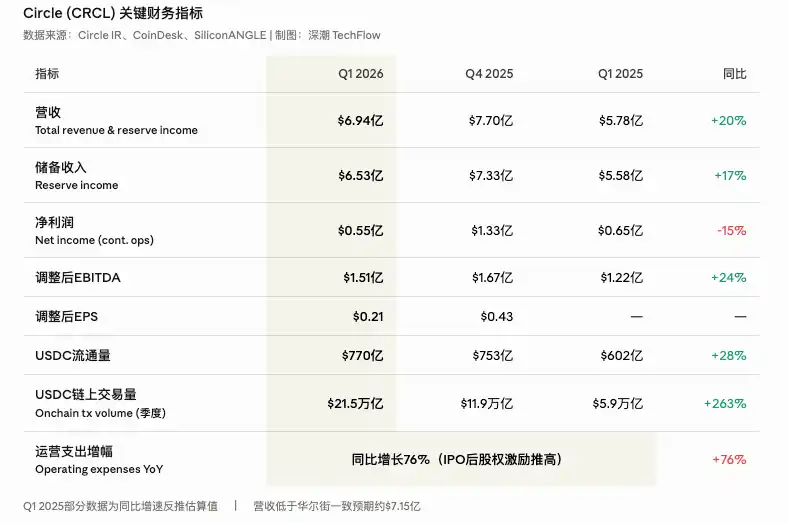
As of the end of Q1, USDC circulation reached $77 billion, up 28% year-over-year. More notably, on-chain USDC transaction volume reached $215 trillion for the quarter, skyrocketing 263% year-over-year. According to a Mizuho analyst report, adjusted USDC transaction volume for 2026 to date is approximately $2.2 trillion, surpassing Tether's USDT (approximately $1.3 trillion), capturing about 64% of adjusted stablecoin transaction volume to take the top spot. This is the first time USDC has led in this metric since 2019.

But the core reason for the revenue miss is clear: interest rates. Over 95% of Circle's revenue comes from interest income on USDC reserve assets. Q1 reserve revenue was $653 million, up 17% year-over-year. In Q4 2025, the reserve yield had already fallen 68 basis points year-over-year to 3.8%. The dampening effect of the interest rate cutting cycle on Circle's revenue is gradually becoming apparent. Even as USDC circulation continues to expand, declining rates remain a sword hanging overhead. This is precisely the underlying motivation for Circle's urgency in crafting its 'second growth curve' story.

Arc Token Pre-Sale: Building Its Own Blockchain, $3 Billion Valuation

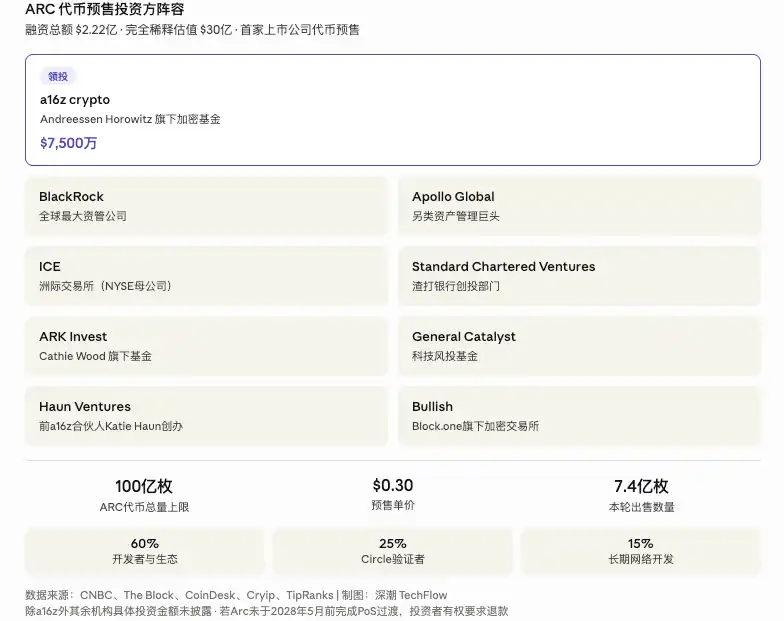
Disclosed alongside the earnings was the heavyweight news of the completion of the Arc blockchain token pre-sale. According to an exclusive CNBC report, Circle sold 740 million ARC tokens at a price of $0.30 per token, raising $222 million at a fully diluted valuation of $3 billion. This marks the first token pre-sale conducted by a publicly listed company.

a16z crypto led the round with a $75 million investment. Other participating investors formed a formidable lineup: BlackRock, Apollo Global Management, Intercontinental Exchange (ICE), Standard Chartered Ventures, ARK Invest, General Catalyst, Haun Ventures, and Bullish.
Currently, USDC heavily relies on third-party networks like Ethereum and Solana for settlement and on distributors like Coinbase to reach users. Building its own blockchain signifies Circle's desire to control more of the underlying infrastructure on which USDC operates. From a defensive perspective, with the GENIUS Act signed into law and the CLARITY Act scheduled for a preliminary vote in the Senate Banking Committee this week, the legalization of stablecoin regulation is lowering industry barriers to entry, potentially allowing banks and fintech companies to launch their own dollar tokens. By building its own network, Circle is attempting to lock in a first-mover advantage at the infrastructure layer before this competitive landscape fully materializes.

Circle explicitly stated in its earnings report that current performance guidance does not yet include "future Arc-related revenue streams," hinting that Arc could become an independent revenue source alongside USDC.

Agent Stack: When AI Agents Become the 'Customer'

The third card played on the same day was the Circle Agent Stack, a suite of financial infrastructure tools designed for AI agents.

According to Decrypt, Agent Stack consists of four core components: Agent Wallets allow AI agents to autonomously hold assets; Circle CLI allows developers and AI agents to build applications on the Circle platform; Agent Marketplace enables AI agents to browse, evaluate, and pay for services offered by other agents; Nanopayments, based on Circle Gateway, support gas-free USDC transfers as low as $0.000001.

Allaire stated in the press release, "Financial infrastructure has historically been built for humans, with manual onboarding flows, approvals, and payment flows. It was never designed for software that runs autonomously. Agent Stack is our first full-service suite built for AI agents themselves as customers, not just developers and enterprises."

Circle is betting on a future of machine-to-machine payments: AI agents autonomously transacting with each other, hiring each other's services, settling instantly on-demand, all conducted in USDC.

But Circle is not the only player; recently, Amazon partnered with Coinbase and Stripe, Google Cloud with the Solana Foundation, and MoonPay have all launched similar AI agent stablecoin payment solutions.

$35 Billion Valuation: Can It Hold?

CRCL's current market capitalization is approximately $35 billion, with a forward P/E ratio of about 135x, far above the industry median of around 33x. Citi analyst Peter Christiansen has a $243 price target, Bernstein's Gautam Chhugani has a $190 target, and all 12 analysts tracked by TipRanks give a 'Buy' rating, with a consensus target price of $138.50.

But some are applying the brakes. Compass Point downgraded CRCL to 'Sell' in April, warning that gross margins are narrowing in the first half of 2026 due to USDC supply shifting to lower-margin areas. Even per management guidance, non-reserve revenue (full-year $150-170 million) remains negligible compared to the reserve revenue engine. Whether Arc can transition from a whitepaper to a business line that genuinely contributes revenue is a core validation point for the second half of 2026.

William Blair analyst Andrew Jeffrey told clients that Circle stock "could remain volatile" in the near term, but the company has multiple positive catalysts stemming from its "significant stablecoin commercial advantages."

CRCL had already surged nearly 20% on May 4th when the bipartisan compromise version of the CLARITY Act was finalized. This week's preliminary vote in the Senate Banking Committee will be the next catalytic event. Analysts believe the Act essentially provides Circle with a "regulatory shield": compliance restrictions mean Circle is not required to distribute USDC reserve earnings to users, effectively preserving its profit margins under regulatory cover.

Having played its three cards, Circle's valuation narrative has shifted from a 'stablecoin interest income stock' to an 'infrastructure platform + AI agent economy gateway.' Whether this narrative materializes depends on the actual adoption of the Arc mainnet after its launch and Agent Stack's competitive performance in the machine-to-machine payments arena.


Perguntas relacionadas

QWhat were the key highlights of Circle's Q1 2026 financial results, and what is the main concern regarding its revenue?

ACircle's Q1 2026 revenue was $6.94 billion, missing analyst estimates, but adjusted EPS of $0.21 exceeded expectations. USDC circulation reached $770 billion, and on-chain transaction volume surged 263% to $21.5 trillion. The main concern is that over 95% of revenue comes from interest on USDC reserves. With interest rates declining, this poses a significant risk to future revenue, driving Circle's need to develop new growth areas.

QWhat is the significance of Circle's Arc blockchain token presale, and which major investors participated?

AThe Arc blockchain token presale raised $222 million at a $3 billion fully diluted valuation. This marks the first token presale by a publicly traded company. Major investors include a16z crypto (leading $75 million), BlackRock, Apollo Global Management, ICE, Standard Chartered Ventures, ARK Invest, General Catalyst, Haun Ventures, and Bullish. Arc aims to give Circle more control over the underlying infrastructure for USDC and create a new, independent revenue stream beyond stablecoin interest.

QWhat is Circle Agent Stack, and what future trend does it represent for the company?

ACircle Agent Stack is a financial infrastructure toolkit designed for AI agents. Its core components include Agent Wallets for autonomous asset holding, a CLI for development, an Agent Marketplace for AI-to-AI service transactions, and Nanopayments for tiny, gasless USDC transfers. It represents Circle's bet on a future of machine-to-machine (M2M) payments, where AI agents autonomously trade, hire services, and settle transactions instantly using USDC, positioning Circle as an entry point to the AI agent economy.

QWhat is the current market valuation and analyst sentiment for Circle (CRCL), and what are the opposing views?

ACircle's market capitalization is approximately $35 billion, with a forward P/E ratio of about 135, significantly higher than the industry median. Analysts are generally bullish, with Citi setting a $243 price target and Bernstein at $190. TipRanks shows all 12 tracked analysts give a 'Buy' rating. However, Compass Point downgraded CRCL to 'Sell', citing narrowing gross margins and the still-insignificant contribution of non-reserve revenue compared to the core interest income business.

QHow is Circle attempting to change its valuation narrative, and what does its success depend on?

ACircle is attempting to shift its valuation narrative from being a 'stablecoin interest income stock' to an 'infrastructure platform + AI agent economy gateway.' This strategic pivot is driven by the launch of the Arc blockchain and the Agent Stack toolkit. The success of this new narrative depends on the actual adoption of the Arc mainnet after its launch and Circle's competitive performance in the emerging machine-to-machine payment sector against rivals like Amazon/Coinbase and Google Cloud/Solana.

Leituras Relacionadas

Both Suffer Massive Losses Exceeding $90 Billion, Which Is in Greater Peril: Strategy or Bitmine?

Facing massive paper losses exceeding $90 billion each amidst a sharp market downturn, "Digital Asset Treasury" (DAT) giants Strategy and Bitmine find themselves in a precarious position, but with different underlying risks. Strategy, heavily invested in Bitcoin (BTC), faces significant financial strain. Its strategy relies heavily on debt, including convertible notes and preferred stock (STRC) requiring substantial dividend payments. With its cash reserves dwindling and BTC offering no staking yield for cash flow, Strategy's high leverage makes it vulnerable. A continued price decline could force asset sales to meet obligations, potentially creating a negative feedback loop. Its market value has already fallen sharply. In contrast, Bitmine, an Ethereum (ETH) holder, appears on firmer financial ground. It primarily funds its purchases through equity offerings (like ATM programs), avoiding debt pressure. It also generates income by staking a large portion of its ETH holdings. While not immune to market drops and shareholder dilution concerns, Bitmine maintains more flexibility, recently announcing a new preferred share offering to raise further capital. The core divergence lies in their financing: Bitmine uses equity (investor money), while Strategy uses debt (borrowed money). Consequently, Bitmine currently faces less immediate liquidity pressure than Strategy, which must navigate the dual challenge of servicing debt/dividends and a declining core asset (BTC) price.

marsbitHá 10m

Both Suffer Massive Losses Exceeding $90 Billion, Which Is in Greater Peril: Strategy or Bitmine?

marsbitHá 10m

Where the AI Bubble Really Is: Which Layer of Players Are Naked

AI Bubble: Where It Really Is and Who's Swimming Naked This analysis dissects the AI industry not as a single entity but as a five-layer pyramid, arguing that bubbles are concentrated in specific tiers, not uniformly distributed. **Key Distinction from the 2000 Dot-com Bubble:** Unlike 2000, where companies had stock prices before revenue, today's leading AI players have massive, contract-backed revenue driving their valuations. Core infrastructure demand is real, with every GPU running at full capacity for paying customers. **The Five-Layer Pyramid & Bubble Assessment:** * **L0 (Fab/Manufacturing) & Top L4 (Leading AI Apps): NO BUBBLE.** Companies like TSMC, NVIDIA, major cloud providers (Microsoft, Google, Meta, Amazon), and top AI labs have real revenues and orders. Supply is tightly constrained by TSMC's disciplined capacity control and physical limits like power/land for data centers, preventing a supply glut. * **L1 (Memory): BATTLEGROUND.** Sky-high HBM margins could signal a new structural cycle or a classic "boom before bust." The oligopoly of three major players may enforce supply discipline, making this a high-stakes bet. * **L2 (Interconnect/Optical Modules): BUBBLE TERRITORY.** Companies like Lumentum and AAOI have seen stock surges (4-10x) far outpacing revenue growth. This hardware segment has lower physical barriers to expansion than fabs, allowing speculation. It mirrors the 2000 bubble's epicenter—optics. * **L3 (Infrastructure/"GPU Landlords"): VULNERABLE.** GPU leasing companies profit from the current compute shortage but own no long-term moat. Their business model relies on a temporary bottleneck that will ease as big tech expands and new tech (e.g., potential space-based data centers) emerges. * **L4 Long Tail (VC-backed Startups): STRONG BUBBLE SIGNALS.** VC funding concentration in AI is twice that of the 1999 peak. Many startups with little revenue use the valuation logic of successful giants to justify their own, creating high risk of a "valuation crunch" when funding dries up. **Critical Risks to Monitor:** 1. **GPU Depreciation & Accounting:** Companies extending the assumed useful life of GPUs artificially boost profits. The true economic life depends on future generational leaps from NVIDIA. 2. **"GPU Credit" & Off-Balance-Sheet Leverage:** Emerging structures where shell companies borrow to buy GPUs and lease them out (with chipmakers sometimes investing) move debt off major balance sheets. This echoes the "vendor financing" of 2000 and the securitization risks of 2008, though currently small-scale. 3. **TSMC Abandoning Caution:** If the primary supply bottleneck (TSMC's conservative capacity planning) breaks, runaway supply could trigger a bust. 4. **Algorithmic Efficiency Breakthrough:** A major leap in software efficiency could drastically reduce the need for raw compute hardware, undermining the investment thesis. **Conclusion:** The AI boom is expensive and has frothy areas, but its core is underpinned by real demand and physical supply constraints. The bubble risk is layered: most present in optical components, GPU leasing, and the long-tail startup ecosystem, while the foundational chip manufacturing and leading application layers remain relatively solid—for now.

marsbitHá 22m

Where the AI Bubble Really Is: Which Layer of Players Are Naked

marsbitHá 22m

Trading

Spot
Futuros

Artigos em Destaque

Como comprar BEAT

Bem-vindo à HTX.com!Tornámos a compra de Audiera (BEAT) simples e conveniente.Segue o nosso guia passo a passo para iniciar a tua jornada no mundo das criptos.Passo 1: cria a tua conta HTXUtiliza o teu e-mail ou número de telefone para te inscreveres numa conta gratuita na HTX.Desfruta de um processo de inscrição sem complicações e desbloqueia todas as funcionalidades.Obter a minha contaPasso 2: vai para Comprar Cripto e escolhe o teu método de pagamentoCartão de crédito/débito: usa o teu visa ou mastercard para comprar Audiera (BEAT) instantaneamente.Saldo: usa os fundos da tua conta HTX para transacionar sem problemas.Terceiros: adicionamos métodos de pagamento populares, como Google Pay e Apple Pay, para aumentar a conveniência.P2P: transaciona diretamente com outros utilizadores na HTX.Mercado de balcão (OTC): oferecemos serviços personalizados e taxas de câmbio competitivas para os traders.Passo 3: armazena teu Audiera (BEAT)Depois de comprar o teu Audiera (BEAT), armazena-o na tua conta HTX.Alternativamente, podes enviá-lo para outro lugar através de transferência blockchain ou usá-lo para transacionar outras criptomoedas.Passo 4: transaciona Audiera (BEAT)Transaciona facilmente Audiera (BEAT) no mercado à vista da HTX.Acede simplesmente à tua conta, seleciona o teu par de trading, executa as tuas transações e monitoriza em tempo real.Oferecemos uma experiência de fácil utilização tanto para principiantes como para traders experientes.

278 Visualizações TotaisPublicado em {updateTime}Atualizado em 2026.06.02

Como comprar BEAT

Discussões

Bem-vindo à Comunidade HTX. Aqui, pode manter-se informado sobre os mais recentes desenvolvimentos da plataforma e obter acesso a análises profissionais de mercado. As opiniões dos utilizadores sobre o preço de BEAT (BEAT) são apresentadas abaixo.

活动图片