Dumping US Bonds, Buying Japanese Bonds: Wall Street Prepares for 'Capital Repatriation to Japan'

marsbitPublicado em 2026-05-18Última atualização em 2026-05-18

Resumo

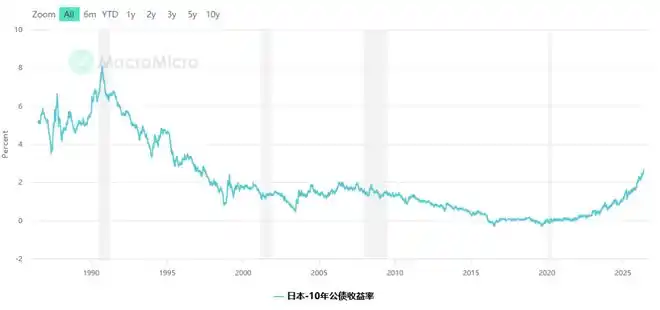
Wall Street is bracing for a potential "great repatriation" of Japanese capital as yields on Japanese Government Bonds (JGBs) soar to multi-decade highs. The 10-year JGB yield recently hit 2.73%, its highest since 1997, while the 30-year yield broke 4% for the first time. This dramatic shift is causing global asset managers to reassess a long-ignored risk: that Japanese investors, who hold roughly $1 trillion in U.S. Treasury debt, could start bringing that money home. For decades, Japan's ultra-low interest rates pushed domestic insurers, pension funds, and banks to seek yield overseas, primarily in U.S. Treasuries. Now, with the Bank of Japan hiking rates and JGB yields climbing, the incentive is reversing. Firms like BlueBay Asset Management are preparing for this shift, believing new Japanese investments will be directed domestically rather than to foreign bonds. Early signs of repatriation are emerging, with record monthly inflows into Japanese sovereign bond funds in March. Some managers, like Ruffer's Matt Smith, hold yen as a hedge, anticipating that market stress could trigger a rapid acceleration of capital returning to Japan. However, analysts caution that a mass exodus hasn't begun yet. Japanese investors were still net buyers of foreign bonds over the past year. Uncertainty remains high as Japan's government fiscal plans could push JGB yields even higher, making investors hesitant to buy immediately. Furthermore, the Bank of Japan's withdrawal as a dominant bo...

Japan's government bond market is experiencing volatility unseen in decades, prompting global asset management institutions to re-examine a long-ignored risk: will Japanese investors, who hold approximately $1 trillion in US Treasury bonds, move their money back home?

According to a recent report by the Financial Times, several investment firms have begun preparing for the potential large-scale repatriation of Japanese capital, betting that Japanese investors will gradually sell US Treasuries and instead buy Japanese Government Bonds (JGBs) with their continuously rising yields.

Soaring JGB Yields Hit Multi-Decade Highs

On Friday, Japan's benchmark 10-year government bond yield rose to 2.73% in intraday trading, its highest level since May 1997.

The yield on 30-year JGBs broke through 4% for the first time—a level never reached since these bonds were first issued in 1999. Yields on 5-year and 20-year bonds also hit record highs earlier this week.
Japanese Finance Minister Satsuki Katayama told reporters on Friday that yields on benchmark bonds in major global markets are rising, "These dynamics influence each other, creating a compounding effect."

Analysts expect JGB yields to continue climbing. The Bank of Japan raised its policy rate to 0.75% in December last year, the highest in thirty years, and the market widely anticipates another 25 basis point hike to 1% this June.

The $1 Trillion 'Repatriation to Japan' Logic

To understand this bet, one must first understand why Japanese investors hold such vast assets overseas.

For decades, Japan maintained ultra-low interest rates, offering almost no return on domestic bonds. To seek yields, Japanese institutional investors such as insurance companies, pension funds, and banks went on a massive overseas buying spree, purchasing US Treasuries, European bonds, and various global assets.

Currently, Japanese investors hold roughly $1 trillion in US Treasury bonds, making them the largest foreign holder of US debt, far surpassing other countries.

Now, with Japanese bond yields rising sharply, this logic is reversing. Mark Dowding, Chief Investment Officer at British asset manager BlueBay, directly highlighted this shift. BlueBay just launched its first Japanese bond fund in March this year.

Dowding stated: "New money will not be deployed overseas. It won't go into US corporate bonds, it won't go into US Treasuries; it will come back and be deployed domestically in Japan."

'Trickle' of Capital Repatriation Has Begun

Market data shows signs of capital returning, although the scale is still small.

According to fund tracker EPFR, investors netted about $700 million into Japanese sovereign bond funds in March, setting a record for the largest monthly inflow in the category's history. April saw a net inflow of $86 million, returning to recent normal levels.

Ruffer fund manager Matt Smith offered a more direct assessment. He said: "The pressure is building—long-end domestic yields keep going up, and the signal at an institutional level is 'please bring your money back to Japan'. We think the yen appreciation will happen slowly at first, then all at once."

Smith also said Ruffer currently holds a long yen position as a core hedging tool. "In a market dislocation, particularly one centered around US credit markets, you will get Japanese investors bringing capital back home, and the yen will strengthen."

Large-Scale Repatriation Not Yet Happening, JGBs Have Their Own Concerns

However, analysts caution that Japanese institutional investors are still net buyers of foreign bonds.

RBC Capital Markets Asia macro strategist Abbas Keshvani pointed out that although JGB yields now "superficially offer better compensation for investors," over the past 12 months, Japanese investors have still been net buyers of about $50 billion in foreign bonds.

The reason lies in the uncertainty within the JGB market itself. Japanese Prime Minister Sanae Takaichi won the election this February, with campaign promises including expanded government spending and subsidies to ease inflation pressures. Analysts increasingly warn that the government will be forced to compile a supplementary budget later this year, which would further depress JGB prices and push yields higher.

Keshvani said: "Both supply and demand dynamics point to yields moving higher. As an investor, it's very difficult to have the will to step in now if you know yields will continue to rise."

Previously, the Bank of Japan, through quantitative easing and yield curve control policies, was the market's most significant buyer of JGBs. As the BOJ gradually exits, the market returns to traditional supply-demand logic, leading to noticeably increased volatility in JGB prices.

Implications for the US Treasury Market

The potential scale of Japanese capital repatriation forces the US Treasury market to take this risk seriously.

Japan is the largest foreign holder of US Treasury bonds, with holdings of approximately $1 trillion. If Japanese institutional investors begin systematically reducing their holdings, the impact on the supply-demand dynamics of US Treasuries would be substantial.

Currently, Wall Street's bet is more of a forward-looking positioning rather than a reaction to an established fact. But as Japanese bond yields continue to climb—with analysts viewing a 10-year JGB yield reaching 3% later this year as a realistic target—the logic behind this bet will become increasingly clear.


Perguntas relacionadas

QAccording to the article, why are global asset managers beginning to reassess the risk of Japanese capital outflows from foreign bonds?

AThey are reassessing this risk due to unprecedented volatility in the Japanese government bond (JGB) market, where yields are soaring to multi-decade highs. This creates a new incentive for Japanese investors, who hold roughly $1 trillion in US Treasuries, to potentially repatriate capital to buy higher-yielding domestic bonds.

QWhat specific recent yield levels for Japanese government bonds are highlighted in the article as being particularly significant?

AThe article highlights that the 10-year JGB yield rose to 2.73%, its highest since May 1997. The 30-year JGB yield surpassed 4% for the first time since its issuance in 1999. Yields on 5-year and 20-year JGBs also recently hit record highs.

QWhat is the core investment logic behind the potential 'repatriation to Japan' trade, as explained by BlueBay's Mark Dowding?

AThe core logic is reversal. For decades, Japanese investors sought higher yields abroad due to near-zero rates at home. Now, with JGB yields rising sharply, the incentive has flipped. New capital will no longer be allocated to foreign assets like US Treasuries or corporate bonds, but will instead be deployed back into the domestic Japanese bond market.

QWhat evidence does the article provide that some capital is already starting to flow back to Japan, and what counter-evidence suggests a large-scale shift hasn't happened yet?

AEvidence of early flows: In March, Japanese sovereign bond funds saw a record $700 million in net inflows. Evidence against a large-scale shift: Over the past 12 months, Japanese investors have remained net *buyers* of foreign bonds, purchasing about $50 billion worth. Analysts cite ongoing uncertainty in the JGB market, with expectations of further yield increases, as a reason for hesitation.

QWhat is the potential implication for the US Treasury market if Japanese investors begin a systematic sell-off of their holdings?

AThe implication is a substantial and material impact on the supply-demand dynamics of the US Treasury market. Japan is the largest foreign holder of US debt, with approximately $1 trillion in holdings. Systematic selling by Japanese institutions would remove a major source of demand, putting upward pressure on US yields and creating volatility.

Leituras Relacionadas

Google CEO Admits Lagging Behind in Coding

Google CEO Sundar Pichai acknowledged in a recent interview that Google's Gemini AI models are currently "lagging behind" in coding capabilities, particularly for complex, long-horizon tasks requiring advanced developer expertise. He noted the field is advancing at an "unprecedented" pace, where 30-60 days now brings changes equivalent to five years in the past. Pichai expressed that achieving Artificial General Intelligence (AGI) now seems closer than previously imagined due to rapid progress. While highlighting strengths in text, multimodal, and reasoning tasks, Pichai admitted competitors like Anthropic and OpenAI have focused more intently on coding. He emphasized Google's commitment to catching up, citing internal tools like Antigravity 2.0 and the newly released Gemini 3.5 Flash, which aims to address previous shortcomings. Regarding Google Search's AI-driven overhaul, Pichai stated changes will be gradual to align with user needs, not disrupt the core search experience or its advertising model. He addressed public AI anxiety as understandable, given the technology's potential to reshape jobs and society, but remained optimistic about AI augmenting human capabilities and creating new opportunities. Pichai stressed the need for broad societal dialogue and responsible development as AI approaches more advanced, potentially recursive self-improvement stages. He affirmed Google's long-term commitment to leading in AI while navigating its profound implications responsibly.

marsbitHá 12m

Google CEO Admits Lagging Behind in Coding

marsbitHá 12m

The Paradox of Automation: The Stronger the AI, the Busier Humans Become

The Paradox of Automation: The more powerful AI becomes, the more work humans have to do. This article, based on observations from AI-heavy company Every, argues that while AI agents automate tasks like coding, writing, and customer service, they don't eliminate human jobs. Instead, they transform work and create *more* demand for human expertise. AI commoditizes "yesterday's human capabilities" by cheaply generating code, text, and images from past data. This leads to an abundance of similar, generic outputs. Consequently, what becomes scarce and valuable is human judgment in the present moment: knowing *what* is worth doing, *why*, and *how* to do it well. The article identifies two collaboration models: "Agent employees" for delegated tasks and "human-AI collaboration" within tools like Claude Code for complex work. In both cases, humans are essential to set direction, judge quality, and maintain systems. As AI makes execution cheap, human roles shift from executors to designers, reviewers, and meaning-makers. The author addresses "benchmark anxiety" by explaining that AI excels within specific, human-defined problem "frames." As AI masters one frame (e.g., code rewriting), new, more complex frames emerge (e.g., deciding *when* to rewrite). This creates an ongoing cycle where AI chases the frames, but humans remain the "framers." Even with advanced AGI, this dynamic may persist as long as AI lacks true human-like agency and self-directed purpose. The core paradox holds: automation amplifies the need for the very human judgment it seems to replace.

marsbitHá 1h

The Paradox of Automation: The Stronger the AI, the Busier Humans Become

marsbitHá 1h

a16z: 7 Charts to Understand How Tokenization is Changing the Nature of Assets

"a16z: 7 Charts on How Tokenization is Changing the Nature of Assets" Tokenized Assets (or Real-World Assets - RWA) are transforming asset forms, liquidity, and financial system construction. The market recently surpassed $30 billion, stabilizing around $34 billion (excluding stablecoins), representing a tenfold increase in less than two years, driven by clearer regulations, mature institutional infrastructure, and increased financial institution adoption. The primary driver of recent growth is tokenized U.S. Treasury bonds. These offer investors efficient, flexible digital access to yield-bearing assets and improve institutional operations like settlement and collateral management. Other asset classes show varied growth: asset-backed credit leads, followed by niche financial assets (e.g., reinsurance, mining notes), while venture capital took longer to scale. Market segmentation shows high concentration. In commodities, tokenized gold dominates (~$5 billion), as its standardized, storable nature fits tokenization well. Bonds are the largest category ($15.2B), but only ~5% are used in DeFi protocols. Conversely, smaller niches like reinsurance tokens see high (~84%) on-chain utilization, highlighting a core industry divide: most current tokenized assets are merely digitized records for easier holding/transfer, lacking the "composability" (free combination/interaction) that is key to blockchain-native finance. The ecosystem is distributed across multiple blockchains, with Ethereum hosting over half the value ($15.7B), followed by BNB Chain, Solana, and others. Future market size predictions vary widely (e.g., $2-$30 trillion by 2030+), but all indicate massive potential from the current small base. Tokenized assets currently represent minuscule fractions of their global counterparts (e.g., 0.01% of global bonds). The current phase focuses on digitizing straightforward assets. The next challenge is to bring more complex financial components on-chain and deeply integrate tokenized assets into composable, internet-native financial infrastructure.

链捕手Há 2h

a16z: 7 Charts to Understand How Tokenization is Changing the Nature of Assets

链捕手Há 2h

a16z: How Tokenization is Transforming the Nature of Assets in 7 Charts

"Tokenized Assets: How Tokenization Changes the Nature of Assets" by a16z Crypto The market for tokenized assets, excluding stablecoins, has grown from under $3 billion two years ago to over $340 billion today. US Treasury bonds are the primary growth driver, allowing investors to hold yield-bearing assets digitally and enabling more efficient settlement. Other key sectors include private credit (growing fastest), commodities (dominated by gold), and niche financial assets. However, the market remains concentrated in tokenized US Treasuries and gold. A critical insight is that most tokenized assets currently lack "composability." While the total market is large, only a small fraction is actively used within DeFi protocols. For instance, only about 5% of tokenized bonds and a low percentage of tokenized gold are utilized on-chain. In contrast, assets like reinsurance and private credit tokens show much higher on-chain usage rates (84% and 33%, respectively). This highlights a divide: many tokenized assets are merely digital records on a blockchain without enabling new, programmable financial applications. The Pantera Capital Token Native Index indicates over 70% of tokenized assets have minimal on-chain native functionality. Ethereum remains the dominant blockchain for tokenized assets (over $150B), but the ecosystem is diversifying across chains like BNB Chain, Solana, and Stellar, based on factors like cost and compliance. Major institutions forecast massive future growth, with predictions for the tokenized asset market ranging from $2 trillion to over $30 trillion by the early 2030s. However, compared to the global financial system (e.g., ~$140T bonds, multi-trillion dollar gold market), tokenized assets currently represent a tiny fraction (0.01% or less). The conclusion is that while tokenization has begun by digitizing and streamlining settlement for simpler assets, the next phase involves bringing more complex financial instruments on-chain and deeply integrating them into composable, internet-native financial infrastructure.

Odaily星球日报Há 2h

a16z: How Tokenization is Transforming the Nature of Assets in 7 Charts

Odaily星球日报Há 2h

The Revived Codex, Carrying OpenAI's Hopes for IPO

This article analyzes the intense recent development of OpenAI's Codex, positioning it as a crucial component for OpenAI's impending IPO. Over the past two months, Codex has seen a rapid series of major updates focused on integrating into real enterprise workflows. Key new features include enhanced context capture (Appshots, file previews, built-in browser), long-running task execution ("Goal Mode"), remote operation (phone control, lock-screen access), and enterprise management tools (plugin sharing, access tokens, automated risk review). These updates aim to make Codex a comprehensive AI workbench that can "see the scene, push tasks, and manage risks." The author argues that while ChatGPT proves OpenAI's massive user base and API provides foundational revenue, Codex represents OpenAI's clearest path to demonstrating tangible, high-value commercial viability. It targets developers and engineering teams—a segment already accustomed to paying for efficiency gains in costly software development cycles. This is critical because, despite higher overall revenue, OpenAI's adjusted operating margins remain deeply negative, highlighting the challenge of outrunning immense compute costs. The pressure is amplified by competitor Anthropic's success with Claude Code, which has shown that a focused approach on high-value enterprise and developer workflows can lead to a path toward profitability. Codex's aggressive evolution is thus seen as OpenAI's strategic move to capture a similar enterprise-ready, revenue-generating narrative essential for its market debut. In essence, "ChatGPT proved OpenAI has users. Codex needs to prove OpenAI is a business that can make money."

marsbitHá 3h

The Revived Codex, Carrying OpenAI's Hopes for IPO

marsbitHá 3h

Trading

Spot
Futuros
活动图片




