Duan Yongping's Bottom-Fishing in CoreWeave Is Turning into a Battleground for Bulls and Bears

marsbitPublicado em 2026-05-11Última atualização em 2026-05-11

Resumo

CoreWeave's Q1 2026 earnings report has intensified the ongoing bull-bear battle over the AI infrastructure stock. While revenue doubled year-over-year to $2.08B and the firm's remaining performance obligation (RPO) surged to nearly $100B, its net loss more than doubled to $740M. The critical point of contention is profitability: while adjusted EBITDA margin was a robust 56%, the adjusted operating margin collapsed to just 1% due to soaring infrastructure and sales costs. A weaker-than-expected Q2 revenue guidance further triggered an 11.4% single-day stock drop. The bull thesis hinges on CoreWeave's massive order backlog, deep strategic ties with NVIDIA (as a customer, investor, and key supplier), and a diversified client base now including Anthropic and Meta. The bear case focuses on the "scale at all costs" model, where expanding revenue leads to wider losses, ballooning debt ($25B), and massive capital expenditures ($6.8B in Q1). Insider selling by executives contrasts with a notable new investor: Chinese investor Duan Yongping initiated a small position (0.12% of his portfolio) in Q4 2025 near the stock's lows. The coming Q2 report is seen as a key test for management's promise of a profit margin recovery.

Author: Deep Tide TechFlow

On May 8, AI cloud computing power supplier CoreWeave (CRWV) plunged 11.4% in a single day, closing at $114.15. This marked another "earnings day decline" since the company's IPO in March last year. However, unlike previous drops, this decline coincided with a more dramatic contrast: Duan Yongping, widely known in the Chinese-speaking community as a disciple of Warren Buffett, had just established his first position in CoreWeave in Q4 2025, with an allocation of approximately $20 million. Based on the position size and the Q4 average price, the entry point was close to CoreWeave's lowest level for the year in December 2025.

CoreWeave is currently one of the most divisive AI assets in the US stock market. On one side lies the narrative of being the "picks and shovels" seller with nearly $100 billion in order backlog and deep ties to Nvidia; on the other side is the financial reality of widening losses despite scale expansion and continuous insider selling. The Q1 earnings report acted like a prism, making this divergence exceptionally clear.

Q1 Earnings: Revenue Doubles but Losses Widen, Q2 Guidance Punctures Valuation

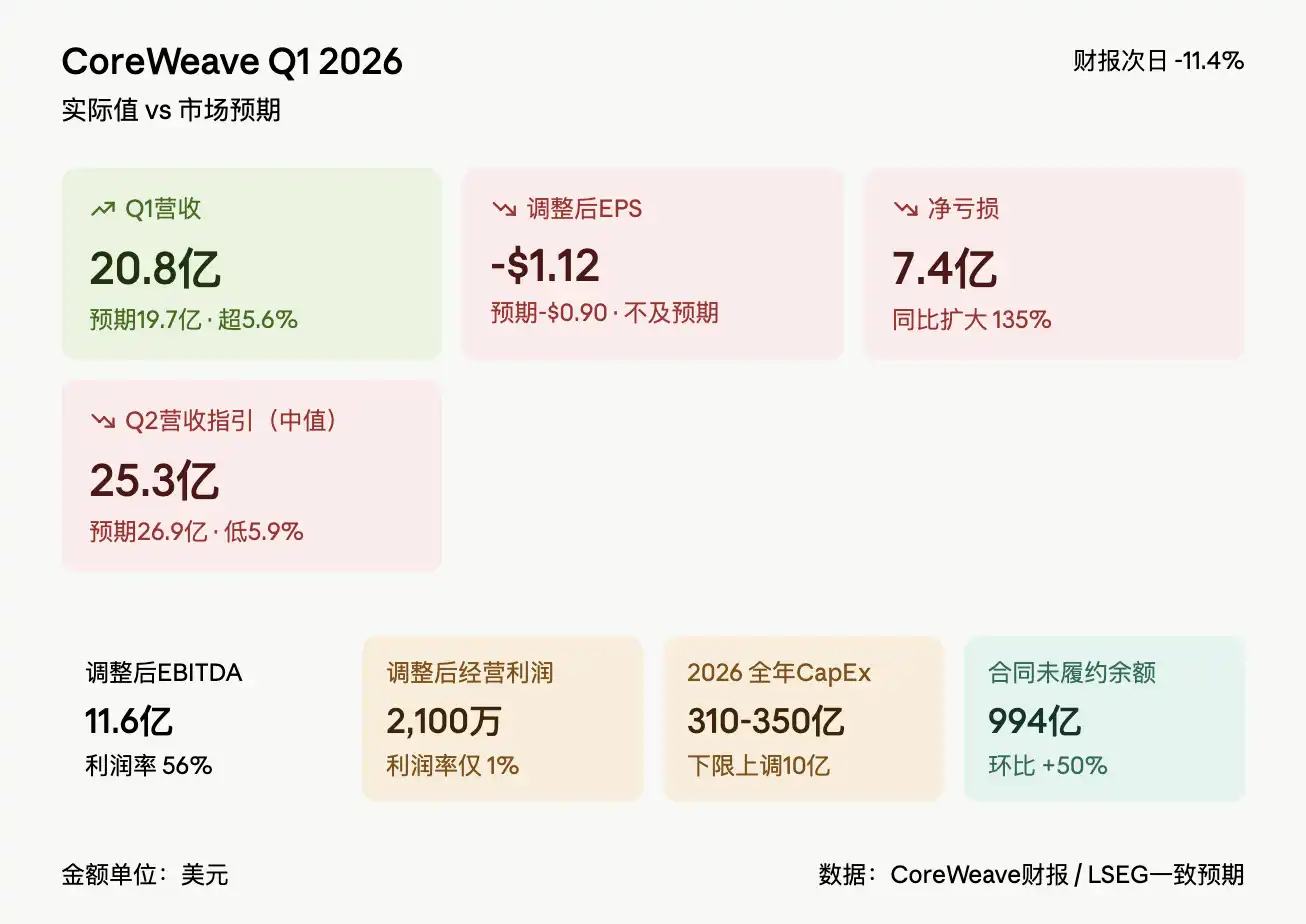
CoreWeave's Q1 revenue was $2.08 billion, a 112% year-over-year increase and a 32% sequential increase, surpassing the LSEG market expectation of $1.97 billion. However, adjusted loss per share was $1.12, worse than the expected loss of $0.90. Net loss expanded to $740 million, more than doubling from $315 million in the same period last year.

What truly ignited the sell-off was the forward guidance. The company provided a Q2 revenue range of $2.45 billion to $2.6 billion, with a midpoint of $2.53 billion, far below the market expectation of $2.69 billion. Simultaneously, the lower limit of full-year 2026 capital expenditure was raised from $30 billion to $31 billion, which CFO Nitin Agrawal attributed to rising component costs.

The fragility of the profit structure was exposed. Q1 adjusted EBITDA reached $1.16 billion (a 56% margin), seemingly impressive, but adjusted operating profit was only $21 million, with the operating margin compressed to 1%. The reason lies in technology and infrastructure costs soaring 127% year-over-year to $1.27 billion, and sales & marketing expenses skyrocketing over 6 times year-over-year to $69 million. Revenue is growing, but costs are growing faster.

CEO Michael Intrator emphasized on the earnings call: "We have reached hyperscale." He disclosed that the company now has 10 customers committed to spending over $1 billion each. Compared to 2024 when 62% of revenue relied on Microsoft as a single customer, concentration risk has significantly improved. Intrator also expects CoreWeave's annualized revenue to exceed $30 billion by the end of 2027.
Bull Narrative: $100 Billion Order Backlog, Deep Ties with Nvidia

The core supporting the bull case is the order backlog. As of the end of Q1, CoreWeave's remaining performance obligations (RPO) amounted to $99.4 billion, a net increase of approximately $33 billion sequentially and nearly quadrupling year-over-year. Intrator stated that new contracts signed in Q1 alone exceeded $40 billion.

The client list is also reshaping market perceptions. In Q1, Anthropic was added as a customer, providing computing power for its Claude series models; a $2.1 billion AI cloud agreement was signed with Meta; trading firm Jane Street committed to approximately $6 billion in orders and separately completed a $1 billion equity investment. Nvidia again purchased $2 billion worth of CoreWeave Class A common stock this quarter. This global largest GPU supplier is simultaneously an investor and a major customer of CoreWeave. This triple-role binding relationship is referred to as Nvidia's "favored son."

Regarding financing structure, CoreWeave completed an $8.5 billion investment-grade HPC (High-Performance Computing) secured delayed draw term loan (DDTL) in Q1, priced below 6%, hailed by management as "groundbreaking." Year-to-date, the company has secured over $20 billion in debt and equity financing, with the weighted average cost of debt decreasing by approximately 80 basis points. S&P Global Ratings concurrently revised CoreWeave's credit rating outlook from "stable" to "positive."

Bear Logic: Less Profitable as it Scales, Debt Snowball Growing Larger

However, another set of numbers in the earnings report is causing anxiety. Q1 capital expenditure reached $6.8 billion, and the company expects Q2 capital expenditure to further climb to between $7 billion and $9 billion. The Q2 interest expense guidance range is $650 million to $730 million, reflecting the rapid swelling of debt.

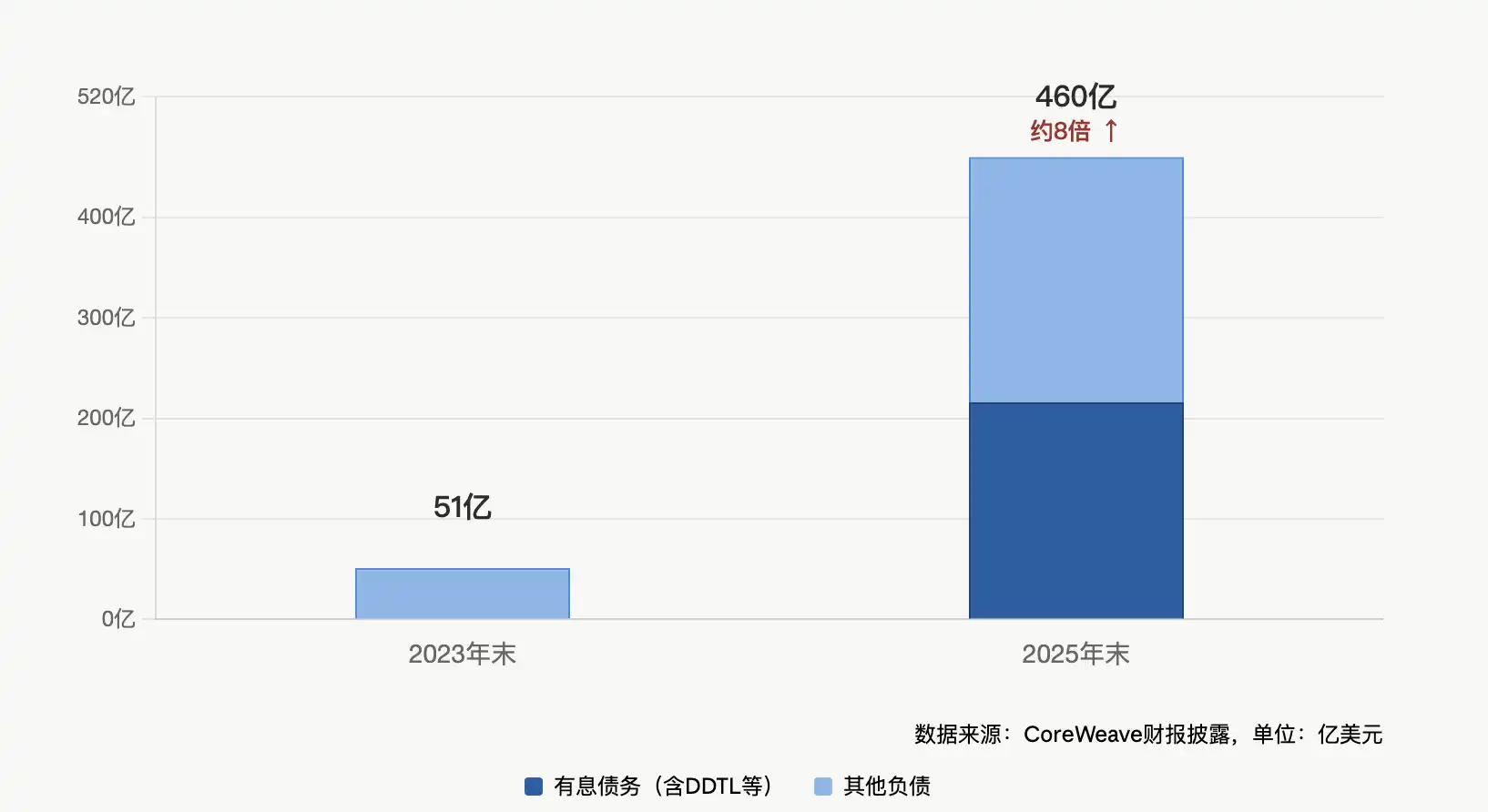
The total debt is already staggering. As of the end of Q1, CoreWeave's total debt stood at approximately $25 billion. Relative to the company's current annualized revenue level, this leverage is significantly higher than that of traditional cloud service providers. Morgan Stanley data shows that CoreWeave's debt financing for the full year 2025 amounted to about $11.8 billion, far exceeding its equity financing of about $1.5 billion. The company's core expansion tool is the DDTL, a "book first, finance later" model that uses order contracts as collateral to secure bank financing for GPU procurement.

The sharpest criticism comes from profit quality. Although management repeatedly emphasized the 56% EBITDA margin, the adjusted operating margin was only 1%. The "real" gross margin after deducting technology and infrastructure costs was about 4%, showing compression both sequentially and against market expectations. Intrator attributed this on the earnings call to the temporary effect of rapid scaling, where the dilution effect on margins from newly added capacity is immense when a company expands dramatically from a 1-gigawatt operational scale. He promised this was the "margin low point" and that margins would gradually recover in future quarters.

But the market is currently unwilling to pay for this promise. While analysts from Morgan Stanley and Jefferies gave positive reviews, CoreWeave has experienced short-term pullbacks after each earnings report previously, with this decline being one of the steeper post-earnings drops.
Insider Selling Continues, Mirroring Duan Yongping's Bottom-Fishing

Around the earnings release, CoreWeave insiders maintained their selling pace. CEO Mike Intrator sold 307,693 shares in late April; co-founders Brian Venturo and Chen Goldberg also recorded sales; institutional shareholder Magnetar Financial had previously sold over $300 million worth. Latest disclosures show that another major shareholder recently sold approximately 1.2 million shares.

This forms a stark contrast with Duan Yongping's position-building in Q4. According to a 13F filing disclosed by H&H International Investment in February 2026, Duan Yongping established his first position in CoreWeave of 299,900 shares in Q4 2025, at a time when the stock had retreated more than 65% from its highs, and market concerns over its debt structure had peaked.

It's noteworthy that CoreWeave accounts for only 0.12% of Duan Yongping's total H&H holdings, constituting a "small pilot" position. In the same quarter, Duan massively increased his stake in Nvidia by over 1110% and established new positions in Credo Technology (high-speed connectivity) and Tempus AI (AI healthcare). These three new AI positions combined account for less than 0.3% of his portfolio. This indicates Duan's true heavy bet is Nvidia itself, with CoreWeave being more like a small extension of his bet on the downstream AI computing power supply chain.

The Crucial Question Now: Inflection Point or Trap?

Intrator posed a somewhat emotional rhetorical question during the Q&A session: "I've always felt that everyone is staring at the stock price tree and missing the entire forest."

This statement aptly summarizes the current bull-bear standoff. Bulls see a forest of nearly $100 billion in contract backlog, a diversified customer base, a triple-binding relationship with Nvidia, and an upgraded credit rating. Bears see a tree of 1% operating margins, widening net losses, aggressive capital expenditures, and persistent insider selling.

CoreWeave's stock price is still up nearly 80% year-to-date and has gained over 200% since its IPO. But when the bull case for a stock rests on a distant narrative and the bear case on current numbers, every earnings report becomes a battleground for these two narratives. Duan Yongping previously stated in an interview with Fang Sanwen: "AI is a massive revolution brought about by a qualitative leap in computing power, with an impact potentially exceeding that of the internet and the industrial revolution. There is a clear AI bubble now, and 90% of companies may be eliminated, but the survivors will become the next-generation giants." His 0.12% light position itself acknowledges the uncertainty of this gamble.

The next test is already clear: the Q2 earnings report. If the operating margin does not recover as promised by management, the credibility of the "forest" narrative will face a genuine stress test.


Perguntas relacionadas

QWhat were the key highlights and concerns from CoreWeave's Q1 2026 earnings report?

ACoreWeave's Q1 2026 revenue was $2.08 billion, up 112% year-over-year and exceeding expectations. However, the company's net loss widened to $740 million and it provided weaker-than-expected Q2 revenue guidance. A major concern was the adjusted operating profit margin collapsing to just 1%, despite a high adjusted EBITDA margin of 56%, due to surging technology and infrastructure costs.

QWhat are the main arguments of the bulls (optimists) and bears (pessimists) on CoreWeave?

ABulls are optimistic due to CoreWeave's massive $99.4 billion Remaining Performance Obligations (RPO), deep strategic and financial ties with NVIDIA, a diversified and growing client base including Anthropic and Meta, and recent credit rating upgrades. Bears are pessimistic because the company is scaling unprofitably, with operating margins near zero, rapidly escalating capital expenditures and debt (now ~$25 billion), and persistent insider selling by executives and major shareholders.

QWhat is the significance of Duan Yongping's (段永平) investment in CoreWeave, and how does it contrast with insider activity?

ADuan Yongping, a well-known value investor in China, initiated a small position in CoreWeave (worth ~$20 million, ~0.12% of his portfolio) in Q4 2025 when the stock was near its yearly low. This 'dip-buying' action contrasts sharply with recent and ongoing insider selling by CoreWeave's CEO, co-founders, and major institutional shareholders like Magnetar Financial. Duan's position is seen as a high-conviction, speculative bet on the AI infrastructure theme, while insider sales raise questions about near-term confidence.

QHow is CoreWeave financing its aggressive expansion, and what are the associated risks?

ACoreWeave is financing its massive GPU procurement and data center build-out primarily through debt, specifically a novel 'Delayed Draw Term Loan (DDTL)' structure secured by its customer contracts. The company raised $8.5 billion in such debt in Q1 alone. The major risk is the rapid ballooning of its total debt to approximately $25 billion, leading to high interest expenses. This 'asset-light, contract-heavy' model creates significant financial leverage, making the company highly sensitive to execution risks and potential slowdowns in AI demand.

QWhat is the critical test for CoreWeave's investment narrative according to the article?

AThe next critical test is the Q2 2026 earnings report. Management, particularly CEO Michael Intrator, has promised that Q1 represented the 'low point' for operating margins and that profitability should improve in subsequent quarters. If the Q2 report fails to show a meaningful rebound in operating profit margins, the company's long-term growth narrative (the 'forest') will face severe credibility pressure from the current poor financial metrics (the 'tree'), potentially leading to further significant stock price volatility.

Leituras Relacionadas

After Three Consecutive Quarters of Decline, Can the Crypto Market Find a Window for Stabilization in Q3?

The cryptocurrency market has just concluded its worst-performing quarter since 2022, with total capitalization dropping 12.6% to $2.1 trillion. All core metrics indicate capital is leaving the sector, not just rotating within it. Bitcoin fell 14.2% and Ethereum dropped 25.4% in Q2, breaking their previous correlation with US tech stocks. A key driver is the reversal in US spot Bitcoin ETF flows, which saw a net outflow of approximately $4.67 billion in Q2, including a record monthly outflow near $4.5 billion in June. While recent data suggests long-term holders are accumulating again, sustained ETF outflows mean continued selling pressure. Market focus is now singularly on the Federal Reserve. The upcoming July FOMC meeting is seen as the most critical event for Q3. A dovish signal could support Bitcoin reclaiming a $68,000-$84,000 range, while a hawkish stance might establish a new trading band around $50,000-$56,000. Additionally, regulatory uncertainty persists, with the progress of the crucial *CLARITY Act* stalling in the Senate, reducing its perceived 2026 passage probability to 40-45%. Despite the broad downturn, a few sectors showed growth. Prediction markets saw nominal volume surge 48.7% year-over-year to $113.8 billion, and tokenized collectibles transaction volume rose 143% quarterly to $1.4 billion. The Real-World Asset (RWA) tokenization sector also continued steady growth, now representing ~$28.1 billion in on-chain value. The market's foundation for an extreme crash appears limited, with Bitcoin price hovering near its 200-week moving average. However, the trading paradigm has shifted from narrative-driven speculation to decisions based on price action, policy developments, and interest rate expectations, making a broad sentiment-driven rally unlikely in the near term.

marsbitHá 17h

After Three Consecutive Quarters of Decline, Can the Crypto Market Find a Window for Stabilization in Q3?

marsbitHá 17h

BIT Trading Moment: BTC Still Suppressed by Weekly 200 EMA, Rejection May Restart Decline; Storage and Semiconductors that Surged Last Night Begin Falling in Evening Trading

**Crypto & Stock Market Wrap: Bitcoin Tests Resistance, Stocks Retreat After AI Surge** Bitcoin consolidates around $66,000, facing key resistance near $68,000—an area seen as a major psychological and technical hurdle where previous rallies have failed. Analysts note the cryptocurrency is caught between its 200-week moving average (~$63,333) and 200-week EMA (~$68,328). A clear break above $68k is needed to signal a stronger bullish trend, while a rejection could lead to a retest of $63k support. Market sentiment remains cautious, with low futures open interest pointing to a low-liquidity rebound rather than a full bull market. Bitcoin spot ETFs saw another $203 million inflow. US stock futures pointed lower after a strong Tuesday session led by a massive rebound in semiconductors and memory stocks. The rally was fueled by renewed optimism about AI-driven hardware demand, with Micron, SanDisk, and SK Hynix surging. However, those gains reversed in pre-market trading. Super Micro Computer (SMCI) soared over 20% after hours on strong guidance and a record backlog. Other standouts included Rocket Lab and nuclear energy plays Oklo and X-Energy. Rising oil prices (Brent above $91) and climbing Treasury yields (10-year near 4.64%), however, are reigniting inflation concerns and acting as a headwind for equities. In Asia, markets were mixed. South Korea's KOSPI pared early gains to close slightly higher as semiconductor stocks like SK Hynix gave back initial surges. Japan's Nikkei edged lower as the yen hit a fresh 38-year low against the dollar, raising fears of potential market intervention. Key events to watch include the Samsung Galaxy launch, AMD's AI event, and a slew of major tech earnings from Alphabet, Tesla, and IBM after the close on Wednesday, followed by the ECB meeting and Intel's earnings on Thursday.

marsbitHá 17h

BIT Trading Moment: BTC Still Suppressed by Weekly 200 EMA, Rejection May Restart Decline; Storage and Semiconductors that Surged Last Night Begin Falling in Evening Trading

marsbitHá 17h

Former CFTC Chairman, Circle President Tarbert: Preaching Long-Termism While Cashing Out $30 Million Himself

Former CFTC Chairman and Circle President Heath Tarbert has consistently advocated for a long-term vision in public, urging patience from investors as Circle’s stock price has fallen significantly from its peak. However, it has been revealed that since Circle’s IPO, Tarbert has continuously sold his CRCL shares through pre-arranged trading plans, cashing out approximately $30 million, without making any public market purchases. This contrast between his public messaging and personal actions has drawn criticism. Tarbert joined Circle in July 2023 as Chief Legal Officer, leveraging his regulatory experience to help guide the company through its IPO and expansion. Despite promoting stablecoins as long-term infrastructure, he established a 10b5-1 trading plan just before Circle went public, leading to substantial stock sales over the following year. In March 2026, he initiated another plan to sell more shares. His career trajectory highlights a pattern of moving between high-level regulatory roles and influential positions in the financial sector. After resigning as CFTC Chairman in early 2021, he joined Citadel Securities as Chief Legal Officer just 27 days later, during a period of intense regulatory scrutiny for the firm. He later joined Circle, aiding its efforts to navigate regulatory challenges for its public listing. While Tarbert's expertise in policy and compliance is valuable to companies like Circle, his actions—advocating long-term confidence while personally divesting—raise questions about the alignment between his public statements and his private financial decisions, leaving investors who followed his advice to bear the market risks.

marsbitHá 17h

Former CFTC Chairman, Circle President Tarbert: Preaching Long-Termism While Cashing Out $30 Million Himself

marsbitHá 17h

Gate Research Institute: The 'Wall Street-ization' Wave of Crypto Financial Products – Competition or Integration?

The article titled "Gate Research Institute: Are Crypto Financial Products Sparking a 'Wall Street' Wave—Competition or Convergence?" explores the evolving relationship between the crypto ecosystem and traditional finance (TradFi). The piece begins by reflecting on Bitcoin's original 2009 vision of decentralization, disintermediation, and moving away from banks. It then contrasts this with the 2024 landscape, where key crypto assets like Bitcoin are increasingly held through Wall Street products like ETFs issued by giants like BlackRock. The article questions whether this signifies that TradFi is systematically taking over the rights to issue, price, custody, and distribute crypto financial assets. The core argument is that this is not a zero-sum takeover but rather a bidirectional convergence where each side addresses the other's weaknesses. Crypto offers 24/7 global markets, programmable settlement, and open access but lacks compliant channels, institutional-grade custody, deep fiat liquidity, and mainstream distribution. TradFi possesses these but is constrained by legacy systems, limited operating hours, and slow settlement. Two primary convergence paths are highlighted: * **Path A (CEX to TradFi):** Exemplified by Gate, which has progressed from offering tokenized stocks and CFDs to providing direct, real stock trading (US, Hong Kong, South Korea) within its platform, using USDT. * **Path B (TradFi to Crypto):** Exemplified by Robinhood, which has integrated crypto trading, acquired exchanges like Bitstamp, and is moving traditional assets like stocks onto the blockchain via tokenization and its own Layer 2. Both paths are ultimately competing to become the next-generation, unified financial account—a "super account" where users can seamlessly trade cryptocurrencies, stocks, ETFs, RWA (Real World Assets), and tokenized treasury products in one interface. The growth of RWA and tokenized treasuries (e.g., BlackRock's BUIDL) is presented as the asset-layer fusion, providing stable, yield-bearing assets on-chain and acting as a bridge between the two worlds. In conclusion, the "Wall Street-ization" of crypto is framed as a mutual transformation. Decentralized ideals persist in the protocol layer, while at the application layer, a more efficient, global, and accessible unified capital market is emerging from this convergence. The future competition lies not between crypto exchanges and stockbrokers, but between platforms vying to offer the most comprehensive asset coverage, liquidity, and user experience within a single account.

marsbitHá 17h

Gate Research Institute: The 'Wall Street-ization' Wave of Crypto Financial Products – Competition or Integration?

marsbitHá 17h

Trading

Spot
活动图片




