Duan Yongping Makes First Investment in Crypto Company: Why Circle?

链捕手Publicado em 2026-05-20Última atualização em 2026-05-20

Resumo

Duan Yongping, a renowned Chinese investor known as the "Chinese Buffett," has made his first investment in the cryptocurrency space through his family office, H&H International Investment LLC. According to a recent 13F filing, the firm acquired a position in stablecoin issuer Circle (CRCL), valued at approximately $19.08 million. While this amount represents only 0.2% of Duan's total portfolio, the move is symbolically significant. Historically cautious towards Web3 and crypto assets, Duan's investment philosophy aligns with traditional value investing principles—emphasizing understandable business models, strong moats, and stable cash flows. Most crypto projects have not met these criteria. Circle, however, stands apart. Its core business revolves around issuing the USDC stablecoin and generating interest income from its reserve assets, primarily U.S. Treasuries. This model resembles a money market fund or digital dollar bank, providing predictable revenue. Circle's Q1 2026 financials showed strong growth: revenue reached $694 million (up 20% year-on-year), with 94% from reserve interest, and adjusted EBITDA was $151 million (up 24%). USDC circulation grew 28% to $77 billion. Duan's investment signals a shift: stablecoin infrastructure like Circle's is becoming legible to traditional value investors. It represents a bridge between crypto and mainstream finance, underscored by Circle's recent $222 million pre-sale for its Arc layer-1 blockchain, backed by major firms like...

Circle Author: Hu Tao, ChainCatcher

H&H International Investment LLC, the family wealth management firm of renowned investor Duan Yongping, often referred to as the "Chinese Buffett," recently filed its Q1 13F holdings report with the U.S. SEC for the period ending March 31, 2026.

According to the report, the total market value of Duan Yongping's investment portfolio grew significantly from $17.49 billion last quarter to $20.004 billion. While continuing to hold heavy positions in Apple (AAPL), Berkshire Hathaway (BRK.B), and NVIDIA (NVDA), a new name has drawn the joint attention of both the crypto industry and value investors: stablecoin giant Circle (NYSE: CRCL).

Although the initial purchase amount of $19.08 million represents only 0.2% of Duan Yongping's vast portfolio, the signal it sends is highly symbolic. For a veteran value investor who has always invested only in businesses that are "understandable, have a moat, and generate good cash flow," the logic behind buying Circle is worth pondering.

From Exclusion to Acceptance

It is well known that Duan Yongping is one of China's most successful entrepreneur-investors and one of the very few Chinese investors who have truly practiced Buffett-style value investing long-term with great success.

However, Duan Yongping has long maintained a cautious attitude towards blockchain and Web3. Over the past few years, he has rarely publicly participated in the Web3 frenzy and has not frequently discussed concepts like NFTs, DeFi, or public blockchains as some tech investors have. He has also shown no significant interest in Bitcoin during its multiple boom-and-bust cycles.

This is actually not surprising. Duan Yongping's core investment framework is essentially closer to the Buffett system: it emphasizes long-term cash flow, understandability of the business model, brand and channel moats, and management quality. He particularly favors companies with strong consumer mindshare, high free cash flow, and long-term compounding ability, such as Apple, Kweichow Moutai, and Berkshire Hathaway.

However, most crypto projects in the past have found it difficult to meet these criteria.

Many Web3 projects have been highly dependent on token price movements, with fragile business models and unsustainable cash flows; the industry has long been accompanied by regulatory uncertainty, governance chaos, and cyclical bubbles. These characteristics are almost inherently at odds with the "certainty" emphasized by traditional value investors.

But Circle is an exception. Compared to many crypto projects that rely on "storytelling" or speculation to sustain valuations, Circle is more like a typical financial infrastructure company.

Why Circle?

Circle's core business is not "speculating on crypto," but issuing the stablecoin USDC and earning interest income through reserve assets like U.S. Treasuries. Its profit model is actually closer to that of a money market fund, a payment clearing platform, or even a "digital dollar bank."

This also means its revenue source is highly predictable. And Circle's latest Q1 2026 earnings report further reinforces this point.

The report shows that Circle's total Q1 revenue reached $694 million, a 20% year-on-year increase, with 94% coming from reserve interest income; adjusted EBITDA reached $151 million, a 24% year-on-year increase.

More crucially, its core business metrics are still expanding rapidly: USDC circulation reached $77 billion, up 28% year-on-year; USDC on-chain transaction volume reached $21.5 trillion, a staggering 263% year-on-year surge.

This means Circle has formed a relatively complete "stablecoin interest machine." Under the U.S. high-interest-rate cycle, the interest income generated from USDC reserves is growing rapidly, making Circle one of the few large companies in the crypto industry that truly has stable cash flow and can sustain profitability.
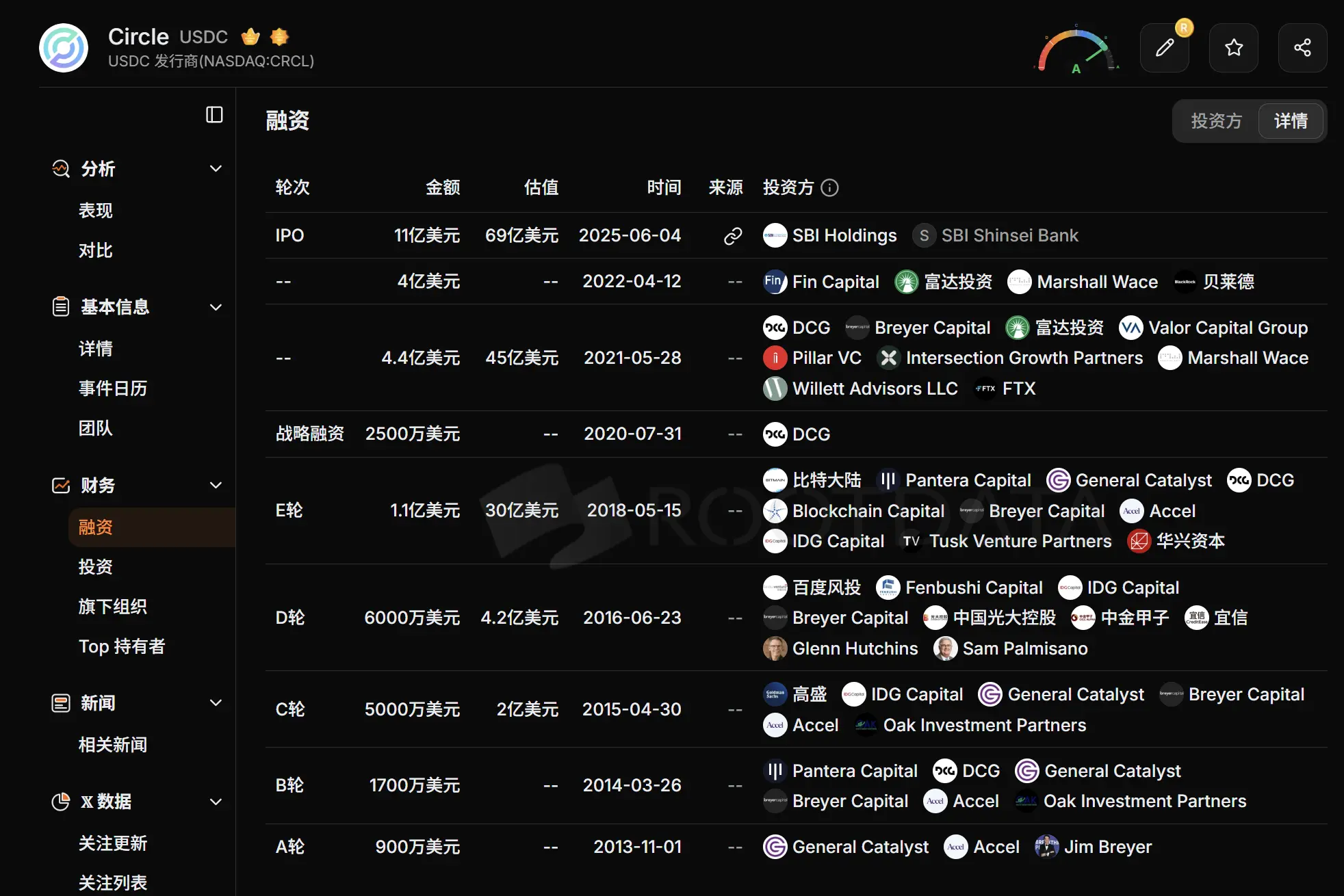
Circle's Financing History Source: RootData

For an investor like Duan Yongping who emphasizes the "essence of business," Circle has finally begun to take on a "understandable" form.

At the end of April, Circle also announced that its Layer 1 network, Arc, completed a token pre-sale financing round of $222 million, valuing it at $3 billion. a16z led a $75 million investment, with participation from more than ten institutions including BlackRock, Apollo Funds, Intercontinental Exchange (ICE), Standard Chartered Ventures, ARK Invest, and Bullish.

The expansion into the public chain network and the issuance of a native token have further opened the ceiling for Circle's business, and its stock price has risen accordingly. In May, Circle's stock price surged nearly 3 times from its yearly low ($50), briefly breaking through $140, and has since retreated slightly to around $111.

Traditional Finance is Increasingly Accepting Crypto Assets

Today, more and more crypto companies are attempting IPOs. From exchanges and stablecoin issuers to on-chain payment and custody infrastructure, many crypto enterprises are actively entering traditional capital markets, hoping to gain more stable financing channels, a broader institutional shareholder base, and stronger regulatory legitimacy.

At the same time, traditional financial giants are also entering the crypto space at an unprecedented pace. Whether it's BlackRock promoting Bitcoin ETFs, traditional banks exploring stablecoin settlement and on-chain asset custody, or payment institutions integrating with the USDC network, it essentially illustrates one thing:

The crypto industry is no longer just an independently existing "alternative market," but is beginning to integrate deeply with the global financial system.

In this process, stablecoin companies like Circle are becoming the bridge most easily understood and accepted by traditional capital.

The significance of Duan Yongping's purchase of Circle lies precisely here. It may not mean he is fully bullish on Web3, nor does it mean the value investing system is embracing all crypto assets. But at the very least, it shows that stablecoins and the on-chain dollar system have begun to enter the "circle of competence" of some traditional top-tier investors.

From a broader perspective, Circle is just one of the pioneers being "translated" by traditional mainstream capital from the crypto industry. As regulatory frameworks gradually become clearer, infrastructure matures, and profit models are continuously validated, more crypto-native enterprises like Circle will likely enter the view of traditional capital markets in the future.

Perguntas relacionadas

QWhat is the significance of Duan Yongping's first investment in a crypto company, Circle, according to the article?

AThe article states that while the investment amount is small relative to his portfolio (0.2%), it is highly symbolic. It signifies that a traditional, Buffett-style value investor, who emphasizes investing in understandable businesses with strong moats and good cash flow, has found a crypto company (Circle) that fits his investment criteria. This reflects a potential bridge between traditional finance and the crypto sector.

QWhy did Duan Yongping historically avoid most crypto investments, and how is Circle an exception?

ADuan Yongping avoided most crypto investments because they often did not meet his value investing criteria: they lacked predictable long-term cash flows, had fragile business models dependent on token prices, and operated in a space with high regulatory uncertainty. Circle is an exception because its core business model, issuing the stablecoin USDC and earning interest from reserve assets, is more akin to a financial infrastructure company or a 'digital dollar bank' with predictable and profitable cash flows.

QWhat are the key financial metrics from Circle's latest quarterly report that likely made it attractive to a value investor?

ACircle's Q1 report showed total revenue of $694 million (up 20% YoY), with 94% coming from reserve interest income. Adjusted EBITDA was $151 million (up 24% YoY). Key operational metrics also grew: USDC circulation reached $77 billion (up 28% YoY) and USDC on-chain transaction volume surged to $21.5 trillion (up 263% YoY), demonstrating a scalable and profitable 'stablecoin interest machine'.

QHow does Circle's recent funding round for its Layer 1 network, Arc, relate to its business prospects and stock performance?

AIn late April, Circle announced a $222 million token pre-sale for its Layer 1 network Arc, valuing it at $3 billion, with backing from major firms like a16z, BlackRock, and Apollo. This expansion into a blockchain network and native token opens up new growth avenues for Circle, increasing its business ceiling. Subsequently, Circle's stock price rose significantly in May, nearly tripling from its yearly low to briefly surpass $140.

QWhat broader trend in the finance industry does Duan Yongping's investment in Circle represent?

AIt represents the increasing integration of the crypto industry with the traditional financial system. More crypto companies are seeking IPOs for legitimacy and funding, while traditional finance giants like BlackRock are entering the crypto space (e.g., via Bitcoin ETFs). In this context, stablecoin companies like Circle, which function as financial infrastructure, are becoming the most understandable and acceptable bridge for traditional capital, signaling a wider acceptance of certain crypto-native business models.

Leituras Relacionadas

Xiaohongshu's Second Great Voyage, This Time Sailing Towards AI

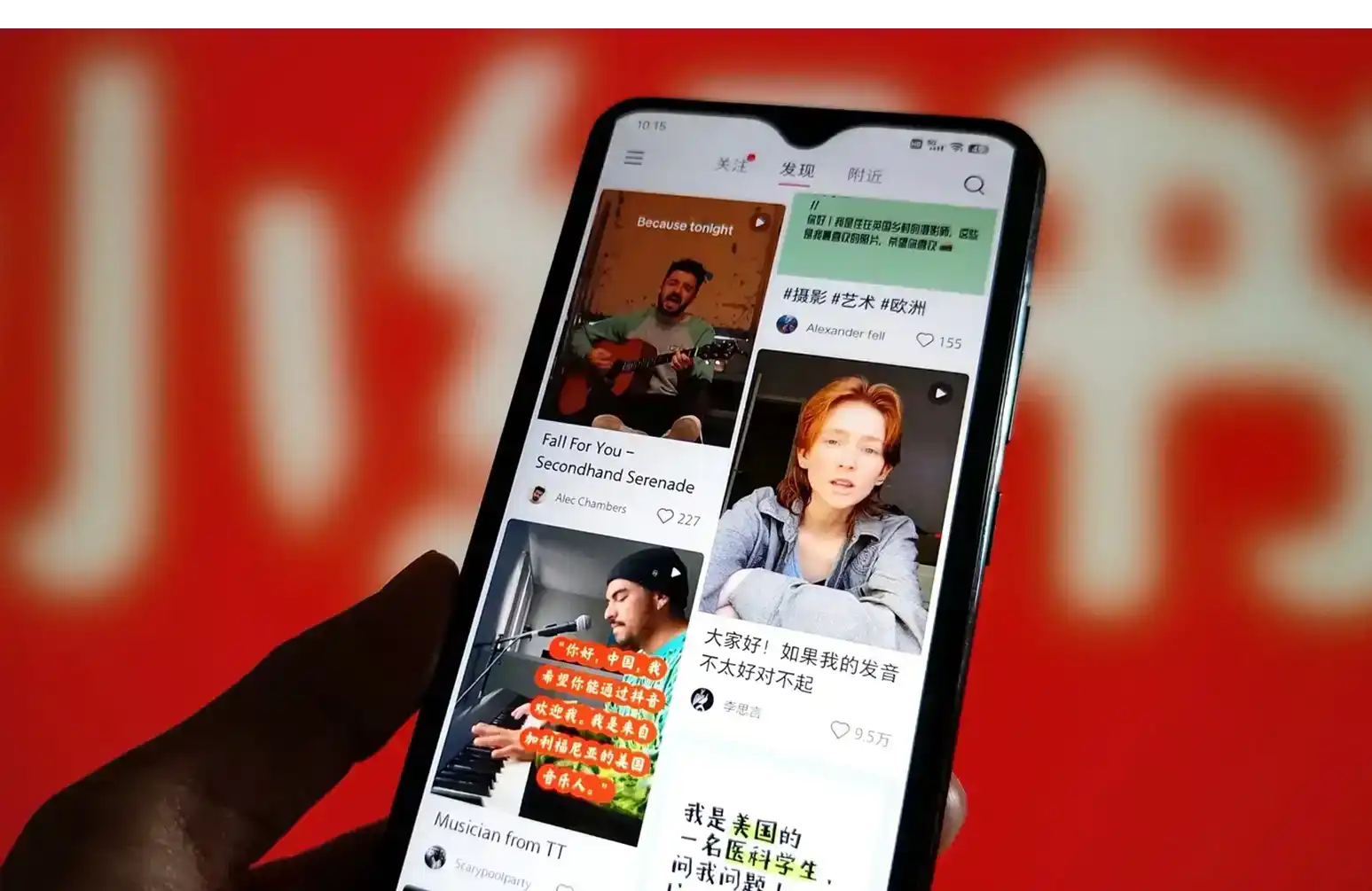
Xiaohongshu's Second Voyage: Navigating Towards AI Since ChatGPT's emergence, Xiaohongshu's founder Mao Wenchao has been acutely aware of AI's potential threat, recognizing that the life advice people seek from chatbots overlaps directly with his platform's core business. Founded in 2013 as a PDF shopping guide for Chinese tourists, Xiaohongshu evolved into a massive community where millions share authentic, personal experiences—from product reviews to travel tips. This vast repository of "I've tried this" human judgment became its most valuable asset. However, the rise of AI, which delivers instant answers, challenges the very need for users to sift through numerous personal notes. Fearing its treasure trove of lived experience could become mere training data for others, Xiaohongshu is proactively adapting. In 2026, it established a dedicated AI division (Dots), launched RED Skill to turn user experiences into usable AI tools, and acquired the AI search product "Diandian." Its investments now extend to AI firms like MiniMax and hardware startups, moving upstream to address needs before they even become search queries. The platform's commercialization strategy is also evolving. With a newly acquired payment license and tools like the AIPS model to track consumer decision journeys, Xiaohongshu aims to seamlessly integrate recommendations with transactions, embedding commerce within AI-generated answers. Yet, a critical tension remains. While building smarter machines to organize and leverage its human experiences, Xiaohongshu must prevent AI from drowning out the authentic, flawed, and trustworthy "I've tried this" voices that built its community. Its core challenge is to harness AI's power without letting the map—the machine's perfect, synthesized answer—replace the territory of genuine human experience. This balance between technological advancement and preserving human trust defines its current journey and its future.

marsbitHá 21m

Xiaohongshu's Second Great Voyage, This Time Sailing Towards AI

marsbitHá 21m

SharpLink CEO: How to Understand Ethereum Developers Just Exceeded 1 Million?

SharpLink CEO reflects on the milestone of Ethereum surpassing 1 million historical developers, emphasizing that this figure represents the largest pool of technical talent ever assembled around an open, permissionless blockchain network. While approximately 232,000 developers remain active, the key question for the crypto industry is not which chain is fastest, but where the best builders choose to build long-term. Ethereum's advantage lies in a decade-long accumulation of infrastructure, standards, tools, liquidity, and a cohesive culture, making it the default operating system for programmable finance. This developer base is tackling complex challenges: the Glamsterdam upgrade aims to enhance scalability while preserving core principles; synchronous composability seeks to unify Rollup ecosystems; and significant efforts are underway for post-quantum security. Ethereum's deeper network effects stem from composability and shared standards (like the EVM and Solidity), creating a flywheel of more developers, tools, and liquidity. Three reinforcing strengths cement Ethereum's lead: credible neutrality (secured by ~900k validators), a modular architecture with interconnected Rollups, and a culture that attracts top researchers. The ecosystem is consolidating as the trusted coordination layer for internet-native finance, favored by large institutions valuing security and liquidity. The future of Ethereum is being built by this global community of founders and architects.

链捕手Há 35m

SharpLink CEO: How to Understand Ethereum Developers Just Exceeded 1 Million?

链捕手Há 35m

A Clod of Chinese Soil Chokes Two Japanese Giants

"Chinese Soil Chokes Japanese Giants" The production of a key electronic specialty gas, tungsten hexafluoride (WF6), vital for manufacturing AI chips, was halted by two leading Japanese producers—Kanto Denka and Central Glass. Their shutdown was not due to a technological failure but a sudden, critical shortage of a raw material they had long taken for granted: ultra-high-purity (6N-grade) tungsten powder, which is almost entirely sourced from China. Following a quiet Chinese export announcement in January 2026, tungsten powder shipments to Japan dropped to zero for months. Despite frantic efforts, Japanese companies found no viable alternative; imported powder was three times more expensive and lacked the required purity. Their existing stockpiles were exhausted by mid-2026. WF6 is essential for depositing tungsten into the microscopic contact holes of High Bandwidth Memory (HBM) chips, which are crucial for advanced processors like those from Nvidia. While Japanese firms had mastered producing ultra-pure WF6 gas, their entire supply chain relied on China's 6N tungsten powder—a dependency now revealed as a fatal vulnerability. China's dominance in this "soil" results from decades of painstaking R&D by companies like Xiamen Tungsten and China Tungsten & Hightech. They overcame immense technical hurdles, such as separating chemically similar molybdenum from tungsten, to achieve mass production of the world's purest tungsten powder. With their primary suppliers gone, Kanto Denka and Central Glass announced a permanent halt to WF6 production starting July 1, 2026. This immediately created a supply crisis for major semiconductor manufacturers like Samsung and SK Hynix, forcing them to urgently seek and certify new Chinese suppliers for WF6 itself. The reversal marks a dramatic shift: China has moved from exporting low-value raw materials to controlling the high-purity foundation of a critical global tech supply chain, upending a long-established industrial hierarchy.

marsbitHá 1h

A Clod of Chinese Soil Chokes Two Japanese Giants

marsbitHá 1h

Trading

Spot
Futuros
活动图片