Dragonfly Partner Haseeb: The Fastest-Growing Companies of the Future May All Get Stuck at 149 Employees

marsbitPublicado em 2026-06-24Última atualização em 2026-06-24

Resumo

Dragonfly partner Haseeb explores the distorted economics of AI model pricing, drawing parallels to tax policy. He notes that startups and small teams (under 150 users) enjoy heavily subsidized, fixed-price AI subscriptions (like Claude Code), where the marginal cost of an additional token is effectively zero. This creates a powerful incentive for them to maximize token usage ("token-maxxing") and innovate aggressively with AI automation. In contrast, large enterprises (over 150 users) are forced onto "Enterprise" plans, paying per-token API fees with high (~75%) markups. This acts like a steep "tax" on AI-powered labor, disincentivizing marginal automation and experimental use, and encouraging them to retain more human workers. Haseeb argues this pricing creates a "150-person cliff," a regulatory notch similar to labor laws in France that discourage firms from growing past 50 employees. He predicts the fastest-growing future companies may deliberately cap their headcount at 149 to avoid the punitive enterprise pricing. This would foster an "AI-first" management philosophy obsessed with automation and outsourcing to stay lean. While not intentionally designed, this bifurcated pricing could become one of the most influential de facto tax policies, shaping how AI replaces labor—not through mass layoffs at big firms, but through agile, AI-native startups outcompeting them.

Author: Haseeb

Compiled by: Jiahuan, ChainCatcher

@SemiAnalysis_ recently discovered an incredible phenomenon in the economics of AI programming subscriptions. If you max out usage, the fee you pay is actually 20 to 70 times cheaper than buying tokens through the API.

Many see this and say: My God, look at how much these LLM companies are subsidizing tokens. The bubble is bound to burst soon.
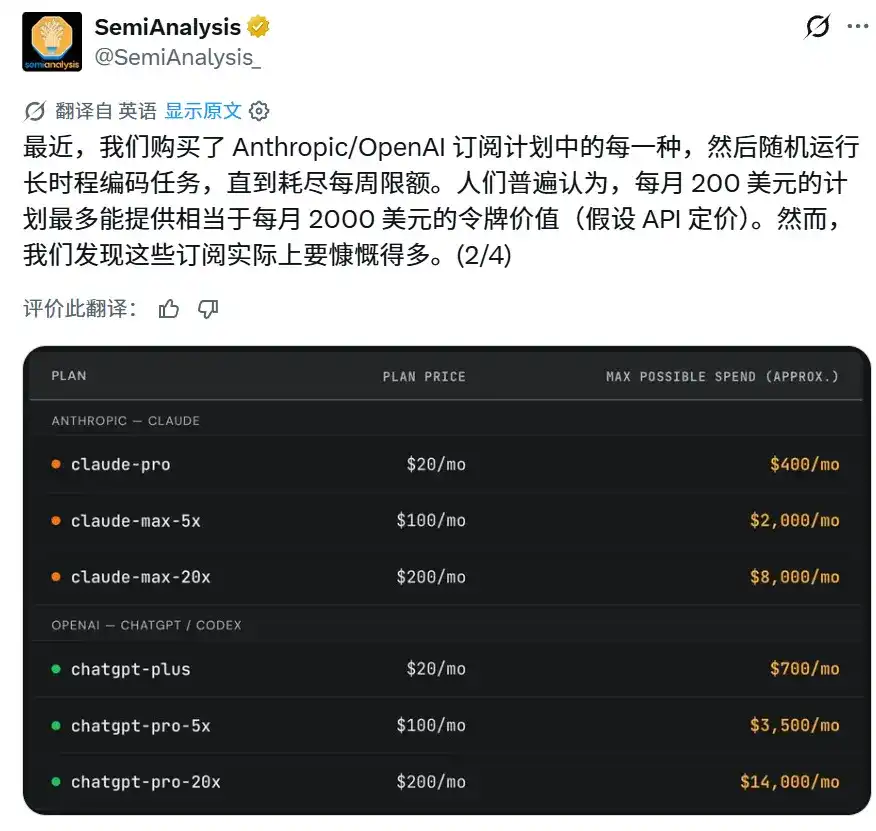
This reaction is wrong. LLM companies are willing to offer such generous packages precisely because most users rarely hit the ceiling. The product is like a gym membership: generous allowances exist because the vast majority of people hardly use them.

But I've spent a long time pondering this; there is something odd here.

We don't know their actual blended margins on subscriptions, but according to SemiAnalysis, at 20% average utilization, Anthropic's Max 5x plan barely breaks even. A 20% utilization rate might even be optimistic, especially in organizations where everyone (including non-programmers) has a subscription but only uses it occasionally. Most institutions I know, including Dragonfly, are generous with Claude Code subscriptions and encourage non-technical staff to try them.

But what SemiAnalysis didn't delve into is that this is purely a small business phenomenon. Large enterprises cannot use this subscription pricing.

Here's why: When you reach 150 people or more, you are forced out of the "Team" subscription model. You must switch to "Enterprise," priced at a base of $20 per seat plus API fees based on actual token usage. Enterprises pay linearly for token costs, and SemiAnalysis estimates API token gross margins to be around 75%. This is a massive price hike that kicks in suddenly at 150 people.

So, if you are a small business or startup (or an individual), your perception of AI spending is distorted. Your token pricing is actually heavily subsidized; Anthropic likely maintains extremely low or even negative margins on you.

You might wonder why Microsoft and Uber fret so much about token spend and talk about "token-mining." That's the reason. Their structural cost per token is much higher than for startups and individuals.

But Anthropic doesn't care! For a B2B company, extracting maximum value from small companies or individuals isn't very meaningful. Look at companies like Datadog or Cloudflare; 80% to 90% of their revenue comes from large contracts (annual recurring revenue over $100,000). Making zero profit on the long tail is just a customer acquisition cost.

This is classic B2B sales thinking.

But there's another way to view the same situation: through the lens of tax policy.

Because if tokens are replacing labor, then the gross margin OpenAI and Anthropic charge on tokens is essentially a tax on AI labor.

Viewing token pricing this way leads to two major consequences.

Token Pricing as Tax Policy

Assuming the profit margins in the SemiAnalysis article hold: subscriptions break even, large enterprise API gross margin is 75%. The initial reaction is to call this a 75% AI labor tax on large organizations, and a 0% tax on startups.

Standard tax analysis would say this discourages large companies from using AI labor internally, pushing them on the margin to reduce automation and retain more human labor. (Obviously, it also encourages using smaller or open-source models, but the net effect is both are incentivized. Remember, we're talking about the margin here.)

However, what drives behavior more strongly is not the average tax rate. In tax policy, it never is. What we really care about is the marginal tax rate.

For startups on flat-rate subscriptions, the marginal price of the next token is zero until they hit the cap. And a zero marginal price creates the maximum possible distortion a policy can create.

For startups, the subscription model is basically an innovation subsidy. The overwhelming incentive is to figure out how to spend the entire token budget as efficiently as possible. This means running Ralph loops, filling screens with Claude Code sessions, scheduling swarms of agents to work together.
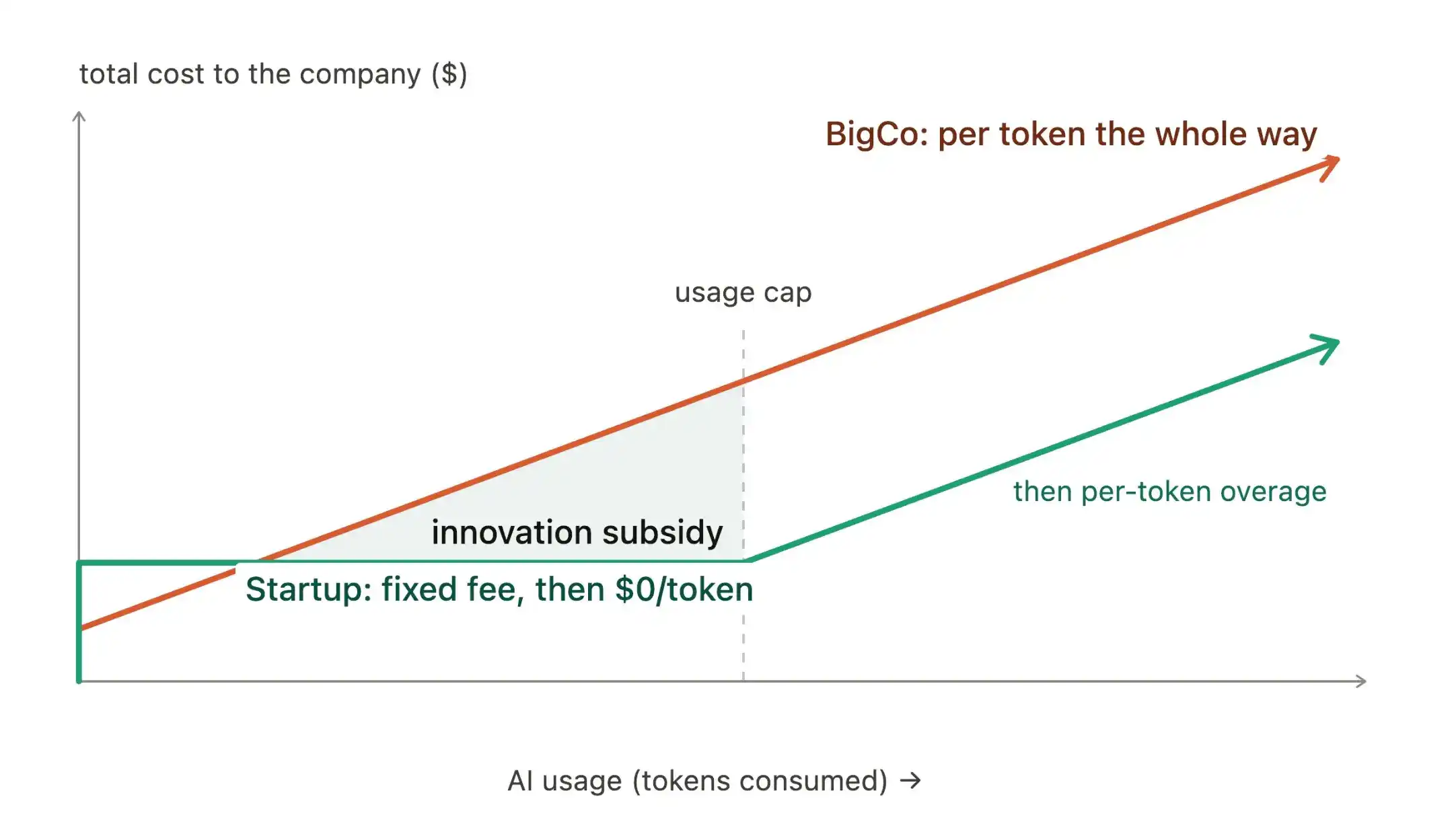
Until the cap is hit, exploration is free. So startups are essentially racing to squeeze the last drop of value from their subscription, out-producing each other. Paradoxically, the more you use, the lower the average token price. Every startup wants to be the one making Anthropic lose the most on subscriptions.

Large enterprises face the opposite incentive. If you exceed 150 seats, every exploratory token is charged at full mark-up (plus a 75% surcharge!). So every step they take exploring the frontier is linearly punished.

Big companies will still automate large, obvious bulk tasks. But marginal, experimental, risky automation will never be discovered because the cost of discovery is too high. This tax structure ultimately encourages them to retain more human labor, preserving their overall organizational structure.

This is the opposite of Japan. Due to a declining population, Japan faces a huge labor shortage. Historically, this meant Japan pursued intense automation, as high human costs incentivized it. That's why Japan has robots in restaurants, factories, hotels, hospitals.

But, strangely, large enterprises find themselves in the opposite dilemma of Japan: if they have to pay an extremely high tax to use AI, it weakens the incentive to automate, strengthening the motivation to retain existing employees (even more so if wages stagnate during this period).

So where does labor substitution flow in this model?

Everyone is staring at big companies, waiting for AI layoffs. But with a 75% tax, aggressively replacing your own employees with AI may simply be uneconomical; token budgets would explode.

But this doesn't mean substitution won't happen; it just manifests differently.

When big firms lose market share to AI-native startups with minimal blended human labor costs, the big firms' revenue and stock price declines trigger layoffs. But those eliminated jobs never reappear at the winning startups. The net reduction effect is the same; this employment gap is just transferred to a lower-taxed part of the economy.

This is also why "AI-washing" (portraying ordinary layoffs as newfound AI efficiency) may not be a flash in the pan. AI-washing is when a company attributes layoffs to AI efficiency, but is actually just masking ordinary business weakness.

Many think this is just a blip in the current AI hype cycle. But even though everyone is primed to witness big companies doing real AI layoffs, "replacing jobs" with AI, that may never happen at scale.

Labor substitution might unfold a different way: startups beat incumbents, incumbents disguise their decline with AI-washing all the way to death, and the startups never rebuild those old jobs. Job substitution still happens, just not where everyone is looking.

That's the first consequence of this model. But there's a second, even weirder consequence.

The 150-Person Cliff

A regulatory notch is a regulatory boundary that induces huge behavioral jumps. Example: the 30-hour-a-week full-time employment threshold, which created tons of jobs that exactly clocked 29 hours a week.

France famously has extremely rigid labor laws that kick in once a company hits 50 employees (works councils, mandatory profit-sharing, firing protections). Smaller companies are exempt. This gives employers a huge incentive to desperately stay below 50 people.
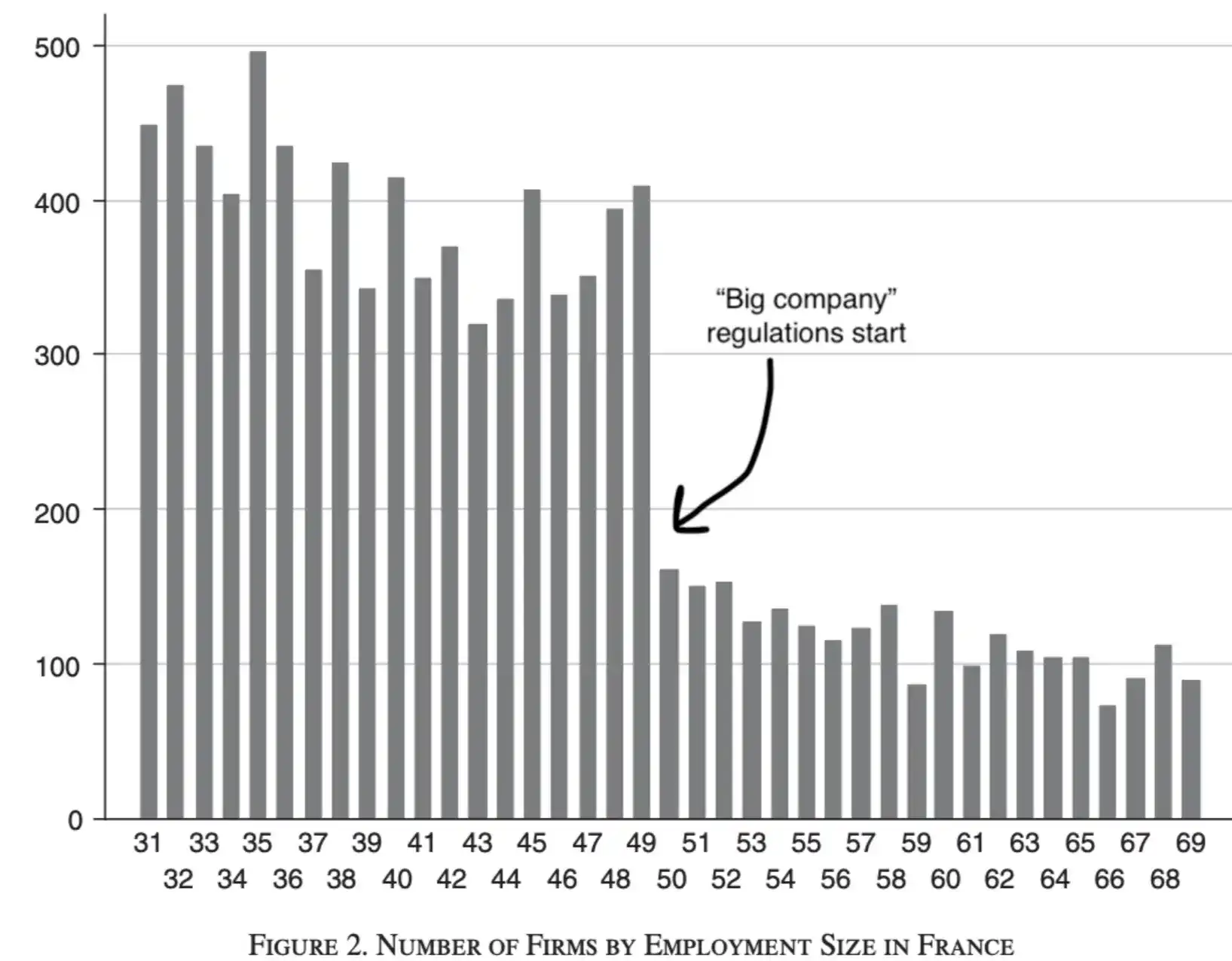
Source: Garicano, Luis, Claire Lelarge, and John Van Reenen, 2016, Firm Size Distortions and the Productivity Distribution: Evidence from France.

Extend this analogy to AI. LLM companies have established a tax threshold that punishes companies exceeding 150 seats. This means you must stay small to keep that wonderful subsidized subscription price, taxing tokens at ~0% (or even negative) rather than 75%.

This could spawn an entirely new management philosophy for companies. Startups will become increasingly obsessed with solving everything with agents, smaller teams, more frequent layoffs, more outsourcing, doing everything possible to keep human-touch points to an absolute minimum.

Not because it's the "optimal" level of automation, but because the incentives force them there. If the magic number is 149, then every seat is precious; you can't afford to waste a single person outside the core joints of the company.

This cliff might be touted by Harvard Business School types as "the new wave of AI-first management." But properly understood, it's just a rational response to enterprise pricing schemes.

This might sound exaggerated. But you can already see the behavioral divergence across organizations. Talk to developers at big companies; they are carefully counting tokens, increasingly anxious about leadership cutting token budgets. Meanwhile, developers at startups are furiously maxing out usage (tokenmaxxing), launching swarms of agents overnight, and checking logs in the morning. I expect this trend to accelerate.

No one designed this intentionally. No committee decided to subsidize innovation for startups and tax incumbents. It all follows directly from tried-and-true traditional enterprise pricing strategies.

But this is how tax laws have always been: a bunch of ancillary rules that ultimately determine which companies can be built, and how those companies distort themselves to minimize their tax burden.

You might argue this is temporary; LLM companies will eventually meter everyone. GitHub Copilot already made this shift. Maybe, maybe not. But before pricing normalizes, 149-person companies and this new wave of AI-first management may have already exploded, gobbled up market share, and written the playbook for the next generation of startups.

Tax policy is crucial. The entire "gig economy" concept only exists because of the legal line between W-2 and 1099. As more and more labor is eaten by AI, token pricing may be the most impactful tax policy of the next decade. Yet no one will ever vote on it.

(Don't be surprised if the fastest-growing companies of the next cycle are all conspicuously stuck at 149 seats.)


Perguntas relacionadas

QWhat is the core observation about AI pricing models that Haseeb discusses in the article?

AHaseeb discusses how AI model companies (like Anthropic) have tiered pricing that creates a significant 'cliff effect.' Small startups and individuals can access a generous 'Team' subscription model with a fixed price, effectively subsidizing their token usage. However, once an organization grows beyond approximately 150 seats, it is forced onto an 'Enterprise' pricing model where tokens are billed at full cost with high (75% estimated) margins. This acts like a tax, creating vastly different economic incentives for small companies versus large enterprises.

QHow does the 'Team' subscription model affect the behavior of startups, according to the article?

AThe 'Team' subscription model offers a fixed price for a large token allowance, making the marginal cost of an additional token effectively zero until the cap is reached. This creates a powerful incentive for startups to 'tokenmaxx'—meaning they are encouraged to experiment freely, use as many tokens as possible, and aggressively automate tasks to extract maximum value from their subscription. It acts as a subsidy for innovation, pushing startups to find the most efficient ways to consume their entire token budget.

QWhy might large enterprises not rapidly replace human workers with AI automation, based on the article's analysis?

ALarge enterprises are subject to the 'Enterprise' pricing model, where each additional token incurs a high marginal cost (with an estimated 75% margin for the provider). This makes the exploration and marginal application of AI for automation expensive. Therefore, while they may automate obvious, high-volume tasks, the high 'tax' on AI labor discourages them from pursuing riskier, experimental, or extensive automation. The economic incentive is to retain existing human labor, as aggressively replacing it with AI would cause their token budget to 'explode' in cost.

QWhat is the '150-person cliff' and what potential consequence does the article suggest it could lead to?

AThe '150-person cliff' refers to the pricing threshold where a company must switch from the subsidized 'Team' plan to the costly 'Enterprise' plan. The article suggests this creates a powerful incentive for AI-native companies to deliberately stay below this size (at or near 149 employees) to maintain their low-cost AI access. This could lead to a new management philosophy where companies are 'obsessed' with using AI agents for everything, minimize human headcount through frequent layoffs and outsourcing, and structure themselves to be extremely lean to avoid crossing the pricing cliff.

QWhat broader economic parallel does the article draw between AI token pricing and traditional policy?

AThe article draws a parallel between AI token pricing and traditional tax policy. The tiered pricing structure (subsidized for small companies, high-margin for large ones) functions as a de facto tax on AI labor. Just as tax codes create incentives and distortions (like companies limiting employee hours to avoid benefits), the AI pricing model creates 'regulatory notches' that shape corporate behavior. The author argues this unlegislated 'tax policy' could become one of the most influential forces shaping the economy in the coming decade by determining which types of companies thrive and how they are structured.

Leituras Relacionadas

MSTR Discloses Sale of 3,588 Bitcoins, Stock Price Drops Over 5% at One Point During Trading

MicroStrategy, the world's largest corporate holder of Bitcoin, has significantly shifted its business model. Between June 29 and July 5, the company sold 3,588 bitcoins for approximately $216 million to fund quarterly dividends for its preferred stock. This marks its largest-ever Bitcoin sale and signals a strategic pivot: Bitcoin is transitioning from a "buy-and-hold" reserve asset to a liquidity management tool for the company. This move follows a recent authorization allowing Bitcoin sales when equity fundraising is less attractive. The announcement contributed to a more than 5% intraday drop in MicroStrategy's stock price, while Bitcoin fell to around $61,800—below the company's average holding cost of roughly $75,700. The sale represents a major departure from MicroStrategy's long-standing "never sell" commitment, which saw its first minor breach in May with a $2.5 million sale. The latest, hundred-times-larger transaction underscores growing financial pressures. Analysts note the company faces about $1.5 billion in annual preferred dividend obligations, far exceeding cash flow from its software business. As of July 5, MicroStrategy holds 843,775 bitcoins. Its current operational logic involves buying Bitcoin during favorable financing conditions and selling portions to cover dividends when needed, creating a flexible capital management cycle amidst a challenging market environment.

华尔街日报Há 4h

MSTR Discloses Sale of 3,588 Bitcoins, Stock Price Drops Over 5% at One Point During Trading

华尔街日报Há 4h

Q-Day Countdown: Will Quantum Computing End Cryptocurrencies?

Quantum Computing's Threat to Cryptocurrency: A Countdown to Q-Day Quantum computing, specifically Shor's algorithm, poses a fundamental threat to the public-key cryptography (e.g., ECDSA, RSA) that secures blockchain networks like Bitcoin and Ethereum. This critical juncture, known as Q-Day, is estimated to occur potentially within the next 5-15 years. The core vulnerability stems from the public and immutable nature of blockchains. Assets in addresses where the public key is already exposed on-chain (e.g., spent outputs) are at direct risk, as a sufficiently powerful quantum computer could derive the private key. This threatens the very trust model of cryptocurrencies. The response lies in Post-Quantum Cryptography (PQC)—algorithms like lattice-based ML-DSA and hash-based SLH-DSA, which are resistant to quantum attacks. NIST has standardized key PQC algorithms (FIPS 203, 204, 205), providing a migration path. However, the primary challenge is not technical but socio-economic and involves complex governance: * **Bitcoin's** path is constrained by its conservative ethos. Migrating requires a soft-fork to new address types, facing hurdles like significantly larger signature sizes and, most critically, the divisive governance question of how to handle at-risk legacy UTXOs without violating core principles. * **Ethereum** is pursuing a "cryptographic agility" strategy, with a multi-layered roadmap. It leverages account abstraction for user accounts and is developing compressed hash-based signatures (e.g., leanXMSS) for its consensus layer, aiming for a full-stack upgrade over time. In conclusion, quantum computing does not spell an instant end for cryptocurrency but initiates a critical countdown. The industry has a limited "engineering comfort window" to orchestrate a coordinated, ecosystem-wide migration to PQC. The ultimate bottlenecks are the immense coordination efforts and governance decisions required for this foundational transition.

marsbitHá 4h

Q-Day Countdown: Will Quantum Computing End Cryptocurrencies?

marsbitHá 4h

Trump, the President Who Knows Best How to 'Trade Stocks'

Former US President Donald Trump reported a record-breaking $2.2 billion in personal income for 2025, the highest annual income ever disclosed by a sitting president. This figure, from a 927-page government ethics filing, represented a 3.5-fold increase from his $600 million income in 2024 and boosted his net worth to $6.5 billion. The primary drivers were cryptocurrency (64% of income, approximately $1.4 billion) and real estate (26%, approximately $575 million). His crypto earnings stemmed largely from the launch of his personal meme coin, $TRUMP, generating over $600 million in licensing fees, and substantial profits from the WLFI token and its parent company. Despite a sluggish property market, his Mar-a-Lago resort and associated golf clubs saw revenue surges of 50% and 27%, respectively, attributed to their use as venues for presidential events. Trump's financial disclosure also revealed an unprecedented level of stock market activity, with over 22,000 trades executed in 2025, averaging 87 trades per market day. Media analyses noted several instances where significant trading coincided with major policy announcements, such as proposed tariffs, raising questions about potential conflicts of interest. While the White House stated these trades were handled by a family-managed trust fund and not Trump directly, critics highlighted this as a departure from the blind trusts traditionally used by presidents post-Watergate. The report has intensified debate over the commercialization of the presidency. Supporters view it as a success story of a businessman-president, while critics argue it demonstrates an unprecedented conversion of public influence into private wealth, with policy decisions potentially linked to personal financial gains. The controversy centers on whether Trump's earnings represent innovative entrepreneurship or a fundamental conflict of interest, sparking renewed calls for stricter ethics reforms in US governance.

marsbitHá 5h

Trump, the President Who Knows Best How to 'Trade Stocks'

marsbitHá 5h

Countdown to Q-Day: Will Quantum Computing End Cryptocurrencies?

The article explores the existential threat quantum computing poses to cryptocurrencies and the urgent need for "post-quantum" migration. It outlines that quantum computers, through Shor's algorithm, could break the elliptic-curve cryptography (ECC) underlying blockchain security, potentially allowing private keys to be derived from public keys. The core challenge is not a lack of post-quantum cryptography (PQC) standards—like NIST's ML-KEM and ML-DSA—but the immense complexity of upgrading entire ecosystems before "Q-Day" (when quantum computers become capable of such attacks, estimated around 2035-2045). Key points include: * **Bitcoin's** risk is concentrated in legacy UTXOs with exposed public keys (e.g., early P2PK outputs). Migration faces massive hurdles: PQC signatures are much larger, increasing transaction size and cost, and the governance dilemma of handling un-migrated assets threatens its "code is law" ethos. * **Ethereum's** strategy focuses on "cryptographic agility," using Account Abstraction for user accounts and developing compressed hash-based signatures (like leanXMSS with SNARK aggregation) for consensus. Its migration is a complex, full-stack overhaul of execution, consensus, and data layers. * The "security debt" is enormous. The comfortable engineering window for a coordinated, ecosystem-wide upgrade is only 5-8 years. High-value infrastructure (exchanges, bridges) may face pressure before mainnet protocols. In conclusion, quantum computing is not an instant "doomsday" event but a forcing function for systemic change. Bitcoin's ultimate test is social consensus and property rights governance, while Ethereum's is technical complexity. Failure to migrate in time could lead to a fundamental re-pricing of crypto assets.

链捕手Há 5h

Countdown to Q-Day: Will Quantum Computing End Cryptocurrencies?

链捕手Há 5h

Trading

Spot
活动图片