DraftKings eyes crypto offerings as it expands into prediction markets

cointelegraphPublicado em 2025-12-19Última atualização em 2025-12-19

Resumo

DraftKings is expanding beyond sports betting into prediction markets with its new DraftKings Predictions app, which allows users to trade contracts on sports and financial outcomes. Initially available in 38 states, the company plans to eventually include crypto-linked contracts, as well as entertainment and cultural events. The trading operates through Railbird Exchange, a CFTC-regulated derivatives venue, providing a established regulatory framework. This move aligns with a broader trend of prediction markets gaining mainstream traction in the U.S., driven by platforms like Polymarket and Kalshi. Other crypto-native firms, including Coinbase and Gemini, are also entering the prediction market space.

DraftKings is expanding beyond sports betting into the realm of prediction markets, laying the groundwork for future crypto-linked contracts as regulated event trading gains momentum in the United States.

As Bloomberg reported, the company announced on Friday that it has launched the DraftKings Predictions app, which allows users to trade contracts on sports and financial outcomes. At launch, the app is available in 38 states, with sports-related trading permitted in 17 of them.

DraftKings ultimately plans to expand its prediction market offerings beyond sports and finance to include contracts linked to crypto, entertainment and cultural events, according to Bloomberg.

DraftKings’ push into prediction markets is underpinned by regulated derivatives infrastructure connected to CME Group–style market standards.

The company said trading will be conducted through Railbird Exchange, a derivatives venue it acquired and which is registered with the US Commodity Futures Trading Commission, allowing DraftKings to offer event-based contracts within an established regulatory framework.
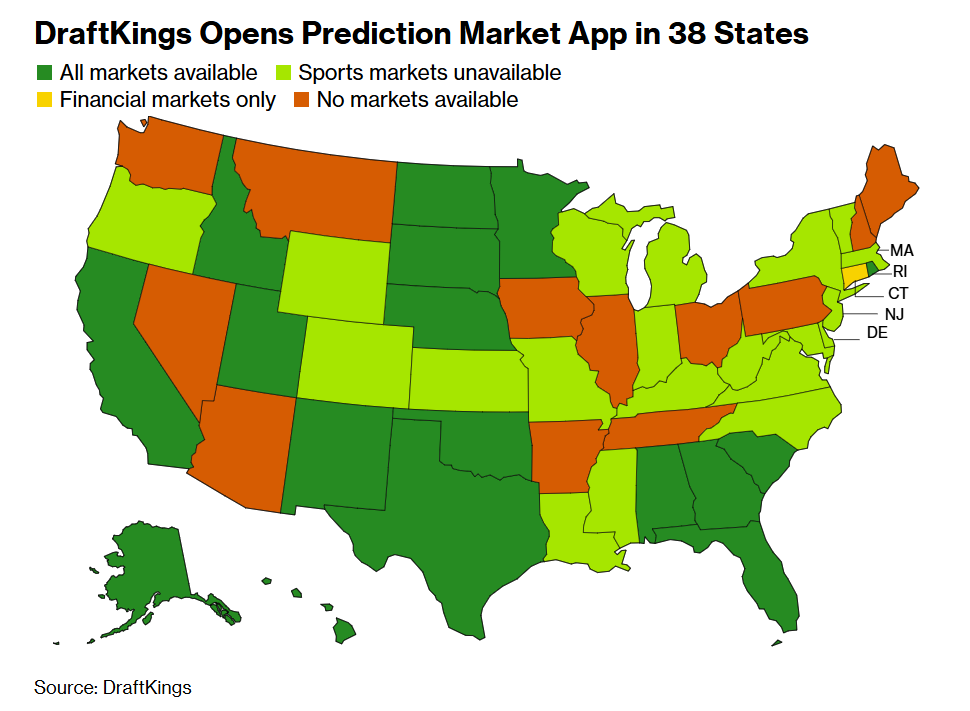
DraftKings’ growing national footprint. Source: Bloomberg

As a publicly traded US-based sports betting and entertainment company, DraftKings brings increased visibility and mainstream exposure to prediction markets and potentially crypto-linked contracts as regulated event trading gains traction in the United States.

In early November, DraftKings reported third-quarter revenue of $1.14 billion, up 4% year over year, alongside an adjusted loss of $127 million. The company said it expects to generate up to $6.1 billion in revenue this year, roughly triple the amount it generated in 2022.

Related: Polymarket shows stronger retention than most DeFi, wallets and exchanges

From Polymarket to Wall Street: Prediction markets go mainstream

While DraftKings’ prediction market offering is not built on blockchain or decentralized technology, the broader sector has gained momentum in recent years largely due to crypto-native platforms that redefined how prediction markets operate.

The most prominent example is Polymarket, which brought prediction markets onchain by using crypto rails to enable global participation and near-instant settlement.

The platform helped popularize prediction markets among crypto-native users, particularly during major political events and most notably the 2024 US presidential election. Its rise has coincided with growing interest in other event-based trading venues, including Kalshi, a US-regulated prediction market operating under the Commodity Futures Trading Commission (CFTC).

Beyond consumer-facing platforms, crypto-focused financial infrastructure providers are also expanding into the space. Bitnomial Clearinghouse, a derivatives clearing organization regulated by the CFTC, has signaled plans to support prediction markets tied to cryptocurrency and macroeconomic outcomes.

Crypto-native exchanges are also broadening their product suites to include prediction-style offerings. Coinbase recently announced plans to integrate stock trading and prediction markets into its long-term vision of becoming an “everything app.”

Source: Gemini

Meanwhile, the Winklevoss-led Gemini cryptocurrency exchange has launched prediction markets in the US, having secured the necessary regulatory approvals.

Related: Phantom taps Kalshi to offer regulated prediction markets in wallet

Perguntas relacionadas

QWhat new market is DraftKings expanding into, and what future offerings are they planning?

ADraftKings is expanding into prediction markets and is planning future crypto-linked contracts, as well as offerings related to entertainment and cultural events.

QThrough which regulated entity will DraftKings conduct its prediction market trading?

ADraftKings will conduct its trading through Railbird Exchange, a derivatives venue it acquired that is registered with the US Commodity Futures Trading Commission (CFTC).

QWhat is a key crypto-native platform that helped popularize onchain prediction markets?

APolymarket is the key crypto-native platform that helped popularize onchain prediction markets by using crypto rails for global participation and near-instant settlement.

QBesides DraftKings, name two other US-based companies or platforms mentioned that are involved in prediction markets.

ATwo other US-based companies involved in prediction markets are Kalshi, a CFTC-regulated prediction market, and the Gemini cryptocurrency exchange, which has launched its own prediction markets.

QWhat was DraftKings' reported third-quarter revenue and how does it compare to the previous year?

ADraftKings reported third-quarter revenue of $1.14 billion, which was up 4% year over year.

Leituras Relacionadas

US Senate Makes Important Amendments to "Conflict of Interest" Section of Cryptocurrency Bill

The U.S. Senate has taken a key step regarding the CLARITY Act, which could shape the future of the U.S. crypto market. On July 29, Senators Tom Tillis and Ruben Gallego finalized amendments to the bill's "conflict of interest" rules, one of its most contentious aspects. The bipartisan bill aims to tighten restrictions on high-level federal officials' ties to digital assets. The new text, crafted as an alternative to a White House-endorsed ethics code, is expected to impose stricter rules limiting officials' ability to issue or directly participate in digital asset projects. However, with Congress entering an August recess and the revised text not yet reviewed by much of the Senate, the bill's timeline is uncertain. Senate Majority Leader John Thune indicated a procedural vote could occur between July 29 and August 1 but expressed doubt the full bill could pass before the break. The House-approved CLARITY Act, passed in July 2025, has been under Senate negotiation for over a year. Key goals of the CLARITY Act include clarifying jurisdictional boundaries between the SEC and CFTC, setting rules for digital commodity spot markets, and addressing topics like stablecoin yields, DeFi, and illicit financing. The stablecoin yield provisions could significantly impact U.S.-based DeFi protocols, exchanges, and issuers, affecting their global competitiveness. The outcome is being closely watched by both the U.S. and global digital asset markets.

cryptonews.ruHá 5m

US Senate Makes Important Amendments to "Conflict of Interest" Section of Cryptocurrency Bill

cryptonews.ruHá 5m

Pavel Durov Designated as a Terrorist in Russia. What Does This Mean for Telegram Users?

Pavel Durov, the founder of Telegram, has been added to Russia's list of terrorists and extremists by Rosfinmonitoring, as published on July 30. The entry includes his name and date of birth. The designation follows an announcement by the Russian Federal Security Service (FSB) on July 29, which charged Durov with aiding terrorist activity. The FSB alleges that a Telegram dating bot named "DaiVinchik" was used to recruit 46 individuals for attacks on police and arson, orchestrated by Ukrainian special services. The FSB also accuses Telegram's administration of failing to remove channels and bots used by Ukrainian intelligence and extremist groups. Durov is reportedly subject to an international arrest warrant. Inclusion on the Rosfinmonitoring list leads to significant restrictions: the freezing of Durov's bank accounts and assets, severe limitations on financial transactions, and a ban on election participation, media interaction, and event organization. Transfers to his accounts may be considered terrorism financing. For ordinary Russian Telegram users, purchasing Telegram Premium is not classified as financing terrorism, according to an IT expert. General use of the messenger—messaging, managing channels—does not automatically make a user a participant in extremist activity. There has been no official decision to ban Telegram itself. It is noted that French authorities are also investigating Durov over allegations of inadequate measures against criminal activity on the platform and insufficient cooperation with law enforcement. Durov denies all charges.

cryptonews.ruHá 14m

Pavel Durov Designated as a Terrorist in Russia. What Does This Mean for Telegram Users?

cryptonews.ruHá 14m

Trading

Spot
活动图片