Don't Just Focus on Iran, the US Private Credit Crisis is Step by Step Repeating the 'Subprime Crisis'

比推Publicado em 2026-03-09Última atualização em 2026-03-09

Resumo

Amidst geopolitical tensions, a private credit crisis is rapidly unfolding within the US financial system, drawing parallels to the 2008 subprime mortgage crisis. Major asset managers are facing significant stress: BlackRock restricted redemptions from its $26 billion HPS Corporate Lending Fund (HLEND), capping repurchases at 5% despite 9.3% redemption requests to avoid forced asset sales. Similarly, Blackstone’s $82 billion private credit fund (BCRED) saw a record 7.9% in redemption demands, prompting internal capital injections to avoid gating. Blue Owl Capital, whose stock fell below its $10 SPAC IPO price, sold $1.4 billion in loans to manage redemptions, exacerbating liquidity fears. PIMCO issued a stark warning, predicting a "full default cycle" for direct lending due to relaxed underwriting standards, overexposure to the software sector (vulnerable to AI disruption), and insufficient liquidity compensation for investors. The crisis highlights structural vulnerabilities: semi-liquid funds offering quarterly redemptions are backed by long-duration private loans, creating a mismatch. Redemptions force asset sales, driving down valuations and triggering further withdrawals—a vicious cycle reminiscent of 2008. With the private credit market valued at $1.8 trillion, systemic risks from opacity, concentration, and liquidity mismatches are now under severe strain.

Source: Wall Street Insights

Original Title: Don't Just Focus on Iran, the US Private Credit Crisis is Step by Step Repeating the 'Subprime Crisis'


While market attention is focused on geopolitical risks, a quietly spreading private credit crisis is accelerating within the US financial system. Redemption waves, asset sell-offs, fund gating—this script, investors have seen it in 2008.

This week, the world's largest asset management company, BlackRock, announced restrictions on investor redemptions from its $26 billion HPS Corporate Lending Fund (HLEND), becoming the most impactful signal to date.

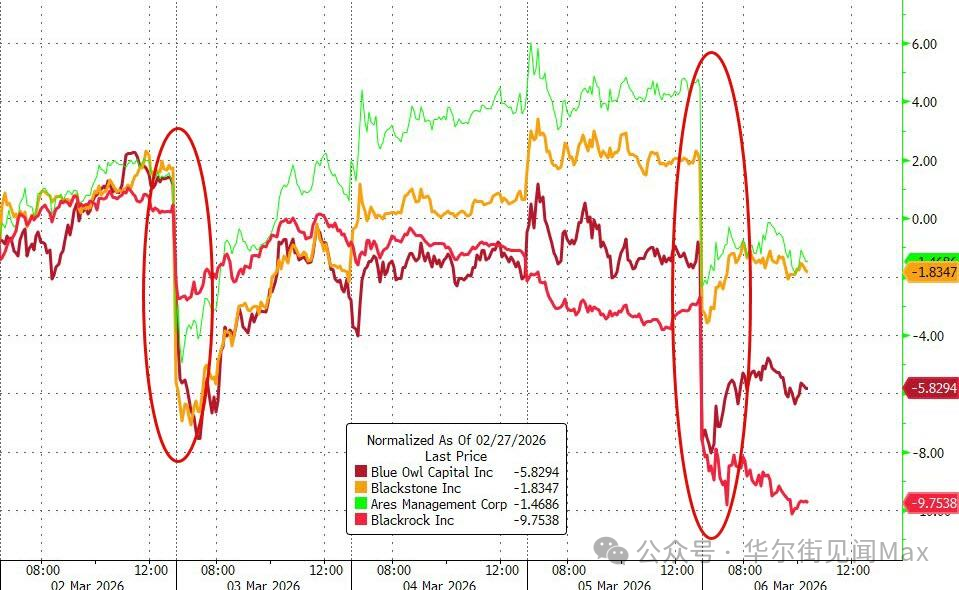
Previously, Blackstone's private credit fund faced a record 7.9% redemption request, and Blue Owl's stock price fell below its SPAC IPO price.

Three private credit giants sounding alarms in succession—the gears of a vicious cycle have already engaged.

Simultaneously, Pacific Investment Management Company (PIMCO) warned in its latest client report: the direct lending industry is about to face a "full default cycle," and stress testing is inevitable. This judgment comes from a long-time critic of private credit, and its weight cannot be ignored.

The spread of the private credit crisis is directly reflected in the stock price trends of related listed companies. Blue Owl's stock price fell below its SPAC issuance price, while private credit-related businesses of institutions like Blackstone and BlackRock face valuation pressure. The entire industry is undergoing a systemic reassessment of investor confidence.
01 Gating: BlackRock "Restricts Redemptions" for Its Private Credit Fund

According to a Wall Street Insights article, BlackRock stated in a declaration on Friday that shareholders of its HPS Corporate Lending Fund (HLEND) applied to redeem 9.3% of the shares this time, but the fund's management decided to set the repurchase上限 at 5%, approximately $12 billion.

BlackRock characterized this move in the statement as a "fundamental" arrangement for fund liquidity management, stating that without restrictions, a "structural mismatch" between investor capital and the duration of private credit loans would occur.

This wording sounds calm, but the market understood its implication: if redemptions were fully paid, BlackRock would be forced to initiate large-scale asset sales.

Previously, another private credit division under BlackRock had shown alarming signals—BlackRock TCP Capital Corp. reported in its Q4 report that it wrote down a $25 million loan to Infinite Commerce Holdings directly to zero from 100 cents, whereas just three months prior, the loan was marked at par value. From 100 to 0, three months, without warning.

02 Spreading Fire: The Vicious Cycle Triggered by Sell-offs

BlackRock's gating is not an isolated event, but the end point—or rather, a new starting point—of a fuse that has already been lit.

Three weeks ago, Blue Owl Capital took action first.

Faced with substantial redemption requests (primarily due to its highly concentrated exposure to software loans, which are rapidly depreciating under the impact of AI), Blue Owl announced the sale of $1.4 billion in private credit loans, effectively freezing investor funds by substituting asset sales for restoring the quarterly redemption mechanism.

The company emphasized that the assets slated for sale were all of the highest internal risk rating (Tier 1 or 2 on a five-tier system).

However, this strategy of "selling the best assets first" is precisely an accelerator for the crisis spread. If secondary market buying interest exists only for high-quality assets, the sale of investment portfolios from other Business Development Companies (BDCs) will face even thinner liquidity. It is reported that NMFC has indicated it is advancing the sale of approximately $500 million of its investment portfolio (17% of its total investments as of Q3 2025).

Blackstone's situation is equally severe. Its private credit fund BCRED manages $82 billion, and redemption requests this quarter reached a record 7.9%, exceeding the statutory上限 of 7%. To avoid triggering the gating mechanism, Blackstone employees were required to personally subscribe to $150 million to fill the gap.

Three institutions, three responses, but the same logic: gating or de facto gating to avoid forced sales triggering a greater valuation collapse. Analysis points out that the problem is, BlackRock's gating decision itself has sent the strongest panic signal to the market, potentially triggering more investors to rush for redemptions.

03 Blue Owl: Stock Price Falls Below IPO Price, Risk Exposure Continues to be Revealed

As the "epicenter" of this crisis, Blue Owl Capital's situation continues to deteriorate. Its stock price fell below the $10 SPAC IPO price this week, hitting a three-year low.

According to Bloomberg citing informed sources, Blue Owl holds a £36 million (approximately $48 million) exposure to London property lender Century Capital Partners Ltd.—a risk exposure it indirectly acquired through the acquisition of Atalaya Capital Management in 2024.

Century applied for administration last month, with total liabilities of about £95 million; NatWest Group and Hampshire Trust Bank are its priority creditors.

Blue Owl holds the riskiest junior tranche in Century's loan portfolio. Century's administrator, RSM UK, expects to fully recover the senior loans, but the fate of the junior tranche is another matter.

This event reveals another side of the private credit expansion period: asset-backed financing was once seen by industry leaders as a new frontier for growth, with executives from Pimco, Carlyle Group, Marathon, and Blackstone publicly optimistic about this track. Now, the risks of this track are emerging in unexpected ways.

04 PIMCO Warning: A Full Default Cycle is on the Way

Just as the private credit market was filled with alarm, PIMCO analysts Lotfi Karoui and Gabriel Cazaubieilh issued the most direct warning to date in their latest client report. The two analysts wrote in the report:

"Like every mature segment of the leveraged finance market, direct lending will eventually face a full default cycle—a cycle that will test its resilience to both industry-specific shocks and macroeconomic shocks."

PIMCO is one of the early critics of private credit. While direct lending strategies saw soaring fundraising规模, this institution managing approximately $2.3 trillion in assets chose to position contrarily, actively seeking potential problems among private credit-backed companies.

PIMCO's analysis pointed out several core risks:

First, record fundraising规模 post the 2008 financial crisis led to持续松弛 underwriting standards;

Second, the high concentration of direct loan portfolios in the software industry will drag down relative performance under AI impact;

Third, direct loan funds have long failed to provide sufficient risk premium compensation for investors' liquidity lock-up.

Regarding the liquidity困境 faced by BDC investors, PIMCO's wording was equally blunt: "Semi-liquidity does not equal full liquidity. Investors must assess their own liquidity needs and tolerance for capital being restricted."

However, PIMCO also differentiated between different tracks within private credit, believing that细分领域 like asset-backed financing still have investment value, offering "investment-grade-like" risk levels. Last year, PIMCO raised over $7 billion for its asset-backed financing strategy.

05 Repeating the Subprime Crisis?

The structural logic of this round of crisis is not complicated: semi-liquid products promise quarterly redemptions, but the underlying assets are longer-duration private loans; when redemption requests exceed a threshold, managers either gate or sell assets; selling depresses asset prices, triggers more valuation markdowns,进而引发更多赎回—thus the cycle.

This logic played out once in the subprime mortgage market in 2008. Back then, the initial cracks also appeared in a market corner considered "sufficiently diversified, sufficiently professional."

Today, the private credit market has reached a规模 of $1.8 trillion, and the risk concentration, valuation opacity, and liquidity mismatch within it are being tested in a similar way.


Twitter:https://twitter.com/BitpushNewsCN

Bitpush TG Discussion Group:https://t.me/BitPushCommunity

Bitpush TG Subscription: https://t.me/bitpush

Original link:https://www.bitpush.news/articles/7617966

Perguntas relacionadas

QWhat major signal did BlackRock send regarding the private credit crisis, and what was the specific action taken?

ABlackRock announced it would limit investor redemptions from its $26 billion HPS Corporate Lending Fund (HLEND), capping repurchases at 5% of shares instead of the requested 9.3%, to prevent a structural mismatch between investor capital and the duration of private credit loans.

QAccording to the article, what is the 'vicious cycle' mechanism currently unfolding in the private credit market?

AThe vicious cycle involves redemption requests forcing fund managers to either gate redemptions or sell assets. Asset sales depress valuations, which triggers further markdowns and, in turn, prompts more redemption requests, creating a self-reinforcing downward spiral.

QWhich company is described as the 'epicenter' of this crisis, and what specific financial trouble is it facing?

ABlue Owl Capital is described as the 'epicenter.' Its stock price fell below its $10 SPAC IPO price, and it was revealed to have a high-risk, junior exposure of £36 million to the now-bankrupt London property lender Century Capital Partners Ltd.

QWhat stark warning did PIMCO issue in its client report about the direct lending industry?

APIMCO warned that the direct lending industry is headed for a 'full default cycle' that will test its resilience to both industry-specific shocks, like the impact of AI on the software sector, and broader macroeconomic shocks.

QHow does the article draw a parallel between the current private credit crisis and the 2008 subprime mortgage crisis?

AThe article draws a parallel by highlighting the similar structural logic: a liquidity mismatch where semi-liquid products (like private credit funds offering quarterly redemptions) are backed by illiquid, long-duration assets. This creates a cycle of redemptions, forced asset sales, and collapsing valuations, mirroring the initial cracks seen in the 'sufficiently diversified and professional' subprime mortgage market in 2008.

Leituras Relacionadas

From South Korea to the United States: Blue-Collar Jobs Are Becoming Increasingly Popular, Thanks to AI

AI is reshaping the labor market's value proposition. The traditional four-year college degree is losing its appeal as a guaranteed career path, while skilled blue-collar trades like electricians, welders, and plumbers are experiencing historic demand and wage premiums. This shift is driven by dual pressures: AI's displacement of certain white-collar roles and a booming need for physical infrastructure and data center construction. Data confirms the trend. In the U.S., vocational school revenue surged, and a significant portion of recent layoffs are AI-related. Surveys show a majority of Gen Z adults plan to pursue blue-collar work, citing better job security against AI automation. Vocational education interest has exploded recently. Experts cite a psychological shift as younger generations seek tangible, AI-resistant careers and avoid high student debt. In many cases, salaries for skilled trades now match or exceed those requiring a bachelor's degree. In South Korea, semiconductor vocational high schools boast near-total employment, with graduates securing high-paying roles at companies like Samsung. The shortage is structural, exacerbated by a retiring baby boomer workforce and massive infrastructure projects. Companies like JPMorgan Chase, Meta, and Lowe's are investing heavily in training programs. However, overcoming historical stigma and a "perception gap" around trade careers remains a key challenge to closing the talent gap.

marsbitHá 1h

From South Korea to the United States: Blue-Collar Jobs Are Becoming Increasingly Popular, Thanks to AI

marsbitHá 1h

Qualcomm: AI Hype Subsides, When Will Smartphones Emerge from the Gloom?

Qualcomm reported its Q3 FY2026 results (ending June 2026), with revenue of $9.95B, down 4% YoY but above expectations. Gross margin declined to 53.1%, pressured by rising costs across manufacturing and memory. Key business segments showed mixed performance: Handset revenue fell 19.6% YoY to $5.09B, dragged by an 11% decline in non-Apple Android shipments and weaker high-end mix. Conversely, Automotive revenue surged 61% to $1.59B, and IoT grew 9% to $1.83B. Core operating profit dropped 41% YoY due to margin compression and higher expenses. Management's Q4 FY2026 guidance projects revenue of $9.7B-$10.5B, in line with consensus, but Non-GAAP EPS guidance of $2.05-$2.25 fell short of expectations. Amidst persistent weakness in its core handset market, Qualcomm is pursuing growth in AI, focusing on Edge AI (smartphones, PCs, automotive) and Data Center AI. Its data center strategy includes four pillars: AI accelerators (e.g., AI200), commercial CPUs (Dragonfly C1000), custom silicon, and connectivity solutions. While these initiatives initially boosted its stock, concerns over AI capital expenditure sustainability have since erased those gains. The company targets $5B in data center revenue for FY2027 and $15B for FY2029. The report concludes that with the traditional handset business still under pressure, the data center opportunity is currently viewed as a longer-term option, and a more conservative valuation based on core operations may be warranted until AI contributions materialize.

marsbitHá 1h

Qualcomm: AI Hype Subsides, When Will Smartphones Emerge from the Gloom?

marsbitHá 1h

From TPU to Self-Evolving Agents: How Jeff Dean Predicts the Next Step in AI

At the 2026 YC Startup School, Jeff Dean outlined his vision for AI's next phase, shifting focus from simply scaling models to building intelligent, autonomous systems. He believes AI's progress is no longer just about creating smarter models, but about integrating them into systems capable of long-term, iterative work, automated experimentation, and continuous learning. This evolution moves the competition from "who has the bigger model" to "who can best organize intelligence." Dean suggests AI capabilities are now comparable to a junior engineer, enabling the automation of complex workflows. However, the true challenge and opportunity lie in managing these AI "workers" at scale. He emphasizes the importance of **context engineering**—structuring tools, memory, and feedback loops—over raw model power. For startups, this means building deep expertise in niche domains where general models currently fail (near 0-1% success rates), leveraging proprietary data, specialized tools, and domain-specific evaluators. A recurring theme is re-examining fundamental constraints. Dean's past work, like moving Google's search index to memory or creating the TPU, stemmed from questioning outdated assumptions about hardware and cost. He sees similar inflection points today, particularly in **specialized inference hardware** to drastically reduce latency and energy consumption for real-time Agent operation. Notably, he points out that in modern AI systems, the dominant cost is often not computation but **data movement**. Reliable, long-running Agents require robust system design, borrowing concepts from distributed computing like checkpointing, state management, and parallel exploration to handle failures and maintain progress over days or weeks. As AI automates execution, the scarcest human skills will shift to **defining clear specifications**, **judging what problems are worth solving** (taste), and designing effective feedback loops. Ultimately, Dean's framework prioritizes understanding the problem deeply, identifying the true bottlenecks, and systematically building closed-loop systems where AI can not only perform tasks but also improve AI itself.

marsbitHá 1h

From TPU to Self-Evolving Agents: How Jeff Dean Predicts the Next Step in AI

marsbitHá 1h

Trading

Spot
活动图片





