Dogecoin Regains Memecoin Momentum as Selling Pressure Eases and New Catalysts Emerge

bitcoinistPublicado em 2026-01-15Última atualização em 2026-01-15

Resumo

Dogecoin (DOGE) is showing signs of recovery after months of decline, stabilizing around the $0.14–$0.15 range with increased trading volumes and improved technical indicators. The easing of selling pressure and renewed speculative interest have contributed to its momentum, particularly as traders shift toward high-beta assets like meme coins. Broader meme token rallies, including Pepe, reflect a return of risk appetite. Key resistance lies at $0.15–$0.155, with support near $0.138–$0.140. New catalysts include potential expansion of DOGE-related initiatives in Japan and a proposed spot Dogecoin ETF from 21Shares in the U.S., which could boost regulated investment and liquidity.

After months of steady declines and fading enthusiasm, Dogecoin (DOGE) is showing signs of renewed life. The meme-based cryptocurrency has recently stabilized near the $0.14–$0.15 range, breaking out of a short-term downtrend and attracting fresh speculative interest.

Related Reading: Crypto Users Hit By 1,400% Surge In Impersonation Scams, Research Shows

While broader crypto markets remain mixed, DOGE’s price action suggests that selling pressure has eased, creating room for short-term momentum to build.

Dogecoin is trading around $0.148, supported by higher trading volumes and improving technical indicators. The move comes as traders rotate into high-beta assets, such as meme coins, particularly when Bitcoin trades sideways, and macro catalysts are limited.
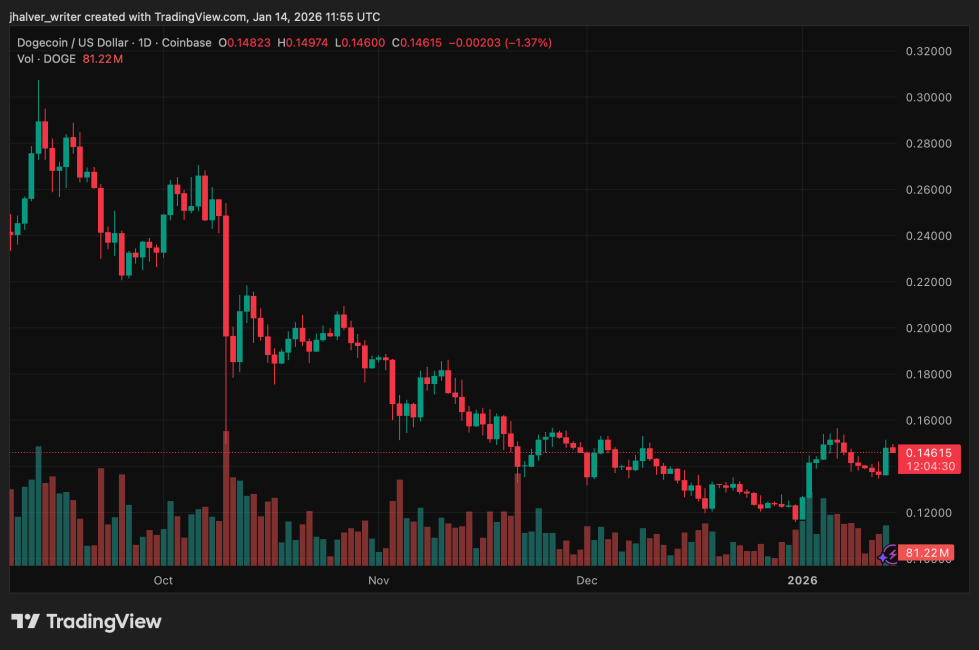
DOGE's price records some gains on the daily chart. Source: DOGEUSD on Tradingview

Selling Pressure Eases as Dogecoin Price Finds Support

Dogecoin’s recent stabilization follows a prolonged selloff from October highs, which pushed the price toward the $0.13 zone. That decline flushed out leveraged positions and cooled speculative activity.

In recent sessions, however, DOGE has reclaimed short-term support near $0.14 and briefly touched $0.147, signaling a slowdown in aggressive downside momentum.

On the daily chart, the price remains below key long-term moving averages, indicating a cautious broader trend. Still, DOGE has moved back above its 20-day and 50-day averages, levels many short-term traders watch for early signs of trend shifts.

Momentum indicators also point to stabilization. The RSI has climbed from oversold territory into neutral levels, suggesting buyers are returning without pushing the market into overheated conditions. While spot outflows continue, derivatives data show rising open interest, indicating traders are positioning for near-term volatility.

Speculative Interest Returns to Meme Coins

The recent rally is not limited to Dogecoin. Other meme tokens, including Pepe, have also posted sharp gains, reflecting a broader return of speculative appetite. CoinGecko’s GMCI Meme Index has climbed in tandem with rising trading volumes, suggesting the move is driven by active participation rather than thin liquidity.

Investors note that meme coins often outperform when Bitcoin trades within a range, and traders seek faster-moving opportunities. DOGE’s breakout above a weeks-long descending trendline has shifted short-term bias in favor of buyers.

Holding above the $0.138–$0.140 area maintains the rebound, with $0.15 serving as the next key level of resistance. A sustained move above $0.15–$0.155 could open the door to a test of the declining 50-day average near $0.16. Failure to hold current levels, however, would likely send the price back toward the $0.13 base.

New Catalysts: Japan Expansion and Spot ETF

Beyond technical factors, potential ecosystem developments are adding to Dogecoin’s visibility.

Discussions around expanding DOGE-related initiatives in Japan, focused on real-world asset tokenization and regulated Web3 applications, highlight growing interest in compliant blockchain use cases within a tightly regulated market.

Related Reading: Ripple Calls XRPL Permissioned Domains A ‘Gamechanger’ As Go-Live Nears

In the U.S., a proposed spot Dogecoin ETF from 21Shares is also drawing attention. If launched, the product would track DOGE’s spot price without leverage or derivatives, giving traditional investors a regulated way to gain exposure. While ETF inflows are not guaranteed, the listing itself could increase market participation and liquidity.

Cover image from ChatGPT, DOGEUSD chart from Tradingview

Perguntas relacionadas

QWhat recent price range has Dogecoin stabilized in, indicating a break from its short-term downtrend?

ADogecoin has recently stabilized near the $0.14–$0.15 range.

QAccording to the article, what technical indicators suggest that selling pressure for DOGE has eased?

AThe RSI has climbed from oversold territory into neutral levels, and the price has moved back above its 20-day and 50-day moving averages.

QWhat broader market condition often leads meme coins like DOGE to outperform, as mentioned in the text?

AMeme coins often outperform when Bitcoin trades sideways within a range, and traders seek faster-moving opportunities.

QWhat are the two new catalysts mentioned that are adding to Dogecoin's visibility and potential growth?

AThe two new catalysts are discussions around expanding DOGE-related initiatives in Japan for real-world asset tokenization and a proposed spot Dogecoin ETF from 21Shares in the U.S.

QWhat is the next key level of resistance for DOGE's price, and what could a sustained move above it lead to?

AThe next key level of resistance is $0.15. A sustained move above $0.15–$0.155 could open the door to a test of the declining 50-day average near $0.16.

Leituras Relacionadas

The Verdict in Choi Tae-won's Divorce Case: Revealing the Inheritance Undercurrent Behind SK Hynix's Trillion-Won Empire

SK Group Chairman Chey Tae-won's high-profile divorce case, involving a record 1.38 trillion won settlement, has drawn attention to the succession plans for Korea's second-largest conglomerate, especially its crown jewel, SK hynix. Unlike traditional chaebol scripts centered on the eldest son, Chey's three children from his marriage to former President Roh Tae-woo's daughter, Roh Soh-yeong, are carving distinct, non-traditional paths. Eldest daughter Chey Yun-jung (b. 1989) is seen as the most evident successor. With a scientific and consulting background, she holds executive roles at SK bioscience and SK Inc.'s growth support department, focusing on future strategy and biopharma. Her marriage is to an AI infrastructure entrepreneur, not a traditional business alliance. Second daughter Chey Min-jung (b. 1991) took a unique route, voluntarily serving as a South Korean naval officer, including an anti-piracy deployment. She later worked on policy and strategy for SK hynix in Washington D.C. before co-founding an AI-driven healthcare startup. She married a former U.S. Marine Corps officer, connecting her to U.S. defense and policy circles—networks crucial for a global semiconductor giant. The only son, Chey In-geun (b. 1995), who studied physics like his father, worked briefly at SK E&S before joining McKinsey. Despite fitting the traditional "heir" profile as the eldest son, he remains silent and holds no public position or shares in SK, suggesting the old succession playbook is obsolete. As SK hynix's valuation soars, becoming a geopolitical asset in the AI era, the heirs' legitimacy is no longer automatic. They must prove themselves in fields like AI biotech, global policy, and strategic consulting. Their marriages also reflect new elite networks in tech and defense, not old political alliances. Their inheritance is the complex challenge of navigating a globalized, tech-driven world, not just a corporate throne.

marsbitHá 20h

The Verdict in Choi Tae-won's Divorce Case: Revealing the Inheritance Undercurrent Behind SK Hynix's Trillion-Won Empire

marsbitHá 20h

From OpenSea to OpenRouter: Is Alex Atallah Repeating His 'Exit at the Peak' Playbook?

From OpenSea to OpenRouter: Is Alex Atallah Repeating His "Exit at the Peak" Playbook? According to the Wall Street Journal, payments giant Stripe is in talks to acquire the AI model aggregation platform OpenRouter in a potential deal valuing the company near $100 billion. This would mark founder Alex Atallah's second creation of a company reaching a $100 billion valuation, following his co-founding of NFT marketplace OpenSea. OpenRouter, founded just over three years ago, has grown rapidly by acting as a unified gateway for developers to access over 400 AI models. It currently has about 10 million users and processes over 200 trillion tokens monthly. While the platform's annualized revenue is around $50 million, its valuation has skyrocketed from $1.3 billion in March 2026. The potential acquisition by Stripe, a company OpenRouter's founder once likened it to, represents a major expansion into AI infrastructure for the payments leader. This move echoes Atallah's previous timing with OpenSea, where he departed before the NFT market's significant downturn. For OpenRouter, selling now may be strategic. Despite its scale, its business model—charging a 5-5.5% fee on AI inference calls—faces pressure from competition, open-source models, and potential price wars among model providers, limiting its profitability narrative for an IPO. A key asset for potential acquirers like Stripe is OpenRouter's vast repository of real-world AI usage data, which offers unique insights into model performance and developer preferences that are difficult to replicate. Whether this potential deal signifies a new valuation benchmark for AI infrastructure or another market peak signal remains to be seen.

链捕手Há 21h

From OpenSea to OpenRouter: Is Alex Atallah Repeating His 'Exit at the Peak' Playbook?

链捕手Há 21h

Trading

Spot
活动图片





