Do Not Apply Blindly: A Comprehensive Evaluation of the Eight Main Pathways to Hong Kong Residency by 2026

marsbitPublicado em 2026-06-24Última atualização em 2026-06-24

Resumo

Hong Kong has recently updated its talent attraction policies, offering eight mainstream pathways to residency. These include programs like the Top Talent Pass Scheme (TTPS), Quality Migrant Admission Scheme (QMAS), the newly introduced Technology Professionals Admission Scheme (TP Stream), and Vocational Professionals Admission Scheme (VPAS). Navigating these options involves understanding key details such as core eligibility criteria, employer sponsorship requirements, and the respective advantages and drawbacks of each scheme. A comprehensive comparison chart is provided to help applicants evaluate their choices and potentially save on consultancy fees. Applicants are reminded to always verify information with the official announcements from the Hong Kong Immigration Department.

Author: Biteye

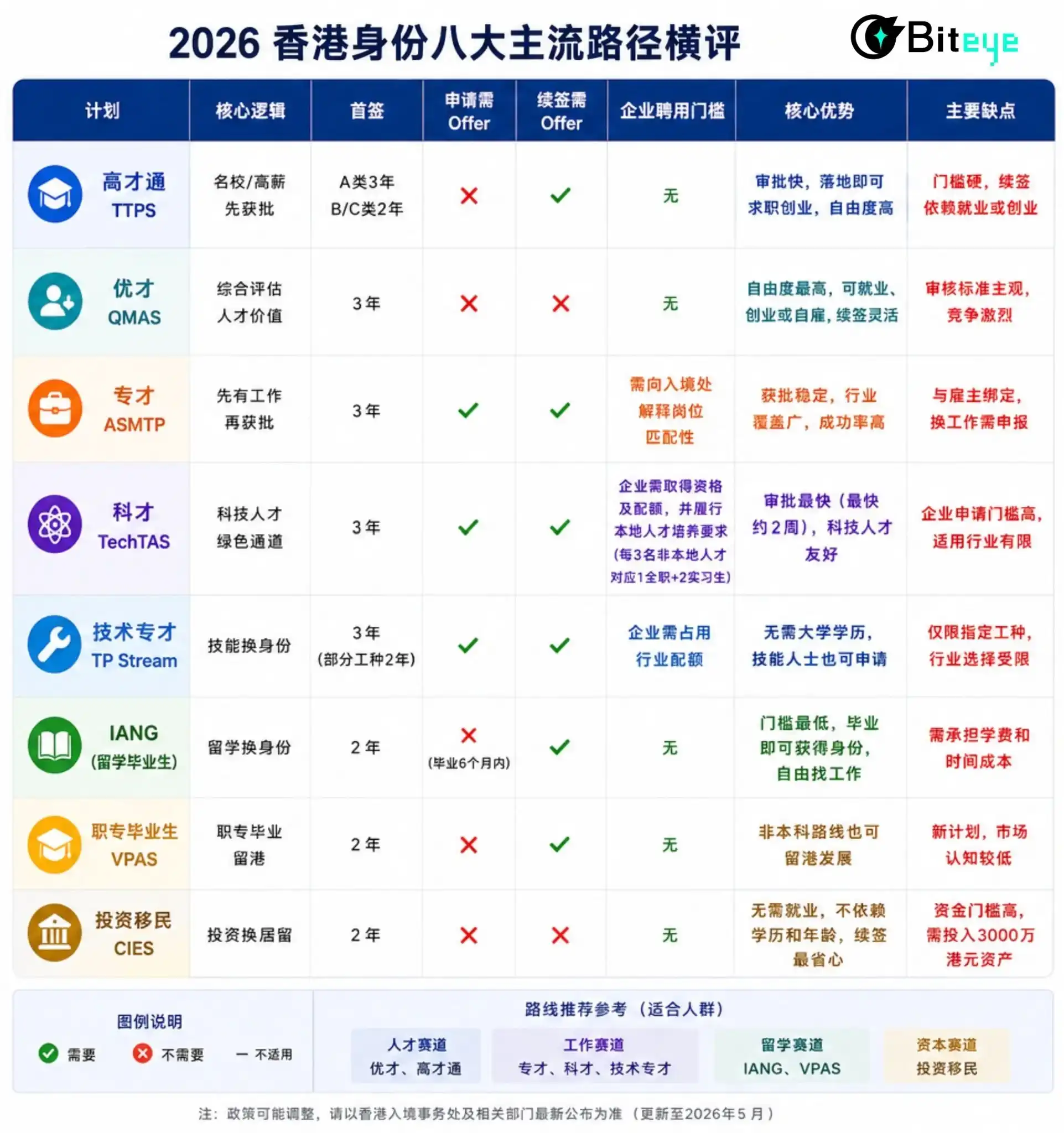
Recently, Hong Kong's talent policies have undergone intensive adjustments. From the Top Talent Pass Scheme (TTPS) and Quality Migrant Admission Scheme (QMAS) to the latest Technical Professionals Stream (TP Stream) and Vocational Professionals Admission Scheme (VPAS), there are now a total of eight mainstream pathways to obtaining residency.

There are many underlying unspoken rules regarding Hong Kong residency. Biteye has distilled the core logic, corporate sponsorship requirements, as well as the advantages and disadvantages of these eight schemes into the comprehensive comparison chart below.

This one chart can save you tens of thousands in agency fees.

(All interested individuals must remember: all information should be verified against the official announcements from the Hong Kong Immigration Department.)

Perguntas relacionadas

QAccording to the article, how many main pathways are there to obtain Hong Kong residency status in 2026?

AAccording to the article, there are eight main pathways to obtain Hong Kong residency status in 2026.

QWhat does the article claim its comprehensive comparison chart can help readers save money on?

AThe article claims its comprehensive comparison chart can help readers save tens of thousands of dollars on agency or intermediary fees.

QWhich Hong Kong government department's official announcements does the article advise readers to refer to for the final authoritative information?

AThe article advises readers to refer to the official announcements of the Hong Kong Immigration Department for the final authoritative information on all policies.

QWhat are two examples of the eight Hong Kong talent schemes mentioned in the article?

ATwo examples of the eight Hong Kong talent schemes mentioned in the article are the Top Talent Pass Scheme (TTPS) and the Quality Migrant Admission Scheme (QMAS).

QWhat does the article say are the key aspects condensed into its comparison chart regarding the eight residency pathways?

AThe article states that its comparison chart condenses the core logic, employer hiring thresholds, as well as the advantages and disadvantages of each of the eight residency pathways.

Leituras Relacionadas

Goldman Sachs In-Depth Report: Who Will Be the Long-Term Winners in China's AI Large Model Industry?

Goldman Sachs Report: China's AI Models at an Inflection Point China's open-source/open-weight large language models (LLMs) have reached performance parity with top global proprietary models, according to a Goldman Sachs report. This is driven by architectural innovations and higher parameter efficiency, allowing Chinese models to achieve comparable capabilities at 2%-10% the parameter size and significantly lower cost. The market is evolving into a two-tiered structure: a high-end segment (e.g., GLM5.2, Qwen3.7 Max) with premium pricing and a low-end, price-sensitive segment for global SMEs and individual users. Key points: * **Cost & Performance:** Innovations like Mixture of Experts (MoE) enable high performance with smaller models. Projects like Meituan's LongCat 2.0, trained on domestic hardware, highlight progress in tech self-sufficiency. * **Open-Source Strategy:** Most Chinese players use open-source/open-weight models for flexibility and ecosystem growth. However, Goldman notes this may underreport actual deployment and revenue. A shift toward "open-weight + community license" models with revenue sharing (e.g., MiniMax) could improve monetization. * **Market Shift & Global Expansion:** Enterprise AI adoption is shifting from "token maximization" to "ROI-first." International expansion, especially in non-US markets, is a major growth driver. Chinese models are increasingly available on global platforms like AWS Bedrock and Microsoft Copilot. * **Competitive Landscape:** Using a framework based on pricing power, cost advantage, and financial strength, Goldman identifies **Zhipu AI and DeepSeek** as the strongest in foundational text models, and **ByteDance** as the leader in multimodal/video generation. The report maintains Buy ratings on MiniMax and Kuaishou. * **Market Growth:** China's AI model API and subscription revenue is projected to grow from an estimated ¥35 billion in 2026 to ¥879 billion by 2030.

marsbitHá 11m

Goldman Sachs In-Depth Report: Who Will Be the Long-Term Winners in China's AI Large Model Industry?

marsbitHá 11m

Goldman Sachs Deep Dive Report: Who Will Become the Long-Term Winners in China's AI Large Model Industry?

Goldman Sachs Report: Who Will Be the Long-Term Winners in China's AI Large Model Industry? China's AI large model sector is at a historic inflection point. Goldman Sachs argues that the intelligence of Chinese open-source/open-weight models is approaching top global proprietary models. Rapid adoption by domestic enterprises and global SMEs is creating a data flywheel effect that will further drive model iteration. The evolution is summarized as moving from "DeepSeek's cost-efficiency moment last year to GLM's model-intelligence moment this year." Chinese models achieve near-state-of-the-art performance at significantly lower cost, primarily due to architectural innovations like Mixture of Experts (MoE) and higher parameter efficiency. Models like DeepSeek V4 Pro (1.6T params), GLM5.2 (0.7T), and MiniMax M3 (0.4T) are much smaller than global leaders. Recent advancements in coding capability are attributed to better data curation and RLHF. Landmarks like Meituan's LongCat 2.0, trained fully on domestic AI chips, demonstrate progress in hardware stack independence. The market is forming a "two-tiered structure." The high-end tier (e.g., GLM5.2, Alibaba's Qwen3.7 Max) prices around $1 per million tokens, about 10-25% of US top models, with estimated inference gross margins of 10-20%. The low-end tier (priced as low as $0.06-$0.2 per million tokens) targets price-sensitive global SMEs and individuals. MiniMax derives 60-70% of revenue overseas. Goldman forecasts China's AI model API/subscription revenue to grow from an estimated RMB 35bn in 2026 to RMB 879bn by 2030. Most Chinese players adopt open-source/open-weight strategies for deployment flexibility and community feedback, though this limits monetization as deployments on third-party platforms (e.g., Alibaba Cloud) may not generate direct revenue. A shift towards "open-weight + community license" models with revenue-sharing agreements (like MiniMax's approach) could improve unit economics. International expansion, particularly in non-US markets, is the key growth driver. The global enterprise AI paradigm is shifting from "token maximization" to "ROI prioritization." Chinese models are already hosted on major global platforms like AWS Bedrock and are under consideration for integration into Microsoft Copilot. Using a competitive framework based on pricing power, cost advantage, and financial strength, Goldman identifies the strongest players: In foundational text models, Zhipu AI (initiated coverage) and DeepSeek lead. In multimodal/video generation, ByteDance's Seed is the frontrunner, with Kuaishou's Kling and MiniMax's Hailuo also well-positioned. Goldman maintains a Buy rating on MiniMax, citing its attractive valuation.

链捕手Há 15m

Goldman Sachs Deep Dive Report: Who Will Become the Long-Term Winners in China's AI Large Model Industry?

链捕手Há 15m

Is Ethereum Truly a "World Computer"?

Title: Is Ethereum Really a "World Computer"? Ethereum, envisioned as a "world computer" by its founder Vitalik Buterin, aims to be a decentralized platform for global applications. However, a recent analysis by Four Pillars raises questions about whether it is more accurately a "Western computer," based on the geographical distribution of its validators. Currently, the United States dominates with 38.19% of all validators, followed by Germany at 13.04%. Combined, these two countries account for over half of the network. In contrast, Asian representation is minimal, with Singapore holding only 3.15%. The concentration is partly due to affordable cloud hosting services like Hetzner and OVH in Europe and North America, as well as the prevalence of residential validators in the U.S., where individuals run nodes via home internet connections. When examining professionally operated validators, the distribution becomes more balanced. The U.S. share drops to 25.81%, while Asian countries like Singapore (7.28%), Hong Kong (6.44%), Japan (6.38%), and South Korea (4.59%) collectively approach the U.S. level. This shift reflects strategic deployments by institutions to meet regulatory requirements and reduce latency for local users. However, regions like South America, the Middle East, and Africa remain underrepresented. Ethereum's peer-to-peer network mechanisms, such as gossipsub, disadvantage areas with low node density, creating a feedback loop where delayed message propagation reduces validator performance and rewards. This imbalance challenges Ethereum's promises of censorship resistance and global accessibility. Despite these issues, opportunities exist for growth in underrepresented regions. As demand for localized staking infrastructure rises, early entrants in areas like the Middle East could establish dominant positions by offering compliant, low-latency solutions. The evolving validator landscape highlights both the structural challenges and the potential for Ethereum to move closer to its "world computer" ideal.

Foresight NewsHá 2h
Is Ethereum Truly a "World Computer"?

Foresight NewsHá 2h

Trading

Spot
活动图片