Did Jane Street 'Manipulate' BTC? Deconstructing the AP System and Understanding the Pricing Power Game Behind the ETF Creation and Redemption Mechanism

marsbitPublicado em 2026-02-28Última atualização em 2026-02-28

Resumo

The article investigates allegations that Jane Street Capital manipulated Bitcoin prices by exploiting the ETF creation and redemption mechanism. It clarifies that the issue is not unique to Jane Street but stems from structural features of the Authorized Participant (AP) system common to all Bitcoin ETFs, including those from major firms like JPMorgan, Goldman Sachs, and Citadel. APs hold a unique regulatory exemption under Reg SHO, allowing them to create and redeem ETF shares without typical short-selling constraints like borrowing costs or hard deadlines. This creates a potential conflict: while market inefficiencies (e.g., ETF trading below NAV) should naturally attract arbitrageurs to correct prices, APs—who control the arbitrage pipeline—may delay arbitrage to profit elsewhere, such as in derivatives markets. The shift to in-kind (rather than cash) creations/redemptions further reduced structural buying pressure on Bitcoin spot markets. The core problem is not deliberate price suppression by any single AP but a systemic flaw: the AP framework, designed for traditional finance, may undermine price discovery integrity for Bitcoin. The article concludes by questioning whether existing regulatory frameworks are suitable for an asset class predicated on decentralization.

Author: Eddie Xin, Chief Analyst at OSL Group

"They were fcking us the whole time".

This expletive, circulating on Reddit and CT (Crypto Twitter) following the lawsuit, alongside an epic short squeeze with a liquidation scale exceeding $240 billion, directed the market's fury at the same target: Jane Street Capital.

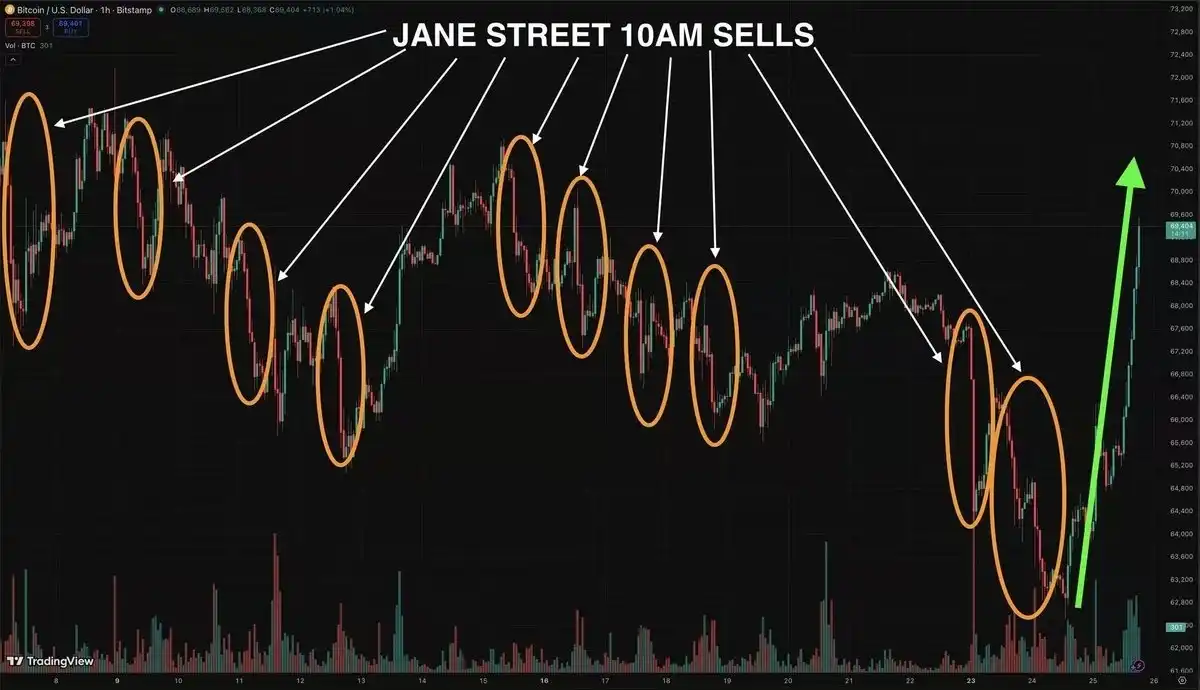
At 10 AM, the liquidity low point in the Asian market for the past few months, the tip of the iceberg was finally revealed with the U.S. Department of Justice's complaint. It all stemmed from Jane Street Capital, a top-tier market maker founded in 2000, which was accused of executing a months-long 'sleight of hand' in the spot and derivative order books by means of targeted ETF arbitrage in the market, utilizing the spot ETF creation and redemption mechanism.

It wasn't until a legal complaint pushed this controversy into the public eye that discussions around the ETF arbitrage mechanism and price discovery structure rapidly heated up, triggering a violent market rebound and an epic short squeeze with a liquidation scale exceeding $240 billion.

But was Jane Street truly the culprit that pressed the suppression button? This is a question worth at least $10 billion.
I. Did Jane Street Really Suppress the BTC Price?

This question deserves an accurate answer. The most important thing to understand first is that this isn't just a question about Jane Street.

It's a question about the structural characteristics of the Bitcoin ETF framework, which applies equally to every Authorized Participant (AP) in the ecosystem. For BlackRock's IBIT alone, this list includes Jane Street Capital, JPMorgan, Macquarie, Virtu Americas, Goldman Sachs, Citadel Securities, Citigroup, UBS, and ABN Amro.

The role of these institutions is deeply misunderstood by the outside world, even among experienced industry veterans, and this misunderstanding deserves to be corrected before drawing any conclusions.

The first thing to understand about APs is that they occupy a marginal exception within the regulatory framework of Reg SHO (the SEC's rule on naked short selling). For instance, Reg SHO requires short sellers to locate shares (locate the stock) before shorting, but APs are exempted due to their contractual right to participate in creations and redemptions.

While this sounds procedural, its practical consequences are significant. It means any AP can create shares at will—no borrowing costs, no capital commitment traditionally associated with short selling, and aside from commercially reasonable timeframes, no hard deadline to close the position.

This is the gray area: a regulatory exemption designed for orderly ETF market making is, structurally, indistinguishable from regulatory arbitrage with an unmatched duration. This exemption is not unique to any single company. It is a prerequisite for membership in the AP club.

II. What Does This AP Exemption Mean?

Normally, if IBIT is trading below its Net Asset Value (NAV), you would expect arbitrage buyers to step in, redeem shares for bitcoin, and close the discount. But any AP *is* that arbitrage buyer; they control the pipeline. This means their incentive to close this discount is different from that of a third-party trading desk without creation/redemption rights.

It sounds complex, but a simple analogy makes it clearer:

First Layer: What is Normal 'Closing the Discount'?

Imagine there's a blind box on the market (this is the IBIT ETF). Everyone knows the blind box contains a real bitcoin voucher worth $100 (this is the NAV). But today, due to market panic, the blind box is priced at $95.

Following normal logic, smart merchants (arbitrage buyers) would frantically buy the blind box for $95, then go to the official source to open it, exchange it for the $100 bitcoin, sell it, and pocket the $5 difference.

And precisely because everyone is buying the blind boxes for arbitrage, the price of the blind box is quickly pushed up by buying pressure, returning to $100. This is called "closing the discount".

Second Layer: The AP with the 'Monopoly Channel'

But in the real world of Bitcoin ETFs, ordinary trading firms and retail investors are not qualified to go to the official source to "open the blind box" (i.e., they lack creation/redemption rights). Only a few privileged Wall Street investment banks (APs) in the entire market can do this. That is, APs monopolize the only channel to exchange ETFs for real bitcoin (they control the pipeline).

Third Layer: Why Don't APs Play by the Arbitrage Rules?

If it were an ordinary third-party merchant, seeing this $5 risk-free spread, they would act immediately. But APs are different; they calculate a more shrewd account: "Since only I can open the blind box, why should I hurry? If I intentionally don't pull the price back to $100, but instead use the current illusion of a low $95 price to go short or long in another casino (like the bitcoin futures market), I might make $20!"

In summary: The market originally has an automatic correction mechanism (if the price falls too much, someone will buy for arbitrage and push the price up). However, because the "only switch" to execute this correction mechanism is held by the APs, and the APs find that "not correcting, maintaining the discount" allows them to make more money elsewhere, they have no incentive to pull the price back to normal levels.

Retail investors suffer waiting for the arbitrage army to save the price, unaware that the only arbitrage army (the APs) is right next door, using this spread to make money in other markets.

III. The Problem Isn't Jane Street, It's the AP Structure

IBIT's short exposure could in principle be hedged by going long bitcoin spot, but this is not mandatory, as long as the chosen instrument maintains a tight correlation.

The obvious alternative is BTC futures, especially given their capital efficiency. This effectively means that if the hedging instrument is futures rather than spot, then the spot is never actually bought. And because the natural arbitrage buyer chooses not to buy spot, this discount cannot be closed through the natural arbitrage mechanism.

It's worth noting that the spot/futures basis is itself the domain of the entire basis trading community, which works to keep this relationship tight. But every separation between the hedging instrument and the underlying asset introduces impure basis risk (dirty basis risk), and this risk compounds throughout the structure—and it is under stress conditions that basis risk is where market dislocation appears.

The final piece of the puzzle involves the recently SEC-approved in-kind creation and redemption. Under the previous cash-only regime, APs were required to deliver cash to the fund, and then the custodian used this cash to buy bitcoin spot. This buying action was a structural regulator—it mechanically forced the purchase of spot as a consequence of creation.

In-kind creation/redemption completely eliminates this. Now any AP can deliver bitcoin directly, and the timing and counterparty for its source can be chosen at its own discretion: OTC desks, negotiated pricing, minimizing market impact.

The broadest interpretation of this flexibility is that an AP could maintain derivative positions aimed at capturing funding rate or volatility profits during the time between establishing a short and completing the in-kind delivery—all while ensuring each individual step still fits the definition of legitimate AP activity.

And this is precisely the crux of the problem. The beginning looks like normal market making, and the end looks like normal market making. It is the middle process that is difficult to clearly categorize. This is not an indictment of any single company. Every AP on the IBIT list, and by extension every AP for every Bitcoin ETF, operates within the same structural framework, enjoys the same exemptions, and therefore possesses the same theoretical capability. Whether any of them exercised this capability in a manner that verges on coordinated activity is a question that falls squarely within the purview of the "surveillance sharing agreements" the SEC required upon ETF approval.

Whether these agreements are sufficient to capture behavior that simultaneously spans spot, futures, and ETF markets (even including cross-border trading venues) remains a truly open question.

In a nutshell, Jane Street is just in the spotlight. The real problem is buried deep in the underlying architecture of the Bitcoin ETF, designed by Wall Street veterans. No specific AP is explicitly suppressing the bitcoin price. What the AP structure can suppress is the integrity of the price discovery mechanism itself, which may have far more profound implications than the former.

Therefore, the question truly worth asking is not whether a specific company is the villain, but whether a regulatory framework built for 20th-century traditional finance is suitable for hosting an emerging 21st-century asset whose "value lies in being free from control by regulatory agencies".

This is perhaps the tuition fee the crypto market must pay to enter the "era of big institutions." After all, while we crave the liquidity irrigation from Wall Street, we do not wish to passively accept the black-box games they construct using regulatory exemptions.

This is not just the answer about Jane Street, but the ultimate question of the Bitcoin ETF era.

Perguntas relacionadas

QWhat is the core allegation against Jane Street Capital in relation to Bitcoin ETFs?

AJane Street Capital is accused of exploiting the creation and redemption mechanism of Bitcoin ETFs to conduct arbitrage between spot and derivative markets, using a regulatory exemption that allows them to potentially suppress price discovery rather than correct market inefficiencies.

QWhat is an Authorized Participant (AP) in the context of Bitcoin ETFs, and what special privilege do they hold?

AAn Authorized Participant (AP) is a large financial institution, like Jane Street or J.P. Morgan, that has the exclusive right to create and redeem ETF shares. They hold a key regulatory exemption from Reg SHO, allowing them to create shares without first locating the stock, which eliminates borrowing costs and hard deadlines associated with traditional short selling.

QWhy might an AP choose not to arbitrage a price discrepancy between an ETF and its Net Asset Value (NAV)?

AAn AP might choose not to arbitrage a discount because they control the only mechanism to correct it. They can profit more by maintaining the discrepancy and using it to execute strategies in derivative markets (like futures) to earn funding rates or volatility profits, rather than simply closing the gap for a smaller, immediate gain.

QHow did the shift from cash-only to in-kind creation and redemption for Bitcoin ETFs change the market dynamics?

AThe shift to in-kind creation removed a structural market stabilizer. Under the cash-only model, APs had to deliver cash to the fund, which forced the custodian to buy Bitcoin spot, supporting its price. With in-kind creation, APs can deliver Bitcoin directly from sources like OTC desks, giving them more flexibility and eliminating the forced spot market purchases.

QAccording to the article, what is the fundamental problem, and is it specific to Jane Street?

AThe fundamental problem is not specific to Jane Street but is a structural issue inherent in the Bitcoin ETF framework. The regulatory exemptions and arbitrage mechanisms granted to all APs can suppress the integrity of the price discovery process itself, raising questions about whether a traditional financial regulatory framework is suitable for a decentralized asset like Bitcoin.

Leituras Relacionadas

The Shutdown of Claude Mythos Revealed the True Cost of Renting AI to Me

The sudden shutdown of Claude Mythos this week starkly highlights a critical, often overlooked risk for founders: when your core capability relies entirely on someone else's platform, your fate is not in your own hands. The key question becomes: who truly owns the intelligence your product depends on? For years, the debate around open-source models focused on cost. Now, the evidence is clear: fine-tuned open-source models can achieve frontier-level quality for specific, mission-critical tasks at a fraction of the cost. However, the deeper issue is control. Relying on a third-party API is like renting; it works until the landlord changes the rules, raises the rent, or asks you to leave—as Mythos experienced. The lesson is not to stop using frontier models—they are incredible infrastructure. The goal is ownership. Ownership means starting with a powerful open-source model and shaping it around what makes your company unique: your data, workflows, domain expertise, and definition of "good." Over time, the model becomes less generic and more reflective of your business, creating durable value. The optimistic conclusion is that AI's future doesn't hinge on one superior model. There is no single frontier. The frontier includes proprietary models, models fine-tuned on company-specific knowledge, specialized models for narrow problems, and intelligent routers orchestrating model ensembles. The most interesting development is not models getting smarter, but intelligence becoming increasingly customizable. The winning companies will be those that transform intelligence into a unique, owned asset. Looking ahead, the vision is not one model dominating all, but many teams owning the part of the frontier that matters most to them.

marsbitHá 5m

The Shutdown of Claude Mythos Revealed the True Cost of Renting AI to Me

marsbitHá 5m

Tiger Research: U.S. Strategic Bitcoin Reserve - Should the Market Be Happy or Disappointed?

Tiger Research analyzes the evolution of U.S. legislative efforts regarding a strategic Bitcoin reserve, concluding the market impact is limited in the short term but potentially positive long-term. The core event was a March 2025 executive order by former President Trump, which designated confiscated Bitcoin as a strategic reserve and promised not to sell existing holdings (approx. 190k BTC). As it contained no mandate to purchase new Bitcoin, the market reacted negatively, with prices dropping 5.7%. Legislative history shows a significant retreat from initial ambitions. The 2024 "BITCOIN Act" proposed mandatory purchases of 1 million BTC over five years. Reintroduced in 2025, it stalled due to high fiscal costs, concerns over dollar hegemony, and opposition from the Treasury Secretary. The current frontrunner, the 2026 "American Retirement and Monetary Advancement (ARMA) Act," is a compromise. It lacks any purchase requirement, instead focusing on consolidating existing government-held Bitcoin and legally prohibiting its sale for at least 20 years. While ARMA has higher passage odds due to bipartisan support and no purchase mandate, its immediate market effect is neutral. It eliminates potential government selling pressure but creates no new demand. The long-term significance is that formally establishing Bitcoin as a national reserve asset in law could later reignite debates on mandatory purchases. Therefore, the path to a government buyer is longer than initially priced by the market, but the directional narrative remains intact.

marsbitHá 8m

Tiger Research: U.S. Strategic Bitcoin Reserve - Should the Market Be Happy or Disappointed?

marsbitHá 8m

US Stock Market Trend (June 16): SpaceX Rises 42% in Two Days, New Fed Chairman Takes Office Today

**U.S. Stocks Trend (June 16): SpaceX Soars 42% in Two Days, New Fed Chair Takes Office Today** Markets surged on Monday following former President Trump's social media announcement of a completed U.S.-Iran deal to reopen the Strait of Hormuz, pending a June 19 signing. The news triggered a broad risk-on rally: oil prices crashed, tech stocks soared, bond yields fell, and defensive sectors lagged. **Market Performance:** The Nasdaq jumped 3.07%, led by semiconductor stocks like Micron (+9.2%). The S&P 500 gained 1.65%, and the Dow rose 0.92% to a record high. However, the Russell 2000 small-cap index underperformed (+0.72%). SpaceX continued its hot streak, rising another 5% pre-market after disclosures of large buys by an Australian billionaire and Cathie Wood's ARK. Boeing also rallied on the transportation optimism. Conversely, energy stocks like Chevron fell over 3% on the oil price plunge, with other defensive sectors also selling off. The day's action showed a clear rotation of funds from energy/defensive plays into AI and tech narratives. **Macro & Outlook:** The VIX fear index fell 8.37%. Treasury yields declined, and WTI crude dropped over 5%. Attention now shifts to a packed schedule: the Bank of Japan is widely expected to hike rates to 1.0% on Tuesday. The Fed's June meeting concludes Wednesday, marking new Chair Wash's debut. While rates are expected to hold, his tone on stubborn inflation and the "dot plot" will be crucial for gauging the 2024 rate path. The formal Iran deal signing is set for Friday. **Trend Perspective:** While the peace deal is a genuine positive, Monday's explosive rally may have gotten ahead of itself, pricing in a swift resolution to inflation concerns. The shortened trading week faces a triple test: BoJ tightening, the Fed's policy stance, and deal implementation details. Tech and semiconductors, which led the surge, remain vulnerable to any disappointment from these key events. The real price discovery begins with the central banks' communications this week.

marsbitHá 29m

US Stock Market Trend (June 16): SpaceX Rises 42% in Two Days, New Fed Chairman Takes Office Today

marsbitHá 29m

Xiaohongshu's Second Great Voyage, This Time Sailing Towards AI

Xiaohongshu's Second Voyage: Navigating Towards AI Since ChatGPT's emergence, Xiaohongshu's founder Mao Wenchao has been acutely aware of AI's potential threat, recognizing that the life advice people seek from chatbots overlaps directly with his platform's core business. Founded in 2013 as a PDF shopping guide for Chinese tourists, Xiaohongshu evolved into a massive community where millions share authentic, personal experiences—from product reviews to travel tips. This vast repository of "I've tried this" human judgment became its most valuable asset. However, the rise of AI, which delivers instant answers, challenges the very need for users to sift through numerous personal notes. Fearing its treasure trove of lived experience could become mere training data for others, Xiaohongshu is proactively adapting. In 2026, it established a dedicated AI division (Dots), launched RED Skill to turn user experiences into usable AI tools, and acquired the AI search product "Diandian." Its investments now extend to AI firms like MiniMax and hardware startups, moving upstream to address needs before they even become search queries. The platform's commercialization strategy is also evolving. With a newly acquired payment license and tools like the AIPS model to track consumer decision journeys, Xiaohongshu aims to seamlessly integrate recommendations with transactions, embedding commerce within AI-generated answers. Yet, a critical tension remains. While building smarter machines to organize and leverage its human experiences, Xiaohongshu must prevent AI from drowning out the authentic, flawed, and trustworthy "I've tried this" voices that built its community. Its core challenge is to harness AI's power without letting the map—the machine's perfect, synthesized answer—replace the territory of genuine human experience. This balance between technological advancement and preserving human trust defines its current journey and its future.

marsbitHá 1h

Xiaohongshu's Second Great Voyage, This Time Sailing Towards AI

marsbitHá 1h

Trading

Spot
Futuros

Artigos em Destaque

O que é BITCOIN

Compreender o HarryPotterObamaSonic10Inu (ERC-20) e a Sua Posição no Espaço Cripto Nos últimos anos, o mercado de criptomoedas assistiu a um aumento na popularidade das moedas meme, cativando não apenas os traders, mas também aqueles que procuram envolvimento comunitário e valor de entretenimento. Entre estes tokens únicos está o HarryPotterObamaSonic10Inu (ERC-20), um projeto intrigante que mistura referências culturais no tecido das criptomoedas. Este artigo explora os principais aspetos do HarryPotterObamaSonic10Inu, examinando os seus mecanismos, a sua ética orientada pela comunidade e o seu envolvimento com o vasto panorama cripto. O que é o HarryPotterObamaSonic10Inu (ERC-20)? Como o nome sugere, o HarryPotterObamaSonic10Inu é uma moeda meme construída na blockchain Ethereum, classificada sob o padrão ERC-20. Ao contrário das criptomoedas tradicionais, que podem enfatizar a utilidade prática ou o potencial de investimento, este token prospera no valor de entretenimento e na força da sua comunidade. O projeto visa promover um ambiente onde utilizadores envolvidos possam reunir-se, partilhar ideias e participar em atividades inspiradas por diversos fenómenos culturais. Uma característica notável do HarryPotterObamaSonic10Inu é a zero taxa sobre transações. Este elemento atraente visa encorajar a negociação e o envolvimento da comunidade, isento de encargos adicionais que podem desencorajar os traders de pequena escala. A oferta total da moeda está fixada em mil milhões de tokens, uma cifra que marca a sua intenção de manter uma circulação substancial dentro da comunidade. Criador do HarryPotterObamaSonic10Inu (ERC-20) As origens do HarryPotterObamaSonic10Inu estão um pouco envoltas em mistério; os detalhes sobre o criador permanecem desconhecidos. O desenvolvimento deste token carece de uma equipa identificável ou de um plano explícito, o que não é raro no setor das moedas meme. Em vez disso, o projeto surgiu de forma orgânica, com o seu progresso a depender fortemente do entusiasmo e da participação da sua comunidade. Investidores do HarryPotterObamaSonic10Inu (ERC-20) No que diz respeito a investimentos externos e apoios, o HarryPotterObamaSonic10Inu também permanece ambíguo. O token não lista quaisquer fundações de investimento conhecidas ou apoio organizacional significativo. Em vez disso, o “sangue vital” do projeto é a sua comunidade de base, que informa o seu crescimento e sustentabilidade através da ação coletiva e do envolvimento no espaço cripto. Como Funciona o HarryPotterObamaSonic10Inu (ERC-20)? Como uma moeda meme, o HarryPotterObamaSonic10Inu opera principalmente fora dos quadros tradicionais que muitas vezes governam o valor dos ativos. Existem vários aspetos distintivos que definem como o projeto funciona: Transações Sem Taxas: Sem taxas sobre transações, os utilizadores podem comprar e vender o token livremente, sem a preocupação de custos ocultos. Envolvimento da Comunidade: O projeto prospera na interação da comunidade, aproveitando plataformas de redes sociais para criar entusiasmo e facilitar a participação. Discussões, partilha de conteúdo e envolvimento são elementos cruciais que ajudam a expandir o seu alcance e a fomentar a lealdade entre os apoiantes. Sem Utilidade Prática: Deve ser notado que o HarryPotterObamaSonic10Inu não oferece utilidade concreta dentro do ecossistema financeiro. Em vez disso, é classificado como um token principalmente para entretenimento e atividades comunitárias. Referência Cultural: O token incorpora de forma inteligente elementos da cultura popular para atrair interesse, conectando-se tanto com entusiastas de memes como com seguidores de criptomoedas. HarryPotterObamaSonic10Inu exemplifica como as moedas meme operam de forma diferente de projetos de criptomoedas mais tradicionais, entrando no mercado como construções sociais inovadoras em vez de ativos utilitários. Linha do Tempo do HarryPotterObamaSonic10Inu (ERC-20) A história do HarryPotterObamaSonic10Inu é marcada por vários marcos notáveis: Criação: O token surgiu de um meme viral, capturando a imaginação de muitos entusiastas de criptomoedas. Datas específicas de criação não estão disponíveis, sublinhando a sua ascensão orgânica. Listagem em Exchanges: O HarryPotterObamaSonic10Inu conseguiu entrar em várias exchanges, permitindo um acesso e negociação mais fáceis pela comunidade. Iniciativas de Envolvimento da Comunidade: Atividades contínuas direcionadas a melhorar a interação comunitária, incluindo concursos, campanhas em redes sociais e geração de conteúdo por fãs e defensores. Planos de Expansão Futura: O roteiro do projeto inclui o lançamento de uma coleção de NFTs, mercadorias e um site de eCommerce relacionado aos seus temas culturais, envolvendo ainda mais a comunidade e tentando adicionar mais dimensões ao seu ecossistema. Pontos-Chave sobre o HarryPotterObamaSonic10Inu (ERC-20) Natureza Orientada pela Comunidade: O projeto prioriza a contribuição coletiva e a criatividade, assegurando que o envolvimento dos utilizadores está na vanguarda do seu desenvolvimento. Classificação como Moeda Meme: Representa o epítome da criptomoeda baseada em entretenimento, destacando-se dos veículos de investimento tradicionais. Sem Afiliação Direta com o Bitcoin: Apesar da semelhança no nome do ticker, o HarryPotterObamaSonic10Inu é distinto e não tem qualquer relação com o Bitcoin ou outras criptomoedas estabelecidas. Foco na Colaboração: O HarryPotterObamaSonic10Inu é projetado para criar um espaço de colaboração e partilha de histórias entre os seus detentores, proporcionando uma via para a criatividade e o fortalecimento da comunidade. Perspectivas Futuras: A ambição de expandir além da sua premissa inicial para NFTs e mercadorias delineia um caminho para o projeto potencialmente entrar em avenidas mais mainstream dentro da cultura digital. À medida que as moedas meme continuam a capturar a imaginação da comunidade cripto, HarryPotterObamaSonic10Inu (ERC-20) destaca-se devido aos seus laços culturais e abordagem centrada na comunidade. Embora possa não se encaixar no molde típico de um token orientado para utilidade, a sua essência reside na alegria e camaradagem fomentadas entre os seus apoiantes, destacando a natureza em evolução das criptomoedas em uma era cada vez mais digital. À medida que o projeto continua a desenvolver-se, será importante observar como as dinâmicas comunitárias influenciam a sua trajetória no panorama em constante mudança da tecnologia blockchain.

1.7k Visualizações TotaisPublicado em {updateTime}Atualizado em 2024.12.03

O que é BITCOIN

Como comprar BTC

Bem-vindo à HTX.com!Tornámos a compra de Bitcoin (BTC) simples e conveniente.Segue o nosso guia passo a passo para iniciar a tua jornada no mundo das criptos.Passo 1: cria a tua conta HTXUtiliza o teu e-mail ou número de telefone para te inscreveres numa conta gratuita na HTX.Desfruta de um processo de inscrição sem complicações e desbloqueia todas as funcionalidades.Obter a minha contaPasso 2: vai para Comprar Cripto e escolhe o teu método de pagamentoCartão de crédito/débito: usa o teu visa ou mastercard para comprar Bitcoin (BTC) instantaneamente.Saldo: usa os fundos da tua conta HTX para transacionar sem problemas.Terceiros: adicionamos métodos de pagamento populares, como Google Pay e Apple Pay, para aumentar a conveniência.P2P: transaciona diretamente com outros utilizadores na HTX.Mercado de balcão (OTC): oferecemos serviços personalizados e taxas de câmbio competitivas para os traders.Passo 3: armazena teu Bitcoin (BTC)Depois de comprar o teu Bitcoin (BTC), armazena-o na tua conta HTX.Alternativamente, podes enviá-lo para outro lugar através de transferência blockchain ou usá-lo para transacionar outras criptomoedas.Passo 4: transaciona Bitcoin (BTC)Transaciona facilmente Bitcoin (BTC) no mercado à vista da HTX.Acede simplesmente à tua conta, seleciona o teu par de trading, executa as tuas transações e monitoriza em tempo real.Oferecemos uma experiência de fácil utilização tanto para principiantes como para traders experientes.

4.2k Visualizações TotaisPublicado em {updateTime}Atualizado em 2026.06.02

Como comprar BTC

O que é $BITCOIN

OURO DIGITAL ($BITCOIN): Uma Análise Abrangente Introdução ao OURO DIGITAL ($BITCOIN) OURO DIGITAL ($BITCOIN) é um projeto baseado em blockchain que opera na rede Solana, com o objetivo de combinar as características dos metais preciosos tradicionais com a inovação das tecnologias descentralizadas. Embora partilhe um nome com o Bitcoin, frequentemente referido como “ouro digital” devido à sua percepção como uma reserva de valor, o OURO DIGITAL é um token separado projetado para criar um ecossistema único dentro da paisagem Web3. O seu objetivo é posicionar-se como um ativo digital alternativo viável, embora os detalhes sobre as suas aplicações e funcionalidades ainda estejam em desenvolvimento. O que é o OURO DIGITAL ($BITCOIN)? OURO DIGITAL ($BITCOIN) é um token de criptomoeda explicitamente projetado para uso na blockchain Solana. Em contraste com o Bitcoin, que fornece um papel amplamente reconhecido como armazenamento de valor, este token parece focar em aplicações e características mais amplas. Aspectos notáveis incluem: Infraestrutura Blockchain: O token é construído na blockchain Solana, conhecida pela sua capacidade de lidar com transações de alta velocidade e baixo custo. Dinâmicas de Oferta: O OURO DIGITAL tem um fornecimento máximo limitado a 100 quatrilhões de tokens (100P $BITCOIN), embora os detalhes sobre o seu fornecimento circulante ainda não tenham sido divulgados. Utilidade: Embora as funcionalidades precisas não estejam explicitamente delineadas, existem indicações de que o token poderia ser utilizado para várias aplicações, potencialmente envolvendo aplicações descentralizadas (dApps) ou estratégias de tokenização de ativos. Quem é o Criador do OURO DIGITAL ($BITCOIN)? Neste momento, a identidade dos criadores e da equipa de desenvolvimento por trás do OURO DIGITAL ($BITCOIN) permanece desconhecida. Esta situação é típica entre muitos projetos inovadores no espaço da blockchain, particularmente aqueles alinhados com finanças descentralizadas e fenómenos de moedas meme. Embora tal anonimato possa fomentar uma cultura orientada pela comunidade, intensifica as preocupações sobre governança e responsabilidade. Quem são os Investidores do OURO DIGITAL ($BITCOIN)? As informações disponíveis indicam que o OURO DIGITAL ($BITCOIN) não tem apoiantes institucionais conhecidos ou investimentos proeminentes de capital de risco. O projeto parece operar num modelo peer-to-peer focado no apoio e adoção da comunidade, em vez de rotas de financiamento tradicionais. A sua atividade e liquidez estão principalmente situadas em exchanges descentralizadas (DEXs), como a PumpSwap, em vez de plataformas de negociação centralizadas estabelecidas, destacando ainda mais a sua abordagem de base. Como Funciona o OURO DIGITAL ($BITCOIN) A mecânica operacional do OURO DIGITAL ($BITCOIN) pode ser elaborada com base no seu design de blockchain e nas características da rede: Mecanismo de Consenso: Ao aproveitar o exclusivo proof-of-history (PoH) da Solana combinado com um modelo de proof-of-stake (PoS), o projeto assegura uma validação eficiente das transações, contribuindo para o alto desempenho da rede. Tokenomics: Embora mecanismos deflacionários específicos não tenham sido extensivamente detalhados, o vasto fornecimento máximo de tokens implica que pode atender a microtransações ou casos de uso de nicho que ainda estão por definir. Interoperabilidade: Existe o potencial para integração com o ecossistema mais amplo da Solana, incluindo várias plataformas de finanças descentralizadas (DeFi). No entanto, os detalhes sobre integrações específicas permanecem não especificados. Cronologia de Eventos Chave Aqui está uma cronologia que destaca marcos significativos relacionados ao OURO DIGITAL ($BITCOIN): 2023: O lançamento inicial do token ocorre na blockchain Solana, marcado pelo seu endereço de contrato. 2024: O OURO DIGITAL ganha visibilidade ao tornar-se disponível para negociação em exchanges descentralizadas como a PumpSwap, permitindo que os utilizadores o negociem contra SOL. 2025: O projeto testemunha atividade de negociação esporádica e potencial interesse em envolvimentos liderados pela comunidade, embora não tenham sido documentadas parcerias ou avanços técnicos notáveis até ao momento. Análise Crítica Forças Escalabilidade: A infraestrutura subjacente da Solana suporta altos volumes de transações, o que pode aumentar a utilidade do $BITCOIN em vários cenários de transação. Acessibilidade: O potencial preço de negociação baixo por token pode atrair investidores de retalho, facilitando uma participação mais ampla devido a oportunidades de propriedade fracionada. Riscos Falta de Transparência: A ausência de apoiantes, desenvolvedores ou um processo de auditoria publicamente conhecidos pode gerar ceticismo em relação à sustentabilidade e confiabilidade do projeto. Volatilidade do Mercado: A atividade de negociação depende fortemente do comportamento especulativo, o que pode resultar em volatilidade significativa dos preços e incerteza para os investidores. Conclusão O OURO DIGITAL ($BITCOIN) surge como um projeto intrigante, mas ambíguo, dentro do ecossistema em rápida evolução da Solana. Embora tente aproveitar a narrativa do “ouro digital”, a sua divergência do papel estabelecido do Bitcoin como reserva de valor sublinha a necessidade de uma diferenciação mais clara da sua utilidade pretendida e estrutura de governança. A aceitação e adoção futuras dependerão provavelmente da abordagem da atual opacidade e da definição mais explícita das suas estratégias operacionais e económicas. Nota: Este relatório abrange informações sintetizadas disponíveis até outubro de 2023, e desenvolvimentos podem ter ocorrido além do período de pesquisa.

92 Visualizações TotaisPublicado em {updateTime}Atualizado em 2025.05.13

O que é $BITCOIN

Discussões

Bem-vindo à Comunidade HTX. Aqui, pode manter-se informado sobre os mais recentes desenvolvimentos da plataforma e obter acesso a análises profissionais de mercado. As opiniões dos utilizadores sobre o preço de BTC (BTC) são apresentadas abaixo.

活动图片