DeFi vs. SEC: Should ‘non-custodial platforms’ be treated like exchanges?

ambcryptoPublicado em 2026-04-02Última atualização em 2026-04-02

Resumo

DeFi Education Fund (DEF) argues that non-custodial DeFi protocols, AMMs, and their developers should not be regulated as exchanges or intermediaries, as they don’t perform exchange functions or control user assets. They oppose SIFMA’s push for SEC regulation based on function rather than decentralization. SIFMA and Citadel Securities advocate for regulating DeFi platforms handling tokenized securities to ensure investor protection, citing risks and scams. DEF suggests Wall Street’s stance may be motivated by business interests, as DeFi disrupts traditional intermediaries. The SEC faces the challenge of balancing innovation and regulation in its upcoming framework.

DeFi regulation is back in the headlines as the crypto industry and Wall Street disagree on the proposed ‘innovation exemption’ for tokenized assets.

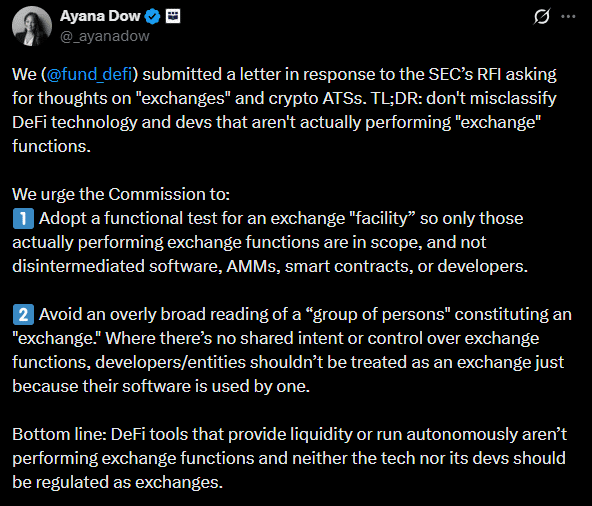
On the 1st of April, a DeFi advocacy group, the DeFi Education Fund (DEF), wrote to the SEC arguing that decentralized protocols should not be ‘misclassified as intermediaries’ like centralized traditional exchanges.

Ayan Dow, legal officer at DEF, added,

DeFi tools that provide liquidity or run autonomously aren’t performing exchange functions, and neither the tech nor its devs should be regulated as exchanges.
Source: X

According to the advocacy group, any non-custodial application does not fall within the legal definition of an intermediary or exchange. Additionally, classifying developers as intermediaries, yet they don’t control the ‘non-custodial platforms’ they’ve built, would place an overwhelming regulatory burden on them.

As such, the advocacy group pressed that any suggested DeFi regulation scope should exclude disintermediated software, automated market makers (AMMs), smart contracts, and non-controlling developers.

Wall Street opposes DeFi legal exemption

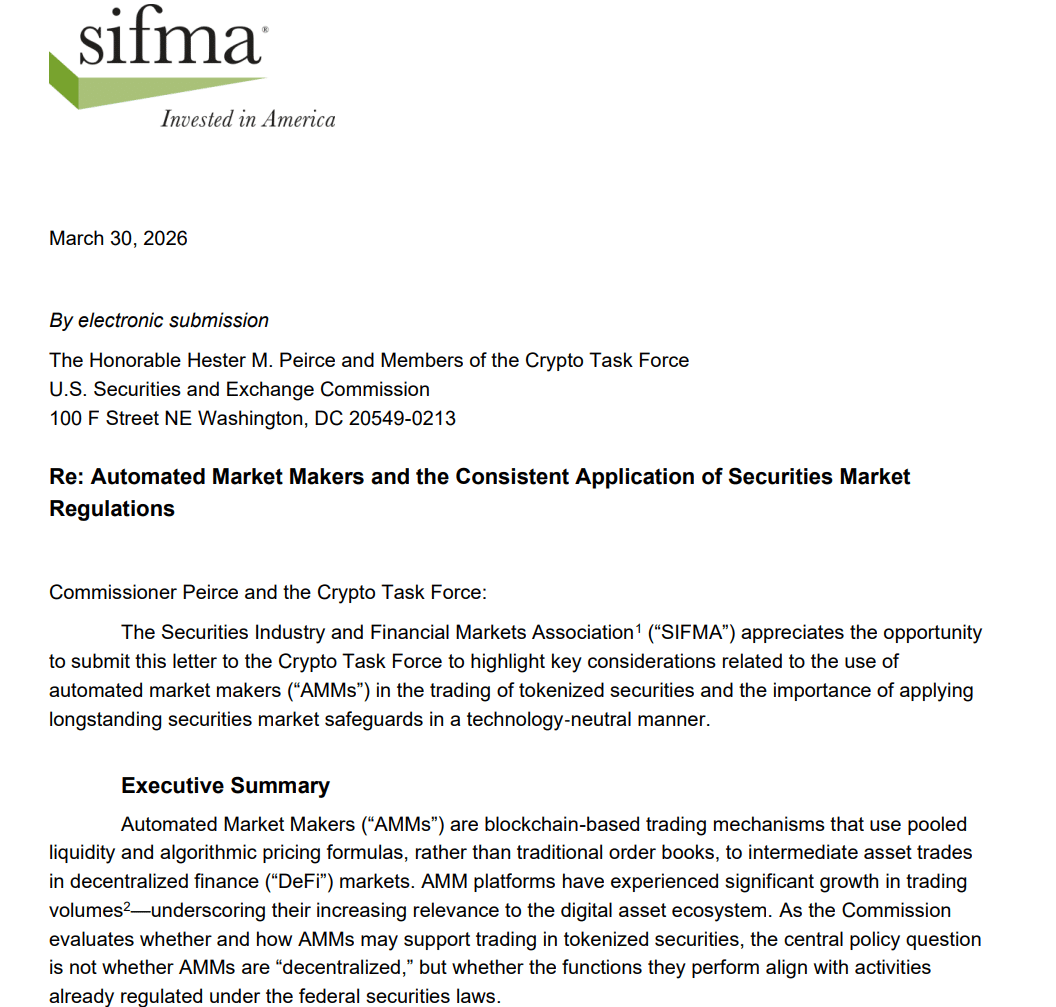
The DEF letter was also a response to SIFMA (Securities Industry and Financial Markets Association). The TradFi umbrella group recently argued that the SEC should regulate AMMs, citing risk to investor protections.

According to SIFMA, the SEC should regulate AMMs and DeFi platforms based on their functions in supporting tokenized securities trading. And not based on whether they’re decentralized, as DeFi supporters propose.

SIFMA believes the Commission should maintain technology neutrality by regulating AMMs based on their market function rather than protocol architecture.
Source: SEC

SIFMA’s stance echoed Citadel Securities’ position. Last year, Citadel called for a strict regulation of DeFi platforms that handle tokenized securities.

SIFMA and Citadel’s opposition to unregulated DeFi could be genuine concerns, given the scams and blowouts seen in the past across the sector. For Wall Street, compliance should apply to everyone handling tokenized securities.

However, Citadel gets most of its revenue from being a centralized intermediary, especially for retail platforms like Robinhood. As a result, DEF views the Wall Street opposition as motivated by the potential disruption of DeFi tech (removing intermediaries) to its business interests.

It remains to be seen how the SEC will address these competing interests while still supporting innovation in the upcoming ‘exemption’ framework for tokenized securities.


Final Summary

  • Advocacy group DeFi Education Fund (DEF) has opposed SIFMA’s push to regulate AMMs and other non-custodial DeFi platforms
  • However, SIFMA claims most ‘decentralized’ platforms pose investor protection risks.

Perguntas relacionadas

QWhat is the main argument made by the DeFi Education Fund (DEF) in their letter to the SEC?

AThe DEF argues that decentralized protocols should not be misclassified as intermediaries like centralized exchanges. They state that DeFi tools providing liquidity or running autonomously are not performing exchange functions, and neither the technology nor its developers should be regulated as exchanges.

QWhy does the DEF believe that regulating developers as intermediaries would be problematic?

AThe DEF believes that classifying developers as intermediaries when they do not control the 'non-custodial platforms' they built would place an overwhelming and inappropriate regulatory burden on them.

QWhat is SIFMA's position on the regulation of Automated Market Makers (AMMs) and DeFi platforms?

ASIFMA argues that the SEC should regulate AMMs and DeFi platforms based on their function in supporting tokenized securities trading, not on whether they are decentralized. They believe regulation should be technology-neutral and based on market function.

QWhat potential conflict of interest does the DEF suggest motivates Wall Street's opposition to DeFi exemptions?

AThe DEF suggests that Wall Street firms, like Citadel Securities which earns most of its revenue as a centralized intermediary, are motivated by the potential disruption that DeFi technology (which removes intermediaries) poses to their business interests.

QWhat is the core issue that the SEC must address regarding the proposed 'innovation exemption' for tokenized assets?

AThe SEC must address the competing interests between the crypto industry, which seeks exemptions for non-custodial DeFi platforms, and traditional finance (Wall Street), which argues for function-based regulation, all while still trying to support innovation.

Leituras Relacionadas

Bitcoin Withdrawals Continue: 8 Years of Storage in a Coldcard Cold Wallet Ended in Zero

Coldcard Hardware Wallet Hacked: Losses Mount Due to Vulnerable Seed Generation A critical vulnerability in Coldcard hardware wallets has led to a continued wave of fund thefts. According to Galaxy Research, the total stolen has reached 1,367.05 BTC (approx. $88.6 million) from 4,585 addresses, a significant increase from the initial 594.5 BTC reported on July 30, 2026. Most of the stolen funds remain on the attackers' addresses. The issue is not with the current firmware, which Coinkite has updated, but with seed phrases generated on vulnerable devices between March 2021 and the release of fixed firmware versions. Due to a programmer error, devices switched from using a hardware random number generator to the software-based Yasmarang generator, which was initialized with publicly accessible data like the chip's serial number. This made the seed phrases predictable through offline brute-force attacks, meaning wallets remain at risk until funds are moved to a new wallet generated with the patched firmware. Affected devices include Mk2/Mk3 with firmware 4.0.1–4.1.9 (and up to 5.0.3), Mk4/Mk5 up to version 5.6.0, and Q models up to 1.5.0Q. The only exceptions are seeds created with a high-entropy method like at least 50 independent dice rolls or a strong unique BIP-39 passphrase. All other owners must generate a new seed on the fixed firmware and transfer their assets. A case highlighting the human impact involves a 39-year-old long-term investor who lost 2 BTC (approx. $130,000) in minutes. He had accumulated the Bitcoin over eight years through physical labor, viewing it as a financial lifeline and a retirement plan in a country suffering from hyperinflation. His story underscores that even conservative "buy and hold in cold storage" strategies can be compromised by such underlying technical flaws. From a technical perspective, this incident echoes historical failures where weak random number generators undermined cryptographic security, challenging the assumption that offline storage is automatically foolproof.

cryptonews.ruHá 1h

Bitcoin Withdrawals Continue: 8 Years of Storage in a Coldcard Cold Wallet Ended in Zero

cryptonews.ruHá 1h

Trading

Spot
活动图片





