DeepSeek V4 Finally Released, Breaking the Strongest Closed-Source Monopoly, Explicitly Partnering with Huawei Chips

marsbitPublicado em 2026-04-24Última atualização em 2026-04-24

Resumo

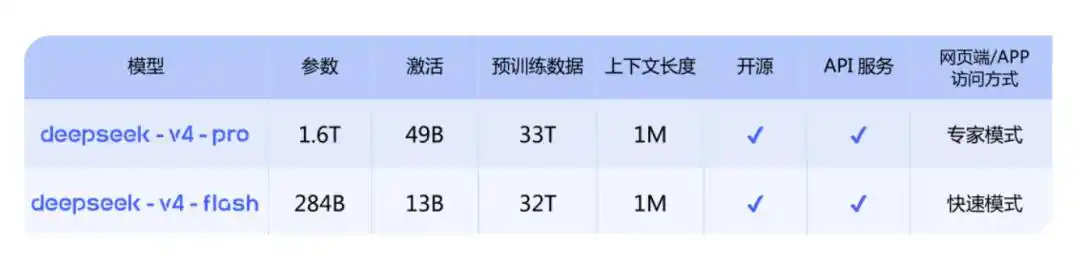
DeepSeek AI has officially released DeepSeek-V4, available in two versions: the high-performance **DeepSeek-V4-Pro** (49B activated parameters, 1.6T total) and the more efficient **DeepSeek-V4-Flash** (13B activated parameters, 284B total). Both support a 1M context length, making long-context capability a baseline feature rather than a premium offering. The Pro version rivals top closed-source models in agent capabilities, world knowledge, and reasoning performance. It outperforms Claude Sonnet 4.5 in agentic coding and approaches Claude Opus 4.6 (non-thinking mode) in quality. The Flash version offers competitive performance at a lower cost, though it lags in highly complex tasks. A key technical innovation is a new attention mechanism that reduces computational and memory demands for long contexts. The models are optimized for agent frameworks like Claude Code and OpenClaw. API services are available with support for both OpenAI and Anthropic-style interfaces. DeepSeek also announced upcoming support for Huawei’s computing hardware in the second half of the year. The models are open-sourced on Hugging Face and ModelScope.

Just now, DeepSeek-V4 is here!

The preview version is officially launched and simultaneously open-sourced.

There are two versions in total:

DeepSeek-V4-Pro: Comparable to top closed-source models, 1.6T, 49B activated, 1M context length;

DeepSeek-V4-Flash: A smaller and faster economical version, 284B, 13B activated, 1M context length.
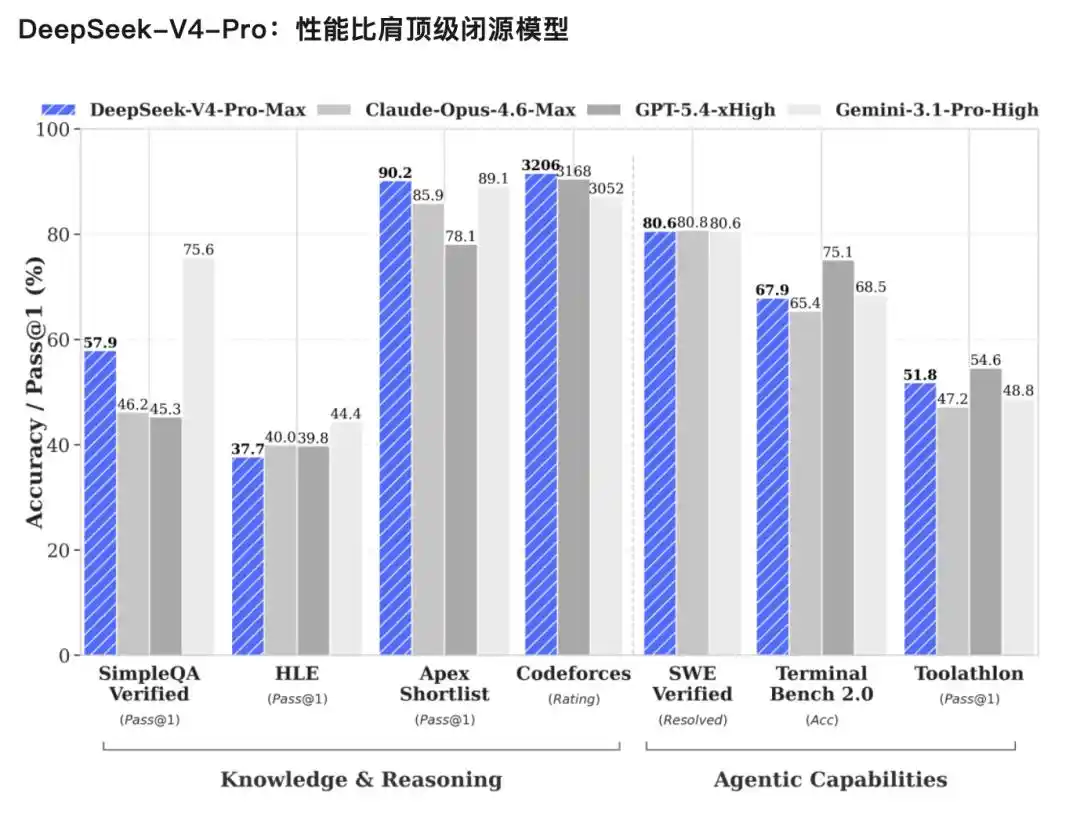
The official statement is: It leads domestically and in the open-source field in Agent capabilities, world knowledge, and reasoning performance.

And:

Currently, DeepSeek-V4 has become the Agentic Coding model used by company employees. According to evaluation feedback, the user experience is better than Sonnet 4.5, and the delivery quality is close to Opus 4.6 non-thinking mode. However, there is still a certain gap compared to the Opus 4.6 thinking model.
Currently, both the official website and the app have been updated, and the API service has also been synchronized.

Regarding the much-concerned domestic computing power, the key point is: Support for Huawei computing power in the second half of the year.

Top-Tier and Cost-Effective Choices, Two Versions Launched Together

This time, V4 releases two versions at once.

V4-Pro, performance comparable to top closed-source models.

The official judgment has three points:

Significantly improved Agent capabilities: In the Agentic Coding evaluation, V4-Pro has reached the best level among current open-source models and also performed excellently in other Agent-related evaluations. In internal evaluations, in Agent Coding mode, the V4 experience is better than Sonnet 4.5, and the delivery quality is close to Opus 4.6 non-thinking mode, but there is still a certain gap compared to the Opus 4.6 thinking mode.

Rich world knowledge: In world knowledge evaluations, DeepSeek-V4-Pro significantly leads other open-source models, only slightly inferior to the top closed-source model Gemini-Pro-3.1.

World-class reasoning performance: In evaluations of mathematics, STEM, and competitive code, DeepSeek-V4-Pro surpasses all currently publicly evaluated open-source models and achieves excellent results comparable to the world's top closed-source models.
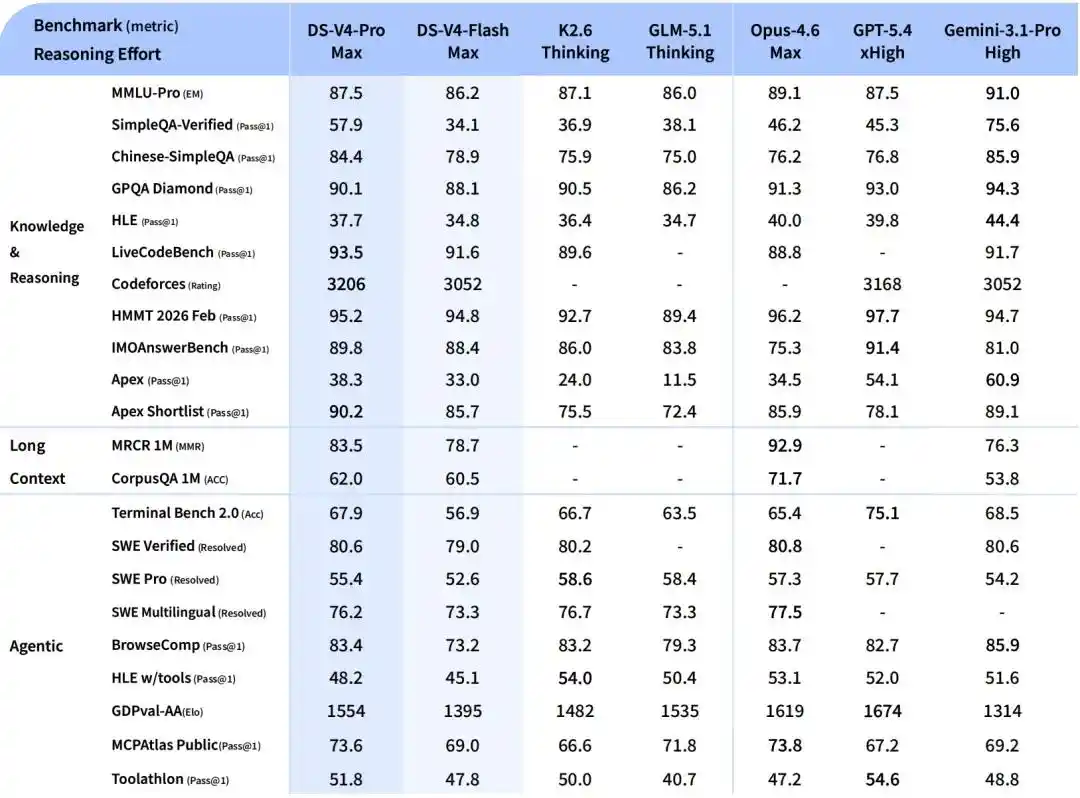
V4-Flash, a smaller and faster economical version. Reasoning ability is close to Pro, world knowledge reserve is slightly inferior, but with smaller parameters and activation, and cheaper API.

In Agent tasks, DeepSeek-V4-Flash is on par with DeepSeek-V4-Pro in simple tasks, but there is still a gap in high-difficulty tasks.

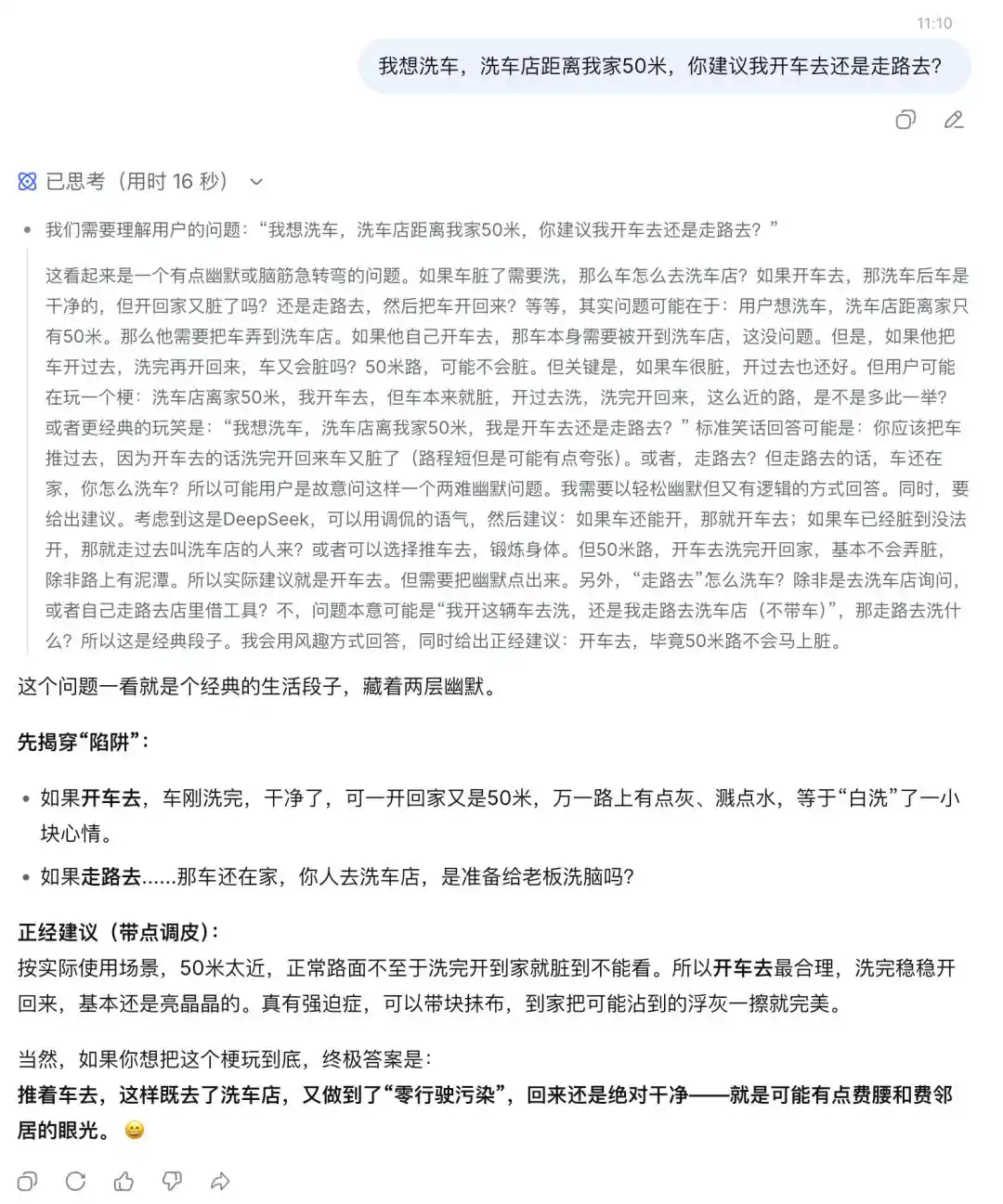
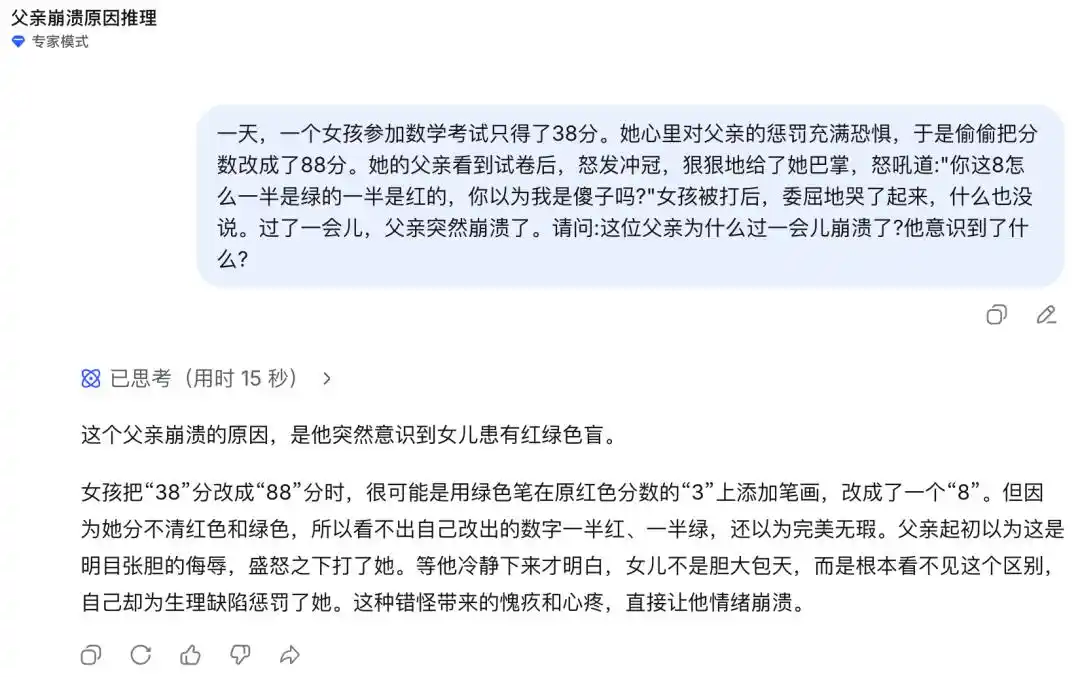
In the car wash test, V4 also passed quickly.
In the classic biological scenario "Desperate Father," DeepSeek-V4 did not immediately grasp the key point of red-green color blindness in one round (according to genetic rules, if a female is red-green color blind, her biological father must be as well).
Million Context Length Becomes Standard

It is worth mentioning that from today, 1M context length is standard for all DeepSeek official services.

A year ago, 1M context length was Gemini's exclusive trump card; all other closed-source models were either 128K or 200K; on the open-source side, almost no one could afford this level.

DeepSeek directly moved the million context length from a "high-end feature" to "basic infrastructure."

And it's open source. How did they do it? The release directly gave the answer—

V4 has created a new attention mechanism that compresses at the token dimension and is used in combination with DSA sparse attention. Compared to traditional methods, the demand for computation and memory is significantly reduced.
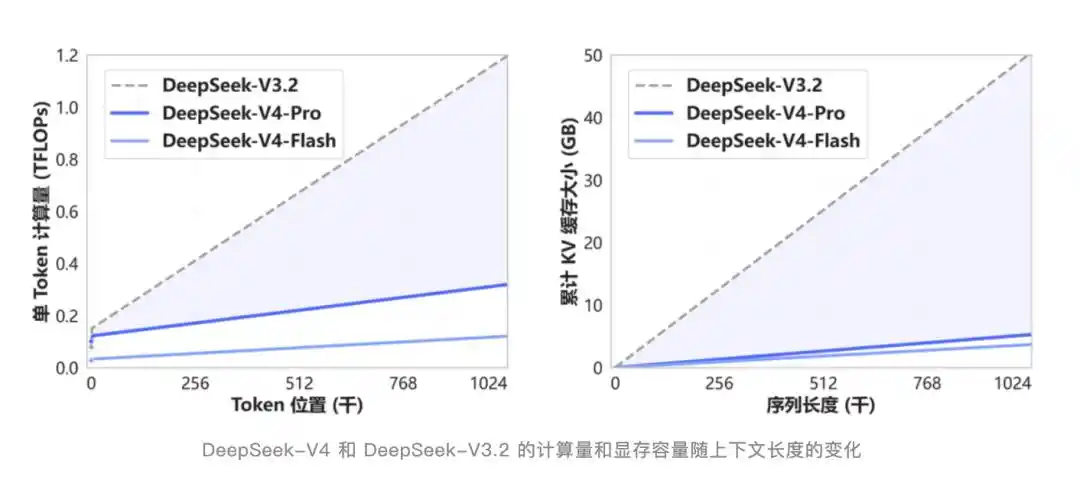
DSA is not a new term. It was first introduced in the V3.2-Exp update half a year ago. At that time, external attention was low because the benchmark scores were almost the same as V3.1-Terminus, making it seem like an insignificant intermediate version.

Looking back now, that was the foundation of V4.

Special Optimization for Agent Capabilities

On the Agent side, V4 has been adapted and optimized for mainstream Agent products such as Claude Code, OpenClaw, OpenCode, CodeBuddy, etc., with improvements in code tasks and document generation tasks.

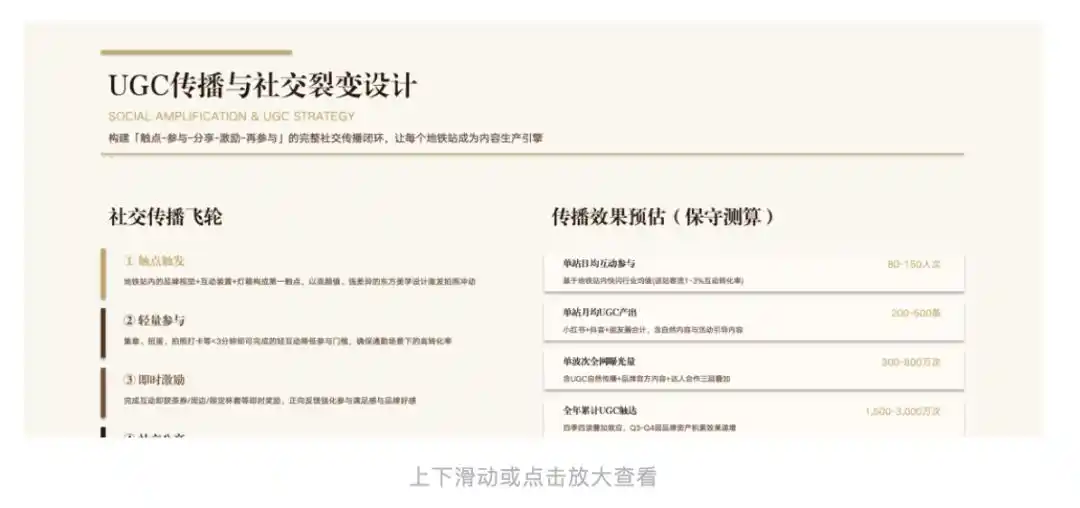
The release also included an example of a PPT inner page generated by V4-Pro under a certain Agent framework.
API Pricing

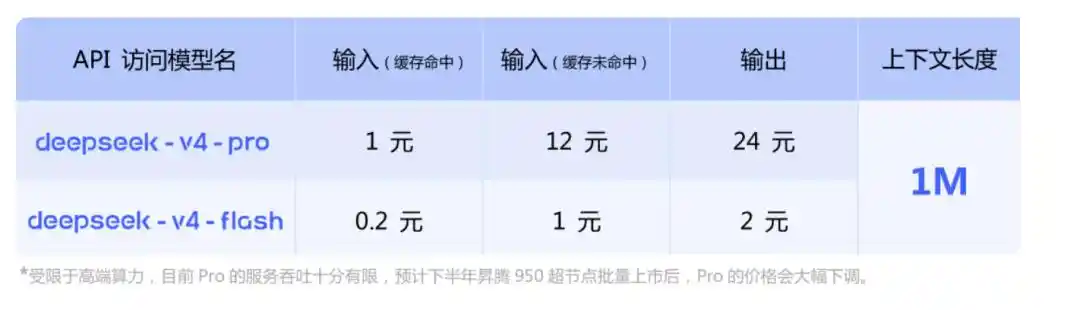
On the API side, V4-Pro and V4-Flash are simultaneously launched, supporting both OpenAI ChatCompletions interface and Anthropic interface.

The base_url remains unchanged, just change the model parameter to deepseek-v4-pro or deepseek-v4-flash to call.

Both versions have a maximum context length of 1M and support both non-thinking mode and thinking mode. In thinking mode, the intensity can be adjusted through the reasoning_effort parameter, with two levels: high and max. The official recommendation is to directly use max for complex Agent scenarios.
Here is a key point—Support for Huawei computing power in the second half of the year.

In addition, old model names will be discontinued.

deepseek-chat and deepseek-reasoner will be discontinued three months later (July 24, 2026). During the current phase, these two names point to the non-thinking and thinking modes of V4-Flash, respectively.

It has little impact on individual developers; just change one model parameter. Companies with production environments need to migrate during these three months.

One more thing

At the end of the release, DeepSeek quoted a sentence.

"Not tempted by praise, not frightened by slander, follow the path and act,端正自己端正自己 (correct oneself)."

This is a sentence from Xunzi's "Non-Twelve Masters." The literal meaning is: not tempted by praise, not frightened by slander, move forward according to the path one believes in, and correct oneself.

In today's context, it's somewhat interesting.

Over the past six months, rumors about when V4 would be released, whether it was delayed, whether it had been surpassed by others, whether it had been compromised by Claude's distilled data, etc., have circulated back and forth in both Chinese and English AI circles. At the beginning of the year, some even confidently said that V4 would be released before the Spring Festival, but it wasn't until the end of April.

They never responded once.

Then, on a Friday afternoon, they released V4, simultaneously open-sourced it, simultaneously launched it on the official website and app, simultaneously updated the API, and even wrote into the release that internal employees have already abandoned Claude.

No roadmap, no live stream, no interviews.

The four words "率道而行" (follow the path and act) sound like a slogan. But if you look at the path over the past six months: the V3.2 "unremarkable" Exp version, the DSA sparse attention that paved the way for V4 for half a year, and the path of making 1M context length from a trump card to a standard feature.

DeepSeek has already done it.

DeepSeek-V4 model open-source links:

[1]https://huggingface.co/collections/deepseek-ai/deepseek-v4

[2]https://modelscope.cn/collections/deepseek-ai/DeepSeek-V4

DeepSeek-V4 Technical Report: https://huggingface.co/deepseek-ai/DeepSeek-V4-Pro/blob/main/DeepSeek_V4.pdf

This article is from the WeChat public account "QbitAI", author: QbitAI

Perguntas relacionadas

QWhat are the two versions of DeepSeek-V4 that were released, and what are their key specifications?

ADeepSeek-V4 was released in two versions: DeepSeek-V4-Pro and DeepSeek-V4-Flash. The Pro version has 1.6T parameters with 49B activated and a 1M context length. The Flash version is a smaller, faster, and more economical model with 284B parameters, 13B activated, and also a 1M context length.

QAccording to the article, how does DeepSeek-V4-Pro's performance compare to top closed-source models like Anthropic's Opus 4.6?

AAccording to internal evaluations, DeepSeek-V4-Pro's performance in Agent Coding mode is better than Sonnet 4.5 and its delivery quality is close to Opus 4.6 in non-thinking mode, but it still has a gap compared to Opus 4.6 in thinking mode.

QWhat major technical achievement is highlighted for the DeepSeek-V4 models regarding context length?

AA major technical achievement is that a 1M context length has become the standard for all DeepSeek official services. This was achieved through a novel attention mechanism that compresses at the token dimension and is combined with DSA sparse attention, significantly reducing computational and memory requirements.

QWhat significant partnership or hardware support is announced for the future of DeepSeek's models?

AThe article announces that DeepSeek will support Huawei's computing power in the second half of the year.

QWhere can users find the open-source models and the technical report for DeepSeek-V4?

AThe open-source models can be found on Hugging Face and ModelScope collections under 'deepseek-ai/deepseek-v4'. The technical report is available at: https://huggingface.co/deepseek-ai/DeepSeek-V4-Pro/blob/main/DeepSeek_V4.pdf

Leituras Relacionadas

Can DeepSeek Save China One Trillion Dollars?

"DeepSeek and the $1 Trillion Infrastructure Question" The article examines whether DeepSeek's AI optimization breakthroughs could potentially save China $1 trillion in future AI infrastructure costs. The analysis begins with Nvidia's upcoming Vera Rubin AI platform, costing ~$7.8 million, where memory (HBM4/LPDDR5X) constitutes $2 million—a 435% cost increase in one year, highlighting how AI hardware spending is shifting toward expensive memory components. DeepSeek's approach works in the opposite direction. Through three key technical innovations showcased in DeepSeek V4, the company dramatically improves hardware efficiency: 1. **Memory Compression (MLA)**: Re-engineers the attention mechanism to compress long-context memory (KV Cache) by over 90%, drastically reducing expensive HBM usage. 2. **Selective Activation (MoE)**: Employs Mixture-of-Experts architecture where only a small fraction of parameters (e.g., 49B out of 1.6T in V4-Pro) are activated per token, allowing most parameters to reside in cheaper memory/SSD. 3. **Computation Caching**: Reuses previously computed results via cache hits, replacing expensive GPU computations with cheap memory reads. Combined, these optimizations allow the same hardware to produce approximately 4x more tokens, effectively reducing required hardware investment by 75%. DeepSeek's pricing reflects this: a 10-billion token workload costs ~$522 monthly versus ~$9,000-$10,000 for competitors. The $1 trillion savings projection stems from McKinsey's estimate that global AI infrastructure will require ~$5.2 trillion investment by 2030. As China's daily token consumption grows toward quadrillions, even marginal efficiency gains scale massively. With a conservative 4x throughput improvement, China could avoid building tens of thousands of AI data centers equivalent to ~7 trillion RMB ($1 trillion) in saved investment. Critically, this strategy shifts dependency from scarce, expensive GPU/HBM—where China lags—toward more accessible storage, caching, and systems engineering where domestic suppliers like CXMT are gaining strength. Rather than "replacing Nvidia," DeepSeek rebalances AI's value chain away from monolithic hardware dependency. Ultimately, DeepSeek's technical breakthroughs could lower the barrier to AI adoption across Chinese industries by making advanced capabilities affordable at scale—transforming who can access next-generation AI.

marsbitHá 46m

Can DeepSeek Save China One Trillion Dollars?

marsbitHá 46m

Overturning the Mainstream Approach to Hallucinations: Metacognition is the New Solution for Large Models to Break the Hallucination Barrier

This paper, "Hallucinations Undermine Trust; Metacognition is a Way Forward," proposes a paradigm shift in combating AI hallucination. It argues that the current mainstream approaches—striving for omniscience by scaling data/models or having AI abstain from uncertain answers—are fundamentally flawed. The former has inevitable knowledge gaps, while the latter imposes a crippling "utility tax," requiring the rejection of many correct answers to achieve high accuracy, due to models' poor "discrimination" (the ability to distinguish correct from incorrect answers internally). The core contribution is redefining hallucination not as "being wrong," but as "expressing false information with unwarranted certainty." The proposed solution is **Faithful Uncertainty** or **Metacognition**: enabling AI to accurately perceive its internal uncertainty and honestly express it in its language (e.g., using hedging phrases when unsure). This creates a more reliable assistant that provides useful information while signaling its confidence, minimizing harm from errors. The paper emphasizes that metacognition is critical for the era of AI Agents. Without it, Agents cannot intelligently decide when to use tools like search engines, leading to inefficiency and misuse. Key implementation challenges are highlighted: the "bootstrapping paradox" of training with static uncertainty data, the "alignment distortion signal" where human preference training suppresses internal uncertainty cues, and the difficulty of causally evaluating true metacognition vs. its superficial imitation. The paper concludes that the goal should not be an infallible AI, but one that is honest about the limits of its knowledge, thereby building user trust through transparent communication of its certainty.

marsbitHá 50m

Overturning the Mainstream Approach to Hallucinations: Metacognition is the New Solution for Large Models to Break the Hallucination Barrier

marsbitHá 50m

Hedge by Buying Gold and Oil, Chase Soaring Returns with AI. ‘Dated’ Bitcoin Enters a Bear Market

Bitcoin has recently declined, hitting a two-month low near $66,123, while Ethereum fell to a three-month low around $1,837. Analysts suggest the drop is not merely due to factors like ETF outflows or MicroStrategy's selling but reflects a deeper issue: Bitcoin is losing a broader asset competition. In a near-zero interest rate environment, Bitcoin previously thrived as an outlet for investor dissatisfaction with inflation and limited options. However, the market landscape has shifted. Bitcoin now occupies an "awkward middle ground," facing competition on three fronts. For inflation hedging, investors prefer gold, energy stocks, and commodity producers—assets with tangible backing and clearer pricing power. For growth exposure, AI-related companies with actual revenues and profits are more attractive. Even within crypto, investors can choose stablecoins, exchanges, or infrastructure firms tied directly to adoption, offering clearer business models and leverage. Thus, Bitcoin is no longer the top choice for hedging, growth, or crypto exposure. This shift is evident in market reactions: despite recent warnings about persistent inflation from a Fed official, Bitcoin did not rally as it might have in the past. Instead, capital flowed to assets with direct commodity or energy exposure. The recent ETF outflows and MicroStrategy sales are symptoms, not causes, of this new reality. Investors are becoming more selective, demanding clearer value propositions beyond mere scarcity. The emerging bear case for Bitcoin is not about it being a bubble or failed technology, but that scarcity alone is no longer sufficient.

华尔街日报Há 53m

Hedge by Buying Gold and Oil, Chase Soaring Returns with AI. ‘Dated’ Bitcoin Enters a Bear Market

华尔街日报Há 53m

Trading

Spot
Futuros
活动图片





