Deconstructing HyperEVM: Which Applications Can Truly Reap the Core Benefits of Hyperliquid?

Foresight NewsPublicado em 2026-06-26Última atualização em 2026-06-26

Resumo

### Summary HyperEVM, positioned as a smart contract layer, enables applications to directly access and utilize HyperCore's trading, collateral, positions, and risk data. Its core value lies in making the exchange programmable, distinguishing it from typical "chain-first" approaches. Valuable HyperEVM-native applications must leverage EVM flexibility, rely on HyperCore's unique state, and enhance Hyperliquid's utility as a financial venue. Applications can be categorized within a 2x2 matrix based on their need for general EVM logic and integration with HyperCore. Key categories include: - **Local EVM Finance:** Portable DeFi primitives (e.g., AMMs, lending markets) that form the essential base layer. - **Core-Native Extensions:** Applications that tokenize or wrap Hyperliquid-native assets to enhance their utility. - **Programmable HyperCore:** The most promising category, where applications deeply integrate EVM logic with HyperCore's state and execution to create novel products. The ultimate vision is a unified financial account where a single user balance can seamlessly power trading, lending, yield generation, hedging, and payments, all built on HyperCore's robust infrastructure and controlled by the user via HyperEVM's open application layer.


Author: ponyo_fp (Four Pillars Research Team)

Compiled by: AididiaoJP, Foresight Newsna


Key Takeaways


HyperEVM should be viewed as a smart contract layer, whose core value lies in enabling applications to directly read and utilize HyperCore's trading, collateral, positions, and risk data.


The simplest way to judge whether a HyperEVM application is valuable is to ask two questions: Why does it need EVM? Why does it need Hyperliquid?


Basic functions like swaps, lending, and asset wrappers are certainly necessary, but what truly creates a competitive edge are products that cannot function properly without HyperCore.


In the long run, the ultimate form is a highly integrated account—users can perform all operations like trading, lending, yield farming, hedging, and payments using just one balance.


Exchange First


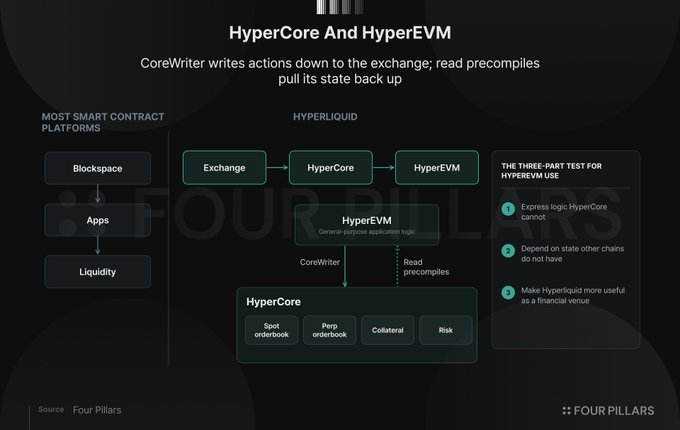
Most smart contract platforms follow the 'chain first, then find applications' route: first launch infrastructure, subsidize liquidity, attract developers, and finally hope that applications naturally create financial gravity.


Hyperliquid's path is completely opposite. It builds the exchange first, possessing a native spot and perpetual order book, trader mindshare, a protocol-owned liquidity system, and real trading volume already flowing through HyperCore. This fundamentally changes the positioning of HyperEVM—it is not another place to simply fork DeFi contracts, but rather to make the exchange itself programmable.


This article is not a comprehensive list of all factors that can drive Hyperliquid's growth (HIP 3 markets, builder codes, portfolio margin, native liquidity, Unit assets, fee recycling, etc., are also important). It focuses on just one question: What characteristics should truly worthwhile applications on HyperEVM possess?


A valuable native HyperEVM application needs to satisfy three points simultaneously:


  • Can express general logic not achievable by HyperCore itself (requiring EVM's flexibility);
  • Relies on unique states not available on other chains (HyperCore's composability);
  • Makes Hyperliquid more useful as a financial venue.


HyperCore is the home for trading, collateral, and risk engines. HyperEVM is the place to write application logic. Through precompiles, contracts can directly query HyperCore data such as balances, positions, prices, staking delegation, and vault equity; through CoreWriter, contracts can write operations back to HyperCore.


This design turns the exchange into a native input source for applications. Collateral, execution, settlement, and allocation can be more tightly integrated on the same ledger.


Of course, not all HyperEVM applications need to pursue 'novelty'. The ecosystem first needs familiar primitives for users to naturally perform swaps, lending, leveraging, rebalancing, and exits. A local financial surface can keep capital within the system, making the entire ecosystem truly usable.


But the deeper opportunity is definitely not simply forking existing lending protocols with a new front end. It's building credit, asset management, payments, and structured finance around the exchange ledger—things ordinary EVM chains cannot replicate even by issuing incentives.


CoreWriter will not turn HyperEVM into a synchronous extension of the order book either. Cross-environment operations have ordering constraints, delayed writes, and state coordination issues. Builders must handle failure rollbacks, delayed execution, cross-environment collateral accounting, and risk management. While this narrows some design spaces, it also forms a unique moat.


Understanding the HyperEVM Economy Through a 2×2 Matrix


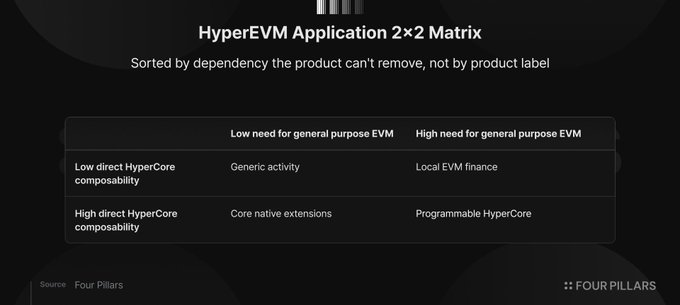
The best framework for evaluating HyperEVM applications is a two-dimensional matrix:


  • Horizontal Axis: Does the application require general EVM logic?
  • Vertical Axis: Does the application directly compose with HyperCore's state or execution?


Category labels are not important; the key is the product's non-removable dependencies.


Local EVM Finance


Applications in this category need smart contracts, but their product models are largely portable. AMMs, money markets, CDPs, routers, option venues, leverage products, and yield markets belong to this quadrant.


Felix is a typical example. HyperLend also started here, as one of the main credit venues on HyperEVM (its roadmap later evolves towards programmable HyperCore).


This quadrant is easily underestimated but is actually very important. Any financial center needs banks, brokers, liquidity venues, and risk transfer markets to support more complex balance sheet products. Portability makes them the foundational layer for user activity.


Core-Native Extensions


Applications in this category are more directly dependent on Hyperliquid, but EVM's role is mainly wrapping, tokenizing, or composing native primitives.


Typical examples include: Kinetiq, StakedHYPE, Kintsu, HLP wrappers, Unit-linked assets, etc. Their core task is to make assets inside Hyperliquid more useful.


This quadrant is crucial—collateral is the raw material for all financial activity. Money markets need assets users are willing to borrow, structured products need assets that can be staked or hedged, and unified accounts require balances that can freely flow between different functions.


Programmable HyperCore


This is the quadrant with the most imagination: applications require both the general logic of EVM and deeply depend on HyperCore's state and execution. Here, exchange activity truly begins to be 'productized'.


  • Rysk: Converts options into volatility income for assets users already own;
  • Liminal: Packages Hyperliquid strategies into tokenized products;
  • Hyperbeat: Delta-neutral strategies combining Core positions with ERC-20 composability.


Derive sits at the edge—it enables HYPE and kHYPE to be used as collateral for options/perpetuals via HyperEVM-vault bridging, but its core trading and settlement logic remains within its own stack. It expands HYPE collateral usage but does not strictly belong to the native programmable HyperCore category.


Currently, projects strictly meeting the 'contract-custodied assets + reading HyperCore state + using CoreWriter for execution' criteria are still early. Valantis Prime is a representative public beta case: it uses HyperEVM smart accounts as a control layer, operates HyperCore via CoreWriter, and sets constraints like permissions, proxies, session keys, and guardians, making the account itself a programmable interface to the exchange.


HyperLend and Rysk also point towards the same frontier from different angles, but ultimately must be measured against the standard of 'whether assets are truly custodied and CoreWriter is deeply integrated.'


The Financial Account is the Ultimate Form


The most valuable HyperEVM application might not look like an 'application' at all, but more like an account.


Today, crypto users still have to switch between multiple interfaces: exchange balances for trading, wallet balances for DeFi, vault shares for yield, borrowing capacity hidden in money markets, hedging requires opening another platform... This fragmentation is not just a user experience issue; it reflects the fact that liquidity, collateral, execution, and risk are scattered across different systems.


HyperEVM has the opportunity to compress these systems into the same account. Users can deposit assets like BTC, ETH, SOL, HYPE just once and start from the same balance: trade on HyperCore, lend on HyperEVM, earn yield through vaults, hedge with perpetuals, and directly spend from the payment account. The product is not a bridge; the product is that balance that can flow across functions.


Centralized exchanges have long understood this—their accounts feel unified because trading, margin, lending, and yield all exist in one controlled environment. But the problem is the closed ledger, opaque risk engines, and the inability for external developers to build freely.


General-purpose public chains are the opposite: users truly control accounts, but the financial stack is highly fragmented.


Hyperliquid sits at the sweet spot: HyperCore provides exchange-level liquidity and risk infrastructure, while HyperEVM provides an open application surface. The end result is a unified financial account completely controlled by the user yet backed by HyperCore as a powerful balance sheet engine—this is the strongest manifestation of the 'all-in-one financial home' vision.


Future evidence will appear at the account level: collateral follows users across trading, lending, saving, hedging, and spending; risk is priced in real-time from HyperCore state; liquidations are executed via HyperCore depth; structured products directly hedge with Core liquidity; ERC-20s represent claims on various financial activities within the system.


The first wave of HyperEVM makes the ecosystem usable; the next wave will make HyperCore truly programmable.


Criptomoedas em alta

Perguntas relacionadas

QWhat are the three criteria that a valuable native HyperEVM application must meet according to the article?

AA valuable native HyperEVM application must meet three criteria: 1) It must be able to express general logic that cannot be implemented by HyperCore itself (requiring EVM flexibility); 2) It must depend on unique states that are not available on other chains (HyperCore's composability); 3) It must make Hyperliquid more useful as a financial venue.

QWhat is the core value proposition of HyperEVM as described in the article?

AThe core value proposition of HyperEVM is that it should be seen as a smart contract layer, whose primary value lies in allowing applications to directly read and use HyperCore's trading, collateral, position, and risk data. It enables the programming of the exchange itself.

QAccording to the article's framework, what defines the most valuable and imaginative quadrant for HyperEVM applications?

AAccording to the article's 2x2 matrix framework, the most valuable and imaginative quadrant for HyperEVM applications is 'Programmable HyperCore.' Applications in this quadrant both require the general logic of the EVM and deeply depend on the state and execution of HyperCore, effectively 'productizing' exchange activity.

QWhat is the 'ultimate form' or 'ultimate shape' envisioned for the most valuable HyperEVM applications?

AThe ultimate form envisioned is not a typical 'application,' but rather a highly integrated, unified financial account. With just a single balance, a user can simultaneously perform all operations like trading, borrowing, yield farming, hedging, and payments, with liquidity and risk management seamlessly powered by HyperCore.

QHow is Hyperliquid's development path different from that of most smart contract platforms?

AHyperliquid's path is the opposite of most smart contract platforms. Instead of building the chain first and then looking for applications, Hyperliquid built the exchange first. It possesses a native spot and perpetual order book, trader mindshare, protocol-owned liquidity, and real trading volume already flowing through HyperCore. This fundamentally changes HyperEVM's role—it's not just another place to copy DeFi contracts, but to make the exchange itself programmable.

Leituras Relacionadas

Airwallex's Pivot: From Dismissing Stablecoins a Year Ago to Making High-Profile Investments Today

Airwallex, a major cross-border payments fintech, has made a notable strategic shift by leading a seed round investment in Metal, a tokenized financial settlement network. This move is significant given that Airwallex founder Jack Zhang was a prominent critic of stablecoins just a year prior, arguing they failed to reduce costs for mainstream currency corridors and lacked clear utility. The investment targets Metal, a Layer-1 blockchain designed for the tokenization and settlement of assets like stocks, bonds, and stablecoins, aiming for the institutional market. Metal's team includes veterans from Ren Protocol and Meta's Diem project. For Airwallex, this partnership integrates tokenized finance into its global payments network, providing a new settlement layer. Despite his company's investment, Zhang maintains a distinction, stating his skepticism toward "cryptocurrencies" remains, while classifying regulated, asset-backed stablecoins as a separate category. This stance reflects a broader trend of traditional finance (TradFi) cautiously engaging with crypto infrastructure. Companies like Stripe, Mastercard, and major banks are similarly exploring stablecoin payments and tokenization networks, recognizing their potential in emerging markets and 24/7 settlement. The article concludes that Airwallex's investment is less a change of belief and more a strategic necessity to secure a position in the evolving landscape of digital asset settlement, where stablecoins are becoming a key interface for global finance.

marsbitHá 5m

Airwallex's Pivot: From Dismissing Stablecoins a Year Ago to Making High-Profile Investments Today

marsbitHá 5m

Spicy Review|Is the "Most Emotionally Valuable" Post Here? Could STRC Be the Next LUNA?

Here is an English summary of the article (under 1500 characters): This article from the spicy commentary series "LaPing" covers three key stories in the crypto world for the week. First, during a sharp market downturn in June where BTC fell over 20%, a Reddit post on r/Cryptocurrency rallying against "Fear, Uncertainty, and Doubt (FUD)" went viral. The comment section became a hub for retail traders to share memes and encouragement, with many advocating holding (HODLing) through the volatility, embodying the "be fearful when others are greedy" mantra. Second, it examines the situation with STRG (Strategy's perpetual preferred stock), which has "de-pegged," trading around $76 vs. its $100 face value, a ~25% discount. The concern is whether Michael Saylor's company, MicroStrategy, can sustain the $1.2 billion annual dividend payment, given its ~$1.4 billion cash reserve. While analysts note STRG is fundamentally different from the catastrophic LUNA collapse—as Saylor isn't obligated to pay the dividend—risks remain. If MicroStrategy's (MSTR) common stock investors feel their capital is being prioritized for STRG dividends, it could hurt MSTR demand. Third, the article analyzes the online persona of "Chuan Mu," a trader famous for turning $500 into $1 million during the 2023 ORDI inscription boom and again with short positions in 2025. An analysis of his 1,828 tweets reveals his success stems from a top-down analytical framework, asking systemic questions like "Where will the bottleneck be in the AI supply chain?" rather than chasing individual pumps. His investments migrated from crypto-linked stocks to AI infrastructure plays like SK Hynix and Samsung. However, the piece also notes criticism that he has occasionally "pumped" assets and sold positions without notifying followers, creating a contradictory public image. The weekly recap highlights themes of community sentiment during bear markets, financial instrument risks, and the complex realities of following influential online traders.

Foresight NewsHá 39m

Spicy Review|Is the "Most Emotionally Valuable" Post Here? Could STRC Be the Next LUNA?

Foresight NewsHá 39m

Trading

Spot

Artigos em Destaque

Como comprar CORE

Bem-vindo à HTX.com!Tornámos a compra de CORE (CORE) simples e conveniente.Segue o nosso guia passo a passo para iniciar a tua jornada no mundo das criptos.Passo 1: cria a tua conta HTXUtiliza o teu e-mail ou número de telefone para te inscreveres numa conta gratuita na HTX.Desfruta de um processo de inscrição sem complicações e desbloqueia todas as funcionalidades.Obter a minha contaPasso 2: vai para Comprar Cripto e escolhe o teu método de pagamentoCartão de crédito/débito: usa o teu visa ou mastercard para comprar CORE (CORE) instantaneamente.Saldo: usa os fundos da tua conta HTX para transacionar sem problemas.Terceiros: adicionamos métodos de pagamento populares, como Google Pay e Apple Pay, para aumentar a conveniência.P2P: transaciona diretamente com outros utilizadores na HTX.Mercado de balcão (OTC): oferecemos serviços personalizados e taxas de câmbio competitivas para os traders.Passo 3: armazena teu CORE (CORE)Depois de comprar o teu CORE (CORE), armazena-o na tua conta HTX.Alternativamente, podes enviá-lo para outro lugar através de transferência blockchain ou usá-lo para transacionar outras criptomoedas.Passo 4: transaciona CORE (CORE)Transaciona facilmente CORE (CORE) no mercado à vista da HTX.Acede simplesmente à tua conta, seleciona o teu par de trading, executa as tuas transações e monitoriza em tempo real.Oferecemos uma experiência de fácil utilização tanto para principiantes como para traders experientes.

312 Visualizações TotaisPublicado em {updateTime}Atualizado em 2026.06.02

Como comprar CORE

Discussões

Bem-vindo à Comunidade HTX. Aqui, pode manter-se informado sobre os mais recentes desenvolvimentos da plataforma e obter acesso a análises profissionais de mercado. As opiniões dos utilizadores sobre o preço de CORE (CORE) são apresentadas abaixo.

活动图片