‘Death markets!’ U.S lawmaker slams Polymarket bets on lost U.S soldiers in Iran

ambcryptoPublicado em 2026-04-05Última atualização em 2026-04-05

Resumo

U.S. lawmaker Seth Moulton strongly criticized the prediction market platform Polymarket for allowing users to bet on the fate of a missing American soldier in Iran-downed aircraft, calling it a "disgusting death market." He also accused former President Donald Trump, an investor in Polymarket, of potentially profiting from access to non-public intelligence. Polymarket quickly removed the market, citing integrity violations and launched an internal review. This incident is part of a broader pattern; the platform previously faced scrutiny when insiders reportedly earned over $1.2 million from contracts related to U.S. strikes in Iran and the death of its former leader. Senator Chris Murphy announced plans to introduce legislation to make such markets illegal, highlighting growing ethical and regulatory concerns around prediction platforms.

Polymarket is under scrutiny for supporting markets that speculate on deaths.

On Friday, U.S. House representative and senatorial aspirant Seth Moulton (D-MA) lashed out at the prediction site for encouraging “disgusting death markets.”

There is an ongoing search and rescue operation for a missing American service member whose plane was shot down over Iran. Their safety is unknown. They could be your neighbor, a friend, a family member. And people are betting on whether or not they’ll be saved.
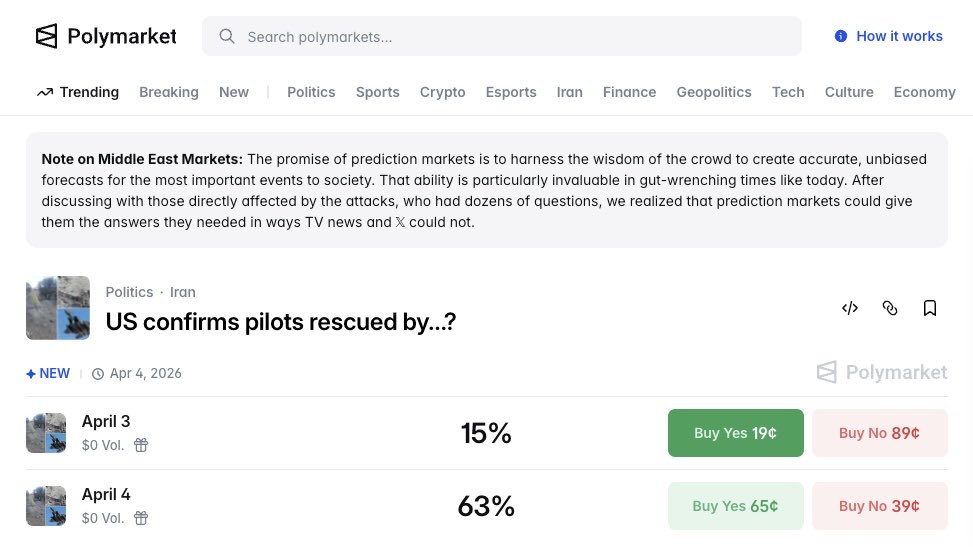
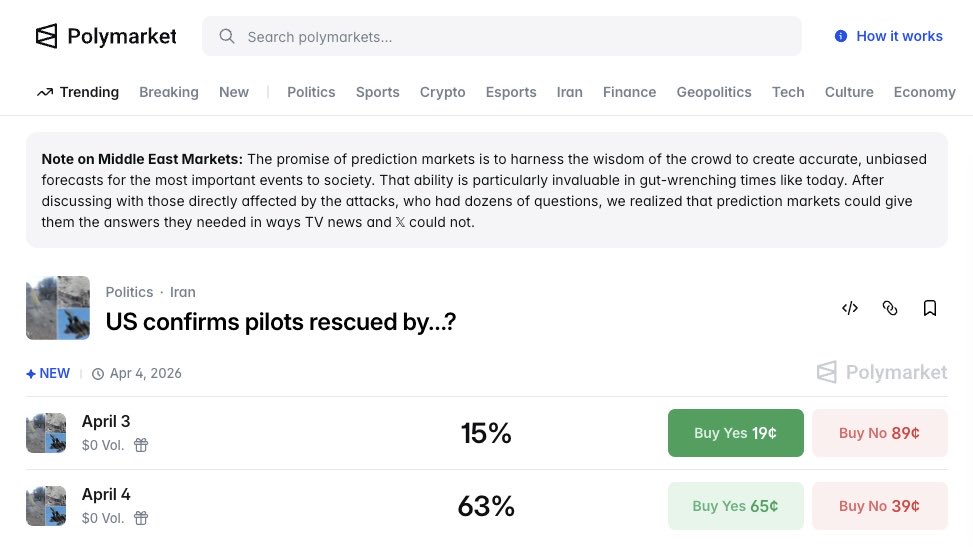
Source: Polymarket

He also criticized President Donald Trump for benefiting from the “death markets,” claiming his access to classified intelligence.

Quick reminder too that Donald Trump is an investor in this dystopian death market and may have access to intelligence that isn’t public yet.

Polymarket removes the alleged ‘death market’

Polymarket quickly archived the market, stating that it did not meet its “integrity standards.” The firm clarified that it was investigating how the market “slipped through its internal safeguards.”


Source: X/Polymarket

Well, this wasn’t the first time Polymarket or prediction markets have faced scrutiny over such markets. In fact, many traders reportedly benefited from Ali Khamenei, the former Supreme Leader of Iran, killed during U.S. and Israeli attacks.

In fact, on Polymarket, an account made over $460K in profits trading contracts related to Iran strikes and Khamenei’s ouster.
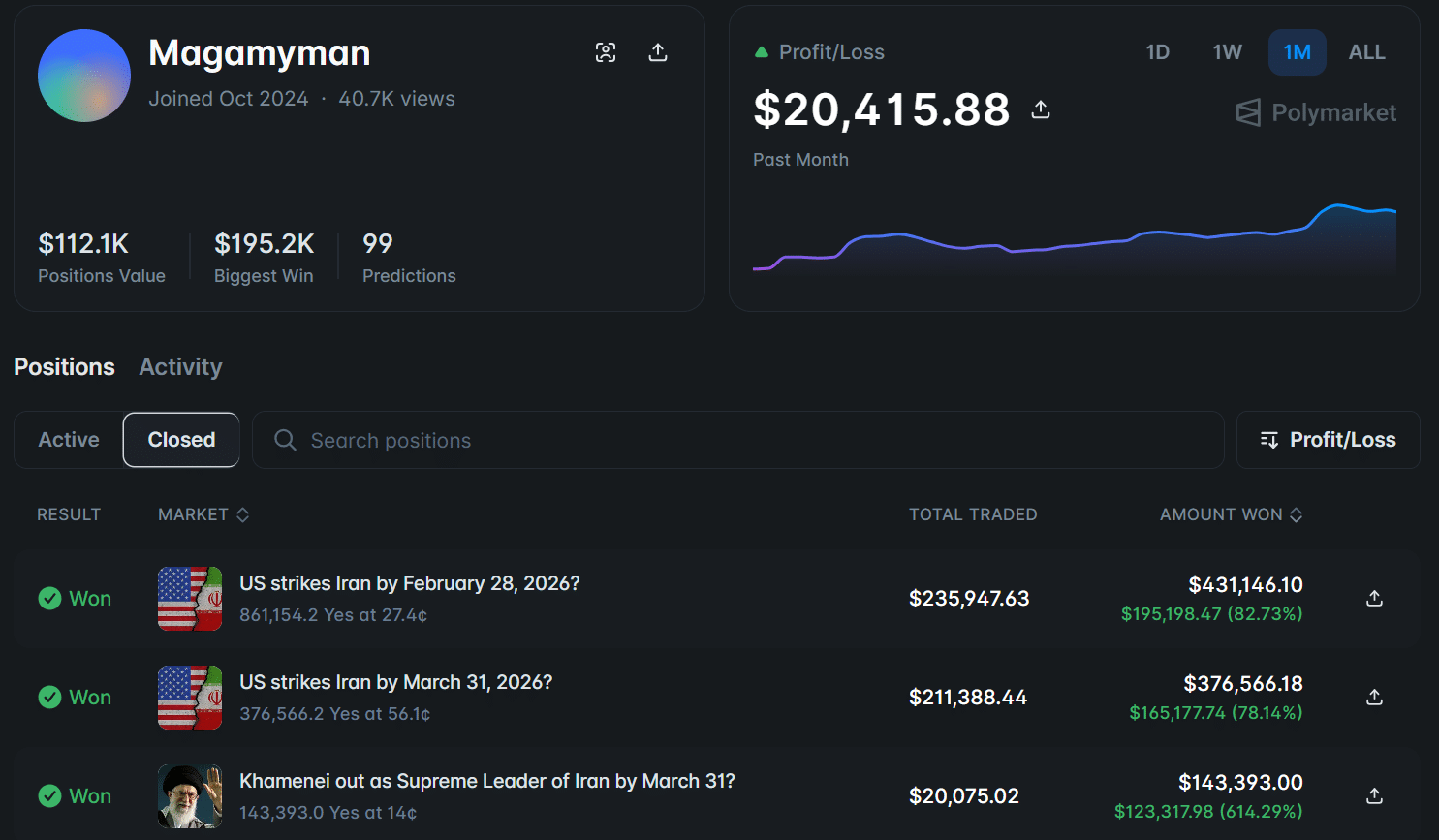
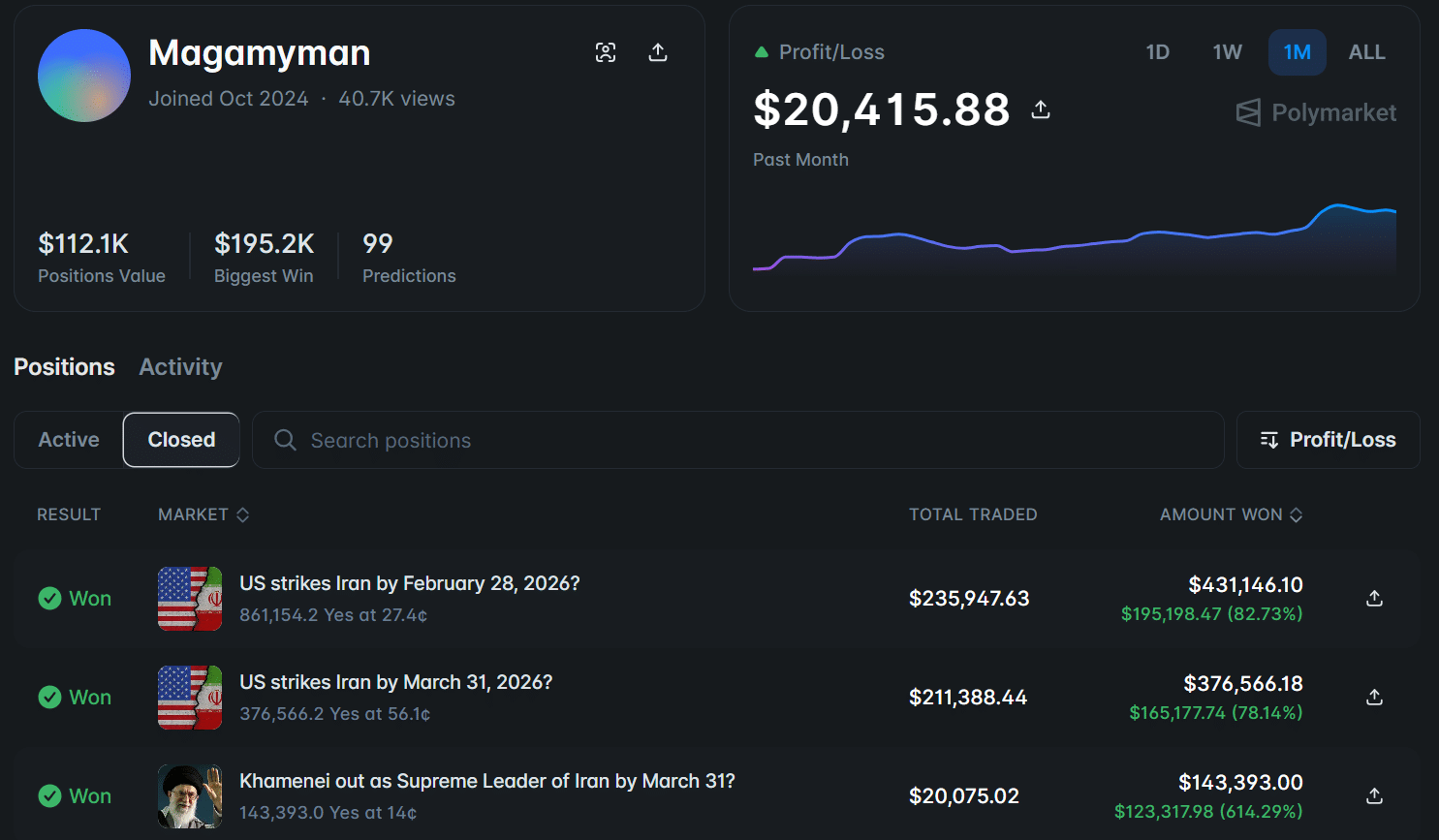
Source: Polymarket

On-chain analytics firm Bubblemaps estimated that 12 insiders made over $1.2 million from the Iran strikes and the subsequent death of its former leader. Most of the wallets were funded 24 hours before and bought the “US strikes Iran by February 28, 2026” contract hours before it happened.

Reacting to the raging ‘death markets’ and alleged insiders, Senator Chris Murphy (D-CT) slammed,

It’s insane this is legal. People around Trump are profiting off war and death. I’m introducing legislation ASAP to ban this.

Kalshi, another prediction site, also faced similar scrutiny and a class lawsuit after it failed to pay $54M to traders betting on Khamenei’s ouster.

Overall, prediction markets have become a multi-billion-dollar segment as speculation interest surges across sports, politics, and other sectors.

That said, apart from the rising ethical questions, the fight between the CFTC and states on who should oversee prediction markets could also stifle the sector’s growth in the U.S.


Final Summary

  • A U.S. lawmaker has slammed prediction site Polymarket for its ‘death markets’ targeting stranded soldiers in Iran.
  • There has been growing criticism against the prediction market amid the ongoing West Asia crisis.


Perguntas relacionadas

QWhy did U.S. lawmaker Seth Moulton criticize Polymarket?

AHe criticized Polymarket for encouraging 'disgusting death markets' that allowed people to bet on the fate of a missing American service member whose plane was shot down over Iran.

QWhat action did Polymarket take regarding the controversial market?

APolymarket archived the market, stating it did not meet its integrity standards, and is investigating how it slipped through internal safeguards.

QHow much profit did an account make from trading contracts related to Iran strikes and Khamenei's ouster on Polymarket?

AAn account made over $460,000 in profits from trading those contracts.

QWhat did Senator Chris Murphy announce in response to the 'death markets'?

ASenator Chris Murphy announced he is introducing legislation to ban such markets, stating it is insane that it is legal for people to profit off war and death.

QWhat broader issue is mentioned that could stifle the growth of prediction markets in the U.S.?

AThe fight between the CFTC and states over who should oversee prediction markets could stifle the sector's growth in the U.S.

Leituras Relacionadas

Single-Day Plunge of 30%, Arthur Hayes Suddenly Liquidates: Why Did ZEC Get Exploded by Security Issues?

On June 5th, Zcash founder Zooko Wilcox disclosed a critical soundness vulnerability in the project's latest Orchard privacy pool. This flaw, found in the elliptic curve multiplication constraints, could allow an attacker to create unlimited counterfeit ZEC within the shielded pool, with transactions appearing valid. The vulnerability was discovered in late May by security researcher Taylor Hornby, who utilized Anthropic's new Opus 4.8 AI model for a targeted audit. The Zcash ecosystem had already performed an emergency network upgrade to patch the issue. However, the detailed disclosure triggered severe market panic, causing ZEC's price to plummet over 30% in a single day. Notably, prominent investor Arthur Hayes announced he had sold his entire ZEC position following the news. The incident starkly challenges the "technological trust" narrative central to privacy coins. Despite years of top-tier cryptographic audits, the bug persisted until uncovered with advanced AI-assisted research. This highlights the growing gap between theoretical perfection and practical implementation in privacy technology. The event serves as a industry-wide warning: in an AI-driven security landscape, the assumption that "undiscovered equals safe" is obsolete. It underscores the urgent need for continuous, proactive security practices combining AI audits, formal verification, and rapid response mechanisms.

foresightnews_apiHá 1h

Single-Day Plunge of 30%, Arthur Hayes Suddenly Liquidates: Why Did ZEC Get Exploded by Security Issues?

foresightnews_apiHá 1h

Breaking the Curse of DeFi Cascading Liquidations, Vitalik Proposes a New Solution

**Vitalik Buterin Proposes New DeFi Design to Eliminate Forced Liquidations** Ethereum co-founder Vitalik Buterin has published a proposal for a new decentralized finance (DeFi) architecture aimed at removing the automatic liquidation mechanisms prevalent in current lending protocols. The core idea involves creating synthetic assets using options as building blocks, fundamentally avoiding the抵押借贷结构 that triggers forced sell-offs. The proposal responds to a recurring flaw in DeFi: during sharp market downturns, mass自动清算 of under-collateralized positions can exacerbate price declines, creating systemic selling pressure and market instability, as evidenced by recent crypto market volatility. Buterin's model would split an asset like 1 ETH into two option-like derivatives, P and N, pegged to a price index with a set strike price and expiration. At expiry, an oracle determines the settlement price to allocate the underlying ETH between P and N holders. This design eliminates the "cliff" of instant liquidation. Instead, a position's value would gradually drift from its target peg if not actively rebalanced by the user, transferring the rebalancing decision from the protocol to the user or automated tools. A key advantage is the reduced reliance on high-frequency, real-time oracle price feeds, which are vulnerable to manipulation and errors in current systems. The delayed settlement in the options model allows for more robust, fault-tolerant oracle designs. However, significant challenges remain for practical adoption. High transaction costs (slippage) from frequent rebalancing on automated market makers (AMMs) could erode user funds. The model may not be suitable for stablecoins requiring a strict 1:1 dollar peg, as it inherently allows for value drift. Success would depend on developing new liquidity provisioning models and deep markets for these synthetic assets. The proposal represents a fundamental rethinking of DeFi risk management, challenging the industry to explore alternatives to被动集中平仓 rather than merely optimizing existing liquidation processes. It remains a theoretical framework awaiting implementation and testing by development teams.

foresightnews_apiHá 1h

Breaking the Curse of DeFi Cascading Liquidations, Vitalik Proposes a New Solution

foresightnews_apiHá 1h

Bitcoin's Decline Marks the Transformation of Crypto

Title: The Decline of Bitcoin Marks the Transformation of Crypto While Bitcoin's price recently fell below $70,000, down approximately 45% from its peak, the broader crypto industry is not following it into decline. Instead, crypto is maturing and evolving beyond its dependence on Bitcoin's price movements. Two of Bitcoin's core functions are being usurped. First, AI has captured its role as the primary speculative asset. AI, with its tangible revenue, explosive demand, and massive capital inflows ($700-830 billion in 2024), is siphoning off the speculative "hot money" that once drove Bitcoin. It also contributes to a sustained high-interest-rate environment, further tightening liquidity for assets like Bitcoin. Second, dollar-pegged stablecoins like USDC and USDT have replaced Bitcoin as the crypto market's foundational currency and primary on/off-ramp. Most trading pairs and on-chain transactions are now settled in stablecoins, severing the historical link where all capital inflows had to pass through Bitcoin first. This decoupling allows projects to thrive based on their own fundamentals rather than Bitcoin's price. Examples include Hyperliquid, an on-chain derivatives exchange with annual revenues of $8-13 billion, and prediction market platform Polymarket, valued at $200 billion with $3.65 billion in annual fees. These projects are evaluated on traditional metrics like revenue and user growth. New opportunities are emerging, particularly around privacy. Privacy coins like Zcash (ZEC) are seeing surging demand, while infrastructure like NEAR enables private, cross-chain asset transfers without requiring users to hold a specific token—privacy becomes a universal service layer. In this new paradigm, stablecoins are the universal cash, various project tokens represent equity, and privacy-enabled cross-chain coordination layers (like NEAR) act as the critical infrastructure connecting a fragmented, multi-chain ecosystem. Bitcoin is now just one asset among many. The era where the entire crypto market moved in lockstep with Bitcoin is over. The industry's health should now be judged by project fundamentals—real revenue, active users, and tokenomics that capture value—and the development of the underlying infrastructure enabling a mature, dollar-denominated crypto economy.

foresightnews_apiHá 1h

Bitcoin's Decline Marks the Transformation of Crypto

foresightnews_apiHá 1h

Lightspark CEO: In Ten Years, Bitcoin Will Be as Invisible as TCP/IP, Yet Power Trillions in Daily Transactions

A decade from now, Bitcoin will function like TCP/IP — invisible yet foundational, supporting trillions in daily transactions globally, according to Lightspark CEO David Marcus. In this future, a coffee shop in Lagos receives instant payment, a manufacturer in São Paulo settles an invoice with a supplier in Ho Chi Minh City, and a freelancer in Bangalore gets paid weekly from an Austin startup — all via Bitcoin's settlement layer, with none of the parties consciously interacting with it. This vision parallels the adoption of open protocols: first driven by necessity where existing systems fail, then scaling rapidly as tools mature and economic benefits become clear. The structural shift begins with wallets. Modern non-custodial wallets, like Spark, allow users to hold dollars, local currency, and Bitcoin in a single address, seamlessly switching between them. This eliminates friction and revolutionizes global custody, moving significant deposits to user-controlled keys not by ideology, but by superior utility. As a result, Bitcoin becomes the default savings layer for billions, as its fixed supply and appreciating value make it a rational choice for savers holding it alongside stablecoins in their everyday wallets. Businesses follow a similar path, from small companies in emerging markets to multinational corporations, holding Bitcoin alongside operational stablecoins. The latest trend is direct Bitcoin transactions for commerce. When both parties hold Bitcoin, transacting in it becomes the simplest option — no conversions, no intermediary currency. This starts in niche areas like high-value B2B settlements but grows as infrastructure makes sending Bitcoin as easy as stablecoins. An accelerating force is AI agents. By 2036, AI agents conducting commerce on behalf of individuals and firms will increasingly choose Bitcoin for settlement. Optimizing for speed, finality, and minimal counterparty risk across jurisdictions, they find Bitcoin's global, neutral, and programmable network ideal for netting and settling obligations. Thus, Bitcoin is becoming the native currency for machine commerce, just as it has become a native savings asset for humans. The global monetary system is being rebuilt from the protocol layer: open infrastructure, default self-custody, Bitcoin settling everything underneath, with stablecoins as the interface. Most users won't think about Bitcoin when they transact — and they won't need to.

foresightnews_apiHá 1h

Lightspark CEO: In Ten Years, Bitcoin Will Be as Invisible as TCP/IP, Yet Power Trillions in Daily Transactions

foresightnews_apiHá 1h

Trading

Spot
Futuros
活动图片




