DAT: The Evolution of Digital Asset Treasuries as Strategic Assets for Crypto Enterprises

marsbitPublicado em 2025-12-22Última atualização em 2025-12-22

Resumo

By the end of 2025, the Digital Asset Treasury (DAT) remains a significant corporate trend in the crypto industry, evolving from passive market participation to a strategic resource integrated into long-term enterprise planning. Companies are increasingly incorporating digital assets like Bitcoin and Ethereum into their balance sheets, shifting focus from mere accumulation to rational asset allocation, risk management, and strategic engagement with blockchain ecosystems. DAT strategies now emphasize diversification, cash flow stability, and participation in on-chain governance, staking, and lending, transforming digital assets into tools for operational resilience and ecosystem influence. Market structure is maturing, with indices like MSCI raising standards for transparency and governance, moving from asset-driven to capability-driven evaluations. Enterprises demonstrating robust risk controls, diversified portfolios, and synergistic business-ecosystem integration show greater resilience. The industry is experiencing differentiation: firms with clear strategic frameworks and sustainable practices are gaining competitive edges, while those reliant on single assets or market sentiment face constraints. Ultimately, DAT's value lies not in the volume of assets held but in the ability to embed them within a coherent strategy, sound governance, and active ecological participation, marking a shift from financial instruments to key strategic resources in corporate growth.

By the end of 2025, Digital Asset Treasuries (DAT) remain one of the most noteworthy corporate behaviors in the crypto industry. An increasing number of enterprises are choosing to incorporate digital assets into their balance sheets. This move is no longer merely a passive participation in market trends but an attempt to transform digital assets into long-term strategic resources. As market conditions and regulatory expectations gradually evolve, the DAT industry is undergoing structural optimization and capability screening. Its core value has shifted from单纯的 asset holding to a test of corporate strategic execution.

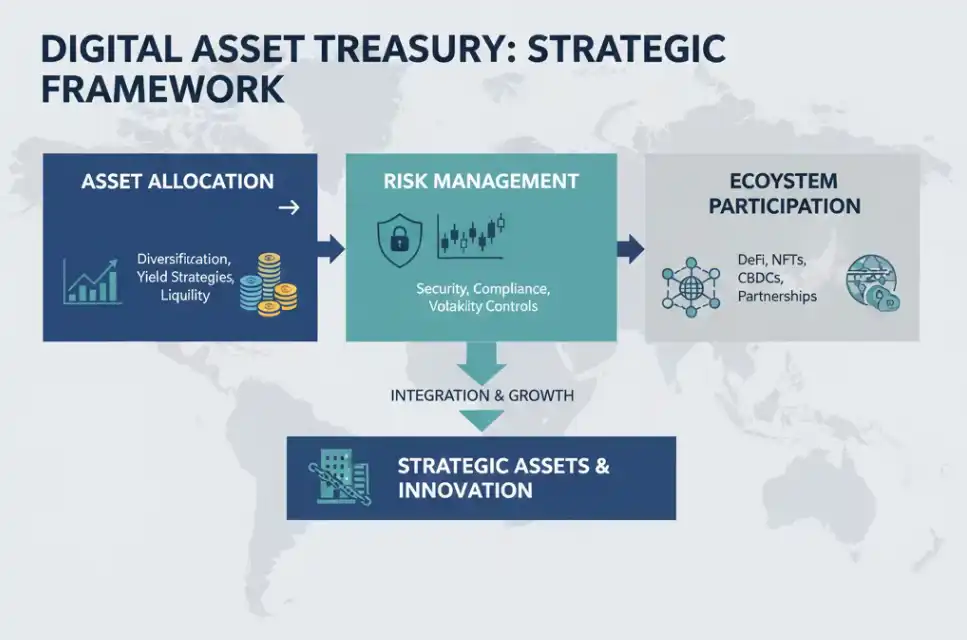
Typical DAT enterprises typically raise funds through stock financing, bond issuance, or private placements and allocate them to mainstream digital assets like Bitcoin and Ethereum. Compared to the early strategy of primarily "hoarding coins," companies now place greater emphasis on the rationality of asset allocation, risk control systems, and strategic linkages with the blockchain ecosystem. On one hand, digital assets provide enterprises with asset diversification and long-term value potential; on the other hand, companies must simultaneously establish cash flow management and risk constraint mechanisms to ensure operational sustainability. Furthermore, holding digital assets means enterprises can participate in on-chain governance, staking, and lending, thereby gaining deeper participation rights and influence at the ecosystem level. This change indicates that DAT has gradually become part of the corporate strategic management system, rather than just a book asset.
Market Structure and Corporate Performance

From recent industry performance, DAT enterprises are entering a clear phase of structural adjustment. Some companies are stabilizing market expectations and improving shareholder structure through share buybacks and asset portfolio optimization; others are gradually returning to more稳健 operational paths through strategic contraction or asset adjustments. At the same time, index agencies like MSCI are beginning to重新审视 the inclusion criteria for DAT-related companies, with significantly increased attention to corporate information disclosure, governance structure, and operational stability. This means the market is weakening its reliance on asset size and short-term price performance,转而 assessing enterprises' operational capabilities and risk management levels in complex environments.

It is worth noting that some companies with Ethereum-related assets as core allocations have shown relative resilience in recent market adjustments. This is not a reflection of a single asset's advantage but rather更多地反映了 the important role of asset diversification, business synergy, and governance capabilities in long-term corporate performance. Overall, changes in market structure are driving the DAT industry from "asset-driven" to "capability-driven."

Corporate Behavior and Strategic Choices

Starting from specific corporate behaviors, the strategic logic behind DAT can be understood more clearly.

At the asset level, enterprises no longer view digital assets as isolated investment targets but incorporate them into a long-term capital allocation framework to support future business expansion and ecosystem布局.

At the risk and stability level, companies balance market expectations and internal robustness through asset diversification, share buybacks, and operational structure improvements. The significance of such operations lies not in short-term market feedback but in securing greater strategic maneuvering space for the enterprise.

At the ecosystem level, holding digital assets enables enterprises to participate in on-chain governance and ecosystem building, transforming financial behavior into actual influence and voice. This shift from "asset management" to "ecosystem participation" is becoming an important path for DAT enterprises to build long-term competitiveness.

Overall, DAT has evolved from simple coin-holding behavior to a comprehensive practice integrating asset strategy, risk control, and ecosystem participation.

Industry Trends and Corporate Divergence

Observing from a longer cycle, the evaluation criteria of the DAT industry are undergoing substantive changes. Market focus is gradually shifting from asset size and short-term price fluctuations to corporate operational capabilities, cash flow stability, and governance transparency. This change directly promotes divergence among enterprises: those with clear asset strategies, diversified allocations, and robust governance structures are more likely to establish advantages in long-term competition; while those highly reliant on single assets or market sentiment see their strategic flexibility and sustainability significantly limited.

More importantly, some enterprises have already begun to transform digital assets into sustainable strategic resources through the combination of business synergy, ecosystem participation, and asset management. This path does not rely on a single market phase but is built on long-term capability building, constituting the core direction for the future development of the DAT industry.

Conclusion

The true value of DAT enterprises is not reflected in how many digital assets they hold, but in whether the enterprise can incorporate these assets into a clear strategic framework, establish a robust operational system and governance structure, and form sustained participation capabilities at the ecosystem level. By observing corporate behavior and industry structural changes, it can be seen that the DAT industry is moving towards a competitive stage centered on strategic capability and long-term execution.

Understanding DAT essentially means understanding how digital assets are transforming from a financial tool into a key resource within the corporate strategic system. This transformation not only reshapes how enterprises manage assets but also provides new judgment coordinates for investors and industry participants. In the future, enterprises that can form良性 synergy between asset strategy, risk management, and ecosystem participation are more likely to establish long-term, stable competitive advantages within the DAT system.

Leituras Relacionadas

How Risky is the "Death Spiral" of MSTR and STRC?

Summary: This article explores the perceived "death spiral" risk between MicroStrategy (MSTR), its Bitcoin holdings, and its perpetual preferred stock (STRC), drawing comparisons to the LUNA-UST collapse. While both systems feature price anchors, high yields for holders, and potential feedback loops, their core mechanisms differ fundamentally. The MSTR-STRC structure relies on continuous financing to sustain its high dividend payouts, primarily through stock ATM offerings. A negative feedback cycle could occur: falling MSTR stock price makes raising equity capital harder, increasing pressure to sell Bitcoin, which undermines STRC confidence and further depresses MSTR. However, unlike LUNA-UST's automated, direct linkage, the MSTR-STRC loop is weaker and has brakes: STRC dividends can be deferred or rates lowered, and STRC holders have a $100/share liquidation preference in bankruptcy, providing a price floor. The company's sustainability hinges on its ability to continue financing. Its current ~$900 million USD reserves cover only about 6.3 months of its ~$1.71 billion annual interest/dividend burden. The next six months are critical, aligning with both the potential bottom in Bitcoin's four-year cycle and the depletion timeline of its reserves. While a LUNA-style catastrophic collapse is deemed highly unlikely due to structural differences, the key question is whether MicroStrategy can navigate this period through healthy deleveraging to restart its capital engine.

Foresight NewsHá 18m

How Risky is the "Death Spiral" of MSTR and STRC?

Foresight NewsHá 18m

How Much Debt Does Strategy Really Have? Is There a Risk of Implosion?

MicroStrategy's Debt Risk: A Turning Point in the "Never Sell" Strategy As of June 3, 2026, MicroStrategy holds 843,706 bitcoins (valued at ~$53.1B) but faces significant financial obligations. Its capital structure includes $6.75B in convertible notes and $15.48B in perpetual preferred stock (led by the $8.5B STRC series), creating an annual payout burden of ~$1.71B. With software revenue at only ~$500M, interest and dividend obligations far exceed operating income. A critical shift occurred in late May 2026 when the company sold 32 bitcoins for ~$2.5M to cover dividends, breaking CEO Michael Saylor's long-standing "never sell" pledge. This symbolic move triggered a sharp decline in both Bitcoin's price and MSTR stock, reflecting market fears about cash flow sustainability. The core of the strain is the STRC perpetual preferred stock, designed as a "permanent loan" with no maturity date but requiring high monthly dividends (currently 11.5%). Its business model relies on a three-part cycle: issuing new STRC shares, using proceeds to buy more Bitcoin and fund a USD reserve, and using that reserve to pay dividends. This cycle depends on continuous investor demand for STRC and Bitcoin's price appreciation. Analysis shows Bitcoin needs to appreciate at least 2.3% annually to cover the $1.71B in yearly obligations at current holdings. With Bitcoin price down ~22% from March 2026 highs, this pressure has intensified. The company's $900M USD reserve can only cover about 7 months of payments if STRC issuance stalls. Key risks are not immediate bankruptcy or forced Bitcoin liquidation (as BTC is not collateral), but rather: 1) The erosion of MSTR's premium to its Bitcoin holdings (mNAV), which would cripple its ability to raise cheap capital; 2) A vicious cycle where stagnant Bitcoin prices reduce STRC demand, draining the USD reserve and forcing BTC sales, further depressing prices. The period from February 2027 to September 2028 is a crucial test, with over $5.9B in convertible notes facing put options or maturity. In essence, MicroStrategy has evolved from a simple Bitcoin holder into a complex financial entity acting like a "private Bitcoin bank," leveraging its BTC holdings to create layered financial products. Its survival depends on maintaining Bitcoin's price trend, its stock premium, and market appetite for its preferred shares. The recent token sale marks not a betrayal of its Bitcoin thesis, but an admission that the leveraged strategy must eventually be paid for.

marsbitHá 28m

How Much Debt Does Strategy Really Have? Is There a Risk of Implosion?

marsbitHá 28m

Anthropic Cries Wolf: Is the AGI Threat Real, or Just an IPO Story?

Anthropic has published an article titled "When AI builds itself," discussing the emerging concept of "recursive self-improvement," where AI begins to actively participate in designing, training, testing, and optimizing its own subsequent versions. The company presents internal data showing that by May 2026, over 80% of code merged into its codebase was written by Claude, its AI model. Claude's capabilities have expanded to handling complex, open-ended engineering tasks, achieving a 76% success rate in such areas, and even contributing to research processes, such as optimizing code performance and conducting AI safety experiments. Anthropic outlines an evolution from human-driven development to AI-assisted workflows, culminating in the current stage where AI agents can autonomously write, run, and delegate code. The company cautions that the path toward a "closed loop," where AI continuously improves itself, is becoming visible. It calls for coordinated global mechanisms to potentially slow or pause frontier AI development to allow safety research and societal structures to catch up. However, the timing of this warning coincides with Anthropic's preparations for an IPO, framing the narrative not just as a safety concern but also as a demonstration of Claude's advanced capabilities and its integral role in accelerating Anthropic's own R&D—creating a potential "flywheel" effect for competitive advantage. This contrasts with OpenAI's recent, more policy-oriented discussion of the same risks, highlighting the competitive dynamics in the AI industry as companies position themselves in both the technological and regulatory landscape.

marsbitHá 1h

Anthropic Cries Wolf: Is the AGI Threat Real, or Just an IPO Story?

marsbitHá 1h

Trading

Spot
Futuros
活动图片