Cypherpunk values are dying, but they’re not dead yet

cointelegraphPublicado em 2025-12-18Última atualização em 2025-12-18

Resumo

The author reflects on their grandfather's distrust of banks and preference for hiding cash, which initially seemed paranoid but later revealed deeper wisdom about privacy and financial sovereignty. Growing up in wartime London, his generation valued privacy as a fundamental right, contrasting sharply with today’s pervasive surveillance and data exploitation. The article critiques modern attitudes that equate privacy with secrecy, citing examples like Vitalik Buterin’s criticized use of a mixer and the erosion of self-sovereignty. It emphasizes that privacy is normal and essential for an open society, echoing Eric Hughes' "Cypherpunk Manifesto." Despite the decline of cypherpunk values—privacy, self-sovereignty, and decentralization—the piece argues they are not yet dead, calling for renewed focus on these principles.

Not long before he died, Grandad said something that I thought was a little silly, a little old-fashioned.

He declared that he didn’t trust the banks, and he didn’t want them to know what he did with his money. I scoffed at the time, paranoid old fella! But of course, it turns out I owe him an apology.

As we were walking around his house, he motioned toward an off-white wall with an off-comfortable sofa in front of it. This piece of singularly ugly furniture hadn’t left its spot in more than a decade.

The wall had a small square door that, when pushed in, revealed a crawl space. Inside was packaging from the 1970s, partially gnawed board games and unimportant documents, squirreled as if they would one day stave off a harsh winter.

My Grandad guided my flashlight to a brown padded envelope hidden near what I was truly hoping wasn’t exposed asbestos. I retrieved the envelope and handed it over. He took the opportunity to deliver a short speech. He was proud I was doing my Master’s, and he knew it was a financial burden, so he wanted to help. Inside the envelope was a musty wad of cash fastened with a mostly decayed rubber band.

His speech was meaningful, but what came after was wisdom that took more than 10 years to land. I asked why he hid cash in the wall, and he explained that most of his savings were hidden around the house; in books, in wardrobes, under mattresses. In fact, he joked that when he died, I must tear the house apart before it’s sold.

Well, he did die, and we did examine every crack and cavity, and we did indeed find most of his savings. Some of the cash was so old that we worried the bank may not even agree to exchange it for modern legal tender, though inflation had robbed the piles of most of their purchasing power anyway, two scams of fiat that I’ll save for another article.

My Grandad grew up poor in wartime London, and it meant a fierce caution with currency was woven into his DNA; money was scarce. Still, his philosophy was sound, and it has played on my mind for years now.

The people of my grandparents’ era were highly protective of their privacy, back when it was a basic human right. I know, how quaint.

In 1950, a motorist named Harry Willcock was stopped in London, and the police officer demanded to see his identity card, an unfortunate requirement introduced at the outbreak of World War II.

Harry refused to brandish his papers and was arrested. According to the lord chief justice in charge of the subsequent legal battle, the ID cards were now being used for purposes beyond their original scope. And so, they were scrapped.

Back in the 1950s, privacy was the baseline for most, and it led to suspicion of anything like surveillance, despite there not being much of it. Just 70 years ago, surveillance was rare, labor-intensive and expensive, typically involving someone physically following you, possibly in a trench coat.

Conversations, cash payments and public transport; no permanent record was left. Any records created were mainly on paper and, importantly, siloed. You couldn’t easily cross-reference records; it’s what lawyers call “practical obscurity.”

Today, our data is farmed, sold and cross-referenced en masse as surveillance has become the new baseline.

My Grandad would have loathed the modern way. He was unknowingly a cypherpunk, and those values are eroding with increasing speed.
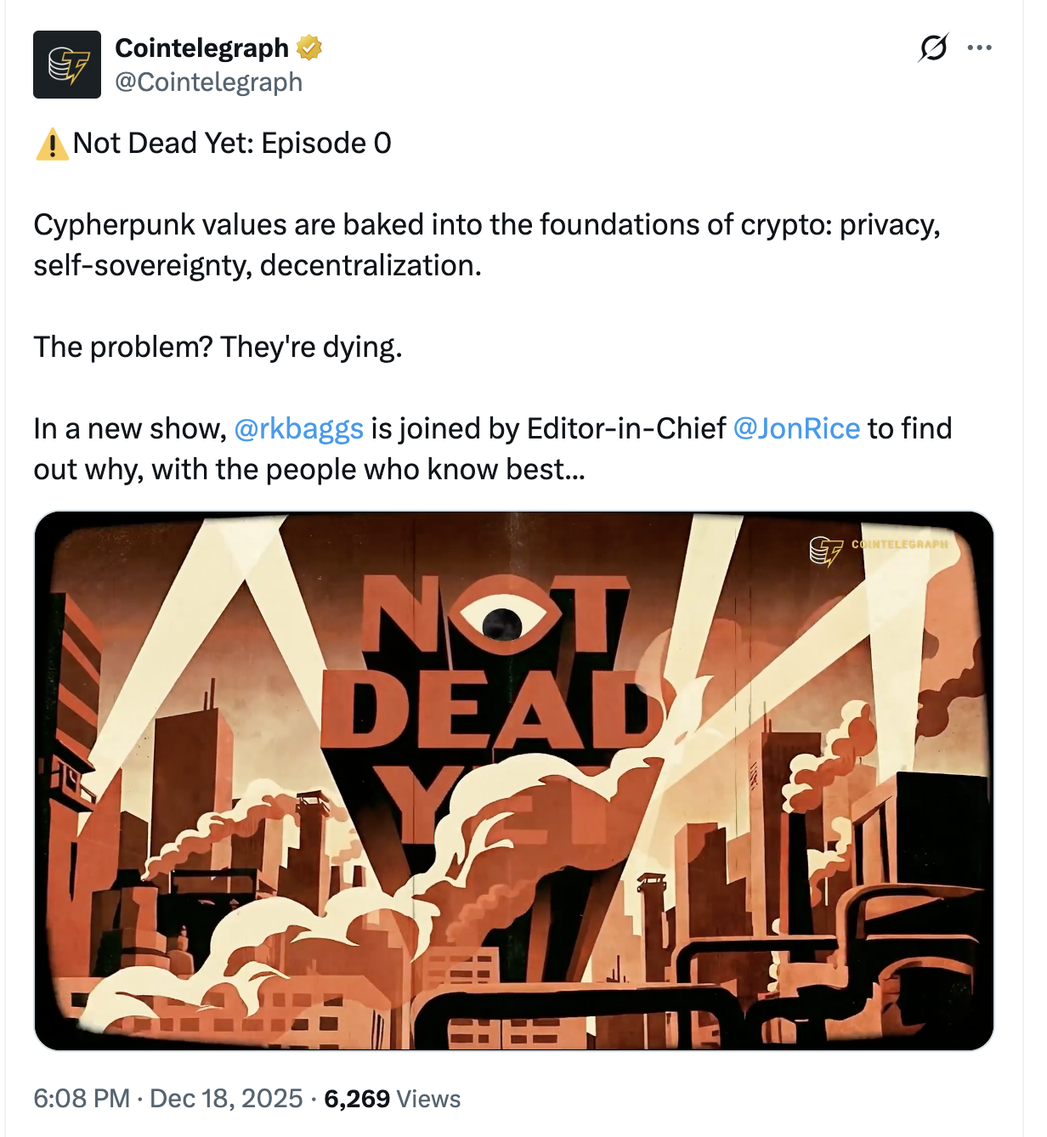
Source: Cointelegraph

Privacy, self-sovereignty, decentralization: Before it’s too late

The privacy narrative that has arisen of late could be chalked up to numerous causes, but it feels like a desperate and inevitable last stand.

Society is somehow so downtrodden that tools to assist with privacy are demonized. Vitalik Buterin used a mixer to donate money and was criticized with winks and nods, suggesting he was shady for doing so. Buterin replied with the simple yet iconic, “Privacy is normal.”

There is a sense that a desire for privacy must mean you have something to hide, but as Susie Violet Ward, CEO of Bitcoin Policy UK, once replied: “You have curtains in your house, don’t you?”

Eric Hughes wrote in “A Cypherpunk Manifesto” in 1993 that “privacy is necessary for an open society in the electronic age. Privacy is not secrecy. A private matter is something one doesn’t want the whole world to know, but a secret matter is something one doesn’t want anybody to know. Privacy is the power to selectively reveal oneself to the world.”

Self-sovereignty has followed the downward trajectory of privacy. Control over one’s identity, data and even property has been steadily stripped away, year after year. We must offer up identification, in nearly a “papers, please” kind of way, to most centralized authorities with which we wish to interact.

With data, extensive legal battles have carved us a sliver of control with the “right to be forgotten,” but even that still requires each person to manually request the erasure of their data from each holder.

Likewise, with property, the “right to repair” was necessary as manufacturers of everything from cars to phones raised the walls of their gardens.

These issues are not the concern of the unscrupulous, and we need not whisper. Privacy is normal, as is agency over the many threads of our lives and the right to a fair, pragmatically decentralized playing field.

That is why Cointelegraph is launching a show dedicated to conversations on the erosion of these basic human rights, with bona fide experts, visionaries and those building the tools of a free and private future. It is a show for the digital dissidents who believe in civil liberties.

Because cypherpunk values are dying.

But they’re Not Dead Yet.


Criptomoedas em alta

Perguntas relacionadas

QWhat core values does the article associate with the cypherpunk movement?

AThe article associates privacy, self-sovereignty, and decentralization as the core values of the cypherpunk movement.

QWhy did the author's grandfather hide cash around his house?

AHe didn't trust the banks and wanted to keep his financial transactions private, a philosophy born from growing up poor in wartime London where money was scarce.

QAccording to the article, how has the public perception of privacy changed from the last century to today?

AIn the past, privacy was considered a baseline human right and the public was suspicious of surveillance. Today, mass surveillance and data farming have become the new baseline, and the desire for privacy is often wrongly equated with having something to hide.

QWhat historical example is given to illustrate the public's past defense of privacy?

AThe case of Harry Willcock in 1950s London, who was arrested for refusing to show his identity card to a police officer, leading to the eventual scrapping of the ID card system as it was being used beyond its original purpose.

QWhat is the main argument the article makes against the notion that wanting privacy means you have something to hide?

AThe article argues that privacy is not secrecy. It quotes Eric Hughes's 'A Cypherpunk Manifesto,' stating that 'privacy is the power to selectively reveal oneself to the world,' and uses the analogy of having curtains in one's house to show that the desire for privacy is normal and not nefarious.

Leituras Relacionadas

Ripple MiCA Authorization Opens A Wider European Payments Lane

Ripple has obtained full MiCA (Markets in Crypto-Assets) authorization in Europe. This regulatory approval provides a clearer path for Ripple's corporate payment entity to offer crypto-enabled payment services across the European Union and European Economic Area. It is important to note that this authorization specifically applies to Ripple's business operations under MiCA, not a blanket endorsement of XRP trading itself. The authorization is significant for Ripple's strategy, as the unified MiCA framework simplifies scaling across Europe for compliant firms. This regulatory clarity can facilitate partnerships with banks, payment providers, and institutional clients by addressing compliance concerns. While the development supports the broader XRP narrative by reducing regulatory uncertainty for Ripple's core payments business, it does not directly translate to regulatory approval for XRP as an investment product. The true impact on XRP will depend on whether this regulatory milestone leads to increased adoption, new client partnerships, and greater payment volume in European corridors. The approval reflects a broader trend where crypto firms are seeking regulatory footing in Europe due to MiCA's comprehensive rulebook, contrasting with the uncertain regulatory landscape in the United States. Ultimately, the license is a permission to operate; its success hinges on Ripple's ability to convert this regulatory advantage into tangible business growth and adoption.

bitcoinistHá 4m

Ripple MiCA Authorization Opens A Wider European Payments Lane

bitcoinistHá 4m

Trading

Spot

Artigos em Destaque

Como comprar O

Bem-vindo à HTX.com!Tornámos a compra de O1 exchange (O) simples e conveniente.Segue o nosso guia passo a passo para iniciar a tua jornada no mundo das criptos.Passo 1: cria a tua conta HTXUtiliza o teu e-mail ou número de telefone para te inscreveres numa conta gratuita na HTX.Desfruta de um processo de inscrição sem complicações e desbloqueia todas as funcionalidades.Obter a minha contaPasso 2: vai para Comprar Cripto e escolhe o teu método de pagamentoCartão de crédito/débito: usa o teu visa ou mastercard para comprar O1 exchange (O) instantaneamente.Saldo: usa os fundos da tua conta HTX para transacionar sem problemas.Terceiros: adicionamos métodos de pagamento populares, como Google Pay e Apple Pay, para aumentar a conveniência.P2P: transaciona diretamente com outros utilizadores na HTX.Mercado de balcão (OTC): oferecemos serviços personalizados e taxas de câmbio competitivas para os traders.Passo 3: armazena teu O1 exchange (O)Depois de comprar o teu O1 exchange (O), armazena-o na tua conta HTX.Alternativamente, podes enviá-lo para outro lugar através de transferência blockchain ou usá-lo para transacionar outras criptomoedas.Passo 4: transaciona O1 exchange (O)Transaciona facilmente O1 exchange (O) no mercado à vista da HTX.Acede simplesmente à tua conta, seleciona o teu par de trading, executa as tuas transações e monitoriza em tempo real.Oferecemos uma experiência de fácil utilização tanto para principiantes como para traders experientes.

167 Visualizações TotaisPublicado em {updateTime}Atualizado em 2026.06.29

Como comprar O

Como comprar PROS

Bem-vindo à HTX.com!Tornámos a compra de Pharos (PROS) simples e conveniente.Segue o nosso guia passo a passo para iniciar a tua jornada no mundo das criptos.Passo 1: cria a tua conta HTXUtiliza o teu e-mail ou número de telefone para te inscreveres numa conta gratuita na HTX.Desfruta de um processo de inscrição sem complicações e desbloqueia todas as funcionalidades.Obter a minha contaPasso 2: vai para Comprar Cripto e escolhe o teu método de pagamentoCartão de crédito/débito: usa o teu visa ou mastercard para comprar Pharos (PROS) instantaneamente.Saldo: usa os fundos da tua conta HTX para transacionar sem problemas.Terceiros: adicionamos métodos de pagamento populares, como Google Pay e Apple Pay, para aumentar a conveniência.P2P: transaciona diretamente com outros utilizadores na HTX.Mercado de balcão (OTC): oferecemos serviços personalizados e taxas de câmbio competitivas para os traders.Passo 3: armazena teu Pharos (PROS)Depois de comprar o teu Pharos (PROS), armazena-o na tua conta HTX.Alternativamente, podes enviá-lo para outro lugar através de transferência blockchain ou usá-lo para transacionar outras criptomoedas.Passo 4: transaciona Pharos (PROS)Transaciona facilmente Pharos (PROS) no mercado à vista da HTX.Acede simplesmente à tua conta, seleciona o teu par de trading, executa as tuas transações e monitoriza em tempo real.Oferecemos uma experiência de fácil utilização tanto para principiantes como para traders experientes.

160 Visualizações TotaisPublicado em {updateTime}Atualizado em 2026.06.29

Como comprar PROS

O que é VERONA

I. Introdução ao Projeto VERONA é uma blockchain construída para todos, em todo o lado, através da abstração da cadeia. Utilizando a sua camada de Abstração Generalizada, a VERONA distingue-se por integrar funcionalidades complexas de blockchain, como contas, assinaturas e interoperabilidade, diretamente ao nível do protocolo. Esta abordagem permite a interação com aplicações de blockchain sem a necessidade de compreender as tecnologias subjacentes.1) Informação Básica Nome: VERONA (VERONA)III. Links Relacionados Link do site oficial: https://xion.burnt.com/ Whitepaper: https://xion.burnt.com/whitepaper.pdf Exploradores: https://explorer.burnt.com/ Mídias Sociais: https://x.com/burnt_xion Nota: A introdução ao projeto provém dos materiais publicados ou fornecidos pela equipa oficial do projeto, que é apenas para referência e não constitui aconselhamento de investimento. A HTX não se responsabiliza por quaisquer perdas diretas ou indiretas resultantes.

778 Visualizações TotaisPublicado em {updateTime}Atualizado em 2026.06.22

O que é VERONA

Discussões

Bem-vindo à Comunidade HTX. Aqui, pode manter-se informado sobre os mais recentes desenvolvimentos da plataforma e obter acesso a análises profissionais de mercado. As opiniões dos utilizadores sobre o preço de A (A) são apresentadas abaixo.

活动图片