Custodia renews bid for Fed master account in rehearing push at Tenth Circuit

cointelegraphPublicado em 2025-12-16Última atualização em 2025-12-16

Resumo

Custodia Bank, a crypto-focused institution, has filed a new petition with the U.S. Court of Appeals for the Tenth Circuit, seeking a rehearing after the court upheld the Federal Reserve's denial of its application for a master account. The bank argues that the decision misinterprets the Monetary Control Act, which it claims entitles eligible banks to such an account, and raises constitutional concerns by effectively allowing the Fed to veto state-approved bank charters. A master account is crucial as it enables direct access to the Fed's payment systems, avoiding the need for intermediary banks and reducing costs and delays. Despite being chartered in Wyoming, Custodia has been unable to secure an account since 2020, highlighting ongoing debanking challenges in the crypto industry.

Custodia Bank, a crypto‐focused bank founded by Bitcoin advocate Caitlin Long, is doubling down on efforts to obtain a master account at the US Federal Reserve by filing a new petition in the United States Court of Appeals for the Tenth Circuit.

On Monday, the Wyoming-chartered company filed a petition asking all active judges of the Tenth Circuit to reconsider its October decision upholding the Federal Reserve’s denial of a master account for Custodia.

Through the petition, formally termed a “rehearing en banc,” Custodia argued that the panel had misread the Monetary Control Act, which it asserts entitles any eligible bank to a master account, and in doing so, undermines state banking authority.

“When the Fed denies a master account to a state-chartered financial institution, it effectively vetoes a bank charter that state regulators have approved,” the petition noted, adding that the issue raises “serious constitutional questions” about the Fed’s structure.

Why is a Fed master account so important?

Issued by the Fed, a master account is a key account that allows a financial institution to hold balances directly with the US central bank and access its core payment systems.

For companies like Custodia, having a master account is crucial, as it enables them to settle payments and clear transactions directly in central bank money, rather than relying on another bank as an intermediary. Without it, they must use correspondent banks to access the Fed’s systems, which can add cost, risk and delay.
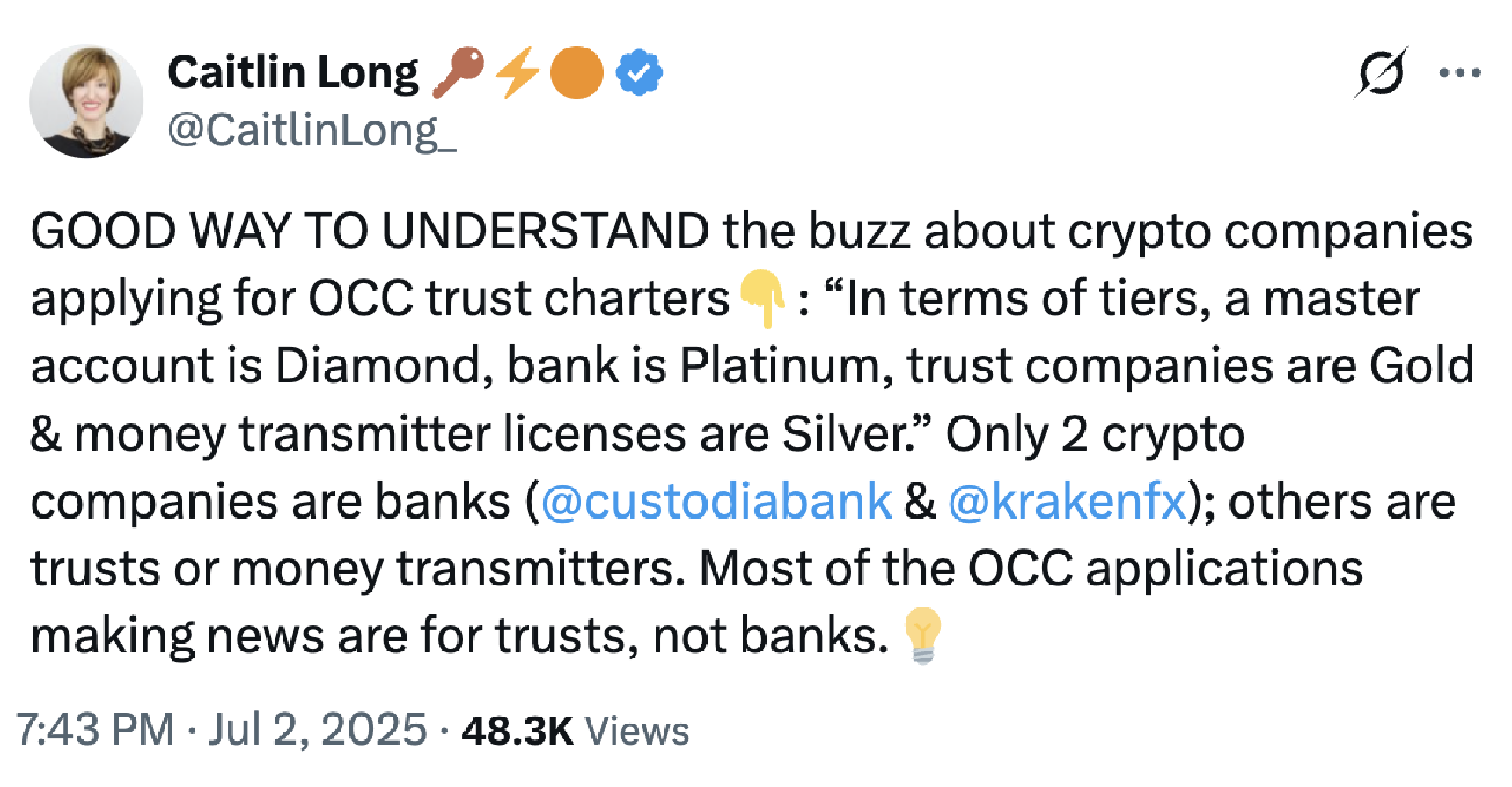
Source: Custodia Bank founder and CEO Caitlin Long

“In terms of tiers, a master account is Diamond, bank is Platinum, trust companies are Gold and money transmitter licenses are Silver,” Custodia Bank founder and CEO Long said in an X post in July, adding that Custodia and Kraken are the “only two crypto companies” that are banks.

Custodia has been trying to get a Fed master account since it launched in 2020, but the Kansas City Fed denied its master account application in January 2023, and the Federal Reserve also rejected its bid to become a member of the Federal Reserve System.

Related: Crypto among sectors ‘debanked’ by 9 major banks: US regulator

Custodia’s long fight for a Fed master account highlights ongoing crypto debanking issues, even though the Trump administration had expressed support for crypto.

In March, Long said the US government has done “nothing” to address crypto debanking issues since President Donald Trump returned to office, highlighting one of the crypto industry’s biggest unresolved challenges.


Leituras Relacionadas

The Tao (τ) Law Makes EDA Go Viral

In May 2026, Huawei's semiconductor division introduced the "Tao (τ) Law" at IEEE ISCAS, shifting the industry focus from Moore's Law's geometric scaling to "time scaling." Unlike traditional approaches relying on transistor miniaturization, τ Law optimizes the time constant (τ) across device, circuit, chip, and system levels to improve information processing speed and efficiency. Huawei has already applied this principle, mass-producing 381 chips across various applications, with a target to achieve performance equivalent to 1.4nm technology by 2031. The implementation of τ Law, involving techniques like Chiplet, 3DIC, and Logic Folding, places new demands on EDA tools, highlighting gaps in current offerings. Traditional 2D or pseudo-3D EDA flows lack native support for true 3D design, cross-layer co-optimization (STCO), and coupled multi-physics analysis (thermal, power, stress), which are crucial for advanced integration. Chinese EDA companies, such as Empyrean Software, Primarius Technologies, and Xpeedic, are evolving from point-tool specialists to providing full-flow, system-level solutions. For instance, Peking University has developed a prototype "true 3D" EDA tool showing significant improvements in wirelength and timing. Empyrean Software has also launched a comprehensive 3DIC design and verification platform. The τ Law framework presents an opportunity for the domestic EDA industry to transition from achieving basic functionality to developing robust, integrated toolsets essential for next-generation chip design.

marsbitHá 49m

The Tao (τ) Law Makes EDA Go Viral

marsbitHá 49m

It's Not Jensen Huang Who Wants to Change the PC, But the PC That's Revolting Against Itself

The 40-year-old PC industry is undergoing a fundamental transformation, driven by the rise of AI PCs. At the GTC Taipei 2026 event, NVIDIA, backed by Microsoft and major PC OEMs, announced the RTX Spark super chip for Windows PCs, marking its official entry into the PC core processor market. This move aims to redefine the AI PC by shifting its core from the CPU to an AI-focused SoC (System on Chip). NVIDIA envisions the PC evolving from a personal computer to a "personal AI"—a platform where local AI Agents can autonomously perform tasks. While Intel pioneered the AI PC concept earlier in 2026, NVIDIA's aggressive push, leveraging its vast CUDA developer ecosystem of 6 million, positions it to potentially reshape the industry's long-standing Wintel (Windows-Intel) power structure. NVIDIA's strategy extends beyond hardware; it's about embedding its CUDA, RTX, and AI software stack into the PC platform itself. The article identifies key shifts: 1) The move from a CPU-centric to an AI SoC-centric architecture, similar to Apple's approach with its M-series chips. 2) The PC's evolution from a human-operated tool to a platform for human-Agent collaboration. 3) The extension of NVIDIA's data center-centric CUDA ecosystem to personal devices via RTX Spark. Ultimately, the change is driven by the broader trend of AI moving to personal devices. Companies like Intel, AMD, Qualcomm, and Apple are all participating in this shift. NVIDIA's entry accelerates the competition, but the core driver is the technology itself finding its optimal expression in the PC. The industry is reinventing itself, with the outcome hinging on execution, ecosystem development, and the creation of compelling local AI applications.

marsbitHá 3h

It's Not Jensen Huang Who Wants to Change the PC, But the PC That's Revolting Against Itself

marsbitHá 3h

Trading

Spot
Futuros

Artigos em Destaque

Como comprar PUSH

Bem-vindo à HTX.com!Tornámos a compra de Push Protocol (PUSH) simples e conveniente.Segue o nosso guia passo a passo para iniciar a tua jornada no mundo das criptos.Passo 1: cria a tua conta HTXUtiliza o teu e-mail ou número de telefone para te inscreveres numa conta gratuita na HTX.Desfruta de um processo de inscrição sem complicações e desbloqueia todas as funcionalidades.Obter a minha contaPasso 2: vai para Comprar Cripto e escolhe o teu método de pagamentoCartão de crédito/débito: usa o teu visa ou mastercard para comprar Push Protocol (PUSH) instantaneamente.Saldo: usa os fundos da tua conta HTX para transacionar sem problemas.Terceiros: adicionamos métodos de pagamento populares, como Google Pay e Apple Pay, para aumentar a conveniência.P2P: transaciona diretamente com outros utilizadores na HTX.Mercado de balcão (OTC): oferecemos serviços personalizados e taxas de câmbio competitivas para os traders.Passo 3: armazena teu Push Protocol (PUSH)Depois de comprar o teu Push Protocol (PUSH), armazena-o na tua conta HTX.Alternativamente, podes enviá-lo para outro lugar através de transferência blockchain ou usá-lo para transacionar outras criptomoedas.Passo 4: transaciona Push Protocol (PUSH)Transaciona facilmente Push Protocol (PUSH) no mercado à vista da HTX.Acede simplesmente à tua conta, seleciona o teu par de trading, executa as tuas transações e monitoriza em tempo real.Oferecemos uma experiência de fácil utilização tanto para principiantes como para traders experientes.

521 Visualizações TotaisPublicado em {updateTime}Atualizado em 2026.06.02

Como comprar PUSH

Discussões

Bem-vindo à Comunidade HTX. Aqui, pode manter-se informado sobre os mais recentes desenvolvimentos da plataforma e obter acesso a análises profissionais de mercado. As opiniões dos utilizadores sobre o preço de PUSH (PUSH) são apresentadas abaixo.

活动图片












