Crypto Winter is Near. Is Bitcoin Headed for a Deep Correction?

bitcoinistPublicado em 2025-12-08Última atualização em 2025-12-08

Resumo

The cryptocurrency market is experiencing heightened anxiety, with high volatility and talks of a "crypto winter" fueling fears of a deep Bitcoin correction. While some investors are moving to stablecoins, others are looking at infrastructure projects built on Bitcoin. Despite being the foundational asset, Bitcoin's limitations—slow transactions, high fees, and lack of flexible smart contracts—hinder its use in DeFi and mass applications. This has increased interest in Layer 2 solutions. Infrastructure altcoins that aim to transform Bitcoin into a base for financial applications are gaining attention. Projects focusing on modular blockchains, virtual machines, and liquidity bridges are being viewed as potential leaders in the next cycle. Among them is Bitcoin Hyper and its token $HYPER, which positions itself as the first Bitcoin Layer 2 integrating the Solana Virtual Machine (SVM). This project aims to combine Bitcoin's security with Solana's high throughput, offering low latency and minimal fees. Bitcoin Hyper's architecture uses Bitcoin for finality and an SVM layer for real-time transactions and smart contracts. It claims to exceed Solana's performance with sub-cent fees, enabling DeFi, NFT platforms, and gaming applications using wrapped Bitcoin. The project has raised $29 million in its early sale, with on-chain data showing significant "smart money" interest. The $HYPER token features staking with high APY and governance rights. Bitcoin Hyper's goal is to address Bit...

The market is nervous again: high volatility, aggressive selling of leveraged positions, and growing talk of a "crypto winter" are fueling fears of a deep Bitcoin correction. For many, this is a reason to freeze capital in stablecoins, but for some investors, such periods are a time to look for infrastructure stories.

Bitcoin has remained the market's base asset for over a decade, but its limitations haven't gone anywhere. Slow transactions, high fees during periods of network load, and an almost complete lack of flexible smart contracts make the network inconvenient for DeFi and mass applications. Hence the surge of interest in layer-2 solutions built on top of Bitcoin.

Against this backdrop, attention is growing towards infrastructure altcoins that aim to turn Bitcoin from "digital gold" into a full-fledged base for financial applications. Investors are increasingly looking not only at price but also at architecture: modular blockchains, virtual machines, liquidity bridges. In such reviews, the best altcoins for the next cycle are already consistently featured.

It is in this context that Bitcoin Hyper and its token $HYPER fit in—an infrastructure project that presents itself as the first Bitcoin Layer 2 with Solana Virtual Machine integration. In the face of a potential deep Bitcoin correction, this poses a simple question for the investor: to leave capital passive or use the downturn to invest in the infrastructure that could scale Bitcoin itself.

BUY BITCOIN HYPER

Why Bitcoin Needs a Second Layer

The main problem with Bitcoin is familiar to anyone who has ever made a transaction during peak demand. Confirmation can take tens of minutes, and fees can reach significant amounts even for a simple transfer. For the world of DeFi, gaming, and high-frequency payments, this is a critical limitation.
Therefore, over the past few years, a whole range of second-layer solutions has emerged. Some bet on payment channels, others on rollup architecture, and others experiment with separate virtual machines and sidechains. This reflects the growing competition for the role of key infrastructure on top of Bitcoin.

In parallel, the segment of high-performance chains like Solana is developing, offering thousands of transactions per second but lacking a direct "native" link to Bitcoin's security. As a result, the market is looking for a hybrid: infrastructure that offers Solana-level performance but is backed by the time-tested Bitcoin network. Bitcoin Hyper is trying to occupy this niche by offering a Layer 2 with SVM support.

Bitcoin Hyper: Betting on SVM and Speed Higher Than Solana

Bitcoin Hyper is building a modular architecture: the base Bitcoin layer handles final settlement, while a separate layer with the Solana Virtual Machine handles real-time transaction execution and smart contracts. This combination allows for ultra-low latency in processing operations while relying on the security of the main network.

The team claims that the performance of the L2 layer exceeds that of Solana itself, and fees are kept at fractions of a cent even under high load. For the user, this opens up the possibility to conduct transactions in wrapped Bitcoin, launch DeFi protocols, NFT platforms, and gaming applications on the familiar Rust stack, but with a link to Bitcoin capital, not just the Ethereum ecosystem.

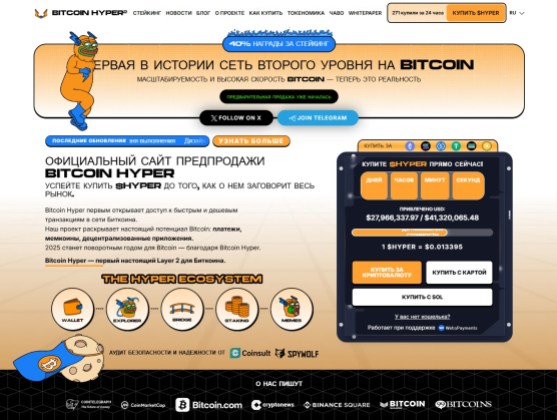
A separate element of the construction is a decentralized canonical bridge for moving Bitcoin to the second layer, as well as compatibility with SPL-format tokens adapted for this L2 environment. At the early placement stage, the project has already raised $29 million at a price of approximately $0.013395 per $HYPER token, demonstrating significant interest in the idea of an accelerated Bitcoin based on SVM. Furthermore, on-chain monitoring data shows that two large wallets have collectively purchased about $396,000, which is usually perceived as a signal of "smart money" attention.

The reward model for $HYPER holders is built around staking with increased APY and participation in network governance. After the token launch, early investors can almost immediately move their tokens to staking, and for pre-sale participants, a seven-day vesting period is provided. In the future, not only financial incentives but also voting rights in the development of the protocol will play a key role.

Bitcoin Hyper's task is simple and ambitious at the same time: to eliminate Bitcoin's three main limitations—slow transactions, high fees, and the lack of developed smart contracts. If the project manages to establish itself as a productive Layer 2 with SVM and a convenient toolkit for developers, $HYPER could become one of the few infrastructure bets that benefit from the next wave of interest in Bitcoin, rather than just following its price.


Perguntas relacionadas

QWhat is the main concern of the cryptocurrency market according to the article?

AThe main concern is a potential sharp correction (deep drawdown) in Bitcoin's price, fueled by high volatility, aggressive leveraged position selling, and growing fears of a 'cryptowinter'.

QWhat are the three main limitations of the Bitcoin network mentioned in the text?

AThe three main limitations are slow transaction speeds, high fees during periods of network congestion, and the near-total lack of flexible smart contracts.

QWhat solution does the Bitcoin Hyper project propose to address Bitcoin's limitations?

ABitcoin Hyper proposes a Layer 2 solution that integrates the Solana Virtual Machine (SVM) to provide high-speed transactions, low fees, and smart contract functionality while leveraging the security of the Bitcoin base layer.

QWhat key advantage does Bitcoin Hyper claim to have over Solana itself?

ABitcoin Hyper claims that the performance of its L2 layer surpasses that of the original Solana network, offering ultra-low latency and transaction fees of a fraction of a cent even under high load.

QWhat was the result of Bitcoin Hyper's early funding round?

AThe project raised $29 million in its early funding round, with the $HYPER token priced at approximately $0.013395.

Leituras Relacionadas

How Many Tokens Away Is Yang Zhilin from the 'Moon Chasing the Light'?

The article explores the intense competition between two leading Chinese AI companies, DeepSeek and Kimi (Moon Dark Side), and the mounting pressure on Yang Zhilin, the founder of Kimi. While DeepSeek re-emerged after 15 months of silence with its powerful V4 model—boasting 1.6 trillion parameters and low-cost, long-context capabilities—Kimi has been focusing on long-context processing and multi-agent systems with its K2.6 model. Yang faces a threefold challenge: technological rivalry, commercialization pressure, and investor expectations. Despite Kimi’s high valuation (reaching $18 billion), its revenue heavily relies on a single product with low paid conversion rates, while DeepSeek’s strategic silence and open-source influence have strengthened its market position and valuation prospects, now targeting over $20 billion. Both companies reflect broader trends in China’s AI ecosystem: Kimi aims for global influence through open-source contributions and agent-based advancements, while DeepSeek prioritizes foundational innovation and hardware independence, notably shifting to Huawei’s chips. Their competition is seen as vital for China’s AI progress, with the gap between top Chinese and U.S. models narrowing to just 2.7% on the Elo rating scale. Ultimately, the article argues that this rivalry, though anxiety-inducing for leaders like Zhilin, is essential for driving innovation and solidifying China’s role in the global AI landscape.

marsbitHá 52m

How Many Tokens Away Is Yang Zhilin from the 'Moon Chasing the Light'?

marsbitHá 52m

TechFlow Intelligence Bureau: ChatGPT Helps Amateur Mathematician Crack 60-Year-Old Problem, CFTC Sues New York Regulator Over Coinbase and Gemini

An amateur mathematician, with the assistance of ChatGPT, has solved a combinatorial mathematics puzzle originally proposed by Hungarian mathematician Paul Erdős in the 1960s. This marks another milestone in AI-aided mathematical research, demonstrating the evolving capabilities of large language models in formal reasoning. In other AI developments, OpenAI introduced a new privacy filter tool for enterprise API usage, automatically screening sensitive data. Meanwhile, the Qwen3.6-27B model achieved 100 tokens per second on a single RTX 5090 GPU using quantization, significantly lowering the cost barrier for local AI deployment. In crypto and Web3, the U.S. CFTC sued New York’s financial regulator, challenging its oversight of Coinbase and Gemini—a first-of-its-kind federal-state regulatory clash. Following a vulnerability, KelpDAO and major DeFi protocols established a recovery fund. Tether froze $344 million in assets linked to Iran’s central bank upon U.S. Treasury request, highlighting the centralized control risks in stablecoins. Separately, Litecoin underwent a 3-hour chain reorganization to undo a privacy-layer exploit. In the U.S., former President Trump invoked the Defense Production Act to address power grid bottlenecks affecting AI data centers and dismissed the entire National Science Board, raising concerns over research independence. A retail trader gained 250% on a $600k Intel options bet amid AI-related speculation. Xiaomi announced its first performance electric vehicle, targeting rivals like Tesla. Meanwhile, iPhone users reported devices automatically reinstalling a hidden app daily, suspected to be MDM-related. A Chinese securities report noted that A-share institutional crowding has reached its second-longest streak since 2007, signaling high valuations and potential style rotation. The day’s developments reflect a dual narrative: AI is enabling unprecedented individual breakthroughs, while centralized power structures—whether governmental or corporate—are becoming more assertive, underscoring that decentralization is as much a political-economic challenge as a technical one.

marsbitHá 1h

TechFlow Intelligence Bureau: ChatGPT Helps Amateur Mathematician Crack 60-Year-Old Problem, CFTC Sues New York Regulator Over Coinbase and Gemini

marsbitHá 1h

Trading

Spot
Futuros

Artigos em Destaque

O que é WL

I. Introdução ao ProjetoWorldLand é uma L2 ou side chain do Ethereum, concebida como uma solução de baixo para cima para melhorar o ecossistema Ethereum.II. Informação sobre o Token1) Informação BásicaNome do token: WL (WorldLand)III. Links RelacionadosWebsite:https://worldland.foundation/Exploradores:https://bscscan.com/address/0x8aaB31fbc69C92fa53f600910Cf0f215531F8239Redes Sociais:https://x.com/WorldLand_space Nota: A introdução ao projeto provém dos materiais publicados ou fornecidos pela equipa oficial do projeto, que é apenas para referência e não constitui aconselhamento de investimento. A HTX não se responsabiliza por quaisquer perdas diretas ou indiretas resultantes.

213 Visualizações TotaisPublicado em {updateTime}Atualizado em 2026.03.28

O que é WL

Como comprar WL

Bem-vindo à HTX.com!Tornámos a compra de WorldLand (WL) simples e conveniente.Segue o nosso guia passo a passo para iniciar a tua jornada no mundo das criptos.Passo 1: cria a tua conta HTXUtiliza o teu e-mail ou número de telefone para te inscreveres numa conta gratuita na HTX.Desfruta de um processo de inscrição sem complicações e desbloqueia todas as funcionalidades.Obter a minha contaPasso 2: vai para Comprar Cripto e escolhe o teu método de pagamentoCartão de crédito/débito: usa o teu visa ou mastercard para comprar WorldLand (WL) instantaneamente.Saldo: usa os fundos da tua conta HTX para transacionar sem problemas.Terceiros: adicionamos métodos de pagamento populares, como Google Pay e Apple Pay, para aumentar a conveniência.P2P: transaciona diretamente com outros utilizadores na HTX.Mercado de balcão (OTC): oferecemos serviços personalizados e taxas de câmbio competitivas para os traders.Passo 3: armazena teu WorldLand (WL)Depois de comprar o teu WorldLand (WL), armazena-o na tua conta HTX.Alternativamente, podes enviá-lo para outro lugar através de transferência blockchain ou usá-lo para transacionar outras criptomoedas.Passo 4: transaciona WorldLand (WL)Transaciona facilmente WorldLand (WL) no mercado à vista da HTX.Acede simplesmente à tua conta, seleciona o teu par de trading, executa as tuas transações e monitoriza em tempo real.Oferecemos uma experiência de fácil utilização tanto para principiantes como para traders experientes.

238 Visualizações TotaisPublicado em {updateTime}Atualizado em 2026.03.28

Como comprar WL

Como comprar BASED

Bem-vindo à HTX.com!Tornámos a compra de Based (BASED) simples e conveniente.Segue o nosso guia passo a passo para iniciar a tua jornada no mundo das criptos.Passo 1: cria a tua conta HTXUtiliza o teu e-mail ou número de telefone para te inscreveres numa conta gratuita na HTX.Desfruta de um processo de inscrição sem complicações e desbloqueia todas as funcionalidades.Obter a minha contaPasso 2: vai para Comprar Cripto e escolhe o teu método de pagamentoCartão de crédito/débito: usa o teu visa ou mastercard para comprar Based (BASED) instantaneamente.Saldo: usa os fundos da tua conta HTX para transacionar sem problemas.Terceiros: adicionamos métodos de pagamento populares, como Google Pay e Apple Pay, para aumentar a conveniência.P2P: transaciona diretamente com outros utilizadores na HTX.Mercado de balcão (OTC): oferecemos serviços personalizados e taxas de câmbio competitivas para os traders.Passo 3: armazena teu Based (BASED)Depois de comprar o teu Based (BASED), armazena-o na tua conta HTX.Alternativamente, podes enviá-lo para outro lugar através de transferência blockchain ou usá-lo para transacionar outras criptomoedas.Passo 4: transaciona Based (BASED)Transaciona facilmente Based (BASED) no mercado à vista da HTX.Acede simplesmente à tua conta, seleciona o teu par de trading, executa as tuas transações e monitoriza em tempo real.Oferecemos uma experiência de fácil utilização tanto para principiantes como para traders experientes.

217 Visualizações TotaisPublicado em {updateTime}Atualizado em 2026.03.30

Como comprar BASED

Discussões

Bem-vindo à Comunidade HTX. Aqui, pode manter-se informado sobre os mais recentes desenvolvimentos da plataforma e obter acesso a análises profissionais de mercado. As opiniões dos utilizadores sobre o preço de A (A) são apresentadas abaixo.

活动图片