Crypto Winter is Near. Is Bitcoin Headed for a Deep Correction?

bitcoinistPublicado em 2025-12-08Última atualização em 2025-12-08

Resumo

The cryptocurrency market is experiencing heightened anxiety, with high volatility and talks of a "crypto winter" fueling fears of a deep Bitcoin correction. While some investors are moving to stablecoins, others are looking at infrastructure projects built on Bitcoin. Despite being the foundational asset, Bitcoin's limitations—slow transactions, high fees, and lack of flexible smart contracts—hinder its use in DeFi and mass applications. This has increased interest in Layer 2 solutions. Infrastructure altcoins that aim to transform Bitcoin into a base for financial applications are gaining attention. Projects focusing on modular blockchains, virtual machines, and liquidity bridges are being viewed as potential leaders in the next cycle. Among them is Bitcoin Hyper and its token $HYPER, which positions itself as the first Bitcoin Layer 2 integrating the Solana Virtual Machine (SVM). This project aims to combine Bitcoin's security with Solana's high throughput, offering low latency and minimal fees. Bitcoin Hyper's architecture uses Bitcoin for finality and an SVM layer for real-time transactions and smart contracts. It claims to exceed Solana's performance with sub-cent fees, enabling DeFi, NFT platforms, and gaming applications using wrapped Bitcoin. The project has raised $29 million in its early sale, with on-chain data showing significant "smart money" interest. The $HYPER token features staking with high APY and governance rights. Bitcoin Hyper's goal is to address Bit...

The market is nervous again: high volatility, aggressive selling of leveraged positions, and growing talk of a "crypto winter" are fueling fears of a deep Bitcoin correction. For many, this is a reason to freeze capital in stablecoins, but for some investors, such periods are a time to look for infrastructure stories.

Bitcoin has remained the market's base asset for over a decade, but its limitations haven't gone anywhere. Slow transactions, high fees during periods of network load, and an almost complete lack of flexible smart contracts make the network inconvenient for DeFi and mass applications. Hence the surge of interest in layer-2 solutions built on top of Bitcoin.

Against this backdrop, attention is growing towards infrastructure altcoins that aim to turn Bitcoin from "digital gold" into a full-fledged base for financial applications. Investors are increasingly looking not only at price but also at architecture: modular blockchains, virtual machines, liquidity bridges. In such reviews, the best altcoins for the next cycle are already consistently featured.

It is in this context that Bitcoin Hyper and its token $HYPER fit in—an infrastructure project that presents itself as the first Bitcoin Layer 2 with Solana Virtual Machine integration. In the face of a potential deep Bitcoin correction, this poses a simple question for the investor: to leave capital passive or use the downturn to invest in the infrastructure that could scale Bitcoin itself.

BUY BITCOIN HYPER

Why Bitcoin Needs a Second Layer

The main problem with Bitcoin is familiar to anyone who has ever made a transaction during peak demand. Confirmation can take tens of minutes, and fees can reach significant amounts even for a simple transfer. For the world of DeFi, gaming, and high-frequency payments, this is a critical limitation.
Therefore, over the past few years, a whole range of second-layer solutions has emerged. Some bet on payment channels, others on rollup architecture, and others experiment with separate virtual machines and sidechains. This reflects the growing competition for the role of key infrastructure on top of Bitcoin.

In parallel, the segment of high-performance chains like Solana is developing, offering thousands of transactions per second but lacking a direct "native" link to Bitcoin's security. As a result, the market is looking for a hybrid: infrastructure that offers Solana-level performance but is backed by the time-tested Bitcoin network. Bitcoin Hyper is trying to occupy this niche by offering a Layer 2 with SVM support.

Bitcoin Hyper: Betting on SVM and Speed Higher Than Solana

Bitcoin Hyper is building a modular architecture: the base Bitcoin layer handles final settlement, while a separate layer with the Solana Virtual Machine handles real-time transaction execution and smart contracts. This combination allows for ultra-low latency in processing operations while relying on the security of the main network.

The team claims that the performance of the L2 layer exceeds that of Solana itself, and fees are kept at fractions of a cent even under high load. For the user, this opens up the possibility to conduct transactions in wrapped Bitcoin, launch DeFi protocols, NFT platforms, and gaming applications on the familiar Rust stack, but with a link to Bitcoin capital, not just the Ethereum ecosystem.

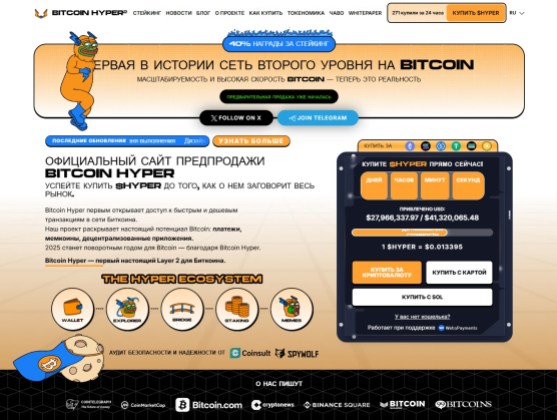
A separate element of the construction is a decentralized canonical bridge for moving Bitcoin to the second layer, as well as compatibility with SPL-format tokens adapted for this L2 environment. At the early placement stage, the project has already raised $29 million at a price of approximately $0.013395 per $HYPER token, demonstrating significant interest in the idea of an accelerated Bitcoin based on SVM. Furthermore, on-chain monitoring data shows that two large wallets have collectively purchased about $396,000, which is usually perceived as a signal of "smart money" attention.

The reward model for $HYPER holders is built around staking with increased APY and participation in network governance. After the token launch, early investors can almost immediately move their tokens to staking, and for pre-sale participants, a seven-day vesting period is provided. In the future, not only financial incentives but also voting rights in the development of the protocol will play a key role.

Bitcoin Hyper's task is simple and ambitious at the same time: to eliminate Bitcoin's three main limitations—slow transactions, high fees, and the lack of developed smart contracts. If the project manages to establish itself as a productive Layer 2 with SVM and a convenient toolkit for developers, $HYPER could become one of the few infrastructure bets that benefit from the next wave of interest in Bitcoin, rather than just following its price.


Criptomoedas em alta

Perguntas relacionadas

QWhat is the main concern of the cryptocurrency market according to the article?

AThe main concern is a potential sharp correction (deep drawdown) in Bitcoin's price, fueled by high volatility, aggressive leveraged position selling, and growing fears of a 'cryptowinter'.

QWhat are the three main limitations of the Bitcoin network mentioned in the text?

AThe three main limitations are slow transaction speeds, high fees during periods of network congestion, and the near-total lack of flexible smart contracts.

QWhat solution does the Bitcoin Hyper project propose to address Bitcoin's limitations?

ABitcoin Hyper proposes a Layer 2 solution that integrates the Solana Virtual Machine (SVM) to provide high-speed transactions, low fees, and smart contract functionality while leveraging the security of the Bitcoin base layer.

QWhat key advantage does Bitcoin Hyper claim to have over Solana itself?

ABitcoin Hyper claims that the performance of its L2 layer surpasses that of the original Solana network, offering ultra-low latency and transaction fees of a fraction of a cent even under high load.

QWhat was the result of Bitcoin Hyper's early funding round?

AThe project raised $29 million in its early funding round, with the $HYPER token priced at approximately $0.013395.

Leituras Relacionadas

South Korean Stock Market Sees Sharp Rebound After Forceful De-leveraging, SK Hynix Rises 30%

On July 31, South Korean stocks staged a historic rebound. The benchmark KOSPI index surged 18.27%, with chipmaker SK Hynix hitting a 30% gain limit. This followed a brutal, near-40% decline in the KOSPI over the previous month, driven largely by a deleveraging spiral involving leveraged ETFs. Analysts attributed the sharp sell-off to structural liquidity issues rather than deteriorating corporate fundamentals. The rally was triggered by a confluence of positive catalysts. Firstly, strong earnings from U.S. cloud giants Microsoft and Amazon alleviated fears of an "AI bubble burst," boosting global tech sentiment. Secondly, SK Group Chairman Chey Tae-won made a rare personal purchase of SK Hynix shares, seen as a strong vote of confidence. Thirdly, the South Korean government announced a 20 trillion won ($139 billion) AI investment fund. In response to the market turmoil, South Korean regulators are tightening controls on leveraged ETFs, admitting oversight shortcomings. Measures include raising minimum cash保证金 requirements for散户 investors and suspending new product launches. While the rebound signals eased liquidity pressure, analysts note deep structural issues remain. The market's future stability is seen as dependent on global tech capital expenditure trends and memory chip price cycles, with some viewing the surge as a technical correction rather than a definitive trend reversal.

marsbitHá 15m

South Korean Stock Market Sees Sharp Rebound After Forceful De-leveraging, SK Hynix Rises 30%

marsbitHá 15m

Cryptocurrency Company Wintermute Makes Pessimistic Statements Regarding Expected Altcoin Growth! Here are the Details

Crypto market maker Wintermute has made a pessimistic assessment regarding the anticipated altcoin season, suggesting that any upcoming rally may benefit only a limited number of projects. The company reports a record 72% of its spot OTC trading volume in H1 2026 came from institutional clients, whose capital is becoming more selective and concentrated. Data shows institutional traders act quickly on price spikes, while retail interest lasts longer. This selective behavior indicates the classic altcoin season, where hundreds of tokens rise simultaneously, may be changing. Wintermute believes only projects with strong use cases, high liquidity, and institutional appeal will stand out. Supporting this view, CryptoQuant data shows altcoin trading volume against Bitcoin is near its lowest since 2021, with the top 10 altcoins (excluding stablecoins) holding about 80.5% of the total altcoin market cap. Similarly, Kaiko reports that the top 10 altcoins now account for 63% of total altcoin trading volume, up from ~50% a few months ago, indicating capital concentration. Analysts suggest that in the current cautious institutional climate, projects with advanced technology, liquidity, and robust ecosystems will attract disproportionate attention. Therefore, any potential new altcoin season may be less broad than past bull markets, with gains concentrated in a narrower set of promising tokens.

cryptonews.ruHá 15m

Cryptocurrency Company Wintermute Makes Pessimistic Statements Regarding Expected Altcoin Growth! Here are the Details

cryptonews.ruHá 15m

UNI Activates Fee Switch: Uniswap Completes Commercial Debut, Faces First Test in September

Uniswap's Fee Switch activation on V4 has driven a surge in protocol revenue, with daily income jumping from $118,000 to $318,000. The newly launched Robinhood Chain has become the primary contributor, accounting for over 52% of total revenue, largely fueled by meme coin trading. This revenue fuels a new tokenomic "flywheel": fees accumulate in a pool, incentivizing arbitrageurs to buy and burn UNI tokens, creating deflationary pressure and boosting the token's price. However, concerns loom beneath the surface. Uniswap's revenue is now highly concentrated and dependent on the speculative, volatile activity on Robinhood Chain, which is currently subsidized by free gas fees. This subsidy is set to expire in late September, posing a significant test for sustained transaction volume and, consequently, protocol revenue. Furthermore, UNI's high valuation faces pressure if growth expectations aren't met. Debate also centers on the Fee Switch's impact. While Uniswap founder Hayden Adams clarified that the protocol fee is an "add-on" for traders and does not cut into Liquidity Providers' (LPs) existing share, questions remain about whether higher overall trading costs could indirectly reduce volume and LP earnings over time. Despite these challenges, Uniswap's Fee Switch marks a major step in protocol monetization, with its long-term success hinging on cultivating more sustainable usage beyond speculative trading.

marsbitHá 24m

UNI Activates Fee Switch: Uniswap Completes Commercial Debut, Faces First Test in September

marsbitHá 24m

Trading

Spot

Artigos em Destaque

Como comprar O

Bem-vindo à HTX.com!Tornámos a compra de O1 exchange (O) simples e conveniente.Segue o nosso guia passo a passo para iniciar a tua jornada no mundo das criptos.Passo 1: cria a tua conta HTXUtiliza o teu e-mail ou número de telefone para te inscreveres numa conta gratuita na HTX.Desfruta de um processo de inscrição sem complicações e desbloqueia todas as funcionalidades.Obter a minha contaPasso 2: vai para Comprar Cripto e escolhe o teu método de pagamentoCartão de crédito/débito: usa o teu visa ou mastercard para comprar O1 exchange (O) instantaneamente.Saldo: usa os fundos da tua conta HTX para transacionar sem problemas.Terceiros: adicionamos métodos de pagamento populares, como Google Pay e Apple Pay, para aumentar a conveniência.P2P: transaciona diretamente com outros utilizadores na HTX.Mercado de balcão (OTC): oferecemos serviços personalizados e taxas de câmbio competitivas para os traders.Passo 3: armazena teu O1 exchange (O)Depois de comprar o teu O1 exchange (O), armazena-o na tua conta HTX.Alternativamente, podes enviá-lo para outro lugar através de transferência blockchain ou usá-lo para transacionar outras criptomoedas.Passo 4: transaciona O1 exchange (O)Transaciona facilmente O1 exchange (O) no mercado à vista da HTX.Acede simplesmente à tua conta, seleciona o teu par de trading, executa as tuas transações e monitoriza em tempo real.Oferecemos uma experiência de fácil utilização tanto para principiantes como para traders experientes.

336 Visualizações TotaisPublicado em {updateTime}Atualizado em 2026.06.29

Como comprar O

Como comprar PROS

Bem-vindo à HTX.com!Tornámos a compra de Pharos (PROS) simples e conveniente.Segue o nosso guia passo a passo para iniciar a tua jornada no mundo das criptos.Passo 1: cria a tua conta HTXUtiliza o teu e-mail ou número de telefone para te inscreveres numa conta gratuita na HTX.Desfruta de um processo de inscrição sem complicações e desbloqueia todas as funcionalidades.Obter a minha contaPasso 2: vai para Comprar Cripto e escolhe o teu método de pagamentoCartão de crédito/débito: usa o teu visa ou mastercard para comprar Pharos (PROS) instantaneamente.Saldo: usa os fundos da tua conta HTX para transacionar sem problemas.Terceiros: adicionamos métodos de pagamento populares, como Google Pay e Apple Pay, para aumentar a conveniência.P2P: transaciona diretamente com outros utilizadores na HTX.Mercado de balcão (OTC): oferecemos serviços personalizados e taxas de câmbio competitivas para os traders.Passo 3: armazena teu Pharos (PROS)Depois de comprar o teu Pharos (PROS), armazena-o na tua conta HTX.Alternativamente, podes enviá-lo para outro lugar através de transferência blockchain ou usá-lo para transacionar outras criptomoedas.Passo 4: transaciona Pharos (PROS)Transaciona facilmente Pharos (PROS) no mercado à vista da HTX.Acede simplesmente à tua conta, seleciona o teu par de trading, executa as tuas transações e monitoriza em tempo real.Oferecemos uma experiência de fácil utilização tanto para principiantes como para traders experientes.

307 Visualizações TotaisPublicado em {updateTime}Atualizado em 2026.06.29

Como comprar PROS

O que é VERONA

I. Introdução ao Projeto VERONA é uma blockchain construída para todos, em todo o lado, através da abstração da cadeia. Utilizando a sua camada de Abstração Generalizada, a VERONA distingue-se por integrar funcionalidades complexas de blockchain, como contas, assinaturas e interoperabilidade, diretamente ao nível do protocolo. Esta abordagem permite a interação com aplicações de blockchain sem a necessidade de compreender as tecnologias subjacentes.1) Informação Básica Nome: VERONA (VERONA)III. Links Relacionados Link do site oficial: https://xion.burnt.com/ Whitepaper: https://xion.burnt.com/whitepaper.pdf Exploradores: https://explorer.burnt.com/ Mídias Sociais: https://x.com/burnt_xion Nota: A introdução ao projeto provém dos materiais publicados ou fornecidos pela equipa oficial do projeto, que é apenas para referência e não constitui aconselhamento de investimento. A HTX não se responsabiliza por quaisquer perdas diretas ou indiretas resultantes.

1.0k Visualizações TotaisPublicado em {updateTime}Atualizado em 2026.06.22

O que é VERONA

Discussões

Bem-vindo à Comunidade HTX. Aqui, pode manter-se informado sobre os mais recentes desenvolvimentos da plataforma e obter acesso a análises profissionais de mercado. As opiniões dos utilizadores sobre o preço de A (A) são apresentadas abaixo.

活动图片