Crypto Whales Build A ‘Fortress Floor’ As Retail Panic Sells The Altcoin Sector

bitcoinistPublicado em 2026-02-20Última atualização em 2026-02-20

Resumo

The crypto market is experiencing significant selling pressure, with altcoins struggling to regain momentum amid ongoing volatility and fragile sentiment. According to a CryptoQuant report, retail investors are panic-selling due to price weakness and negative headlines, amplifying short-term declines. However, underlying data reveals a more complex picture: trading volumes have surged since Ethereum’s recent bottom, suggesting repositioning rather than full capitulation. Larger market participants are systematically absorbing retail sell-offs, forming buying walls and accumulating assets while sentiment remains weak. This dynamic indicates potential accumulation or speculative positioning, though a sustained bullish reversal is not yet confirmed. Macro conditions, regulation, and Bitcoin's dominance will ultimately determine if this redistribution phase leads to a stronger altcoin cycle.

The crypto market continues to face notable selling pressure, with several leading altcoins struggling to regain upward momentum after months of volatility. Sentiment remains fragile as investors weigh macro uncertainty, liquidity conditions, and the lack of sustained bullish catalysts. While periodic rebounds have emerged, most altcoins remain well below previous cycle highs, reinforcing a cautious environment across the broader market.

A recent CryptoQuant report provides additional perspective on this dynamic. According to the analysis, retail investors appear to be under persistent pressure to sell altcoins, particularly as price weakness and negative sentiment dominate headlines. At the same time, the data suggests a more complex underlying picture. Despite ongoing pressure, certain segments of the market are forming notable buying walls, indicating that demand has not disappeared entirely.

Trading volume across altcoins has risen significantly since Ethereum established its recent bottom, reaching levels that are difficult to compare directly with the previous cycle. This increase in activity, even while prices remain depressed, may reflect repositioning rather than pure capitulation. Importantly, most altcoins have yet to stage meaningful recoveries, suggesting that current participation could represent accumulation, speculative positioning, or a mix of both as the market searches for direction.

Retail Capitulation Meets Strategic Crypto Accumulation

The CryptoQuant analysis indicates that much of the current altcoin selling pressure is being driven by retail participants reacting defensively to volatility and prolonged drawdowns. Fear-driven liquidations often emerge during uncertain phases, particularly when liquidity tightens, and price recovery lacks momentum. This behavior tends to amplify short-term weakness, especially across mid- and lower-cap crypto assets.

However, the same data suggests that a portion of this selling volume is being systematically absorbed by larger or more patient market participants. This absorption dynamic typically reflects positioning rather than speculation, as buyers accumulate exposure while sentiment remains fragile. Historically, such phases have preceded structural market transitions, although timing remains uncertain and outcomes are not guaranteed.
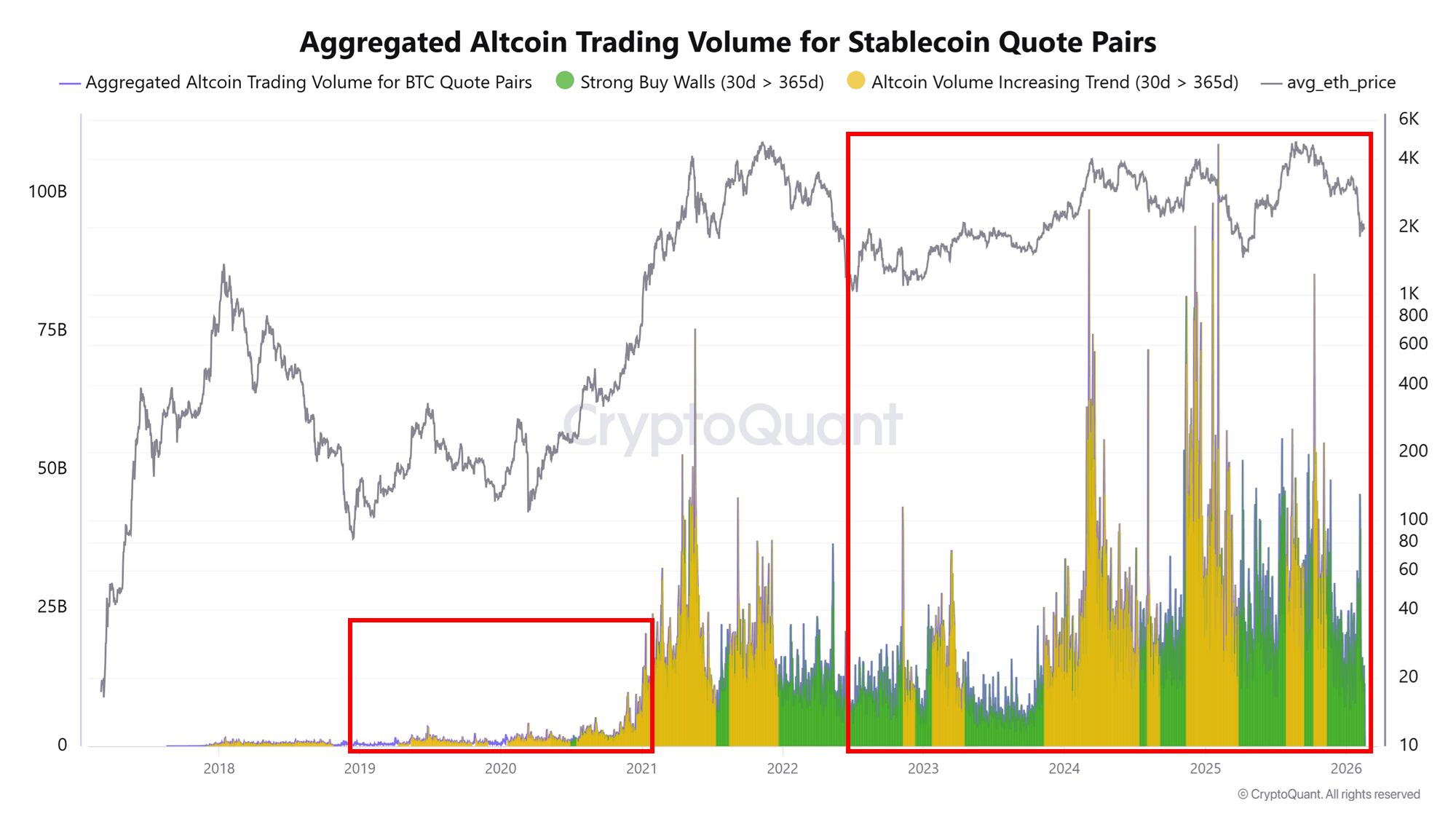
Aggregated Altcoin Trading Volume for Stablecoin Quote Pairs | Source: CryptoQuant

Some analysts argue that the current cycle may be characterized by unusually strong preparatory accumulation compared with previous market phases. Elevated spot volumes alongside persistent volatility suggest capital rotation rather than outright market exit in certain segments.

That said, projections about a future altcoin bull phase being significantly stronger than the previous cycle remain speculative. Market structure, macro liquidity conditions, regulatory developments, and Bitcoin dominance will all influence whether such expectations materialize. The data primarily supports a market undergoing redistribution rather than a confirmed bullish reversal.


Perguntas relacionadas

QAccording to the CryptoQuant report, who is primarily driving the current altcoin selling pressure?

ARetail investors are primarily driving the current altcoin selling pressure, reacting defensively to volatility and prolonged drawdowns.

QWhat does the data suggest is happening to the altcoins being sold by retail investors?

AThe data suggests that a portion of this selling volume is being systematically absorbed by larger or more patient market participants, indicating accumulation.

QWhat is one reason cited for the significant rise in altcoin trading volume despite depressed prices?

AThe increase in activity may reflect repositioning, accumulation, or speculative positioning rather than pure capitulation as the market searches for direction.

QWhat do some analysts argue is unusual about the current market cycle compared to previous ones?

ASome analysts argue the current cycle may be characterized by unusually strong preparatory accumulation.

QWhat factors does the article say will influence whether expectations for a strong altcoin bull phase materialize?

AMarket structure, macro liquidity conditions, regulatory developments, and Bitcoin dominance will all influence whether such expectations materialize.

Leituras Relacionadas

The Niche Consensus Among Elites: Has College Become an Expensive Waste?

**Summary:** A growing "anti-college" movement is gaining traction among elite circles in Silicon Valley, challenging the traditional value of a four-year university degree. Proponents argue that college has become an expensive, slow, and increasingly irrelevant waste of time, especially in the fast-paced tech world where opportunities pass by quickly. The movement is led by figures like billionaire Peter Thiel, who criticizes universities for high costs, ideological indoctrination, and stifling true innovation. His "Thiel Fellowship" pays young people to drop out and pursue ventures. Companies like Palantir Technologies (co-founded by Thiel) fuel this trend with programs like the "Meritocracy Fellowship," which offers high school graduates paid internships as an alternative to immediate college enrollment, promising a practical "Palantir Degree." Key drivers include: 1. **Economics:** Skyrocketing student debt versus the allure of immediate, high-paying tech jobs or startup funding. 2. **Technology:** AI and online tools lowering barriers to self-education and product development, making formal instruction seem inefficient. 3. **Culture:** A backlash against perceived "woke" ideology and DEI policies in universities, coupled with a belief that these institutions suppress meritocracy and masculine drive. The movement is notably male-dominated. Critics, like economist David Deming, warn against overgeneralizing from dropout success stories (survivorship bias). He emphasizes that genuine autodidacts are rare, corporate training is narrowly focused, and the "college wage premium" remains high for most people. University liberal arts education, he argues, builds adaptable problem-solving skills and broad perspectives. The debate highlights a deeper crisis in education. The core model of the modern university appears increasingly mismatched with the speed of the information age. The movement signals a shift in the locus of learning from institutional "education" to personal, active "learning" powered by the internet and AI. Ultimately, this may not mean the end of university, but rather a painful evolution. The future likely holds more hybrid, personalized, and lifelong learning pathways. The central question becomes: in a world changing faster than any curriculum, how do we best learn?

marsbitHá 6m

The Niche Consensus Among Elites: Has College Become an Expensive Waste?

marsbitHá 6m

From Subsidies to Token-Based Pricing to Price Cuts: Is OpenAI Sparking a Price War? Is the Inflection Point for Token Economics Nearing?

The commercialization of generative AI is facing a critical inflection point as a potential price war looms. According to The Wall Street Journal, OpenAI is considering a significant cut to its token fees to compete with rival Anthropic, signaling a shift from a growth-at-all-costs model focused on token consumption. This move comes as both companies, reportedly losing billions on compute, prepare for IPOs, and as enterprise customers face "bill shock" from switching to usage-based token billing. Reports indicate poor ROI, with one analysis finding only 18 cents of every dollar spent on AI tokens generates user-facing value. The industry's initial phases—from flat-rate subscriptions to aggressive subsidies—have given way to a reckoning with real costs. Analysts debate the future: some predict a bifurcation between premium, high-cost models for complex tasks and cheaper alternatives for routine work, while others believe overall spending will still rise as agentic AI increases tokens per task. Notably, Chinese model DeepSeek's low-cost API is gaining traction with U.S. enterprises, adding competitive pressure. The core challenge is redefining value beyond token volume ("tokenmaxxing") toward measurable productivity ("valuemaxxing"), as the entire AI value chain, from cloud providers to chipmakers, feels the ripple effects of unsustainable pricing.

marsbitHá 11m

From Subsidies to Token-Based Pricing to Price Cuts: Is OpenAI Sparking a Price War? Is the Inflection Point for Token Economics Nearing?

marsbitHá 11m

Trading

Spot
Futuros
活动图片




