Crypto Victims Relieved – Or Too Late? What Operation Atlantic Really Means

bitcoinistPublicado em 2026-04-10Última atualização em 2026-04-10

Resumo

Operation Atlantic is a major UK-US-Canada law enforcement initiative targeting crypto fraud and approval-phishing scams, involving agencies like the UK's National Crime Agency and the U.S. Secret Service, along with private partners such as Chainalysis. The operation aims to identify victims and compromised wallets in real time, freeze illicit funds before laundering, and generate investigative leads. Initial results include over 20,000 identified victims, more than 20,000 flagged wallet addresses, and over $12 million in frozen suspected scam proceeds. Globally, $45 million in stolen crypto has been identified. Approval phishing scams trick users into signing malicious transactions, allowing direct wallet draining. The operation highlights growing efforts to combat these rapidly evolving crypto crimes.

Crypto companies and public authorities are joining forces in “Operation Atlantic”, a coordinated push to shut down crypto fraud schemes and approval‐phishing attacks.

A Transnational Operation Against Crypto Phishing Scams

Operation Atlantic is a rare case of law enforcement moving in near real time to block scammers before funds fully disappear on‐chain. The operation is a joint UK–US–Canada venture led by the UK’s National Crime Agency and the US Secret Service, targeting crypto investment and “approval phishing” scams. The multiparty operation is also joined by private industry partners like Chainalysis. The blockchain data and analytics company announced the partnership in a yesterday’s post on their website.

As stated by Chainalysis:

Operation Atlantic’s objective is simple but ambitious: spot victims and compromised wallets in real time, freeze and secure illicit funds before they can be laundered through exchanges or services, generate new investigative leads on the fraud networks behind these scams, and lay the groundwork for ongoing investigations based on the intelligence collected during the operation.

Inside Operation Atlantic’s First Results

The operation, announced last month, has yielded its first striking results.

According to a new report from the National Crime Agency (NCA) of the United Kingdom, more than 20,000 victims have been identified, with over 20,000 wallet addresses flagged and more than $12 million in suspected scam proceeds frozen.

More than $45 million stolen in cryptocurrency fraud schemes has been identified around the world.

The report also highlighted that the operation identified one UK victim that lost more than £52,000 to this type of fraud.

Phishing 101

In approval phishing scams, victims are tricked into signing malicious on‐chain approvals that grant the scammers permission to drain tokens directly from their wallets. These attempts are often disguised as investment opportunities or “account security” prompts.

Such tactics are increasingly favored by organized fraud networks because they bypass traditional password theft and rely on users misunderstanding what they are signing.

Just yesterday, our sister website NewsBTC reported that South Korean authorities are rolling out a new standardized withdrawal‐delay across all exchanges in order to prevent damage from phishing scams that depend on speed.

Last month, the Solana memecoin issuance platform Bonk.fun was hichjacked by a phishing scam that set up a fake “Terms of Services” (TOS) signature prompt which, when signed, allowed the drainer to move the unaware user’s funds.

At the beginning of the month, the social network X announced it is in the process of rolling out its toughest anti-crypto scam measure to date, particularly design to combat phishing scams.

As law enforcement becomes more adept at tracing and freezing stolen funds, scam operations will likely move to more complex laundering routes, creating both new tail risks and new on‐chain data signals for sophisticated traders to track.
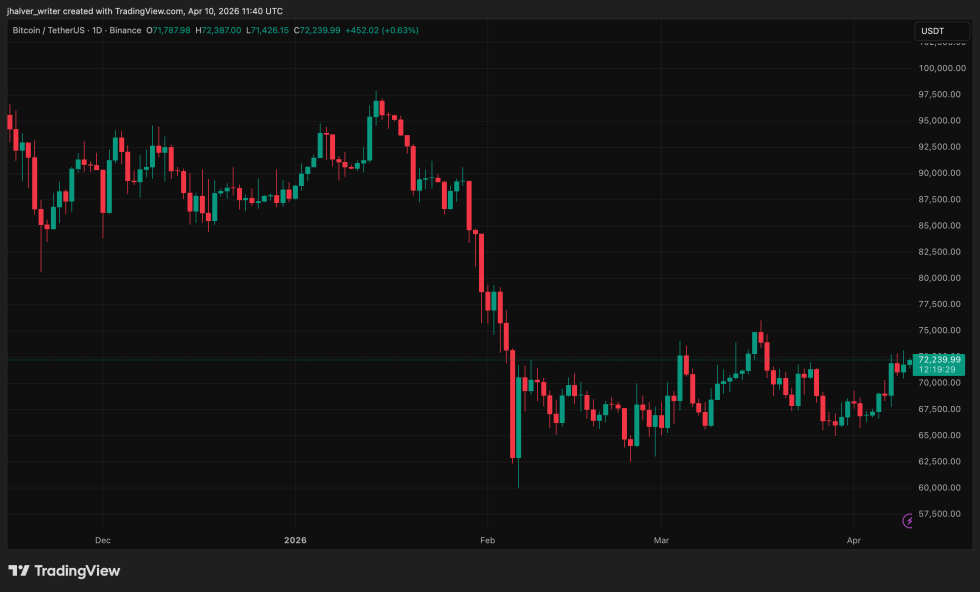
At the moment of writing, BTC trades for the more than $72k on the daily chart. Source: BTCUSDT on Tradingview.

Cover image from Perplexity. BTCUSDT chart from Tradingview.

Perguntas relacionadas

QWhat is the main objective of Operation Atlantic as described in the article?

AThe main objective of Operation Atlantic is to spot victims and compromised wallets in real time, freeze and secure illicit funds before they can be laundered, generate new investigative leads on the fraud networks, and lay the groundwork for ongoing investigations.

QWhich countries and private company are leading the joint venture known as Operation Atlantic?

AOperation Atlantic is a joint UK-US-Canada venture led by the UK's National Crime Agency and the US Secret Service, with the private industry partner Chainalysis also participating.

QAccording to the article, what were the first key results achieved by Operation Atlantic?

AThe operation identified more than 20,000 victims, flagged over 20,000 wallet addresses, and froze more than $12 million in suspected scam proceeds. It also identified over $45 million stolen in cryptocurrency fraud schemes worldwide.

QHow do approval phishing scams work, according to the article?

AIn approval phishing scams, victims are tricked into signing malicious on-chain approvals that grant scammers permission to drain tokens directly from their wallets. These attempts are often disguised as investment opportunities or 'account security' prompts.

QWhat recent actions have other entities taken to combat phishing scams, as mentioned in the article?

ASouth Korean authorities are rolling out a new standardized withdrawal-delay across all exchanges. The social network X announced it is implementing its toughest anti-crypto scam measure to date, specifically designed to combat phishing scams.

Leituras Relacionadas

With Two Consecutive Quarters of Losses, Coinbase Must Rely on Paths Beyond Trading

Coinbase posted its second consecutive quarterly net loss of $359 million on $1.22 billion in revenue for Q2, highlighting its vulnerability to crypto market cycles where weaker prices and lower volatility reduce user trading. However, the report also reveals a strategic shift in its business model. Despite a 25% quarter-over-quarter decline in global spot trading volume, Coinbase increased its market share to a company-record 10.3%. This suggests its position as a compliant U.S. on-ramp is strengthening even in a cooler market. A key development is the diversification of revenue streams. Transaction revenue fell to $599 million, nearly equaling subscription and services revenue of $555 million. Stablecoin services, generating $292 million, are becoming a crucial revenue "floor." This income, derived from interest on the $20 billion average USDC balance held on its platform, is less tied to daily trading activity. Furthermore, while spot trading volume dropped significantly, derivatives volume held steady at $1.03 trillion. Coinbase is pushing to integrate spot, stablecoin, and derivatives liquidity to create a more interconnected and sticky ecosystem for users. The GAAP net loss includes non-cash expenses like stock-based compensation and crypto asset valuation changes. Its adjusted EBITDA remained positive at $208 million for the 14th straight quarter, indicating core operations can cover ongoing costs. The company is also reducing expenses to manage the downturn. The central question moving forward is whether Coinbase's growing market share, stablecoin revenues, and expanding product integration can sufficiently offset the inherent cyclicality of its core trading business during future market contractions.

marsbitHá 9m

With Two Consecutive Quarters of Losses, Coinbase Must Rely on Paths Beyond Trading

marsbitHá 9m

In the Age of Artificial Intelligence, We Need 'Magicians,' Not 'Managers'

In the AI era, leadership must shift from management to magic. As knowledge rapidly expires, value shifts from what leaders know to what they can facilitate. Traditional "inside-out" management, driven by internal experience, is giving way to "outside-in" thinking focused on external opportunities, customer needs, and disruptive change. The core challenge is fostering new ideas that may invalidate existing knowledge. While technologies like steam, electricity, and AI provide the "skeleton" for innovation, it is human vision—connecting technology to customer dreams—that creates magic. Historical figures like Richard Arkwright and Eldridge R. Johnson succeeded not by inventing core technologies, but by reimagining work and business models from the outside in. Leaders must transition from controllers to "architects of flourishing." Their role is to design environments where empowerment, creativity, and adaptive learning thrive. This involves granting autonomy, fostering partnerships, and building resilient systems that scale innovation. Critical leadership qualities now include judgment, creativity, and the ability to learn continuously rather than relying on static expertise. Therefore, cultivating future leaders requires a focus on timeless fundamentals, humanities for broader perspective, and social acuity, rather than over-specialization in quickly outdated technical skills. The future rewards those who respond to the unseen and create conditions for better answers to emerge. Leadership in the AI age is less about having all the answers and more about enabling others to discover them—creating organizations where people explore, imagine, and thrive.

marsbitHá 44m

In the Age of Artificial Intelligence, We Need 'Magicians,' Not 'Managers'

marsbitHá 44m

Trading

Spot
活动图片