Crypto Traders On Edge As Korea Stalls Key Law — Is The “Kimchi Premium” At Risk Next?

bitcoinistPublicado em 2026-04-03Última atualização em 2026-04-03

Resumo

The National Policy Committee of Korea has delayed the debate on the "second-phase" crypto framework until after the June local elections, creating uncertainty in the industry. The proposed Digital Asset Basic Act was excluded from the legislative agenda, despite its importance in regulating stablecoins and exchange ownership. Two major conflicts are stalling progress: first, a dispute between the Bank of Korea and the Financial Services Commission (FSC) over whether banks must hold a 51% stake in won-denominated stablecoin issuers. The FSC opposes this, arguing it would exclude tech firms and exchanges. Second, there is disagreement over equity caps for crypto exchanges, with proposals to limit major shareholders to 20%, affecting giants like Upbit and Bithumb. The delay leaves KRW stablecoin issuers in a gray zone and increases operational costs. Post-election, a bank-heavy stablecoin framework and tighter rules could favor large incumbents, reshaping market liquidity and altcoin listings. Weakening these rules could signal greater openness for crypto in Korea.

The National Policy Committee of Korea pushed the “second‐phase” crypto act debate until after the June 3 local elections.

Crypto Framework Postponed In A Time Of Need

The Korean outlet Maeil Business Newspaper reported uncertainty in the crypto industry deepening after the National Policy Committee excluded the Framework Act on Digital Assets from the 31st of March agenda.

Lawmakers sent five finance-related bills to the subcommittee that day: the Framework Act on Administrative Regulation, the Credit Information Protection Act, the Microfinance Support Act, the Insurance Business Act, and the Capital Markets Act. Not a single bill related to crypto was included, but the Political Affairs Committee’s plenary session received Representative Kim Nam-geun’s “Partial Amendment to the Act on the Protection of Virtual Asset Users, etc.” and forwarded it to the Bill Review Subcommittee.

Lawmakers opted to park the second‐phase bill during a sensitive election window rather than ram through divisive provisions on banks and exchange tycoons, which have become “core landmines” in the legislative process. Speculation in Korean political coverage suggest that the presidential office and the Financial Services Commission (FSC) are not fully aligned on how far to push ownership caps and how tightly to ring‐fence stablecoin issuance, adding to the deadlock narrative.

The proposed crypto framework comes at a time of major importance, as the aforementioned political disagreements also happen to be the two key fights occurring between major players in the Korean cryptocurrency and financial industry.

The Stablecoins Fight

South Korea has recently seen a tug‐of‐war between The Bank of Korea and the FSC over who gets to issue won‐denominated stablecoins.

The BOK is pushing for a bank‐led consortium model where commercial banks must hold at least 51% of any issuer of won‐denominated stablecoins. Bitcoinist reported this on October last year.

The FSC, however, accepts that stablecoins need strict safeguards but opposes a hard 51% bank‐ownership rule, warning it would lock out tech platforms, fintechs and exchanges that actually build the user‐facing products.

These stablecoin-issuers rules are to be hard‐wired under the Digital Asset Basic Act, so every month of delay leaves existing and would‐be KRW stablecoin issuers operating in a gray zone or stuck on the sidelines. According to local outlet Aju Economy, this is a real and concerning issue for the industry. They reported on and industry insider lament:

We need the bill to be finalized quickly to determine our business direction, but currently, we are keeping all possibilities open, which is only increasing the cost burden.

The Equity-Cap Fight

The FSC has been backing proposals to treat big crypto exchanges more like securities or ATS‐style markets, where no single “same person” can own beyond roughly 15–20% in principle. After heavy pushback, regulators and the ruling party have coalesced around a 20% ceiling for “major shareholders”, with a narrow exception that allows stakes up to 34% for new entrants, mirroring the 33.3% veto line in Korea’s Commercial Act. Bitcoinist covered the story at the beginning of the past month.

For existing giants like Upbit and Bithumb, this is a post‐facto rule. Founders and early backers already hold stakes well above 20%, so a hard cap would force them to sell down significant portions of their equity over a three‐year transition (six years for some smaller exchanges). This could potentially disrupt ongoing M&A and reshape control of the local market.

What This Means For The Market

South Korea seems ready to move from ad‐hoc crackdowns to a comprehensive crypto regime. This delay comes on top of recent moves from Seoul to step up oversight with strategies such as AI surveillance, manipulation probes and tax tracking, and to loosen some restrictions, like easing earlier exchange‐stake proposals and reconsidering corporate crypto trading.

Near term, rule uncertainty around KRW stablecoins and exchange ownership could keep Korean venues’ risk premia high and make local listing or market‐making plans harder to model. Post‐election, a bank‐heavy stablecoin framework plus tighter governance rules could favor well‐capitalized incumbents and banks over smaller, high‐beta platforms. This could reshape liquidity and altcoin listings.

Lawmakers watering down ownership caps or opening up stablecoin issuance beyond banks would be a clear risk‐on signal for KRW‐denominated products and for global firms eyeing Korea’s retail base.
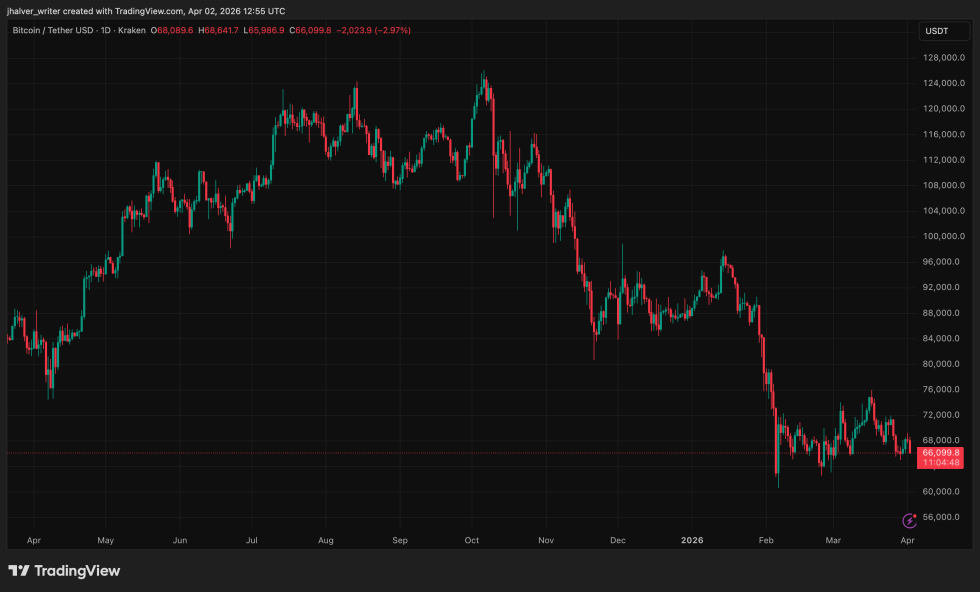
At the moment of writing, BTC trades for exactly $66k on the daily chart. Source: BTCUSDT on Tradingview.

Cover image from Perplexity. BTCUSDT chart from Tradingview.

Perguntas relacionadas

QWhy was the debate on the 'second-phase' crypto act in Korea postponed?

AThe National Policy Committee of Korea postponed the debate until after the June 3 local elections to avoid pushing through divisive provisions on banks and exchange tycoons during a sensitive election window.

QWhat are the two key disagreements causing a deadlock in the Korean crypto framework legislation?

AThe two key disagreements are over ownership caps for major shareholders of crypto exchanges and the regulatory approach for won-denominated stablecoin issuance, particularly between the Bank of Korea and the Financial Services Commission (FSC).

QHow does the Bank of Korea propose to regulate won-denominated stablecoin issuance?

AThe Bank of Korea is pushing for a bank-led consortium model where commercial banks must hold at least 51% of any issuer of won-denominated stablecoins.

QWhat ownership cap is being proposed for major shareholders of crypto exchanges in Korea?

ARegulators and the ruling party have coalesced around a 20% ceiling for major shareholders, with a narrow exception allowing stakes up to 34% for new entrants.

QWhat are the potential market implications of the delayed crypto legislation in Korea?

AThe delay could keep risk premia high for Korean venues, make local listing or market-making plans harder to model, and potentially reshape liquidity and altcoin listings depending on the final rules for stablecoins and exchange ownership.

Leituras Relacionadas

Investors Are Now Hunting for AI Projects on Bilibili and Xiaohongshu

Investors Turn to Bilibili and Xiaohongshu to Source AI Projects The AI hardware boom is in full swing in 2025, with a surge in smart wearables like AI glasses, rings, toys, and companion robots. This frenzy has investors scrambling, not just sifting through business plans, but actively hunting for promising "under-the-radar" projects on youth and tech-enthusiast content platforms like Bilibili and Xiaohongshu. The logic is straightforward: for consumer-facing AI hardware, genuine user demand and potential pitfalls are often revealed earlier in public discussions, comments, and critiques on these communities than in formal pitches. As one industry insider notes, these products must ultimately be tested and understood by real people. This shift highlights a crucial challenge in the sector: user education. The success of AI hardware depends on moving beyond mere efficiency gains to fulfilling higher-order needs like "unleashing personal creativity." Products must convince users they are natural, unobtrusive additions to daily life. Early hype, as seen with devices like the Rabbit R1, often fades if the product fails to clearly solve real-world problems, leading to high return rates and market rejection. The market is now entering a shakeout phase. 2026 is seen as a year of commercial validation. Some projects have already stalled or been canceled due to market resistance, lack of differentiation, or financial woes. However, the long-term opportunity remains vast, with forecasts predicting a multi-trillion dollar global AI hardware market by 2030. The competition is intensifying. With giants like OpenAI and Meta preparing their own hardware, and Chinese companies launching diverse AI-powered products, the battle for user attention, product excellence, and market understanding is just beginning. The core principle endures: in the AI era, it remains a user-sovereign market.

marsbitMesmo agora

Investors Are Now Hunting for AI Projects on Bilibili and Xiaohongshu

marsbitMesmo agora

"Agents' Last Exam", Claude Fable 5 Actually Loses to GPT 5.5

Surprisingly, in the newly released "Agents' Last Exam" (ALE) benchmark from UC Berkeley, GPT-5.5 has outperformed the recently launched and highly-regarded Claude Fable 5. ALE tests AI agents on their ability to perform real-world tasks across 55 professional domains—such as 3D modeling in Siemens NX, creating game scenes in Unreal Engine, and visual effects work in Adobe After Effects—by granting them full GUI and command-line access. In the core task completion rate ranking, GPT-5.5 configurations secured the top two spots (24.0% and 23.0%), while Claude Fable 5 with Claude Code came in third (22.0%). Notably, the highest pass rate was only 24%, and the most difficult "Last-Exam" tier saw most top models, including GPT-5.5 and Fable 5, scoring zero. The benchmark also revealed significant cost and efficiency gaps: Fable 5 spent over four times more money than GPT-5.5's most expensive configuration for a slightly lower score, and was much slower. ALE differs from previous knowledge-based benchmarks by evaluating practical "ability to do" rather than static knowledge retrieval. Its tasks are derived from real expert projects, automatically scored, and designed to prevent cheating through a rotating pool of private challenges. The results suggest that high performance on traditional benchmarks does not necessarily translate to proficiency in complex, open-ended real-world work. The study also notes that agents often fail by prematurely declaring tasks complete without proper verification, and that no single model excels uniformly across all diverse domains.

marsbitHá 6m

"Agents' Last Exam", Claude Fable 5 Actually Loses to GPT 5.5

marsbitHá 6m

Trading

Spot
Futuros

Artigos em Destaque

Como comprar EDGE

Bem-vindo à HTX.com!Tornámos a compra de edgeX (EDGE) simples e conveniente.Segue o nosso guia passo a passo para iniciar a tua jornada no mundo das criptos.Passo 1: cria a tua conta HTXUtiliza o teu e-mail ou número de telefone para te inscreveres numa conta gratuita na HTX.Desfruta de um processo de inscrição sem complicações e desbloqueia todas as funcionalidades.Obter a minha contaPasso 2: vai para Comprar Cripto e escolhe o teu método de pagamentoCartão de crédito/débito: usa o teu visa ou mastercard para comprar edgeX (EDGE) instantaneamente.Saldo: usa os fundos da tua conta HTX para transacionar sem problemas.Terceiros: adicionamos métodos de pagamento populares, como Google Pay e Apple Pay, para aumentar a conveniência.P2P: transaciona diretamente com outros utilizadores na HTX.Mercado de balcão (OTC): oferecemos serviços personalizados e taxas de câmbio competitivas para os traders.Passo 3: armazena teu edgeX (EDGE)Depois de comprar o teu edgeX (EDGE), armazena-o na tua conta HTX.Alternativamente, podes enviá-lo para outro lugar através de transferência blockchain ou usá-lo para transacionar outras criptomoedas.Passo 4: transaciona edgeX (EDGE)Transaciona facilmente edgeX (EDGE) no mercado à vista da HTX.Acede simplesmente à tua conta, seleciona o teu par de trading, executa as tuas transações e monitoriza em tempo real.Oferecemos uma experiência de fácil utilização tanto para principiantes como para traders experientes.

380 Visualizações TotaisPublicado em {updateTime}Atualizado em 2026.06.02

Como comprar EDGE

Discussões

Bem-vindo à Comunidade HTX. Aqui, pode manter-se informado sobre os mais recentes desenvolvimentos da plataforma e obter acesso a análises profissionais de mercado. As opiniões dos utilizadores sobre o preço de EDGE (EDGE) são apresentadas abaixo.

活动图片













