Crypto Traders On Alert: Is CLARITY The Last Chance To Protect Stablecoin Yield?

bitcoinistPublicado em 2026-04-14Última atualização em 2026-04-14

Resumo

A U.S. Senator is preparing to release a compromise draft of the CLARITY Act to resolve the ongoing dispute over stablecoin yields. The key issue is whether crypto firms can pay interest on idle stablecoin holdings, which banks oppose as it competes with traditional deposits. The draft aims to distinguish between prohibited passive yield and permitted activity-based rewards. This legislation will significantly impact stablecoin yields, liquidity, and where traders hold their capital, potentially affecting competition with foreign digital currencies and offshore platforms.

A U.S. Senator might unveil a “compromise draft” aimed at settling the crypto-stablecoin yield dispute in the forthcoming CLARITY Act.

Another Update On The Crypto Legislation

Republican U.S. Senator Thom Tillis (R-N.C.) claimed this Monday he aims to unveil a draft deal this week to break the stalemate over stablecoin yield between banks and crypto firms. According to Politico, he has been collaborating with Sen. Angela Alsobrooks (D‐Md.) on new CLARITY Act language designed to finally settle whether crypto companies can pay interest on idle stablecoin holdings.

According to the report, the text has already been shared with both banking groups and crypto firms. Banks still oppose key elements, the report says, and Tillis has left room for changes.

The already long-standing yield dispute is the main roadblock keeping the landmark CLARITY Act stuck in the Senate, even after the House passed its version last year. Although the GENIUS Act that was passed last year prohibits stablecoin issuers from paying interest directly to holders, it still allows third‐party platforms like exchanges to offer yield.

At the beginning of the month, Coinbase’s chief legal officer Paul Grenwal suggested that negotiators in the Senate were “very close” to a deal on the CLARITY Act’s most contentious crypto issue: the stablecoin yield.

The Stablecoin Yield Dispute

Let’s remember the dispute lays on the fact that yield-bearing stablecoins compete directly with traditional bank deposits because they offer dollar-denominated assets that can move instantly on-chain while still paying attractive returns, thus making them a compelling alternative to savings and money-market accounts.

Banks fear this could drain deposits that fund their lending and investment activities, especially from younger and more digitally native customers who are comfortable holding value in tokenized form. As a result, they push for strict limits or outright bans on interest-like payments to stablecoin holders, arguing that such products should be regulated like banking and that unchecked yield could undermine financial stability and their core funding base.

From the crypto side, however, yield on parked stablecoin balances is seen as a fundamental feature: it’s one of the main ways exchanges and DeFi platforms attract and retain users by turning idle cash into a revenue-generating product. These returns help differentiate on-chain dollars from traditional bank accounts, support token incentive programs, and deepen liquidity across lending markets, perpetuals, and automated market makers.

For many platforms, cutting off or sharply limiting stablecoin yield would hit their core business model, weaken DeFi integrations, and make it harder to compete for global capital that can move to more permissive jurisdictions with a few clicks.

What This Means For The Market

Lately, the emerging policy line seems to be in the direction of no “passive” yield for idle balances, but possible rewards tied to payments, transfers, and other “active use”. Tillis’ compromise draft is meant to codify around it, clarifying what counts as prohibited interest versus allowed activity-based rewards.

The way the U.S. defines stablecoin yield will shape dollar competition with foreign central bank digital currencies (CBDCs) and offshore stablecoin venues that still offer yield. U.S. exchanges may have to pivot to activity-based “rewards” and offshore platforms could attract yield-chasing capital.

Any final text will heavily influence stablecoin APY, liquidity, and where serious traders park their dry powder.
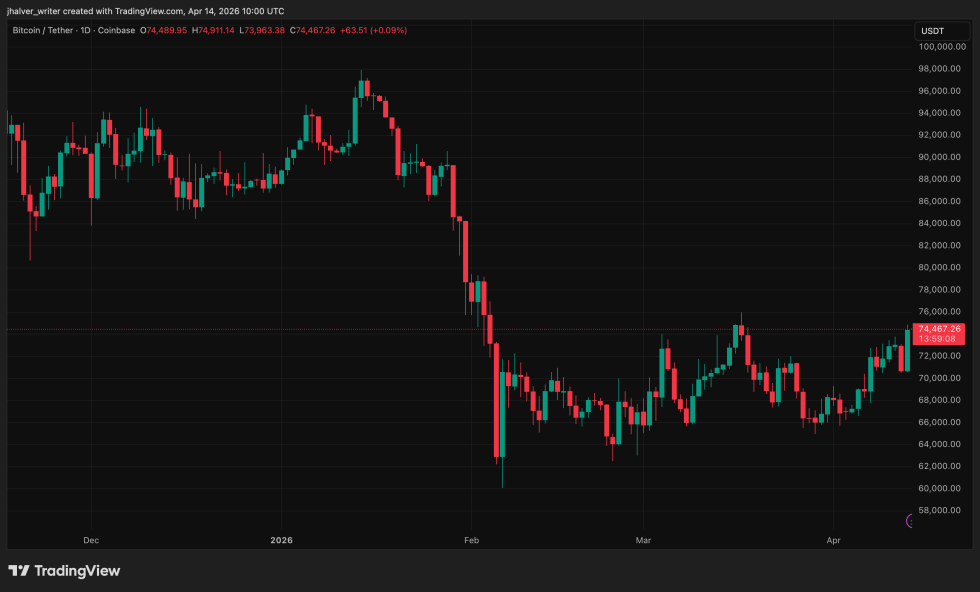
At the moment of writing, BTC trades for more than $74k on the daily chart. Source: BTCUSDT on Tradingview.

Cover image from Perplexity. BTCUSDT chart from Tradingview.

Perguntas relacionadas

QWhat is the main purpose of the upcoming 'compromise draft' in the CLARITY Act, according to Senator Thom Tillis?

AThe main purpose of the compromise draft is to break the stalemate over the stablecoin yield dispute between banks and crypto firms by clarifying whether crypto companies can pay interest on idle stablecoin holdings.

QWhy do traditional banks oppose yield-bearing stablecoins?

ABanks oppose them because they compete directly with traditional bank deposits by offering attractive returns on dollar-denominated assets that can move instantly on-chain. This could drain deposits that fund their lending and investment activities, especially from younger, digitally native customers.

QHow does the crypto industry view the ability to offer yield on stablecoins?

AThe crypto industry views yield on stablecoin balances as a fundamental feature. It is a primary way for exchanges and DeFi platforms to attract and retain users, turn idle cash into a revenue-generating product, differentiate from traditional banks, support token incentives, and deepen liquidity in various markets.

QWhat is the emerging policy direction for stablecoin yield as mentioned in the article?

AThe emerging policy direction seems to be against 'passive' yield for idle balances but allows for possible rewards that are tied to payments, transfers, and other forms of 'active use' of the stablecoins.

QWhat potential market impact could the CLARITY Act's final text have?

AThe final text will heavily influence stablecoin APY (Annual Percentage Yield), liquidity, and where serious traders park their capital. It could force U.S. exchanges to pivot to activity-based rewards and may lead yield-seeking capital to move to offshore platforms or impact competition with foreign CBDCs.

Leituras Relacionadas

Apple's Desired On-Device AI Sees a Dark Horse Emerge: The First Cognitive Model is Born, 4B Matches GPT-5.4

A Chinese company, Tomorrow's Journey (Nextie), has introduced what it is calling the industry's first "cognitive model" for edge devices. Named New Journey Alpha, this 4-billion-parameter model reportedly matches the performance of trillion-parameter giants like GPT-5.4 in group intelligence tasks such as debate and collective decision-making. The development follows Andrej Karpathy's vision of stripping vast factual knowledge from large language models to retain only a smaller "cognitive core" capable of reasoning, planning, and knowing its own limits. This approach directly addresses the soaring computational costs and token expenses hindering AI's widespread deployment, as highlighted by incidents like Amazon shutting down an internal AI tool due to prohibitive costs. Trained via reinforcement learning on a corpus of academic papers from 1800-2020 to enhance generalization, the model enables three key advancements: 1) Improved decision quality in multi-agent systems, 2) Drastically reduced compute costs, allowing for cost-effective cloud or on-device (e.g., MacBook) deployment, and 3) The feasibility of "proactive" AI agents that act autonomously without user prompts, unlocking new commercial possibilities beyond today's reactive models. Built by the former Microsoft Xiaoice team—known for creating a 3.6B model that outperformed a 65B Llama model—the company is now focusing on the multi-agent systems sector, a field gaining significant investor interest. The model's economic impact is profound; by achieving high-level performance with minimal parameters, it fundamentally alters the cost structure of AI services, challenging the prevailing model of ever-larger parameter counts.

marsbitHá 2h

Apple's Desired On-Device AI Sees a Dark Horse Emerge: The First Cognitive Model is Born, 4B Matches GPT-5.4

marsbitHá 2h

OpenAI's 'Blueprint for the Future': Making AI Beneficial for Every Person on the Planet

A new transformative technology emerges every few generations. OpenAI draws a parallel with the advent of electricity in the 1920s, which initially brought convenience but ultimately enabled unprecedented progress in medicine, engineering, and living standards by empowering people to create new possibilities. AI is poised to recreate this phenomenon. Its true significance lies not in the technology itself, but in what people can achieve with it—from understanding a medical bill or starting a business to aiding scientific discovery. OpenAI believes AI should be universally accessible, allowing everyone to use it according to their own needs. This future, however, is not guaranteed. While transformative tech can centralize power, OpenAI's philosophy is that AI must serve humanity, augmenting human capabilities and broadly distributing its benefits. The company's first commitment is to build AI for human service, aiming to empower the many rather than concentrate power in a few. Safety, alignment with human intent, and oversight are paramount. OpenAI is optimistic about AI's potential to expand human welfare but remains clear-eyed about risks. The goal is to help people achieve more, not to replace them. Full automation is not the desired future; human judgment, values, and direction will become even more critical. OpenAI outlines three core goals: 1. Build automated AI researchers to accelerate and increasingly automate the research process itself, maintaining close human collaboration. The internal projection is that by March 2028, a significant portion of their research will be conducted by AI systems working alongside human researchers. 2. Accelerate economic development by advancing science, boosting productivity, and fostering growth, while ensuring the fruits are widely shared. 3. Provide a personal AGI for everyone on Earth, allowing individuals to benefit from this transformative technology in their own way. The company is entering its third phase, moving from foundational AGI research (Phase 1) to product deployment and learning from real-world use (Phase 2). The current challenge is making advanced AI abundant, affordable, safe, practical, and usable for all individuals and organizations. OpenAI concludes that a widely distributed power structure leads to a more resilient, adaptable, and free society. A positive AI future should not be controlled by a handful of entities but built, benefited from, and owned by many. If realized correctly, AI can become a cornerstone for enhancing global productivity, creativity, scientific advancement, and economic opportunity, fulfilling the mission to ensure AGI benefits all of humanity.

marsbitHá 2h

OpenAI's 'Blueprint for the Future': Making AI Beneficial for Every Person on the Planet

marsbitHá 2h

Arthur Hayes' New Article: AI Bubble Nears Bursting, Crypto Market Faces Short-Term Pressure

In a new essay, Arthur Hayes argues that the AI market bubble is approaching a rupture, which will place significant short-term pressure on crypto assets. He identifies rising oil prices, a trio of massive tech IPOs (SpaceX, Anthropic, OpenAI), and potential anti-AI political rhetoric from Trump as the three key catalysts for a correction. Hayes posits that the prolonged blockage of the Strait of Hormuz will drive energy prices higher, increasing operational costs for data centers and squeezing AI company profits. Simultaneously, the market may struggle to absorb the upcoming wave of multi-trillion dollar tech IPOs. Furthermore, with high inflation hurting his election chances, Trump could pivot to attacking the AI sector with proposals for heavy taxation and regulation to win over voters, spooking the market. Hayes notes that nearly all new dollar liquidity since 2022 has flowed into the AI sector, leaving little for Bitcoin, explaining its recent underperformance. He believes an AI stock crash would trigger a broad risk-off sentiment and credit contraction, dragging down crypto in the near term. Consequently, his fund, Maelstrom, has sold all AI-related stocks and non-core cryptocurrencies, retaining only Bitcoin and Ethereum while building positions in traditional energy stocks. He anticipates Bitcoin will bottom and resume its bull run only after the AI bubble pops and a new monetary easing cycle begins.

marsbitHá 3h

Arthur Hayes' New Article: AI Bubble Nears Bursting, Crypto Market Faces Short-Term Pressure

marsbitHá 3h

Trading

Spot
Futuros
活动图片





