Crypto today: Tokenized stocks surge 3000% as U.S. policy shifts to innovation

ambcryptoPublicado em 2026-03-09Última atualização em 2026-03-09

Resumo

The article highlights three major trends in the crypto space. First, stablecoins are rapidly evolving from cross-border settlement tools into core domestic payment infrastructure, driven by extremely low transaction fees on networks like Solana and Base. This has led to surging retail usage and integration by major payment processors. Second, a significant shift in U.S. policy is fostering innovation, with improved regulatory coordination between the SEC and CFTC. This environment has fueled explosive growth, with the tokenized stock market surging nearly 3,000% to $1.1 billion. Finally, institutional investment products saw strong weekly inflows of $619 million, though momentum was tempered by macro pressures and profit-taking, indicating a market that is maturing but remains sensitive to broader economic conditions. Bitcoin solidifies its role as a store of value, while regulated stablecoins become the dominant medium of exchange.

Stablecoins are increasingly shifting from cross-border settlement tools toward domestic payment infrastructure.

Global adjusted transaction volume now exceeds $10 trillion, while raw transfers reached $33 trillion in 2025.

Initially, most activity supported remittances and international treasury transfers.

However, transaction patterns changed as small transfers under $250 surged through 2025 and early 2026, reflecting growing retail and merchant usage.

Cost efficiency continues driving this transition.

Fees on networks such as Solana [SOL] and Base range around $0.00201, far below the 2.3–3.5% typical of credit card networks. As a result, merchants increasingly integrate stablecoin rails through platforms like Stripe, PayPal, and Visa, expanding domestic checkout and payout infrastructure.

At the same time, network scalability improves. Ethereum’s [ETH] Pectra and Fusaka upgrades aim to increase throughput and support higher transaction volumes across payment rails.

These developments reshape market roles.

Bitcoin [BTC] remains the store of value, while regulated stablecoins increasingly function as the medium of exchange powering programmable digital payments, thereby facilitating faster and more efficient transactions in the evolving digital economy.

U.S. crypto policy shifts toward innovation

U.S. crypto policy now reflects a sharp shift toward innovation and coordinated regulation.

In a March 2026 interview, former CFTC Chair Chris Giancarlo described a policy pivot from enforcement to strategic development. He noted that SEC and CFTC leadership now meet biweekly, replacing earlier six-week coordination gaps.

This alignment signals a deliberate effort to accelerate digital asset innovation.

At the same time, regulatory clarity supports emerging markets.

Tokenized Stocks now hold about $1.1 billion, surging nearly 3,000% from $32 million in early 2025. Meanwhile, the broader RWA sector exceeded $26.5 billion, growing 8.3% in 30 days.

Giancarlo also highlighted stablecoins and tokenization as pillars of future financial infrastructure. However, he warned that strict surveillance rules under the GENIUS Act could undermine privacy if poorly implemented.

Institutional crypto inflows face macro pressure

Digital asset investment products recorded $619 million in net inflows, reflecting renewed institutional demand during the week. Early sessions showed stronger momentum as capital steadily entered crypto investment funds.

Weekly flows initially accelerated, with several periods exceeding $1 billion in positive allocations, signaling improving market sentiment.

However, momentum weakened toward the end of the week.

Rising oil prices introduced macro uncertainty, which prompted partial profit-taking across digital asset products. As a result, late-week activity shifted into modest outflows.

Earlier weeks also reveal sharp volatility in institutional positioning. Flows fluctuated between $6 billion inflows and nearly $2 billion outflows, highlighting sensitivity to macro signals.

Despite this volatility, the week still closed with positive net inflows. This pattern suggests institutional investors remain engaged, although capital allocation increasingly reacts to broader economic developments.


Final Summary

  • Bitcoin [BTC] increasingly anchors the store-of-value narrative as stablecoins expand into domestic payment rails powered by high-throughput networks like Ethereum [ETH] and Solana [SOL].
  • Growing institutional inflows and expanding tokenized asset markets signal a maturing crypto ecosystem where regulated stablecoins and BTC increasingly support real financial infrastructure.


Perguntas relacionadas

QWhat is the main shift in the use of stablecoins as described in the article?

AStablecoins are increasingly shifting from cross-border settlement tools toward domestic payment infrastructure.

QHow much did the market for Tokenized Stocks grow from early 2025, and what was its total value mentioned?

ATokenized Stocks surged nearly 3,000% from $32 million in early 2025 to hold about $1.1 billion.

QWhat technological development is Ethereum implementing to improve its network for payments?

AEthereum is implementing the Pectra and Fusaka upgrades to increase throughput and support higher transaction volumes across payment rails.

QAccording to former CFTC Chair Chris Giancarlo, what is the new risk associated with the GENIUS Act?

AHe warned that strict surveillance rules under the GENIUS Act could undermine privacy if poorly implemented.

QWhat was the overall trend for institutional crypto investment products by the end of the week discussed, despite some volatility?

ADespite volatility and some late-week outflows, the week still closed with positive net inflows of $619 million, suggesting institutional investors remain engaged.

Leituras Relacionadas

Circle CEO's Seoul Visit: No Korean Won Stablecoin Issuance, But Met All Major Korean Banks

Circle CEO Jeremy Allaire's recent activities in Seoul indicate a strategic shift for the company, moving away from issuing a Korean won-backed stablecoin and instead focusing on embedding itself as a key infrastructure provider within Korea’s financial and crypto ecosystem. Despite Korea accounting for nearly 30% of global crypto trading volume—with a market characterized by high retail participation and altcoin dominance—Circle has chosen not to compete for the role of stablecoin issuer. Instead, Allaire met with major Korean banks (including Shinhan, KB, and Woori), financial groups, leading exchanges (Upbit, Bithumb, Coinone), and tech firms like Kakao. This approach reflects a broader industry transition: the core of stablecoin competition is shifting from issuance rights to systemic positioning. With Korean regulators still debating whether banks or tech companies should issue stablecoins, Circle is avoiding regulatory uncertainty by strengthening its role as a service and technology partner. The company is deepening integration with trading platforms, building connections, and promoting stablecoin infrastructure. This positions Circle to benefit regardless of which entity eventually issues a won stablecoin. Allaire also noted the potential for a Chinese yuan stablecoin in the next 3–5 years, underscoring a regional trend of stablecoins becoming more regulated and integrated with traditional finance. Ultimately, Circle’s strategy highlights that future influence in the stablecoin market will belong not necessarily to the issuers, but to the foundational infrastructure layers that enable cross-system transactions.

marsbitHá 4m

Circle CEO's Seoul Visit: No Korean Won Stablecoin Issuance, But Met All Major Korean Banks

marsbitHá 4m

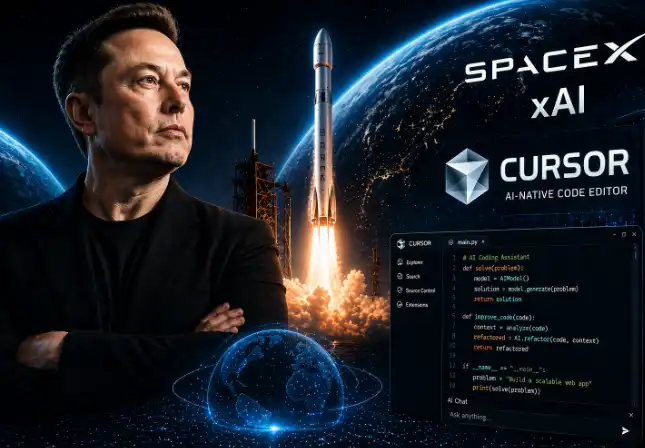
SpaceX Ties Up with Cursor: A High-Stakes AI Gambit of 'Lock First, Acquire Later'

SpaceX has secured an option to acquire AI programming company Cursor for $60 billion, with an alternative clause requiring a $10 billion collaboration fee if the acquisition does not proceed. This structure is not merely a potential acquisition but a strategic move to control core access points in the AI era. The deal is designed as a flexible, dual-path arrangement, allowing SpaceX to either fully acquire Cursor or maintain a binding partnership through high-cost collaboration. This "option-style" approach minimizes immediate regulatory and integration risks while ensuring long-term alignment between the two companies. At its core, the transaction exchanges critical AI-era resources: SpaceX provides its Colossus supercomputing cluster—one of the world’s most powerful AI training infrastructures—while Cursor contributes its AI-native developer environment and strong product adoption. This synergy connects compute power, models, and application layers, forming a closed-loop AI capability stack. Cursor, founded in 2022, has achieved rapid growth with over $1 billion in annual revenue and widespread enterprise adoption. Its value lies in transforming software development through AI agents capable of coding, debugging, and system design—positioning it as a gateway to future software production. For SpaceX, this move is part of a broader strategy to evolve from a aerospace company into an AI infrastructure empire, integrating xAI, supercomputing, and chip manufacturing. Controlling Cursor fills a gap in its developer tooling layer, strengthening its AI narrative ahead of a potential IPO. The deal reflects a shift in AI competition from model superiority to ecosystem and entry-point control. With programming tools as a key battleground, securing developer loyalty becomes crucial for dominating the software production landscape. Risks include questions around Cursor’s valuation, technical integration challenges, and potential regulatory scrutiny. Nevertheless, the deal underscores a strategic bet: controlling both compute and software development access may redefine power dynamics in the AI-driven future.

marsbitHá 44m

SpaceX Ties Up with Cursor: A High-Stakes AI Gambit of 'Lock First, Acquire Later'

marsbitHá 44m

Trading

Spot
Futuros
活动图片