Crypto Shockwave: Circle Sued As $280 Million Drift Hack Unravels

bitcoinistPublicado em 2026-04-17Última atualização em 2026-04-17

Resumo

A class action lawsuit has been filed in a Massachusetts federal court against Circle Internet Financial, alleging the stablecoin issuer was negligent and aided in the theft of $280 million from the Drift Protocol. The plaintiffs, representing over 100 investors, argue Circle had the means to stop the stolen USDC from being moved across blockchains using its Cross-Chain Transfer Protocol but failed to act. They point to Circle's prior action of freezing wallets in a separate civil case as proof it could have intervened. The April 1st hack is attributed to North Korean state-backed actors who moved the funds to Ethereum and laundered them through Tornado Cash. The case raises significant questions about the responsibility of centralized entities in the decentralized crypto ecosystem.

North Korean hackers likely pocketed hundreds of millions in stolen crypto — and now a US court is being asked to decide whether a stablecoin giant should have stopped them.

Circle’s Own Track Record Becomes A Key Weapon

A class action lawsuit filed in a Massachusetts federal court this week names Circle Internet Group as the defendant, with plaintiffs arguing the company had both the means and the opportunity to stop roughly $280 million in stolen USDC from moving across blockchains — and did nothing.

The case was brought by Drift Protocol investor Joshua McCollum, representing more than 100 affected members. Their attorneys put it plainly: Circle allowed criminal use of its own technology.
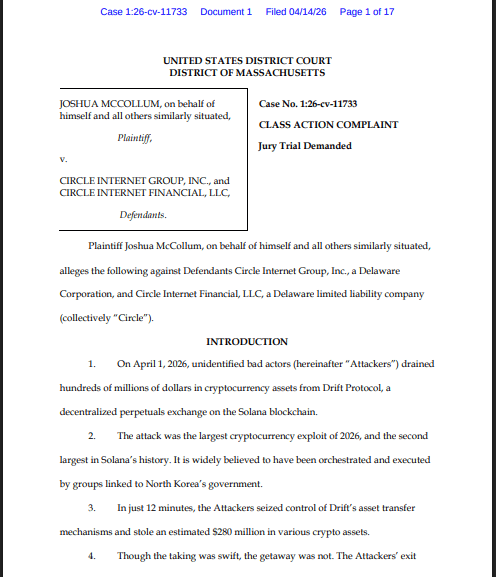
The complaint was filed Wednesday in a Massachusetts US district court by Drift investor Joshua McCollum, representing more than 100 members.

The April 1 attack on Drift Protocol saw attackers drain funds and route them from Solana to Ethereum using Circle’s Cross-Chain Transfer Protocol, a bridging tool the company operates. The transfers happened over several hours, according to reports. The window was wide open.

What makes the lawsuit particularly pointed is what happened just days before the hack. About a week prior, Circle froze 16 USDC wallets tied to a sealed US civil case. Plaintiffs seized on that detail. If Circle could move fast for a court-adjacent matter, they argue, it could have acted here too. That single fact sits at the center of the legal fight.

Accusations Range From Negligence To Aiding The Crime

The suit carries two main charges: negligence and aiding and abetting conversion — a legal term for helping someone unlawfully take another person’s property. The law firm Mira Gibb is handling the case for McCollum and the other Drift investors. Damages have not yet been set and will be determined at trial.

BTCUSD trading at $75,081 on the 24-hour chart: TradingView

Circle has not responded to requests for comment.

Crypto analytics firm Elliptic flagged the attack as the work of North Korean state-backed operatives. Based on Elliptic’s analysis, the hackers executed more than 100 transactions through Circle’s bridging infrastructure during regular US business hours. After moving the funds to Ethereum, the stolen assets were converted and pushed through Tornado Cash, a privacy protocol used to obscure transaction trails.

Image: SOPA Images/Getty Images

ARK Invest Defends Circle, But The Moral Stakes Remain High

Not everyone is pointing fingers at Circle. Lorenzo Valente, ARK Invest’s director of digital asset research, argued that Circle made the right call by not acting without a legal order.

His concern: give a company like Circle the power to freeze funds on judgment alone, and every decision becomes political. He questioned aloud where the line would be drawn — between a North Korean hacker and a suspicious wallet elsewhere in the world.

Featured image from B&G Lawyers, chart from TradingView

Criptomoedas em alta

Perguntas relacionadas

QWhat is the main allegation against Circle Internet Group in the class action lawsuit?

AThe plaintiffs allege that Circle had both the means and the opportunity to stop roughly $280 million in stolen USDC from moving across blockchains but did nothing, thereby allowing criminal use of its technology.

QWhich hacking group is suspected to be behind the $280 million attack on Drift Protocol?

ACrypto analytics firm Elliptic flagged the attack as the work of North Korean state-backed operatives.

QWhat key precedent from just days before the hack do the plaintiffs use to strengthen their case against Circle?

AThe plaintiffs point out that about a week prior to the hack, Circle froze 16 USDC wallets tied to a sealed US civil case, arguing that if Circle could act quickly in that instance, it could have acted to stop the stolen funds.

QWhat are the two main legal charges brought against Circle in the lawsuit?

AThe two main charges are negligence and aiding and abetting conversion, which is a legal term for helping someone unlawfully take another person's property.

QWhat was the primary method the hackers used to obscure the trail of the stolen funds after the attack?

AAfter moving the funds to Ethereum, the stolen assets were converted and pushed through Tornado Cash, a privacy protocol used to obscure transaction trails.

Leituras Relacionadas

MSX US Stock Daily Insight: Amazon 2026 Q2 Earnings: AWS Records Fastest Growth in Five Years

**MSX Daily US Stock Observation: Amazon's Q2 2026 Earnings: AWS Achieves Fastest Growth in Five Years** Amazon's latest quarterly results exceeded expectations, driven by a strong performance from its cloud computing unit. The company reported revenue of $200.66 billion, surpassing estimates of approximately $197 billion. The key highlight was Amazon Web Services (AWS), which generated $42.232 billion in revenue, surging 37% year-over-year. This marked the segment's fastest growth pace in 18 quarters, indicating robust demand for cloud services. Reported Earnings Per Share (EPS) of $5.75 significantly exceeded the $1.84 forecast. However, this figure included a substantial one-time, non-operating gain of $53.4 billion, primarily from the revaluation of Amazon's investment in AI company Anthropic. Excluding this item, core operating profit was $27.461 billion, a strong increase of 43% compared to the same period last year. Despite the positive results, Amazon provided guidance for the upcoming third quarter that fell short of market expectations. The company's revenue guidance midpoint is $199.5 billion, below the consensus estimate of around $204 billion. Operating profit guidance of $24.5 billion also slightly missed expectations of approximately $247.9 billion. Furthermore, Amazon raised its forecast for full-year capital expenditures to $220 billion, citing rising memory chip costs, which weighed on investor sentiment regarding future profitability. In summary, Amazon's quarter showcased accelerating momentum in its core AWS business. The underlying operational profit growth remains solid. However, cautious forward guidance and increased investment spending present key areas for monitoring in the coming quarters, as the market assesses whether the current growth phase will translate into sustained profit margin expansion.

Odaily星球日报Há 2m

MSX US Stock Daily Insight: Amazon 2026 Q2 Earnings: AWS Records Fastest Growth in Five Years

Odaily星球日报Há 2m

Cyclical Stock or Growth Stock? Coinbase's Q2 Earnings Report Reveals 'Valuation Disagreement'

Coinbase's Q2 2026 financial results revealed a mixed performance, reigniting debate over whether the company should be valued as a cyclical stock tied to crypto markets or a growth stock with future potential. Total revenue missed expectations at $1.22 billion, down 19% year-over-year. Transaction revenue fell to $599 million, with retail crypto spot trading revenue dropping 30% to $452 million, back to 2023 levels. The company reported a net loss of $359 million, marking its third consecutive quarterly loss. Despite CEO Brian Armstrong's positive commentary on metrics like a 10.3% overall crypto trading market share and 106% growth in prediction markets, the market reacted negatively, with shares dropping over 5% after-hours. A key issue is the decline in core retail trading. While Coinbase touted record market share, this figure includes derivatives and new products. Its traditional crypto spot trading share is likely shrinking. New ventures like prediction markets, while growing, contributed less than $30 million, insufficient to offset the core revenue decline. The valuation debate hinges on perspective. As a cyclical stock, Coinbase remains deeply tied to the crypto bear market, with user attrition and competitive pressures justifying a lower valuation. The company's strategy appears focused on surviving until the next bull cycle. Viewed as a growth stock, however, Coinbase shows promising diversification. Subscription and service revenue reached $555 million, nearly matching transaction revenue. Stablecoin revenue, its second-largest source at $292 million, remains strong through its partnership with Circle. Critically, Coinbase is positioning itself as a leader in the emerging on-chain "agent economy." Over 90% of agent-based stablecoin transactions occur on its Base network, which it believes could handle trillions in future agent transactions. The recent acquisition of Deribit also aims to boost its international derivatives offering. In summary, Coinbase's present struggles are clear, but its future hinges on whether its investments in revenue diversification, stablecoins, and the agent economy can ultimately transform its business model and justify a growth premium.

Odaily星球日报Há 22m

Cyclical Stock or Growth Stock? Coinbase's Q2 Earnings Report Reveals 'Valuation Disagreement'

Odaily星球日报Há 22m

Global Market Share Survey: Japanese Firms Lead in Semiconductor Materials

Global Market Share Survey: Japanese Firms Lead in Semiconductor Materials According to the 2025 "Major Goods and Services Market Share Survey" by Nikkei, Japanese companies maintain strong positions in semiconductor-related materials. In silicon wafers, Shin-Etsu Chemical ranks first with a 26.3% share, followed by SUMCO at 17.8%. Together, they hold 44.1% of the market, widening their lead over competitors from Taiwan, Germany, and South Korea. In photoresists, Tokyo Ohka Kogyo, JSR, and Shin-Etsu Chemical occupy the top three spots, with a combined share of 60.5%. Despite their strength in materials, Japanese firms have a weaker presence in core semiconductor segments like DRAM and NAND flash memory, where South Korean and U.S. companies dominate. For instance, SK Hynix and Samsung lead in DRAM, while China’s CXMT doubled its share to 6% in 2025. The semiconductor market is projected to grow rapidly, with WSTS forecasting a 90% increase to $1.5112 trillion by 2026. Major players like Samsung, SK Hynix, and Micron are making massive investments to expand capacity. To maintain their edge in materials, Japanese companies must similarly commit to large-scale, risk-taking investments. In contrast, Japan’s automotive sector shows stagnation. Toyota remains the global leader but with only a slight share increase to 12.3%, while Japanese brands are absent from the top five in the EV market. In shipbuilding, Imabari Shipbuilding rose to third place globally with a 7.2% share, benefiting from large container ship deliveries. However, Chinese and South Korean firms dominate the sector, holding the top two positions. Japan aims to revitalize its shipbuilding industry through government and corporate efforts, targeting a near doubling of output by 2035. Addressing labor shortages and adopting advanced technologies like physical AI will be critical for competitiveness.

marsbitHá 47m

Global Market Share Survey: Japanese Firms Lead in Semiconductor Materials

marsbitHá 47m

Trading

Spot

Artigos em Destaque

Como comprar DRIFT

Bem-vindo à HTX.com!Tornámos a compra de Drift Protocol (DRIFT) simples e conveniente.Segue o nosso guia passo a passo para iniciar a tua jornada no mundo das criptos.Passo 1: cria a tua conta HTXUtiliza o teu e-mail ou número de telefone para te inscreveres numa conta gratuita na HTX.Desfruta de um processo de inscrição sem complicações e desbloqueia todas as funcionalidades.Obter a minha contaPasso 2: vai para Comprar Cripto e escolhe o teu método de pagamentoCartão de crédito/débito: usa o teu visa ou mastercard para comprar Drift Protocol (DRIFT) instantaneamente.Saldo: usa os fundos da tua conta HTX para transacionar sem problemas.Terceiros: adicionamos métodos de pagamento populares, como Google Pay e Apple Pay, para aumentar a conveniência.P2P: transaciona diretamente com outros utilizadores na HTX.Mercado de balcão (OTC): oferecemos serviços personalizados e taxas de câmbio competitivas para os traders.Passo 3: armazena teu Drift Protocol (DRIFT)Depois de comprar o teu Drift Protocol (DRIFT), armazena-o na tua conta HTX.Alternativamente, podes enviá-lo para outro lugar através de transferência blockchain ou usá-lo para transacionar outras criptomoedas.Passo 4: transaciona Drift Protocol (DRIFT)Transaciona facilmente Drift Protocol (DRIFT) no mercado à vista da HTX.Acede simplesmente à tua conta, seleciona o teu par de trading, executa as tuas transações e monitoriza em tempo real.Oferecemos uma experiência de fácil utilização tanto para principiantes como para traders experientes.

320 Visualizações TotaisPublicado em {updateTime}Atualizado em 2026.06.02

Como comprar DRIFT

Discussões

Bem-vindo à Comunidade HTX. Aqui, pode manter-se informado sobre os mais recentes desenvolvimentos da plataforma e obter acesso a análises profissionais de mercado. As opiniões dos utilizadores sobre o preço de DRIFT (DRIFT) são apresentadas abaixo.

活动图片