Crypto Project Pudgy Penguins Appears on the Sphere Dome in Las Vegas

RBK-cryptoPublicado em 2025-12-25Última atualização em 2025-12-25

Resumo

Popular NFT project Pudgy Penguins has achieved a major marketing milestone by placing its advertisement on the exterior of the Sphere in Las Vegas, the world's largest spherical LED media platform. The project, which began as a flagship NFT collection on Ethereum, has transformed into a global retail brand by 2025. It now boasts global sales of toys, partnerships with retailers like Walmart and Amazon, the release of animated content, and the launch of its PENGU token on the Solana network. The project has deliberately avoided crypto-themed advertising for this campaign, focusing instead on its physical goods and animated content without mentioning tokens or NFTs. This contrasts with a previous attempt by the Dogwifhat (WIF) meme coin community to run a similar campaign, which was rejected by Sphere despite raising $700,000. The floor price for a Pudgy Penguins NFT is currently around 4 ETH (approximately $12,000). The PENGU token was one of the top-performing major crypto assets in 2025, though it later corrected by more than 70% from its July peak alongside most altcoins. Its previous growth was accompanied by the launch of the Pengu Clash mini-game on Telegram and partnerships with Lufthansa and NASCAR. The project also gained significant attention when dozens of executives from major crypto companies temporarily changed their social media avatars to Pudgy Penguins images.

The team behind the popular NFT project became the first in the crypto industry to secure advertising placement on the world's largest LED screen

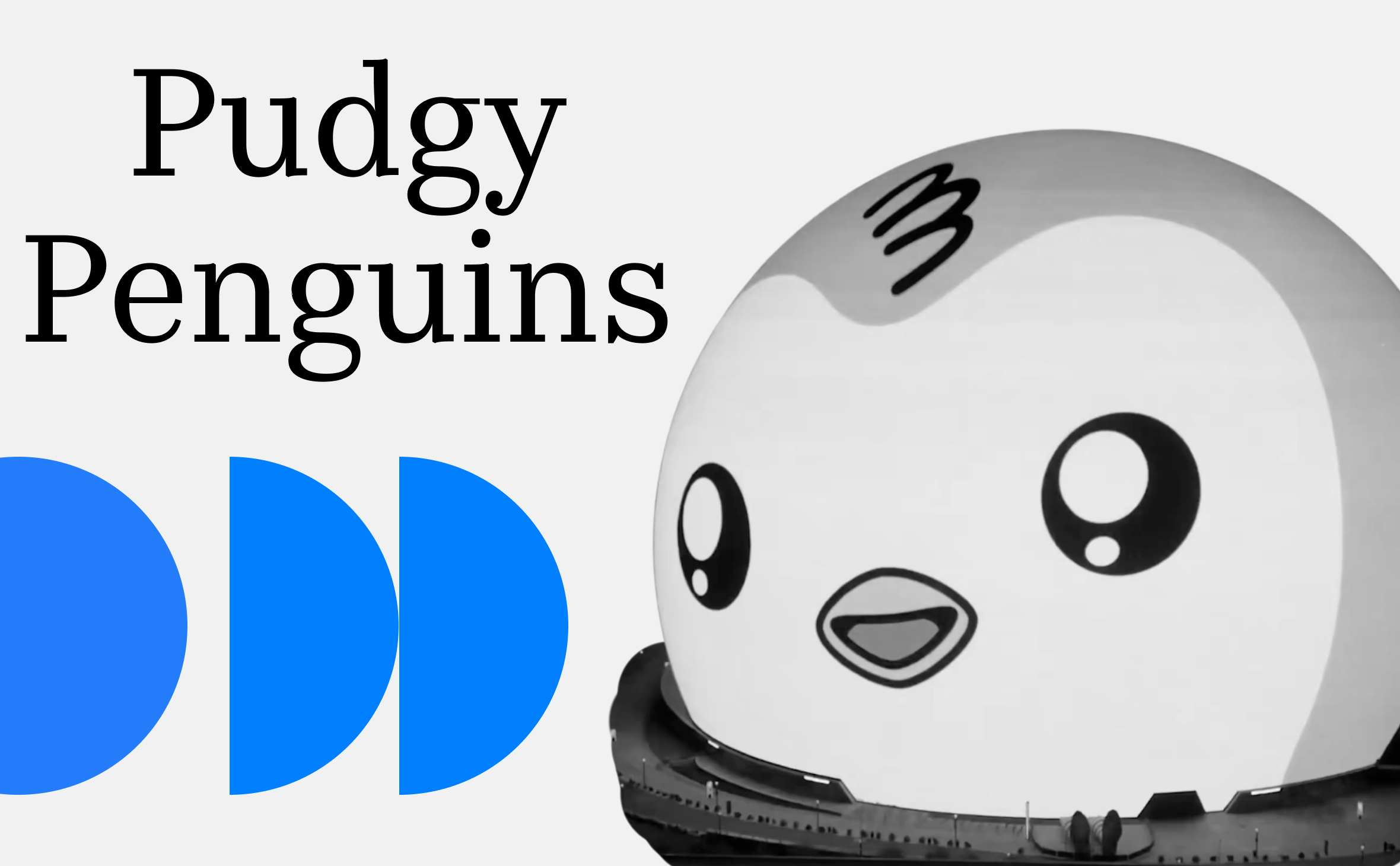
The characters of the Pudgy Penguins brand have become part of the outdoor advertising on the giant LED screen Sphere — the world's largest spherical media platform, located in Las Vegas.
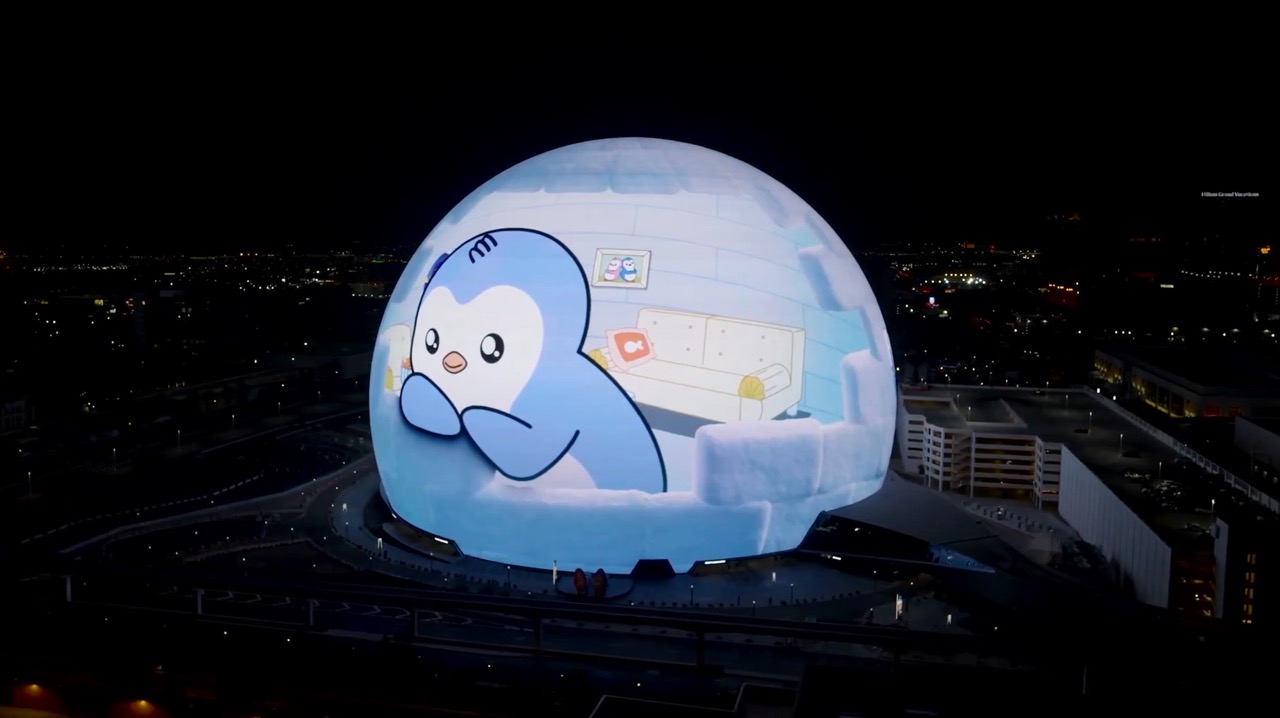
Animation on the LED screen of the Sphere in Las Vegas. Source: pudgypenguins / X

The Pudgy Penguins project began as one of the flagship NFT collections on the Ethereum network, but by 2025 it had transformed into a retail brand with global sales of toys, partnerships with retailers Walmart and Amazon, the release of animated films, and the launch of the PENGU token on the Solana network.

NFT (non-fungible tokens) — these are unique digital objects with ownership confirmed on the blockchain. They became part of the crypto-mania of 2021-2022, when images, videos, and other collectible tokens on the Ethereum or Solana networks were sold for hundreds of thousands of dollars.

The project avoided a ban on crypto advertising from the sphere's operators by focusing on physical goods — toys, merchandise, and animated content, without mentioning tokens or NFTs. Earlier, an attempt by the Dogwifhat (WIF) meme coin community to run a similar campaign was rejected, despite raising $700 thousand for it.

The minimum price (floor price) for one NFT image from the collection is 4 ETH (about $12 thousand), according to CoinGecko data on December 25th.

RBC-Crypto Telegram channel — subscribe and stay up to date with the most important and current news about cryptocurrency.

Join the RBC-Crypto forum on Telegram to discuss news and trends in the crypto world.

The PENGU token showed one of the best growth results among major crypto assets in 2025, but by the end of the year, along with most altcoins, it corrected by more than 70% from its July peak.

That period of growth was accompanied by the launch of the game Pengu Clash as a mini-app on Telegram, a partnership of the project with the airline Lufthansa and the organizer of NASCAR auto races. The same period was marked by a mass flashmob when dozens of leaders and managers of large crypto companies temporarily changed their avatars on social network X to images of Pudgy Penguins.

Volatility interrupted. How the price of bitcoin changed over 10 years at Christmas

AI beat people in a crypto trading tournament. What were the results?

"Capitalization" of miners was called a bullish factor for bitcoin. Why?
Leituras Relacionadas

Wall Street Morning News: V-shaped Rebound at Month-end, but Nasdaq Suffers Worst July in 12 Years; Funds Accelerate Concentration Towards Cloud Giants

Despite a V-shaped rebound at the end of July, the Nasdaq posted its worst July since 2004, while the S&P 500 had its worst July since 2014. Markets were jolted by geopolitical shifts, as President Trump canceled a planned strike on Iran, leading WTI crude to plunge over 8%. This, alongside OPEC+ announcing a supply increase, reversed crude's sharp July gains. Treasury yields surged, with the 10-year yield rising over 30 basis points in July—its largest July increase since 2005. In a rare move, the US and Japan jointly intervened to weaken the USD/JPY, aiming to prevent potential Japanese sales of US Treasuries. While the tech sector faced deleveraging pressure throughout July, cloud giants staged a massive rally on strong earnings. Microsoft, Amazon, and Google collectively added nearly $1.5 trillion in market value last week. Amazon soared over 15% on accelerating AWS growth, Microsoft extended historic gains, Google fully recovered post-earnings losses, and Meta ended an 11-day losing streak. In contrast, Apple tumbled over 7% on supply chain and guidance concerns, ceding its "world's most valuable company" title to Nvidia. The memory and storage sector corrected sharply. Gold edged up 0.91% in July, with analysts viewing the ~30% pullback from January highs as a potential basing period, supported by long-term central bank demand. Key events to watch this week include earnings from Palantir, AMD, SpaceX (its first post-IPO report), and memory giants like Western Digital. The US July non-farm payrolls report on Friday will be critical for gauging the Fed's policy path. SpaceX also faces a significant lock-up expiration, testing market liquidity.

marsbitHá 49m

Wall Street Morning News: V-shaped Rebound at Month-end, but Nasdaq Suffers Worst July in 12 Years; Funds Accelerate Concentration Towards Cloud Giants

marsbitHá 49m

Rubin Ultra Makes Major Cuts, Even Nvidia Can't Handle Memory Price Hikes?

NVIDIA's Rubin Ultra, the top-tier variant of the newly announced Rubin AI accelerators, has reportedly seen significant specification downgrades, according to an industry report from SemiAnalysis. Initially designed with four compute dies (4-die), the Rubin Ultra is now said to be reduced to a 2-die design. Key changes highlighted in the report include: * **No increase in peak theoretical compute performance**, remaining at 35 PFLOPs like the standard Rubin. * **Severe reduction in memory capacity** to 192GB using 8-Hi HBM stacks, which is less than the standard Rubin's 288GB using 12-Hi stacks. * **Negligible memory bandwidth improvement** of only 1 TB/s. * **Slightly higher chip-level power consumption**. * The **primary upgrade is a massive increase in scale-up interconnect capacity**, supporting connections for up to 576 GPUs via NVLink, compared to 72 for the standard Rubin. The report suggests the redesign is primarily a cost-optimization move driven by the sharp rise in HBM (High-Bandwidth Memory) prices. By reducing the expensive HBM content and shifting investment towards enhanced system-scale networking, NVIDIA aims to maintain the platform's value for large-scale AI training clusters while managing soaring material costs. The news reportedly triggered a sell-off in South Korean memory stocks, with SK Hynix and Samsung shares falling around 8%, as markets grew concerned that NVIDIA—a major HBM buyer—might be reducing its reliance on high-capacity memory, potentially capping future pricing power for memory makers.

Odaily星球日报Há 1h

Rubin Ultra Makes Major Cuts, Even Nvidia Can't Handle Memory Price Hikes?

Odaily星球日报Há 1h

Trading

Spot
活动图片