Crypto Prices Drop On The Weekend As Iran Shuts Strait Of Hormuz Again

bitcoinistPublicado em 2026-04-20Última atualização em 2026-04-20

Resumo

Cryptocurrency prices declined over the weekend following Iran's decision to reclose the Strait of Hormuz, reversing the positive market reaction to its brief reopening. Bitcoin fell below $76,000 after reaching a 10-week high of $77,500, while Ethereum dropped to around $2,350. The global crypto market cap decreased by more than 2%, with major altcoins like XRP and Solana also experiencing losses. The renewed geopolitical tension has reintroduced volatility and uncertainty, casting doubt on earlier optimism about a market recovery. Further price fluctuations are expected if diplomatic tensions between the U.S. and Iran continue.

The crypto market suffered a slight dip on Saturday, April 18th, after the tensions in the Middle East took an interesting turn over the weekend. On Friday, United States President Donald Trump announced that Iran fully reopened the Strait of Hormuz (for the first time since March) for the free passage of oil vessels, with the global financial markets and crypto reacting positively to the news. However, Iran announced on Saturday that it has closed the Strait again, with digital asset prices dropping on the back of the fresh development.

Bitcoin Falls Below $76k As Iran Closes Strait Again

On Saturday, Iran’s military announced the closure of the Strait of Hormuz again, with reports suggesting at least three attacks on commercial ships along the waterway. After President Trump’s several announcements going into the weekend, the Iranian Speaker of the Parliament, Mohammad Ghalibaf, said the US president made “seven claims in one hour, all seven of which were false.”

What’s interesting is that the crypto and global financial markets have been seeing a return of bullish momentum after a ceasefire agreement was reached between the United States and Iran in recent weeks. However, with the ceasefire agreement set to expire in a couple of days and negotiations looking broken down, volatility and uncertainty seem set to return to the markets in the coming days.

According to data from CoinGecko, the global cryptocurrency market capitalization is down by more than 2%, with the Bitcoin and Ethereum prices showing dips of 2% and 3%, respectively. Specifically, the premier cryptocurrency, which ran up to a 10-week high of around $77,500 on Friday, is now back below $76,000.
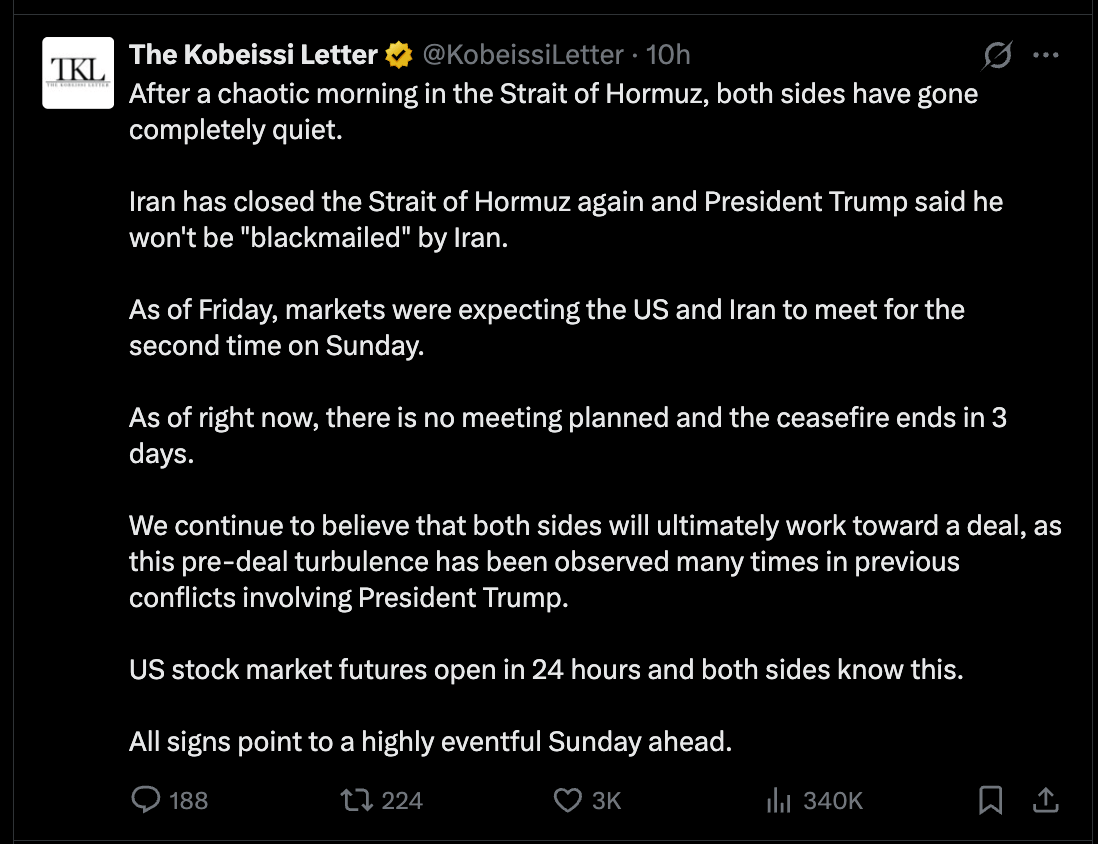
Source: @KobeissiLetter on X

Despite the crypto market gaining notoriety for slow price actions during the weekends, it’s interesting to see asset prices move in line with the latest developments in the Gulf. With no clear resolution in sight, the next few days could come with some degree of volatility.

Crypto Market Back To Point Zero?

Following these recent developments in the Middle East, conversations around the potential formation of a bottom in this current bear market now appear premature. Bitcoin, for instance, seems to have formed a local top around $77,500, with its current value at around $75,760.

Meanwhile, Ethereum, the second-largest cryptocurrency by market cap, sits at around $2,350, as of this writing. Other large-cap cryptocurrencies that have faced significant declines over the weekend include XRP and Solana, each falling by at leaast 3% in the past 24 hours.

The total crypto market cap on the daily timeframe | Source: TOTAL chart on TradingView


Perguntas relacionadas

QWhat event triggered the drop in cryptocurrency prices over the weekend?

AIran's announcement that it has closed the Strait of Hormuz again, with reports of attacks on commercial ships.

QHow did the global cryptocurrency market capitalization and the prices of Bitcoin and Ethereum change according to CoinGecko?

AThe global cryptocurrency market capitalization dropped by more than 2%, with Bitcoin and Ethereum prices falling by 2% and 3%, respectively.

QWhat had initially caused a positive reaction in the global financial and crypto markets on Friday?

AUnited States President Donald Trump's announcement that Iran fully reopened the Strait of Hormuz for the free passage of oil vessels.

QWhat is the current status of the ceasefire agreement between the United States and Iran mentioned in the article?

AThe ceasefire agreement is set to expire in a couple of days, and negotiations appear to have broken down, leading to increased volatility and uncertainty.

QWhat price levels did Bitcoin reach on Friday and where did it fall to after the news on Saturday?

ABitcoin reached a 10-week high of around $77,500 on Friday and fell back below $76,000 after the news on Saturday.

Leituras Relacionadas

Bitcoin Withdrawals Continue: 8 Years of Storage in a Coldcard Cold Wallet Ended in Zero

Coldcard Hardware Wallet Hacked: Losses Mount Due to Vulnerable Seed Generation A critical vulnerability in Coldcard hardware wallets has led to a continued wave of fund thefts. According to Galaxy Research, the total stolen has reached 1,367.05 BTC (approx. $88.6 million) from 4,585 addresses, a significant increase from the initial 594.5 BTC reported on July 30, 2026. Most of the stolen funds remain on the attackers' addresses. The issue is not with the current firmware, which Coinkite has updated, but with seed phrases generated on vulnerable devices between March 2021 and the release of fixed firmware versions. Due to a programmer error, devices switched from using a hardware random number generator to the software-based Yasmarang generator, which was initialized with publicly accessible data like the chip's serial number. This made the seed phrases predictable through offline brute-force attacks, meaning wallets remain at risk until funds are moved to a new wallet generated with the patched firmware. Affected devices include Mk2/Mk3 with firmware 4.0.1–4.1.9 (and up to 5.0.3), Mk4/Mk5 up to version 5.6.0, and Q models up to 1.5.0Q. The only exceptions are seeds created with a high-entropy method like at least 50 independent dice rolls or a strong unique BIP-39 passphrase. All other owners must generate a new seed on the fixed firmware and transfer their assets. A case highlighting the human impact involves a 39-year-old long-term investor who lost 2 BTC (approx. $130,000) in minutes. He had accumulated the Bitcoin over eight years through physical labor, viewing it as a financial lifeline and a retirement plan in a country suffering from hyperinflation. His story underscores that even conservative "buy and hold in cold storage" strategies can be compromised by such underlying technical flaws. From a technical perspective, this incident echoes historical failures where weak random number generators undermined cryptographic security, challenging the assumption that offline storage is automatically foolproof.

cryptonews.ruHá 2h

Bitcoin Withdrawals Continue: 8 Years of Storage in a Coldcard Cold Wallet Ended in Zero

cryptonews.ruHá 2h

Trading

Spot
活动图片




