Crypto Prediction Markets Continue To Be Under Siege — Are Traders Now Fair Game For Prosecutors?

bitcoinistPublicado em 2026-04-09Última atualização em 2026-04-09

Resumo

U.S. federal regulators, including the CFTC and DOJ, are seeking a court order to prevent Arizona from enforcing its gambling laws against crypto prediction-market platform Kalshi. They argue that contracts tied to sports, elections, and real-world events qualify as financial derivatives ("swaps") under federal law, not state-regulated gambling. This legal action is part of a broader conflict between federal and state authorities over jurisdiction on prediction markets. Arizona and other states contend these platforms constitute illegal gambling and have initiated criminal charges. Similar legal pressures are affecting Kalshi’s rival, Polymarket, which faces lawsuits and investigations in multiple states. The outcome could either legitimize and boost U.S. prediction markets or fragment them into riskier offshore operations.

U.S. regulators are urging a court to stop Arizona from enforcing its gambling laws against crypto prediction‐market platform Kalshi.

Another Battle Over Crypto Prediction Markets

In a filing from yesterday, the Commodity Futures Trading Commission (CFTC) and the Justice Department (DOJ) commended a federal court to stop Arizona from using its gambling laws against crypto prediction‐market platform Kalshi.

The agencies are asking for a temporary restraining order and preliminary injunction to halt Arizona’s criminal case and gambling‐law enforcement.

Related Reading: Bitcoin Creator Exposed? New Investigation Points At The Real Identity Of Satoshi Nakamoto

CFTC argues that these contracts tied to sports, elections and other real‐world events qualify as swaps (financial derivatives) under U.S. law, rather than falling under state gambling statutes. The federal regulators based their arguments on the fact that since the contracts are settled on future events with economic impact, they are governed by the Commodity Exchange Act and fall under federal law rather than state authority.

Such interpretation curbs how far individual states can go in blocking or constraining these platforms, which regulators say would otherwise splinter the market into a patchwork of state‐by‐state rules.

The Arizona Lawsuit Explained

Arizona charged Kalshi with illegal gambling over sports and election markets. Arizona, along with an expanding list of other states, argue that contracts tied to sports results operate like ordinary bets and must be treated as gambling, subject to licensing rules, age limits, and consumer safeguards.

According to the court filing, Arizona first sent a cease‐and‐desist order to KalshiEx LLC and Kalshi Trading LLC in May 2025, alleging they were taking unlawful bets in breach of state law. The state then brought criminal charges against both entities for “betting and wagering” under several Arizona statutes, with an arraignment set for April 13.

On Monday, a Third Circuit (one of the 13 U.S. federal courts of appeals) ruling stated that sports event contracts on designated contract markets (DCMs) are “swaps” preempting state gambling laws. However, one judge disagreed, blasting Kalshi’s stance as a “performative sleight” designed to hide the fact that its offerings are, in substance, sports betting.

Crypto Prediction Markets Under A Coordinated State Pushback

This move follows a broader CFTC and DOJ litigation against Arizona, Connecticut, and Illinois over prediction‐market jurisdiction. Bitcoinist reported on it last week. This past month, a bipartisan Senate bill targeting sports‐style bets on platforms like Polymarket and Kalshi was introduced by Senators Adam Schiff (D-CA) and John Curtis (R-UT).

Also on March, democratic representative Seth Moulton of Massachusetts (MA-06) formally banned all his staff from participating in prediction markets. That same day, Congressman Adrian Smith (R-NE-03) and Congresswoman Nikki Budzinski (D-IL-13) from Nebraska introduced the PREDICT Act, banning members of Congress from trading on political and policy outcome markets.

Related Reading: SEC Admits Flaws In Crypto Enforment, What Went Wrong?

Kalshi’s main rival, Polymarket, is also under mounting legal fire, with a New York class action filed in February alleging it runs an unlicensed sports‐betting operation. Regulators in Nevada have launched a civil case against its parent company, and authorities in Ohio, Utah, and Iowa have likewise begun probing the platform.

Not too long ago, Argentinian authorities ordered a full national ban of Polymarket after it “predicted” inflation data back in February. On top of that, the platform faced terrible backlash recently after bettors sent death threats to Times of Israel military reporter Emanuel Fabian, following his report of an Iranian ballistic missile on March 10.

Both Kalshi and Polymarket updated their rules at the end of March to preemptively block politicians, candidates and sports insiders from trading on related markets

If the federal preemption is upheld, it will de‐risks U.S. prediction venues, potentially boosting liquidity and making them more attractive as macro and sports‐beta tools for crypto‐savvy traders. However, if states carve out sports and politics as gambling, markets may fragment offshore or into on‐chain, harder‐to‐police venues, raising operational and legal risk premia for anyone treating these contracts as serious hedging instruments.
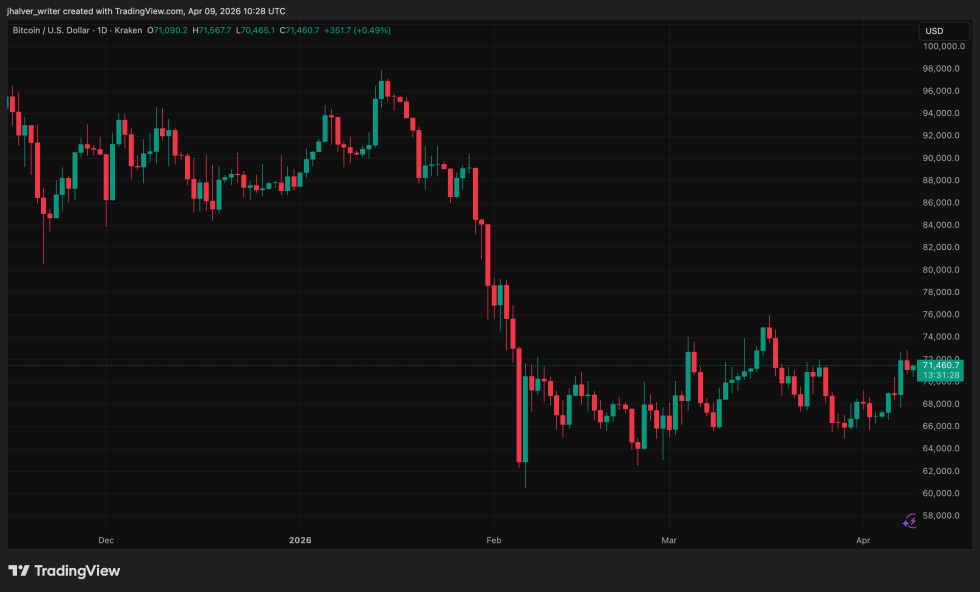
Yesterday, Bitcoin bounced back and reclaimed $72k. At the moment of writing, BTC trades for around $71k on the daily chart. Source: BTCUSD on Tradingview.

Cover image from Perplexity. BTCUSD chart from Tradingview.

Perguntas relacionadas

QWhat is the main argument of the U.S. regulators (CFTC and DOJ) against Arizona's enforcement of its gambling laws on Kalshi?

AThe CFTC and DOJ argue that the contracts offered by Kalshi, which are tied to sports, elections, and other real-world events, qualify as financial derivatives (swaps) under U.S. federal law, specifically the Commodity Exchange Act. They contend that these contracts, because they are settled on future events with economic impact, fall under federal jurisdiction and preempt state gambling statutes.

QWhat specific legal measures are the federal agencies requesting from the court regarding Arizona's case against Kalshi?

AThe Commodity Futures Trading Commission (CFTC) and the Justice Department (DOJ) are asking the court for a temporary restraining order and a preliminary injunction to halt Arizona's criminal case and its enforcement of gambling laws against Kalshi.

QAccording to the article, what was the recent ruling by the Third Circuit court regarding sports event contracts on designated contract markets (DCMs)?

AA recent Third Circuit ruling stated that sports event contracts on designated contract markets (DCMs) are considered 'swaps,' which preempts state gambling laws. However, one judge dissented, calling Kalshi's stance a 'performative sleight' designed to disguise what is essentially sports betting.

QBesides Kalshi, which other major prediction market platform is facing significant legal challenges, and what are some examples?

AKalshi's main rival, Polymarket, is also under significant legal pressure. A New York class action lawsuit was filed in February alleging it runs an unlicensed sports-betting operation. Regulators in Nevada have launched a civil case against its parent company, and authorities in Ohio, Utah, and Iowa are probing the platform. It was also completely banned in Argentina.

QWhat are the two potential future scenarios for U.S. prediction markets outlined at the end of the article, depending on the legal outcome?

AIf federal preemption is upheld, it would de-risk U.S. prediction venues, potentially boosting their liquidity and attractiveness as trading tools. Conversely, if states successfully classify these markets as gambling, the markets may fragment and move offshore or into on-chain venues that are harder to police, thereby raising operational and legal risks for traders.

Leituras Relacionadas

Anthropic's IPO Launch: Commercial Miracle or Valuation Bubble?

Anthropic has confidentially filed for an IPO, led by Morgan Stanley and Goldman Sachs, potentially going public by October. Following its latest $650 billion funding round, its pre-IPO valuation stands at $965 billion, with projections reaching up to $2 trillion at listing, which would make it the highest-valued private company ever. The article, written by Fu Sheng, addresses skepticism that this represents an AI bubble akin to the 2000 dot-com crash. It argues the current situation differs fundamentally. Unlike the internet bubble era, which relied on speculative narratives with little revenue, Anthropic's valuation is backed by unprecedented, measurable financial performance. Key data points include: * **Revenue Growth:** ARR skyrocketed from $10 billion in early 2025 to $470 billion by May 2026, targeting $100 billion by year-end—a growth curve unmatched in business history. * **Profitability:** It achieved operating profitability in Q2 2026 with an estimated $5.6 billion profit. * **Efficiency:** With ~3,000 employees and ~$470 billion ARR, its revenue per employee exceeds $10 million. Products like Claude Code, launched less than a year ago, already generate $25 billion in annualized revenue. * **Enterprise Adoption:** It boasts a strong enterprise client base, with 8 of the Fortune 10 and over 1,000 large firms spending over $1 million annually on Claude. The valuation is framed using a traditional SaaS model (e.g., a 10x Price-to-Sales multiple on $100 billion revenue). The author contends the core question for analysts has shifted from "How big could this be?" to "How much is it earning and will earn next quarter?" The discussion extends beyond Anthropic to a broader paradigm shift: the transition from a "carbon-based" to a "silicon-based" economy. Companies are increasingly prioritizing investment in compute and AI capabilities over human resources, as these directly scale productivity and competitive advantage. Anthropic's IPO is thus positioned not just as a corporate milestone, but as a price anchor for this new economic era.

链捕手Há 23m

Anthropic's IPO Launch: Commercial Miracle or Valuation Bubble?

链捕手Há 23m

Near Returns to the AI Stage: Transformation into a Public Chain Due to 'Payroll Difficulties,' Agent and Privacy Emerge as New Growth Narratives

NEAR Returns to AI Origins: From Payroll Struggles to Blockchain, Now Focusing on AI Agents and Privacy NEAR Protocol's journey began not with grand blockchain ambitions, but from a practical hurdle: its AI startup founders, including Transformer paper co-author Illia Polosukhin, couldn't efficiently pay international developers in 2017. This led them to pivot and build a high-performance, scalable blockchain. After years navigating various crypto narratives like sharding and cross-chain interoperability, NEAR is now leveraging its AI roots to re-enter the AI arena. A key driver is its "NEAR Intents" layer, which abstracts complex cross-chain transactions. Users simply state their goal (e.g., swap BTC for ETH), and a solver network finds the optimal route. This system has processed over $20B in cross-chain volume, generating significant fee revenue. A major growth area is private transactions via "Confidential Intents/Swaps," which hide trade details until settlement to protect against MEV and front-running. Remarkably, private swaps recently accounted for over 40% of NEAR's transaction volume, highlighting strong demand but also potential regulatory scrutiny. With its AI-founder pedigree, NEAR is positioning itself at the intersection of blockchain, AI agents, and privacy, aiming to become infrastructure for the emerging agent economy while navigating the challenges of its rapid adoption.

marsbitHá 2h

Near Returns to the AI Stage: Transformation into a Public Chain Due to 'Payroll Difficulties,' Agent and Privacy Emerge as New Growth Narratives

marsbitHá 2h

From Ethereum to AI's 'CROPS': What Exactly is This Set of 'Slow Variables' That Vitalik Repeatedly Emphasizes?

In recent discussions, Vitalik Buterin has frequently emphasized the concept of "CROPS," a framework defining core values for Ethereum's development. CROPS stands for Censorship Resistance, Capture Resistance, Open Source, Privacy, and Security. Initially outlined in the Ethereum Foundation's "EF Mandate," it represents a commitment to user sovereignty, ensuring that the network resists external control, remains open, protects privacy, and prioritizes security. The relevance of CROPS extends beyond Ethereum's foundational principles, becoming crucial in the context of AI integration. As AI agents begin handling wallet operations and automated transactions, the risk increases that users may cede control over their digital assets, privacy, and intentions to centralized AI service providers. A "CROPS AI" would therefore emphasize local execution where possible, privacy-preserving remote model calls (e.g., using zero-knowledge proofs), and transparent, verifiable processes to maintain user agency. Vitalik highlights a significant convergence between "CROPS Ethereum access layer" and "CROPS AI." Both address the same fundamental challenge: how users can access powerful services—be it blockchain data via RPCs or AI models—without exposing sensitive information or relinquishing ultimate control. This intersection points toward a future digital entry point that is more private, secure, and user-controlled. Ultimately, CROPS is not merely an abstract ideal but a practical guidepost. It steers development—from protocol resilience and wallet design to AI agent safety—towards a future where users retain self-sovereignty even as digital systems grow more complex and powerful. In an era of accelerating AI adoption, these "slow variables" of censorship resistance, openness, privacy, and security may define Ethereum's enduring value.

marsbitHá 3h

From Ethereum to AI's 'CROPS': What Exactly is This Set of 'Slow Variables' That Vitalik Repeatedly Emphasizes?

marsbitHá 3h

Trading

Spot
Futuros
活动图片