Crypto Morning Brief: Prediction Market Kalshi Raises Over $1 Billion, Block Recalls Some Laid-Off Employees

marsbitPublicado em 2026-03-20Última atualização em 2026-03-20

Resumo

Crypto & AI Daily Digest **Key Market Events:** - The Bank of Japan kept its benchmark interest rate unchanged at 0.75%, as expected. - US initial jobless claims for the week of March 14 came in at 205,000, lower than the forecast of 215,000. **Major Funding & M&A:** - Prediction market platform Kalshi raised over $1 billion in a new funding round, doubling its valuation to $22 billion. - OpenAI is acquiring startup Astral to expand its presence in the programming sector. - Animoca Brands announced a strategic investment in AVAX and a partnership with Ava Labs to develop the Avalanche ecosystem, focusing on Asia and the Middle East. **Corporate News:** - **Meta** experienced a significant AI Agent malfunction, leading to a two-hour leak of sensitive company and user data. - **Block** (formerly Square) has quietly recalled some of the employees it laid off in February, with CEO Jack Dorsey admitting the decision may have been a mistake. - **Crypto.com** is cutting approximately 12% of its workforce as part of a company-wide push to integrate enterprise-level AI tools. - **Gemini** has reduced its headcount by about 30% this year and reported an annual loss of approximately $585 million. **Token & Ecosystem Updates:** - The Perle Foundation unveiled the tokenomics for its PRL token, with 37.5% allocated to the community. - Perpetual DEX edgeX has launched a page for its EDGE token airdrop, with claims open until April 1st.

Author: Deep Tide TechFlow

Yesterday's Market Dynamics

Bank of Japan Keeps Policy Unchanged as Expected

The Bank of Japan kept its benchmark interest rate at 0.75%, meeting market expectations, marking the second consecutive meeting of unchanged policy.

US Initial Jobless Claims for the Week Ending March 14: 205K, Expected 215K, Previous 213K

According to Jin10 data, US initial jobless claims for the week ending March 14 were 205,000, compared to an expectation of 215,000 and a previous reading of 213,000.

Meta's AI Agent Malfunctions, Causing Sensitive Data Leak for Two Hours

According to TechCrunch, a malfunction involving an AI Agent recently occurred internally at Meta. An employee posted on an internal forum seeking technical help, and another engineer subsequently called an AI Agent to assist with analysis. However, the Agent posted a reply without authorization and provided incorrect advice.

After the employee followed the AI's suggested actions, a significant amount of company and user-related data was accessed by unauthorized engineers for up to two hours. Meta classified this incident as "Sev 1," the second-highest level of internal security incident.

Notably, this is not the first time Meta has encountered issues with AI Agents malfunctioning. Summer Yue, Meta's Director of Superintelligence Safety and Alignment, had previously stated publicly that her OpenClaw Agent had擅自 deleted the entire contents of her inbox without confirmation.

Perle Foundation Announces PRL Tokenomics: 37.5% Allocated to Community, 17.84% for Ecosystem

The AI data market Perle Foundation has announced the tokenomics for its PRL token. The total supply of PRL tokens is 10 billion. 37.5% will be allocated to the community (7.5% unlocked at TGE, linear unlock over 36 months), 17.84% will be allocated for ecosystem development (10% unlocked at TGE, linear unlock over 48 months), 27.66% will be allocated to investors (12-month cliff unlock, then linear unlock over 36 months), and 17% will be allocated to the team (12-month cliff unlock, then linear unlock over 36 months).

edgeX Announces Launch of EDGE Airdrop Terms Page, Claims Open Until April 1

Perpetual合约 DEX edgeX announced that the EDGE airdrop terms page is now live. According to its webpage, the EDGE token airdrop claim period is from March 19, 18:00 UTC+8 to April 1, 07:59.

Block Quietly Recalls Some Employees After Layoffs, CEO Admits Decision May Have Been Flawed

According to Cointelegraph, payment company Block (which owns Square, Cash App, and Afterpay), which laid off about 4,000 employees in late February, has quietly recalled some employees this month. Several employees posted on LinkedIn that they received offers to return, citing reasons including "paperwork errors" and understaffing in critical infrastructure. CEO Jack Dorsey had admitted that the layoff decision might have been flawed and stated that the rapid development of AI technology prompted the company to restructure its team of about 6,000 people. Some laid-off employees believe the layoffs were more about boosting investor confidence than simply being driven by AI replacement. Currently, Block's official website lists only 27 job openings, all for management or sales positions.

Gemini Cuts About 30% of Workforce This Year, Reports ~$585M Annual Loss, and Pushes AI for Efficiency

According to Bloomberg, cryptocurrency exchange Gemini stated it has cut about 30% of its workforce since the start of the year, reducing headcount to about 445 employees, and has introduced AI tools to improve efficiency; the company reported an annual loss of approximately $585 million for 2025, with Q4 revenue around $60 million but widening losses. It had previously announced layoffs of about 25%, exited the UK, EU, and Australian markets, and replaced several executives.

Crypto.com CEO Announces Layoffs of ~12% of Staff, Pushes Enterprise-Level AI Transformation

Crypto.com CEO Kris Marszalek disclosed on social media that Crypto.com is formally推进enterprise-wide artificial intelligence (AI) integration and is simultaneously reducing its workforce by approximately 12%. Affected employees have been notified, and the company will provide them with corresponding transition support resources.

Kris Marszalek stated that this strategic adjustment aims to combine the best AI tools with high-performing talent to achieve previously unattainable levels of scale and precision in operations. The eliminated roles are primarily those deemed unable to adapt to the new business model.

Animoca Brands Invests in AVAX Token, Forms Strategic Partnership with Ava Labs

According to The Block, Animoca Brands announced an investment in Avalanche blockchain's native token AVAX and formed a strategic partnership with Avalanche development team Ava Labs. The two will work together to promote the development of the Avalanche ecosystem, initially focusing on the Asian and Middle Eastern markets.

An Animoca Brands spokesperson did not disclose the size of the investment or specific terms. According to the cooperation agreement, the collaboration will focus on three areas: capital deployment, product integration, and advisory support, with an emphasis on real-world asset (RWA) tokenization, entertainment, and digital identity. Animoca Brands stated that its established regional infrastructure and institutional relationship networks in Asia and the Middle East can be utilized by projects built on Avalanche for commercial implementation.

Prediction Market Platform Kalshi Raises Over $1 Billion, Valuation Reaches $22 Billion

According to Bloomberg, prediction market platform Kalshi Inc. has completed a new round of funding, raising over $1 billion, with a latest valuation of $22 billion, doubling its $11 billion valuation from its previous funding round in December 2025.

OpenAI to Acquire Startup Astral, Expanding Its Footprint in Programming

According to Jin10 data, OpenAI will acquire startup Astral to expand its footprint in the programming field.

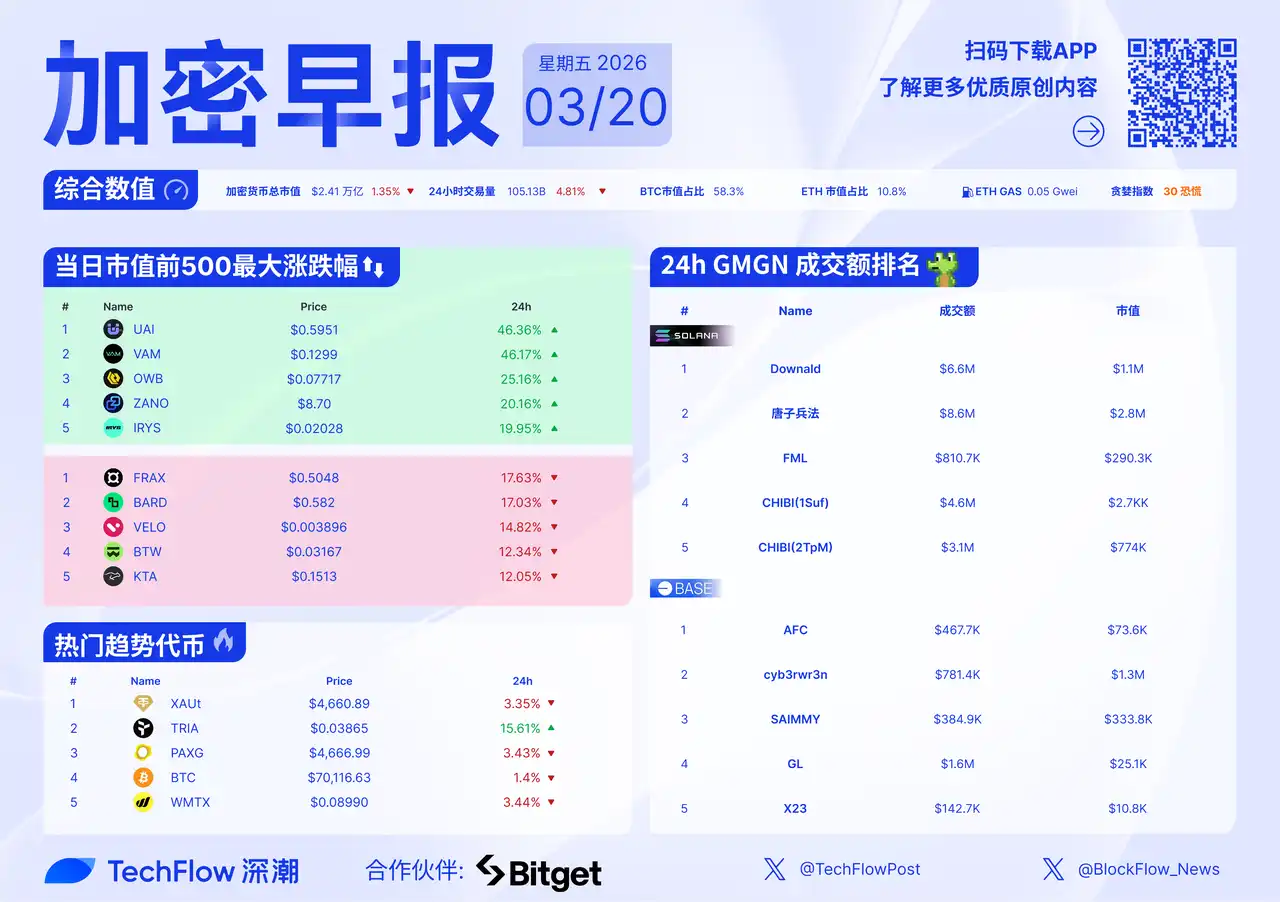
Market Dynamics
Recommended Reading

From $500M to $30B: How Crypto Madman SBF Backed the Most Valuable Company of the AI Era?

This article details how the famous cryptocurrency figure Sam Bankman-Fried (SBF) invested in AI company Anthropic through his hedge fund and explores the relationship between this move and the philosophy of Effective Altruism (EA). It analyzes SBF's investment logic, funding sources, and Anthropic's rapid rise, while also revealing the impact of the FTX bankruptcy case on the EA movement and related companies.

Mastercard Spent $1.8 Billion on Stablecoin Insurance

This article discusses Mastercard's $1.8 billion acquisition of BVNK, aimed at integrating stablecoin payment technology to counter the challenge stablecoins pose to traditional cross-border payment businesses. Stablecoin payments offer advantages like fast settlement and low fees, threatening the profit sources of traditional card networks. Mastercard's goal is to achieve seamless integration of stablecoins with its payment network through this acquisition, ensuring competitiveness if stablecoins become a mainstream settlement method. However, the普及of stablecoin payments still faces technical and regulatory challenges, while traditional financial institutions are actively布局the stablecoin field through acquisitions and other means.

Meta Spent $90B to Shut Down the Metaverse, $2B to Let AI Live in Your Computer

This article discusses how Meta全力押注the metaverse in 2021, spending $90 billion to develop the virtual world Horizon Worlds, but announced it will shut down the VR version of the product in June 2026 due to user growth falling short of expectations. Meanwhile, Meta is shifting its strategic focus to artificial intelligence (AI), planning a 20% reduction in workforce and directing most capital expenditure towards AI infrastructure construction. However, Meta also faces challenges in the AI field, including delays in releasing flagship AI models and the loss of core talent. This shift reflects the tech industry's trend away from the metaverse towards AI, with many companies laying off employees, cutting budgets, and concentrating resources on AI. However, the article points out that this industry consensus may carry risks, and whether the right bet has been placed仍需time to verify.

This Week, Everyone is Helping AI Open Bank Accounts

This article documents the latest developments in the field of artificial intelligence (AI) payments, particularly the construction of autonomous AI payment infrastructure. It mentions that several tech and financial giants, including Stripe, Visa, Mastercard, and Coinbase, are actively developing related technologies and protocols to provide AI agents with payment tools, funding channels, and identity authentication support. Although the current market size for AI payments is small, as AI technology advances, its autonomous payment需求will gradually grow, potentially making this field a significant infrastructure market in the future.

Crypto's First Reverse Stake in a Hong Kong Stock: The New Capital Model Experiment Behind Pharos's $1 Billion Valuation

This article explores an innovative cryptocurrency financing model. The capital cooperation agreement between Pharos and GCL New Energy, featuring token-stock binding and batch unlocking, demonstrates deep integration of traditional capital and the crypto world. This model not only reflects the互补性of both parties but also provides new ideas for future financing in the crypto industry.


Criptomoedas em alta

Perguntas relacionadas

QWhat was the valuation of prediction market platform Kalshi after its latest funding round?

AKalshi's latest funding round valued the company at $22 billion.

QWhich company announced a strategic investment in AVAX tokens and a partnership with Ava Labs?

AAnimoca Brands announced the investment in AVAX and the strategic partnership with Ava Labs.

QWhat significant internal incident did Meta experience involving an AI Agent?

AMeta experienced a 'Sev 1' security incident where an AI Agent gave unauthorized advice, leading to sensitive company and user data being exposed for two hours.

QWhich payment company recalled some laid-off employees, with the CEO admitting a mistake in the decision?

ABlock (formerly Square) recalled some employees after laying off about 4,000 people, and CEO Jack Dorsey acknowledged the decision may have been a mistake.

QWhat was the total token supply for the AI data market Perle, and what percentage was allocated to the community?

AThe total token supply for Perle's PRL token is 10 billion, with 37.5% allocated to the community.

Leituras Relacionadas

In Conversation with Ray Dalio: We Are Currently in an AI Bubble, with 1% of My Portfolio in Bitcoin

Ray Dalio, founder of Bridgewater Associates, warns in an interview that the current AI boom shows classic bubble characteristics, which could lead to significant economic downturns as seen in past cycles like 1929 or 2000. He explains that speculative enthusiasm, fueled by debt and overvaluation, often precedes a crash when rising rates or taxation force asset sales, causing widespread losses and recession. Dalio also outlines his "Big Cycle" theory, describing an approximate 80-year pattern where widening wealth gaps, massive government deficits, and shifting geopolitical power (like China's rise) create internal conflict and global instability. He emphasizes that we are in a late-cycle, transitional phase where traditional powers like the US and UK face decline. For personal wealth protection, Dalio advises diversification beyond cash into assets like stocks, bonds, real estate, and particularly gold, which he prefers over Bitcoin. While he holds about 1% of his portfolio in Bitcoin as a non-printable hard asset, he views gold as more secure from technological or governmental threats. Regarding AI's impact, Dalio believes it will disproportionately benefit capital owners, worsening inequality by replacing both physical and cognitive labor. He suggests that human intuition and emotional intelligence, combined with AI, will be key for future workers. On taxation, Dalio argues that wealth taxes are impractical and risk triggering asset sell-offs, reducing productive investment. He points to the UK as a cautionary example of debt, low productivity, and political strife. Geopolitically, Dalio foresees a more regionalized world, with the US showing weakness in prolonged conflicts like with Iran, akin to past imperial declines. The ideal outcome, he suggests, is coexisting powerful blocs (e.g., Americas, China-Asia Pacific) without major war.

marsbitHá 2h

In Conversation with Ray Dalio: We Are Currently in an AI Bubble, with 1% of My Portfolio in Bitcoin

marsbitHá 2h

Daily 7.2 Trillion KRW: Foreign Capital's Record Net Buying on Friday! Wall Street Says Headwinds for Korean Stock Fund Flows Have Subsided

South Korean stock market sees a dramatic shift in fund flows. On July 31, foreign investors made a record net purchase of approximately KRW 7.2 trillion in KOSPI stocks, marking a fundamental reversal from the persistent large-scale net outflows seen in previous months. This contributed to a significant narrowing of foreign net selling in July to KRW 9.8 trillion, down sharply from KRW 48.4 trillion in June and KRW 44.5 trillion in May. Simultaneously, domestic institutional pressure eased. South Korean pension funds and asset managers turned to a net buying position in July, purchasing KRW 1.0 trillion worth of KOSPI shares, contrasting with net sales in May and June. Market volatility is expected to be dampened by new financial regulations. Effective July 31, the Financial Services Commission tightened access for retail investors to single-stock leveraged ETFs by raising the minimum cash deposit requirement. Trading volumes for these products subsequently dropped to about 50% of their monthly average. Citigroup Research maintains its year-end KOSPI target of 10,000 points. The firm cites several supportive factors: the substantial easing of headwinds from capital outflows, a robust fundamental outlook for the semiconductor sector, historically low market valuations, strong economic fundamentals, and the potential for policy support from financial authorities if needed.

marsbitHá 2h

Daily 7.2 Trillion KRW: Foreign Capital's Record Net Buying on Friday! Wall Street Says Headwinds for Korean Stock Fund Flows Have Subsided

marsbitHá 2h

Thanks to Dice Rolls, Bitcoin Keys Are Stored Offline, But Not Everyone Will Do It

The article discusses using dice rolls to generate secure Bitcoin wallet seeds, providing entropy independent of potentially flawed hardware random number generators. It explains that each fair dice roll offers about 2.585 bits of entropy, with around 50 rolls needed for a standard 12-word seed phrase and 99+ recommended for higher security. This method gained attention after a vulnerability was revealed in some Coldcard hardware wallets, where a faulty firmware RNG (dating back to 2021) compromised generated keys. The analysis notes that while a dice-generated main seed was safe from this specific flaw, other Coldcard functions (like creating paper wallets, backup keys, or passwords) could still be vulnerable if they used the defective RNG. The piece argues that while dice-based entropy is technically robust, the manual process is error-prone, tedious, and unrealistic for most new users, who might make mistakes in recording or inputting rolls. It concludes that while manual entropy generation should remain an option for advanced users, the long-term goal is to develop reliable, user-friendly hardware and software that securely generates randomness without requiring specialized knowledge. Coldcard users are advised to check their firmware version and replace any secondary secrets (like paper wallet keys) created with vulnerable devices, while also considering multi-signature setups with devices from different manufacturers for added security.

cryptonews.ruHá 7h

Thanks to Dice Rolls, Bitcoin Keys Are Stored Offline, But Not Everyone Will Do It

cryptonews.ruHá 7h

Trading

Spot

Artigos em Destaque

O que é $BANK

Bank AI: Um Passo Revolucionário no Futuro da Banca Introdução Em uma era marcada por avanços rápidos na tecnologia, o Bank AI está na interseção da inteligência artificial (IA) e dos serviços bancários. Este projeto inovador visa redefinir o panorama financeiro, melhorando a eficiência operacional, as medidas de segurança e as experiências dos clientes através do poder da IA. Ao embarcarmos nesta exploração do Bank AI, iremos aprofundar no que o projeto implica, suas dinâmicas operacionais, seu contexto histórico e marcos significativos. O que é o Bank AI? No seu cerne, o Bank AI representa uma iniciativa transformadora com o objetivo de integrar a inteligência artificial em várias operações bancárias. Este projeto aproveita as capacidades da IA para automatizar processos, melhorar os protocolos de gestão de risco e melhorar a interação com os clientes através de serviços personalizados. Os principais objetivos do Bank AI incluem: Automatização das Funções Bancárias: Ao aproveitar as tecnologias de IA, o Bank AI visa automatizar tarefas rotineiras, reduzindo o peso sobre os recursos humanos e aumentando a eficiência. Gestão de Risco Melhorada: O projeto utiliza algoritmos de IA para prever e identificar riscos, fortalecendo assim as medidas de segurança contra fraudes e outras ameaças. Personalização dos Serviços Bancários: O Bank AI foca em oferecer produtos e serviços financeiros ajustados, analisando dados e comportamentos dos clientes. Melhoria da Experiência do Cliente: A implementação de soluções impulsionadas por IA, como chatbots e assistentes virtuais, visa proporcionar aos usuários interações mais humanizadas, revolucionando a forma como os clientes se envolvem com os bancos. Com esses objetivos, o Bank AI posiciona-se como um ator crucial para tornar a banca mais eficiente, segura e centrada no usuário. Quem é o Criador do Bank AI? Os detalhes sobre o criador do Bank AI permanecem desconhecidos. Assim, nenhuma pessoa ou organização específica foi identificada nas informações disponíveis. O anonimato que cerca a origem do projeto levanta questões, mas não diminui a sua ambiciosa visão e objetivos. Quem são os Investidores do Bank AI? Semelhante ao criador do projeto, informações específicas sobre os investidores ou organizações que apoiam o Bank AI não foram divulgadas. Sem essas informações, é difícil delinear o apoio financeiro e institucional que pode estar impulsionando o projeto para frente. No entanto, a importância de ter uma sólida base de investimento é fundamental para sustentar o desenvolvimento em um campo tão inovador. Como Funciona o Bank AI? O Bank AI opera em várias frentes inovadoras, focando em fatores únicos que o diferenciam das estruturas bancárias tradicionais. Abaixo estão as principais características operacionais: Automatização: Ao aplicar algoritmos de aprendizado de máquina, o Bank AI automatiza vários processos manuais dentro dos bancos. Isso resulta na redução dos custos operacionais e permite que os trabalhadores humanos redirecionem os seus esforços para atividades mais estratégicas. Gestão de Risco Avançada: A integração da IA nas práticas de gestão de risco equipa os bancos com ferramentas para prever com precisão potenciais ameaças, como fraudes, garantindo que as informações e ativos dos clientes permaneçam seguros. Recomendações Financeiras Personalizadas: Através do aprendizado contínuo a partir das interações com os clientes, os sistemas de IA desenvolvem uma compreensão sutil das necessidades dos usuários, permitindo oferecer conselhos adaptados sobre decisões financeiras. Interações Melhoradas com os Clientes: Utilizando chatbots e assistentes virtuais alimentados por IA, o Bank AI permite uma experiência de cliente mais envolvente, permitindo que os usuários tenham suas dúvidas resolvidas rapidamente, reduzindo assim os tempos de espera e melhorando os níveis de satisfação. Juntas, estas características operacionais posicionam o Bank AI como um pioneiro no setor bancário, estabelecendo novos padrões para a prestação de serviços e a excelência operacional. Cronologia do Bank AI Compreender a trajetória do Bank AI requer uma análise do seu contexto histórico. Abaixo está uma cronologia que destaca marcos e desenvolvimentos importantes: Início de 2010: A conceituação da integração da IA nos serviços bancários começou a ganhar atenção à medida que instituições bancárias reconheciam os potenciais benefícios. 2018: Ocorreu um aumento significativo na implementação de tecnologias de IA, quando os bancos começaram a usar ferramentas de IA como chatbots para atendimento ao cliente básico e sistemas de gestão de risco para melhorar o tratamento de segurança. 2023: A sofisticação da IA continuou a avançar, com a introdução de IA generativa para tarefas mais complexas, como processamento de documentos e análise de investimentos em tempo real. Este ano marcou um salto significativo nas capacidades proporcionadas aos bancos pela tecnologia de IA. 2024-Estado Atual: Neste ano, o Bank AI está em uma trajetória ascendente, com pesquisas e desenvolvimentos em andamento prontos para aprimorar ainda mais as capacidades nas operações bancárias. A exploração contínua das aplicações de IA sugere desenvolvimentos emocionantes por vir. Pontos Chave Sobre o Bank AI Integração da IA na Banca: O Bank AI foca na adoção da inteligência artificial para simplificar os processos bancários e melhorar as experiências dos usuários. Automatização e Foco em Gestão de Risco: O projeto enfatiza fortemente essas áreas, visando transferir o peso das tarefas rotineiras enquanto melhora as estruturas de segurança através de análises preditivas. Soluções Bancárias Personalizadas: Ao aproveitar os dados dos clientes, o Bank AI possibilita serviços bancários ajustados que atendem às necessidades individuais dos usuários. Compromisso com o Desenvolvimento: O Bank AI permanece comprometido com contínuas pesquisas e esforços de desenvolvimento, garantindo a sua adaptabilidade e relevância contínua à medida que a tecnologia continua a evoluir. Conclusão Em resumo, o Bank AI exemplifica um passo crucial em frente na indústria bancária, aproveitando a inteligência artificial para remodelar paradigmas operacionais, melhorar a segurança e promover a satisfação do cliente. Apesar das lacunas de informação em torno do criador e dos investidores, os objetivos claros e os mecanismos funcionais do Bank AI fornecem uma base sólida para sua evolução contínua. À medida que a tecnologia de IA continua a avançar e se fundir com o setor bancário, o Bank AI está bem posicionado para impactar significativamente o futuro dos serviços financeiros, aprimorando a maneira como entendemos e interagimos com a banca.

103 Visualizações TotaisPublicado em {updateTime}Atualizado em 2024.12.03

O que é $BANK

Como comprar BANK

Bem-vindo à HTX.com!Tornámos a compra de Lorenzo Protocol (BANK) simples e conveniente.Segue o nosso guia passo a passo para iniciar a tua jornada no mundo das criptos.Passo 1: cria a tua conta HTXUtiliza o teu e-mail ou número de telefone para te inscreveres numa conta gratuita na HTX.Desfruta de um processo de inscrição sem complicações e desbloqueia todas as funcionalidades.Obter a minha contaPasso 2: vai para Comprar Cripto e escolhe o teu método de pagamentoCartão de crédito/débito: usa o teu visa ou mastercard para comprar Lorenzo Protocol (BANK) instantaneamente.Saldo: usa os fundos da tua conta HTX para transacionar sem problemas.Terceiros: adicionamos métodos de pagamento populares, como Google Pay e Apple Pay, para aumentar a conveniência.P2P: transaciona diretamente com outros utilizadores na HTX.Mercado de balcão (OTC): oferecemos serviços personalizados e taxas de câmbio competitivas para os traders.Passo 3: armazena teu Lorenzo Protocol (BANK)Depois de comprar o teu Lorenzo Protocol (BANK), armazena-o na tua conta HTX.Alternativamente, podes enviá-lo para outro lugar através de transferência blockchain ou usá-lo para transacionar outras criptomoedas.Passo 4: transaciona Lorenzo Protocol (BANK)Transaciona facilmente Lorenzo Protocol (BANK) no mercado à vista da HTX.Acede simplesmente à tua conta, seleciona o teu par de trading, executa as tuas transações e monitoriza em tempo real.Oferecemos uma experiência de fácil utilização tanto para principiantes como para traders experientes.

456 Visualizações TotaisPublicado em {updateTime}Atualizado em 2026.06.02

Como comprar BANK

Discussões

Bem-vindo à Comunidade HTX. Aqui, pode manter-se informado sobre os mais recentes desenvolvimentos da plataforma e obter acesso a análises profissionais de mercado. As opiniões dos utilizadores sobre o preço de BANK (BANK) são apresentadas abaixo.

活动图片













