Crypto Morning Brief: Meme Coins Rally, Michael Saylor Releases Bitcoin Tracker Info

marsbitPublicado em 2026-01-05Última atualização em 2026-01-05

Resumo

In the latest crypto market update, meme tokens are experiencing a rally, while MicroStrategy founder Michael Saylor hints at further Bitcoin purchases by sharing a Bitcoin Tracker update. Key developments include an economist predicting five Fed rate cuts in 2026 due to a potential U.S. unemployment surge, and reports of major U.S. newspapers withholding news of a secret operation in Venezuela. Trump Media sees a rise in short positions ahead of a potential merger, and his family’s crypto project WLFI passes a proposal to boost USD1 adoption. Flow network resumes full operations post-outage, and Ranger announces an ICO on Solana. PwC increases its crypto focus amid U.S. regulatory shifts, and SlowMist warns of a critical vulnerability in HitBTC. Blue Origin now accepts Ethereum for space travel payments, and a major $1.8B crypto money laundering case is uncovered in Shanghai.

Author: Deep Tide TechFlow

Yesterday's Market Dynamics

Economist: U.S. Unemployment Wave Imminent, May Force Fed to Cut Rates 5 Times This Year

According to Jinshi Data, David Rosenberg, who previously worked at Merrill Lynch and has been running his own firm Rosenberg Research since 2020, stated that the U.S. economy will face significant challenges in 2026, with the job market likely to contract sharply, weakening the economy and forcing the Federal Reserve to respond with substantial interest rate cuts.

The U.S. unemployment rate has risen from 4% at the beginning of 2025 to 4.6% in November 2025. Rosenberg believes the unemployment rate will soon break above 5% and "likely test 6% by the end." Rosenberg stated that the collapse of the labor market and the ensuing recession will force the Fed to cut rates by 125 basis points to 2.25% (i.e., five 25-basis-point cuts) by the end of the year.

Notably, Rosenberg's view differs significantly from the general consensus among Wall Street economists, who expect the labor market to remain stable in 2026, with the Fed implementing one or two rate cuts. The median forecast from Fed officials is for one rate cut this year. However, the central bank has emphasized that it sees downside risks in the labor market. The Fed's latest staff projections note that "weaker labor market conditions and heightened economic uncertainty increase the risk of a more pronounced slowdown than expected."

Semafor: New York Times and Washington Post Knew About U.S. Secret Operation in Venezuela Before It Happened

According to a report by U.S. media site Semafor, The New York Times and The Washington Post were informed about the U.S. secret raid operation in Venezuela before it began but agreed to delay publication at the government's request to avoid endangering U.S. troops. President Trump approved the operation at 10:46 PM on Friday, which ultimately succeeded in capturing the President of Venezuela. Despite the tense relationship between the Trump administration and mainstream U.S. media, American media maintained traditional restraint regarding high-stakes national security operations. The Washington Post's editorial strongly supported this operation.

Previous news indicated that three suspected insider wallets placed bets in advance on the ouster of Venezuelan President Maduro, profiting over $630,000 in total. Affected by this, U.S. Congressman Ritchie Torres plans to propose a bill to prohibit federal officials from using insider information for trading on prediction markets.

Short Positions in Trump Media Company Surge; Trump's Personal Stake Would Drop to ~20% Upon Merger with TAE

According to a Reuters report, data from financial analysis firm S3 Partners shows that short positions in Trump Media & Technology Group surged recently after the company announced last month that it was seeking a $6 billion all-stock merger with Google-backed nuclear fusion energy company TAE Technologies. Short positions increased by 31% to nearly 16 million shares,接近 the highest level since October. It is reported that Trump himself holds approximately 115 million shares of Trump Media & Technology Group, representing about 40% of the company's shares. Due to equity dilution from the merger, Trump's stake would drop to about 20% upon merging with TAE.

WLFI Community Passes Proposal to Use Treasury Funds to Incentivize USD1 Adoption with 77.75% Support Rate

Trump family crypto project WLFI announced on platform X that a governance proposal to use part of the unlocked treasury funds to accelerate USD1 adoption passed with a 77.75% approval vote.

Flow: Network Fully Restored, Detailed Technical Post-Mortem Report to Be Released Within 48 Hours

According to an official announcement, the Flow network has been fully restored. Currently, 99.9% of accounts have full operational permissions in both execution environments. The Flow ecosystem is gradually recovering. The decentralized finance ecosystem has begun to resume operations, with decentralized exchanges like KittyPunch and IncrementFi back online and processing trades. Bridge partners are actively working on recovery protocols and are expected to resume operations after final verification.

Flow officials stated that a detailed technical post-mortem report, including the full attack vector, forensic analysis, and remediation methods, will be released within 48 hours. The network is currently secure, operational, and processing transactions in both execution environments. A full ecosystem recovery is expected to be completed this week.

Ranger Announces ICO Launch on January 7th

According to an official announcement, Solana生态 crypto derivatives exchange Ranger will launch a 4-day ICO starting January 7, 2026, at 00:00 UTC+8, with a minimum fundraising target of $6 million. This ICO will be conducted through MetaDAO, allocating 10 million RNGR tokens, representing 39.02% of the total supply. Tokens for ICO participants will be 100% unlocked at TGE, while team tokens will be unlocked upon meeting price milestone triggers.

PwC Significantly Increasing Efforts in the Cryptocurrency Space

According to the Financial Times, as the Trump administration embraces digital assets, PwC, one of the 'Big Four' accounting firms, has decided to increase its investment in this领域 after years of caution towards cryptocurrency.

PwC US lead Paul Griggs stated in an interview that this strategic pivot occurred last year against the backdrop of the U.S. appointing pro-crypto regulatory officials and Congress passing several new laws regulating digital assets, such as stablecoins.

Griggs said: "The Genius Act and the regulatory details around stablecoins will, I believe, boost market confidence in this product and asset class. Asset tokenization will also inevitably continue to evolve, and PwC must be within this ecosystem."

SlowMist: Discovers Potential Critical Vulnerability in HitBTC Exchange

According to an official message from SlowMist, the organization has discovered a potential critical security vulnerability in the HitBTC exchange. SlowMist stated that it had privately disclosed the information to HitBTC in advance but has not yet received a response.

It is reported that HitBTC is an established cryptocurrency exchange founded in 2013. The exchange's trading volume in the past 24 hours was $111,487,461.

Market News: Bezos' Blue Origin Now Accepts Ethereum for Space Travel Payments

According to Solid Intel, Jeff Bezos' space company Blue Origin now accepts Ethereum as a payment method for space travel.

Shanghai Prosecution Discloses a Job-Related Crime Case Involving Virtual Currency Money Laundering, Amounting to 1.8 Billion Yuan

According to a disclosure on the Shanghai Procuratorate's official account, the Shanghai Baoshan District Procuratorate, while handling a job-related crime case, conducted穿透式审查 (penetrative review) of funds, tracked the capital flow chain, and successfully initiated supervision over 24 cases involving 24 individuals. The prosecutor stated that the underground banking团伙 (syndicate) involved had a large number of accounts, making the case difficult to handle, with huge transaction volumes and money laundering amounts reaching 1.8 billion yuan. Ultimately, through pursuit and prosecution, money laundering activities involving cross-border transfer of illicit proceeds via virtual currency were cracked down on. Targeting new and complex money laundering crimes such as those involving underground banks and virtual currency, the Baoshan District Procuratorate guided public security organs to穿透资金账户 (penetrate fund accounts), clarify the source and destination of funds, secure electronic data, ensure precise and effective charges, and fully guarantee the quality and efficiency of money laundering case investigations.

Michael Saylor Again Releases Bitcoin Tracker Information, Hinting at Possible Further BTC Purchases

MicroStrategy founder Michael Saylor again released information related to the Bitcoin Tracker, stating, "Orange or Green?"

Based on previous patterns, MicroStrategy has always disclosed Bitcoin purchase information the day after related messages are posted.

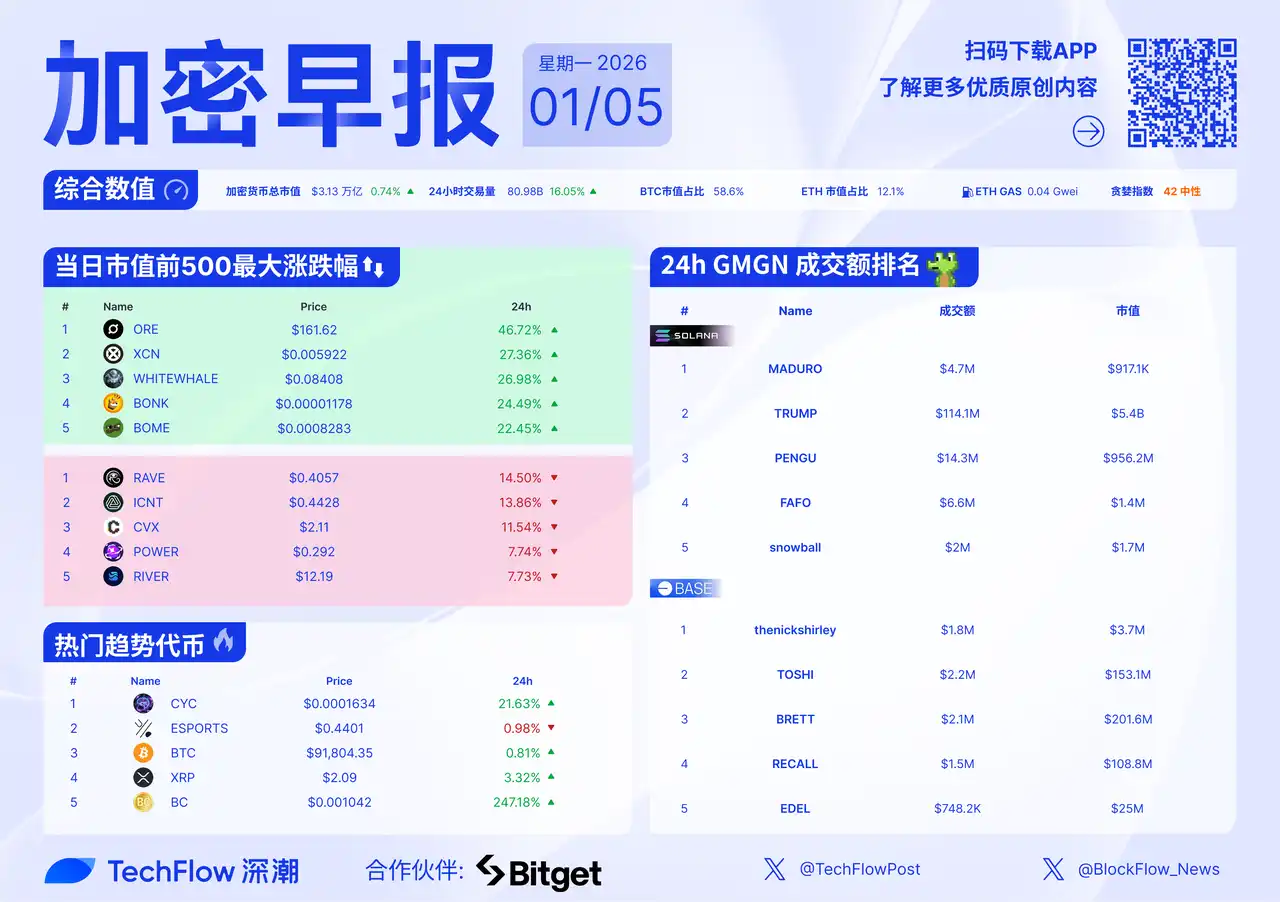
Market Trends
Recommended Reading

The Demise of the Petro: A Microcosm of Venezuela's Failure

This article recounts the failure of "Petro," the world's first sovereign state-backed digital currency launched by Venezuela. The Petro was initially held with high hopes to solve Venezuela's severe economic crisis and counter U.S. sanctions. However, due to technical issues, public indifference, external sanctions, internal corruption, and structural economic defects, the Petro ultimately failed, becoming a microcosm of national governance failure.

Pentagon's Pizza, Polymarket's Money

This article explores the phenomenon of predicting major military operations by analyzing changes in order volumes at pizzerias near the Pentagon. It reviews the history from Soviet agents monitoring Pentagon lights and vehicle numbers during the Cold War to using Google Maps and pizzeria customer traffic to predict war outbreaks today. It also mentions cases where individuals profited from such information on prediction markets and the ensuing discussions on information transparency and insider trading.

Analysis of All x402 Transaction Data in December: Nearly 60% Used for Practical Purposes, Not Speculation

This article primarily discusses the current state and development potential of the x402 protocol, analyzing transaction data from December 2025 and exploring trends in the micro-payment sector and its application potential in AI and blockchain. The article also mentions x402's solutions to payment issues, future challenges, and comparative advantages over other payment platforms.

Multicoin: Why We Are Bullish on Stablecoins Becoming FinTech 4.0?

This article delves into the development history of fintech and the revolutionary impact of stablecoins within it. It reviews the evolution from FinTech 1.0 to 4.0, analyzes the limitations of traditional financial infrastructure, and points out how stablecoins have changed the economic model of financial services through open, programmable networks. The emergence of stablecoins allows fintech companies to reduce operational costs, focus on serving specific niche markets, and achieve higher economic efficiency and deeper user understanding.

Four-Year Cycle Invalidated: 30 Institutions Bet on the New Crypto Landscape of 2026

This article discusses the major transformation the crypto industry will undergo in 2026, transitioning from "adolescent restlessness" to "adult steadiness," entering the so-called "industrialization phase." Various institutions have made predictions about future crypto trends, including decreased Bitcoin volatility, scaled commercial use of stablecoins and real-world assets (RWA), and deep integration of AI and blockchain. The article also mentions potential divergences and challenges, such as the quantum computing threat and competition in the AI payment layer.


Criptomoedas em alta

Perguntas relacionadas

QAccording to economist David Rosenberg, how many times does he predict the Federal Reserve will be forced to cut interest rates in 2026?

ADavid Rosenberg predicts the Federal Reserve will be forced to cut interest rates 5 times (a total of 125 basis points) by the end of 2026.

QWhat action did Michael Saylor take that is often a precursor to his company, MicroStrategy, announcing a new Bitcoin purchase?

AMichael Saylor posted information about the 'Bitcoin Tracker' with the message 'Orange or green?', a pattern that has historically preceded announcements of Bitcoin acquisitions by MicroStrategy.

QWhich major accounting firm is increasing its focus on the cryptocurrency sector, as reported by the Financial Times?

APricewaterhouseCoopers (PwC) is increasing its focus and investment in the cryptocurrency sector.

QWhat was the outcome of the WLFI community governance proposal regarding the use of treasury funds to promote the adoption of USD1?

AThe WLFI community governance proposal to use part of the unlocked treasury funds to accelerate the adoption of USD1 passed with a 77.75% approval rate.

QWhich aerospace company, founded by Jeff Bezos, has begun accepting Ethereum as payment for space travel?

ABlue Origin, the aerospace company founded by Jeff Bezos, now accepts Ethereum as payment for space travel.

Leituras Relacionadas

After Three Consecutive Quarters of Decline, Can the Crypto Market Find a Window for Stabilization in Q3?

The cryptocurrency market has just concluded its worst-performing quarter since 2022, with total capitalization dropping 12.6% to $2.1 trillion. All core metrics indicate capital is leaving the sector, not just rotating within it. Bitcoin fell 14.2% and Ethereum dropped 25.4% in Q2, breaking their previous correlation with US tech stocks. A key driver is the reversal in US spot Bitcoin ETF flows, which saw a net outflow of approximately $4.67 billion in Q2, including a record monthly outflow near $4.5 billion in June. While recent data suggests long-term holders are accumulating again, sustained ETF outflows mean continued selling pressure. Market focus is now singularly on the Federal Reserve. The upcoming July FOMC meeting is seen as the most critical event for Q3. A dovish signal could support Bitcoin reclaiming a $68,000-$84,000 range, while a hawkish stance might establish a new trading band around $50,000-$56,000. Additionally, regulatory uncertainty persists, with the progress of the crucial *CLARITY Act* stalling in the Senate, reducing its perceived 2026 passage probability to 40-45%. Despite the broad downturn, a few sectors showed growth. Prediction markets saw nominal volume surge 48.7% year-over-year to $113.8 billion, and tokenized collectibles transaction volume rose 143% quarterly to $1.4 billion. The Real-World Asset (RWA) tokenization sector also continued steady growth, now representing ~$28.1 billion in on-chain value. The market's foundation for an extreme crash appears limited, with Bitcoin price hovering near its 200-week moving average. However, the trading paradigm has shifted from narrative-driven speculation to decisions based on price action, policy developments, and interest rate expectations, making a broad sentiment-driven rally unlikely in the near term.

marsbitHá 14m

After Three Consecutive Quarters of Decline, Can the Crypto Market Find a Window for Stabilization in Q3?

marsbitHá 14m

BIT Trading Moment: BTC Still Suppressed by Weekly 200 EMA, Rejection May Restart Decline; Storage and Semiconductors that Surged Last Night Begin Falling in Evening Trading

**Crypto & Stock Market Wrap: Bitcoin Tests Resistance, Stocks Retreat After AI Surge** Bitcoin consolidates around $66,000, facing key resistance near $68,000—an area seen as a major psychological and technical hurdle where previous rallies have failed. Analysts note the cryptocurrency is caught between its 200-week moving average (~$63,333) and 200-week EMA (~$68,328). A clear break above $68k is needed to signal a stronger bullish trend, while a rejection could lead to a retest of $63k support. Market sentiment remains cautious, with low futures open interest pointing to a low-liquidity rebound rather than a full bull market. Bitcoin spot ETFs saw another $203 million inflow. US stock futures pointed lower after a strong Tuesday session led by a massive rebound in semiconductors and memory stocks. The rally was fueled by renewed optimism about AI-driven hardware demand, with Micron, SanDisk, and SK Hynix surging. However, those gains reversed in pre-market trading. Super Micro Computer (SMCI) soared over 20% after hours on strong guidance and a record backlog. Other standouts included Rocket Lab and nuclear energy plays Oklo and X-Energy. Rising oil prices (Brent above $91) and climbing Treasury yields (10-year near 4.64%), however, are reigniting inflation concerns and acting as a headwind for equities. In Asia, markets were mixed. South Korea's KOSPI pared early gains to close slightly higher as semiconductor stocks like SK Hynix gave back initial surges. Japan's Nikkei edged lower as the yen hit a fresh 38-year low against the dollar, raising fears of potential market intervention. Key events to watch include the Samsung Galaxy launch, AMD's AI event, and a slew of major tech earnings from Alphabet, Tesla, and IBM after the close on Wednesday, followed by the ECB meeting and Intel's earnings on Thursday.

marsbitHá 22m

BIT Trading Moment: BTC Still Suppressed by Weekly 200 EMA, Rejection May Restart Decline; Storage and Semiconductors that Surged Last Night Begin Falling in Evening Trading

marsbitHá 22m

Former CFTC Chairman, Circle President Tarbert: Preaching Long-Termism While Cashing Out $30 Million Himself

Former CFTC Chairman and Circle President Heath Tarbert has consistently advocated for a long-term vision in public, urging patience from investors as Circle’s stock price has fallen significantly from its peak. However, it has been revealed that since Circle’s IPO, Tarbert has continuously sold his CRCL shares through pre-arranged trading plans, cashing out approximately $30 million, without making any public market purchases. This contrast between his public messaging and personal actions has drawn criticism. Tarbert joined Circle in July 2023 as Chief Legal Officer, leveraging his regulatory experience to help guide the company through its IPO and expansion. Despite promoting stablecoins as long-term infrastructure, he established a 10b5-1 trading plan just before Circle went public, leading to substantial stock sales over the following year. In March 2026, he initiated another plan to sell more shares. His career trajectory highlights a pattern of moving between high-level regulatory roles and influential positions in the financial sector. After resigning as CFTC Chairman in early 2021, he joined Citadel Securities as Chief Legal Officer just 27 days later, during a period of intense regulatory scrutiny for the firm. He later joined Circle, aiding its efforts to navigate regulatory challenges for its public listing. While Tarbert's expertise in policy and compliance is valuable to companies like Circle, his actions—advocating long-term confidence while personally divesting—raise questions about the alignment between his public statements and his private financial decisions, leaving investors who followed his advice to bear the market risks.

marsbitHá 44m

Former CFTC Chairman, Circle President Tarbert: Preaching Long-Termism While Cashing Out $30 Million Himself

marsbitHá 44m

Gate Research Institute: The 'Wall Street-ization' Wave of Crypto Financial Products – Competition or Integration?

The article titled "Gate Research Institute: Are Crypto Financial Products Sparking a 'Wall Street' Wave—Competition or Convergence?" explores the evolving relationship between the crypto ecosystem and traditional finance (TradFi). The piece begins by reflecting on Bitcoin's original 2009 vision of decentralization, disintermediation, and moving away from banks. It then contrasts this with the 2024 landscape, where key crypto assets like Bitcoin are increasingly held through Wall Street products like ETFs issued by giants like BlackRock. The article questions whether this signifies that TradFi is systematically taking over the rights to issue, price, custody, and distribute crypto financial assets. The core argument is that this is not a zero-sum takeover but rather a bidirectional convergence where each side addresses the other's weaknesses. Crypto offers 24/7 global markets, programmable settlement, and open access but lacks compliant channels, institutional-grade custody, deep fiat liquidity, and mainstream distribution. TradFi possesses these but is constrained by legacy systems, limited operating hours, and slow settlement. Two primary convergence paths are highlighted: * **Path A (CEX to TradFi):** Exemplified by Gate, which has progressed from offering tokenized stocks and CFDs to providing direct, real stock trading (US, Hong Kong, South Korea) within its platform, using USDT. * **Path B (TradFi to Crypto):** Exemplified by Robinhood, which has integrated crypto trading, acquired exchanges like Bitstamp, and is moving traditional assets like stocks onto the blockchain via tokenization and its own Layer 2. Both paths are ultimately competing to become the next-generation, unified financial account—a "super account" where users can seamlessly trade cryptocurrencies, stocks, ETFs, RWA (Real World Assets), and tokenized treasury products in one interface. The growth of RWA and tokenized treasuries (e.g., BlackRock's BUIDL) is presented as the asset-layer fusion, providing stable, yield-bearing assets on-chain and acting as a bridge between the two worlds. In conclusion, the "Wall Street-ization" of crypto is framed as a mutual transformation. Decentralized ideals persist in the protocol layer, while at the application layer, a more efficient, global, and accessible unified capital market is emerging from this convergence. The future competition lies not between crypto exchanges and stockbrokers, but between platforms vying to offer the most comprehensive asset coverage, liquidity, and user experience within a single account.

marsbitHá 49m

Gate Research Institute: The 'Wall Street-ization' Wave of Crypto Financial Products – Competition or Integration?

marsbitHá 49m

Trading

Spot

Artigos em Destaque

O que é MEME 2.0

Memecoin 2.0: A Ascensão do $MEME 2.0 no Mundo das Criptomoedas Introdução No panorama em constante evolução das criptomoedas, um novo concorrente surgiu. Memecoin 2.0, simbolizado como $MEME 2.0, eleva o conceito de moedas meme a um novo nível emocionante. Como um subproduto do Memecoin original, este projeto capturou a atenção da comunidade crypto ao mudar o foco de incentivos financeiros típicos para uma experiência envolvente e divertida. Operando na blockchain Ethereum, Memecoin 2.0 redefine audaciosamente o envolvimento da comunidade na esfera crypto. O que é Memecoin 2.0, $MEME 2.0? No seu cerne, Memecoin 2.0 é um projeto de criptomoeda que prioriza o espírito comunitário e a diversão associada à cultura meme. Ao contrário das criptomoedas convencionais, que se concentram em casos de uso práticos e benefícios tangíveis, Memecoin 2.0 distingue-se ao abraçar o lado mais leve da moeda digital. O projeto existe sem promessas de utilidade, um roteiro estruturado ou retornos financeiros, focando em vez disso em fomentar uma comunidade vibrante centrada em memes e no prazer partilhado. Ao fazer isso, aproveita a crescente tendência da cultura meme no espaço online, tornando-se num jogador único no mundo dos ativos digitais. Criador do Memecoin 2.0, $MEME 2.0 Apesar de extensa pesquisa sobre as origens do Memecoin 2.0, a identidade explícita do seu criador continua desconhecida. Esta anonimidade não é incomum na comunidade crypto, onde muitos projetos são liderados por indivíduos ou grupos que preferem ficar nos bastidores. A falta de informações publicamente disponíveis sobre o criador pode ser vista como um movimento estratégico, colocando os holofotes no envolvimento da comunidade em vez de na notoriedade individual dentro do espaço. Investidores do Memecoin 2.0, $MEME 2.0 As informações sobre os investidores ou o financiamento do Memecoin 2.0 são escassas. Esta ausência de detalhes pode sugerir que o projeto é autofinanciado ou que o seu foco na comunidade, em vez de estruturas de investimento tradicionais, atraiu um tipo diferente de apoiador. Como o mundo das moedas memes geralmente envolve mais envolvimento de base do que investimento institucional, esta abordagem alinha-se ao ethos de projetos orientados pela comunidade. Como Funciona o Memecoin 2.0, $MEME 2.0? O Memecoin 2.0 opera inteiramente na blockchain Ethereum, aproveitando as suas robustas características de segurança e escalabilidade. Ao aproveitar os pontos fortes da Ethereum, o Memecoin 2.0 pode oferecer um ambiente seguro para interações dos utilizadores enquanto assegura que as transações são eficientes e custo-efetivas. Uma das características únicas do Memecoin 2.0 reside na sua estrutura orientada pela comunidade. O valor e a popularidade do token $MEME 2.0 derivam da participação ativa dos seus utilizadores, em vez de uma utilidade inerente. Este design reforça o foco do projeto no aspecto de entretenimento das criptomoedas, implicando que o riso e o envolvimento da comunidade são as verdadeiras moedas que impulsionam o seu sucesso. Além disso, o projeto insere-se no ecossistema mais amplo das moedas meme, onde o valor de cada moeda meme oscila com base na cultura, nas tendências e no envolvimento da comunidade, em vez de nos princípios económicos tradicionais. Linhas do Tempo do Memecoin 2.0, $MEME 2.0 Para melhor entender a evolução e os marcos do Memecoin 2.0, aqui está uma linha do tempo que destaca eventos significativos na sua história: 2024: O início do Memecoin 2.0 é reconhecido como um desdobramento do Memecoin original, estabelecendo-se dentro do contexto próspero das moedas meme enquanto opera na blockchain Ethereum. 13 de Julho de 2024: O Memecoin 2.0 posiciona-se oficialmente como uma moeda meme centrada na comunidade na rede Ethereum, enfatizando a sua abordagem centrada no entretenimento que convida os utilizadores a participar e envolver-se no seu crescimento. Pontos Chave Sobre o Memecoin 2.0, $MEME 2.0 Várias características críticas definem o Memecoin 2.0: Abordagem Centrada na Comunidade: A missão primária do Memecoin 2.0 é criar uma experiência comunitária divertida e envolvente, capitalizando o prazer coletivo derivado da cultura meme. Construído na Ethereum: Operar na blockchain Ethereum fornece ao projeto uma infraestrutura essencial que garante segurança e escalabilidade. Falta de Utilidade ou Roteiro: Numa notável divergência das criptomoedas tradicionais, o Memecoin 2.0 não promete quaisquer características utilitárias ou retornos financeiros, reafirmando o seu compromisso com o envolvimento da comunidade e a participação social. Foco na Cultura Meme: Ao abraçar os aspectos humorísticos e culturais do fenómeno meme, o Memecoin 2.0 fornece uma plataforma para que os utilizadores se envolvam com a crypto offline e online. Contexto Adicional: A Importância das Moedas Meme As moedas meme emergiram como uma classe distinta de criptomoeda, frequentemente impulsionadas pelo humor e por uma abordagem leve ao comércio. Estas moedas geralmente carecem de utilidade significativa ou roteiros de desenvolvimento, atraindo os utilizadores com a promessa de diversão, interação comunitária e relevância cultural. No panorama do ecossistema crypto mais amplo, as moedas meme revive a importância do envolvimento da comunidade, resistindo contra abordagens exclusivamente orientadas para o lucro. Projetos como o Memecoin 2.0 inauguram uma era em que o entretenimento pode harmonizar-se com aspirações financeiras, transformando a blockchain numa plataforma para criatividade e interação social. Conclusão O Memecoin 2.0, ou $MEME 2.0, representa uma nova onda de criptomoeda que prioriza o envolvimento da comunidade em detrimento de estruturas financeiras rígidas. Com um foco no humor e na interação social, capitaliza a fascinação em torno da cultura meme. Ao operar na blockchain Ethereum, o Memecoin 2.0 aproveita as capacidades da tecnologia, enquanto mantém um compromisso firme com o valor de entretenimento da moeda digital. À medida que o espaço em torno das criptomoedas continua a evoluir, o Memecoin 2.0 serve como um testemunho da ideia de que o futuro dos ativos digitais pode muito bem depender de experiências partilhadas, risadas e conexões comunitárias sólidas. No mundo imprevisível da crypto, talvez a alegria possa ser tão valiosa quanto o ganho financeiro tradicional.

74 Visualizações TotaisPublicado em {updateTime}Atualizado em 2024.12.03

O que é MEME 2.0

Como comprar MEME

Bem-vindo à HTX.com!Tornámos a compra de Memeland (MEME) simples e conveniente.Segue o nosso guia passo a passo para iniciar a tua jornada no mundo das criptos.Passo 1: cria a tua conta HTXUtiliza o teu e-mail ou número de telefone para te inscreveres numa conta gratuita na HTX.Desfruta de um processo de inscrição sem complicações e desbloqueia todas as funcionalidades.Obter a minha contaPasso 2: vai para Comprar Cripto e escolhe o teu método de pagamentoCartão de crédito/débito: usa o teu visa ou mastercard para comprar Memeland (MEME) instantaneamente.Saldo: usa os fundos da tua conta HTX para transacionar sem problemas.Terceiros: adicionamos métodos de pagamento populares, como Google Pay e Apple Pay, para aumentar a conveniência.P2P: transaciona diretamente com outros utilizadores na HTX.Mercado de balcão (OTC): oferecemos serviços personalizados e taxas de câmbio competitivas para os traders.Passo 3: armazena teu Memeland (MEME)Depois de comprar o teu Memeland (MEME), armazena-o na tua conta HTX.Alternativamente, podes enviá-lo para outro lugar através de transferência blockchain ou usá-lo para transacionar outras criptomoedas.Passo 4: transaciona Memeland (MEME)Transaciona facilmente Memeland (MEME) no mercado à vista da HTX.Acede simplesmente à tua conta, seleciona o teu par de trading, executa as tuas transações e monitoriza em tempo real.Oferecemos uma experiência de fácil utilização tanto para principiantes como para traders experientes.

304 Visualizações TotaisPublicado em {updateTime}Atualizado em 2026.06.02

Como comprar MEME

Discussões

Bem-vindo à Comunidade HTX. Aqui, pode manter-se informado sobre os mais recentes desenvolvimentos da plataforma e obter acesso a análises profissionais de mercado. As opiniões dos utilizadores sobre o preço de MEME (MEME) são apresentadas abaixo.

活动图片













