Crypto Morning Brief: edgeX to Conduct TGE on March 31, SK Hynix Plans to Issue New Shares for US ADR Listing

marsbitPublicado em 2026-03-24Última atualização em 2026-03-24

Resumo

Crypto Morning Brief: EdgeX announces TGE on March 31; SK Hynix plans US ADR listing. US Senate's Clarity Act draft restricts stablecoin yield earnings, allowing only user-based rewards. Aave V4 mainnet activation proposal passes Snapshot vote. Balancer Labs to shut down, transitioning to DAO structure. MicroStrategy adds 1,031 BTC, now holds 762,099 BTC total. Bitmine increases ETH holdings by 65,341, totaling 4.66 million ETH. Early Kalshi employees raise VC fund for prediction markets; ParaFi closes $125M new fund. Market updates include Middle East tensions, with US targeting April 9 as potential war end date. Recommended readings discuss token naming debates, gold's price drop, oil-gold divergence, Iran conflict impact, and AI agent performance linked to token usage.

Author: Deep Tide TechFlow

Yesterday's Market Dynamics

Israeli Media Reports US Sets April 9 as Target Date to End War, but as Strikes Continue, Iran Denies Negotiations

According to a report by Israeli media Ynetglobal, following a statement by President Trump, an Israeli official stated that Washington has set April 9 as the target date to end the war. The official mentioned that talks between Iran and the US are expected to take place later this week in Pakistan, adding that Washington has not yet informed Israel about the contact with Iranian Parliament Speaker Kalibaf. The official stated that ending the war by the target date would allow Trump to visit the country on Israel's Independence Day and accept the "Israel Prize." The official noted that Iran sometimes launches 12 to 15 missiles per day, while on other days, the number drops to about 7. However, they also pointed out that Iran has struggled to launch large-scale salvos, partly due to disruptions in its command and control systems. The US has set April 9 as the target date to end the war with Iran, but as strikes intensify, Tehran has denied any negotiations.

Latest Draft of Clarity Act: Prohibits Earnings Solely from Holding Stablecoins, Only Allows Earnings Based on User Activity

According to a CoinDesk report, the latest draft of the US Senate's "Digital Asset Market Clarity Act" has sparked dissatisfaction in the crypto industry due to its provisions on stablecoin earnings. Insiders revealed that the draft language is overly narrow and unclear.

Based on the latest revisions released by Senators Angela Alsobrooks and Thom Tillis last Friday, the draft explicitly prohibits users from earning returns solely for holding stablecoin balances, while also restricting any earnings schemes that resemble bank deposit interest in form. The draft only allows earnings programs based on user activity, but the specific determination mechanism remains unclear.

Crypto industry representatives attended a closed-door review session on Capitol Hill this Monday, marking their first exposure to the revised draft. The banking industry had previously insisted that stablecoin earnings must not compete with interest-bearing bank deposits, arguing that such products could weaken banks' lending capacity. This compromise was formed under this backdrop.

edgeX to Conduct TGE on March 31

Decentralized derivatives trading platform edgeX officially announced on platform X that it will conduct the EDGE token TGE and listing event on March 31.

Aave V4 Ethereum Mainnet Activation Proposal (ARFC) Passes Snapshot Vote

According to the Aave governance forum, the Aave V4 Ethereum mainnet activation proposal initiated by Aave Labs has passed the Snapshot vote. V4 adopts a modular Hub-and-Spoke architecture, with the Liquidity Hub managing shared liquidity and Spokes defining independent lending environments, supporting more granular risk pricing and credit expansion. The initial deployment will establish three major liquidity hubs: Core Hub, Prime Hub, and Plus Hub, covering mainstream assets such as wETH, wBTC, USDC, USDT, and GHO.

The deployment will start with conservative parameters, prioritizing security, with the DAO gradually adjusting limits, expanding assets, and configuring new Spokes thereafter. The security review for V4 lasted approximately 345 days, covering audits by Trail of Bits, Blackthorn, ChainSecurity, and other institutions, as well as public security competitions, with a security budget of $1.5 million. After launch, it will be deployed on the dedicated interface pro.aave.com, and the next step will involve submitting an AIP with complete risk parameters for formal activation.

Balancer Co-Founder Announces Closure of Balancer Labs and Transition to DAO Structure

Balancer protocol co-founder Fernando Martinelli announced the formal closure of Balancer Labs (BLabs). He stated that BLabs, as a corporate entity, has become a burden to the protocol's development and continues to face legal risks due to the v2 vulnerability incident on November 3, 2025. Coupled with a lack of sustainable revenue sources, the decision to close was inevitable.

Core team members of BLabs will be integrated into Balancer OpCo through a governance vote, with related proposals to be submitted by Marcus and Danko.

Fernando also stated that the protocol still holds practical operational value and will not cease operations entirely. He explicitly supports the currently proposed tokenomics restructuring plan, core elements of which include: reducing BAL emissions to zero, shutting down the veBAL mechanism, allocating 100% of protocol fees to the DAO treasury, reducing the v3 protocol share to 25% to attract organic liquidity, and providing a buyback exit channel for BAL holders.

SK Hynix Plans to Issue New Shares for US ADR Listing, Aims to Raise 10-15 Trillion Won

According to a report by the Korean Economic Daily, SK Hynix plans to issue new shares for a US ADR (American Depositary Receipt) listing, with an issuance scale of approximately 2.4% of the total shares. The raised funds will primarily be used to expand high-bandwidth memory (HBM) production capacity and advance the construction of the Yongin Semiconductor Cluster, consolidating its leading position in the global AI semiconductor market. SK Group Chairman Choi Tae-won had previously announced the ADR listing plan at Nvidia's GTC 2026 developer conference.

Strategy Announces Simultaneous Launch of Two $21 Billion ATM Offering Plans

According to an official announcement by Strategy, the company has announced the simultaneous launch of two large-scale financing plans: a new $21 billion STRC ATM offering and a $21 billion MSTR ATM offering, with a combined financing scale of $42 billion.

Strategy Adds Another 1,031 BTC Last Week, Now Holds 762,099 BTC in Total

According to an official announcement by Strategy, the company recently purchased an additional 1,031 BTC, spending approximately $76.6 million at an average price of about $74,326 per BTC. As of March 22, 2026, Strategy holds a cumulative total of 762,099 BTC, with a total acquisition cost of approximately $57.69 billion and an average purchase price of about $75,694 per BTC.

Bitmine Adds 65,341 ETH Last Week, Total Holdings Increase to Approximately 4.66 Million

According to a PRNewswire report, Ethereum treasury company Bitmine Immersion Technologies disclosed that it added 65,341 ETH last week. The company's current crypto asset holdings include 4,660,903 ETH, 196 BTC, $95 million worth of equity in Eightco Holdings, and $200 million worth of shares in Beast Industries. Additionally, the total amount of ETH staked by the company is 3,142,643 (valued at $6.5 billion based on $2,072 per ETH).

Early Kalshi Employees Establish Prediction Market VC Fund, Backed by Kalshi and Polymarket CEOs

According to a Fortune report, two early Kalshi employees, Adhi Rajaprabhakaran and Noah Zingler-Sternig, are raising up to $35 million for a newly established venture capital fund, 5c(c) Capital, focused on investing in startups in the prediction market sector. Kalshi CEO Tarek Mansour and Polymarket CEO Shayne Coplan have both committed capital. Other early backers include a16z co-founder Marc Andreessen, Ribbit Capital founder Micky Malka, and former Multicoin Capital managing partner Kyle Samani. The fund plans to invest in about 20 companies over the next two years, with the first close expected within a month.

Digital Asset Management Firm ParaFi Completes $125 Million Raise for New Fund

According to a Bloomberg report, New York-based digital asset management firm ParaFi completed fundraising for a new venture capital fund this month, raising $125 million. KKR & Co. co-founder Henry Kravis is among the firm's investors.

ParaFi also disclosed that since early 2025, it has raised an additional $325 million for its existing digital asset-related investment strategies. Combined with these fundraising efforts, ParaFi currently manages approximately $2 billion in assets.

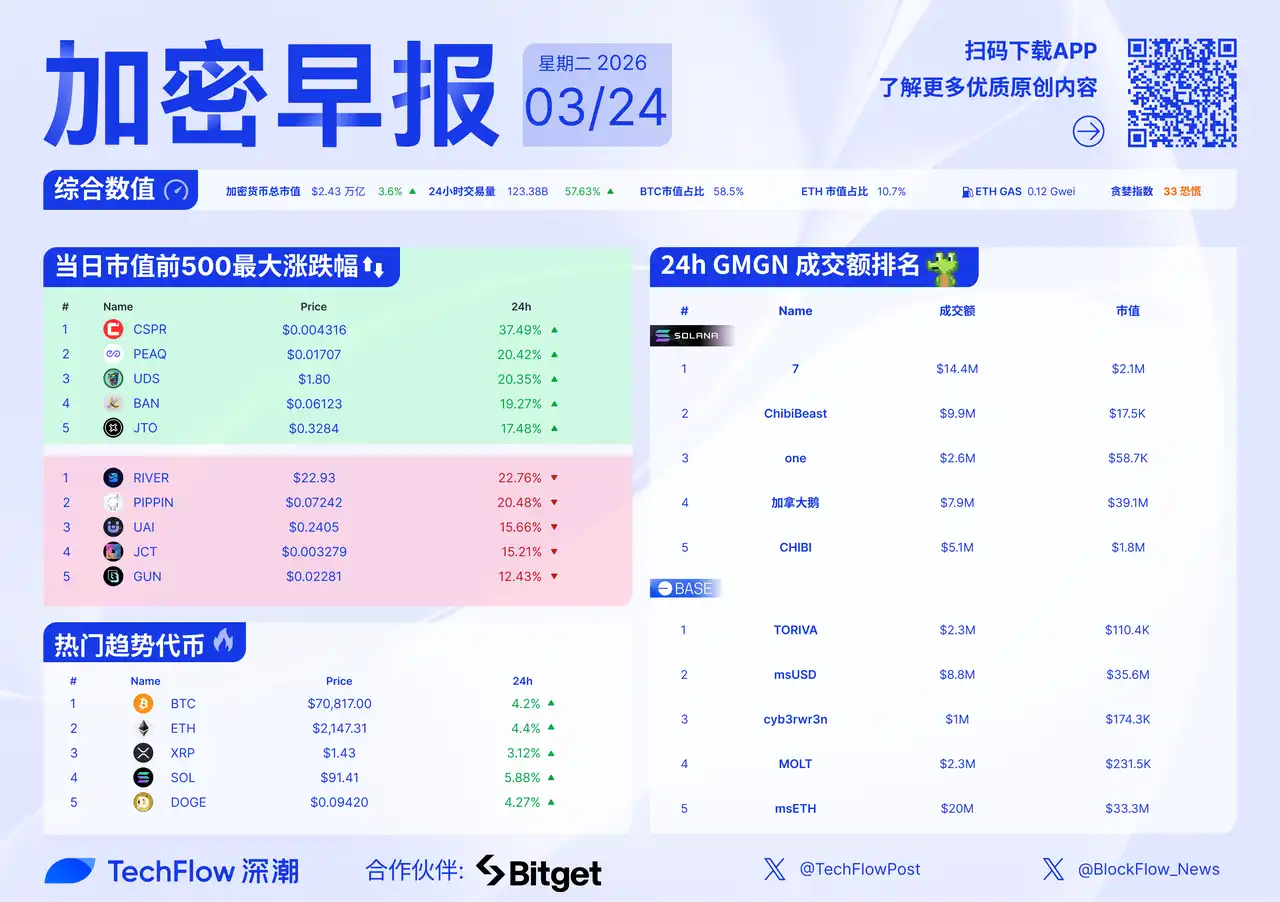
Market Trends
Recommended Reading

Token Doesn't Need a Chinese Name, but the Business Behind It Does

This article discusses how, as Token gradually becomes a unit of billing for cloud services, a revenue source for large models, and a core metric for national AI industry statistics, its Chinese translation has garnered widespread attention. The translation of the term "Token" has sparked a naming battle, with different stakeholders proposing various translations such as "智元" (Zhi Yuan), "模元" (Mo Yuan), and "符元" (Fu Yuan). Each translation represents different industry narratives and interest distributions. Naming is not just a linguistic issue but also a matter of interest allocation. Different names may influence the归属 of industry discourse power and future business models and value distribution.

Gold Has Stabbed Everyone in the Back

This article analyzes the significant drop in gold prices against the backdrop of the Middle East war, exploring the failure of gold as a safe-haven asset and its potential future trends. The article points out that gold has gradually transformed from a traditional safe-haven asset into a risk asset, affected by both liquidity crises and high-leverage liquidations, leading to a continuous decline in gold prices. Meanwhile, factors such as war, inflation, and expectations of Fed rate hikes have further exacerbated instability in the gold market.

How to View the Divergence Between Gold and Oil Prices?

This article discusses the divergence in the trends of gold and oil prices since the outbreak of the Middle East war, with gold prices falling slightly while oil prices rose significantly, primarily due to the different safe-haven attributes and market expectations for gold and crude oil. Gold prices initially rose due to geopolitical safe-haven demand but subsequently plummeted as funds shifted from gold to oil, coupled with market concerns about potential Fed monetary tightening. The future trends of gold and oil prices will depend on the progress of the US-Iran conflict, particularly key events such as whether the Strait of Hormuz can be reopened.

Four-Stage Projection of the Iran War: 6 Weeks is the Turning Point, July is the Real Buying Opportunity

This article analyzes the impact of the Iran war on global markets, proposing a four-stage framework that details how the conflict could drive up energy prices, economic inflation, and the possibility of Fed policy adjustments. The article also explores the accelerated application of artificial intelligence in enterprises and its impact on the economy and employment.

AI Agent Outputting Garbage? The Problem is You're Reluctant to Burn Tokens

This article explores the relationship between the output quality of AI Agents and the number of Tokens invested, proposing two simple methods to improve Agent output quality. It analyzes the impact of Token quantity on solving complex problems while also pointing out the limitations of Tokens in addressing "novelty" issues.


Perguntas relacionadas

QWhat is the target date set by the US to end the war with Iran, according to the Israeli media report?

AApril 9th.

QWhat is the main restriction on stablecoin yields proposed by the latest draft of the US Digital Asset Market Clarity Act?

AIt prohibits users from earning yields solely for holding stablecoin balances and restricts any yield schemes that resemble bank deposit interest, only permitting yields based on user activity.

QWhen is the edgeX Token Generation Event (TGE) scheduled to occur?

AMarch 31st.

QWhat is the primary purpose of SK Hynix's planned ADR issuance and fundraising?

ATo raise between 10 to 15 trillion won to expand its high-bandwidth memory (HBM) production capacity and advance the construction of the Yongin semiconductor cluster.

QHow many bitcoins did MicroStrategy announce it had purchased in its most recent acquisition, and what is its total holdings?

AIt purchased 1,031 bitcoins, bringing its total holdings to 762,099 bitcoins.

Leituras Relacionadas

US Government Suddenly Halts Anthropic's Strongest Model, "Quasi-IPO Stock Price" Plunges 3.7% Overnight

U.S. Government Halts Anthropic's Top AI Models, 'Pre-IPO' Price Drops 3.7% On June 12, the U.S. government ordered Anthropic to shut down access to its two most powerful AI models, Claude Fable 5 and Claude Mythos 5, citing national security concerns. The directive, issued by the Department of Commerce, required Anthropic to block access for all foreign nationals, leading the company to disable the models globally for all users. Anthropic strongly opposed the move, arguing the government's basis was a "narrow jailbreak vulnerability" and warning that applying such a standard industry-wide would effectively halt all frontier model deployments. The news impacted Anthropic's implied valuation in speculative markets. The Anthropic perpetual contract on Hyperliquid fell approximately 3.7% to around $1,627, down from highs above $1,800 following the models' release. Unauthorized tokenized products linked to Anthropic on Solana also saw significant declines. The models, launched just days earlier on June 9, represented a major capability leap for Anthropic. Fable 5 was its first public release of a "Mythos"-tier model above its flagship Claude Opus. The shutdown creates an ironic situation for Anthropic, a company founded on "AI safety" principles, and adds uncertainty to its ongoing IPO preparations. The company is actively engaging with regulators to resolve what it calls a "misunderstanding" and restore service.

marsbitHá 17m

US Government Suddenly Halts Anthropic's Strongest Model, "Quasi-IPO Stock Price" Plunges 3.7% Overnight

marsbitHá 17m

SpaceX IPO Creates Trillion-Dollar Billionaire: Musk's Wealth Equals Half of Crypto Market

SpaceX's record-breaking IPO has propelled Elon Musk to become the first modern billionaire with a personal net worth exceeding $1 trillion, reaching $1.11 trillion according to Bloomberg. This staggering wealth surpasses the total market capitalization of all cryptocurrencies excluding Bitcoin and equals roughly half of the entire crypto market's value. The milestone highlights extreme wealth concentration and the significant devaluation of the altcoin market, whose total cap has nearly halved since late 2025 as capital flows into large tech stocks. SpaceX's Nasdaq debut saw its valuation hit $2.2 trillion, with shares soaring from a $135 offer price to close at $161. Its first-day trading volume of $85 billion set a new global IPO record. Musk owns 42% of the company. Despite his wealth dwarfing the altcoin sector, Musk maintains deep ties to digital assets. He personally holds Bitcoin, Ethereum, and Dogecoin, while his companies, SpaceX and Tesla, collectively hold over 30,000 Bitcoin, ranking among the top corporate BTC holders globally. His acquisition and integration of financial data tools into X (formerly Twitter) further connect his ecosystem to the markets. Ultimately, Musk's trillion-dollar status underscores the immense wealth controlled by tech founders, though this fortune remains largely tied to volatile stock prices rather than liquid assets.

Foresight NewsHá 25m

SpaceX IPO Creates Trillion-Dollar Billionaire: Musk's Wealth Equals Half of Crypto Market

Foresight NewsHá 25m

Hardcore First Look | Ocean Embodied Intelligence Company 'Shihang Intelligence' Secures Record-Breaking 1 Billion in Funding, Zhu Xiaohu, Temasek Place Bets

Breaking News | Ocean Embodied Intelligence company "Shihang Intelligent" secures a record-breaking 1 billion RMB (approximately 10 billion yuan) in Series A financing, with investment from Zhu Xiaohu and Temasek. Author: Qiu Xiaofen | Editor: Yuan Silai Ocean Embodied Intelligence company "Shihang Intelligent" has completed its Series A funding round, raising over 1 billion RMB. This marks the largest single funding round in the global marine robotics field to date. Investors include upstream momentum funds from chip companies "Moore Thread" and "Kunlunxin," Singapore's state-owned investment platform Vertex Growth, and listed company Dyneo, among others. Existing investors like GSR Ventures (whose founder Zhu Xiaohu has invested for the fifth time), Vertex Ventures China, Hua Ying Capital, and Long Capital also significantly increased their investments. Founder and CEO Chen Xiaobo, a 1989-born alumnus of Harbin Engineering University, is a long-time expert in underwater robotics. He received the National Defense Science and Technology Progress Award at age 28 (the youngest recipient) and led the development of China's first commercial underwater cleaning robot. The funds will be used for core technology R&D, global market expansion, and building the industry chain ecosystem to scale the application of marine robots in complex underwater scenarios. The ocean is considered one of the most challenging environments for robotics due to low light, high turbidity, complex currents, limited communication, high pressure, and corrosion. "Shihang Intelligent" focuses on developing core underlying technologies for marine robots, covering six key systems: power, control, sensing, navigation, sealing, and deployment. Its robots are capable of operating at depths from 0 to 10,000 meters with full degrees of freedom, performing complex maneuvers, autonomous navigation, and multi-robot collaboration. Applications include ship cleaning, underwater security, offshore wind power, marine ranching, and seabed inspection. The company's order value for the first half of 2026 alone has exceeded 1 billion RMB. Its "Orca Robot" is used by major shipping companies and has performed maintenance on over a thousand large vessels. In April of this year, the company launched its ocean embodied large model "Cangqiong CEORION." Unlike traditional remote-controlled or pre-programmed robots, this model integrates environmental perception, task understanding, and action generation into a single end-to-end architecture. Trained on millions of hours of commercial operation data and simulation data, it covers 12 major underwater operation scenarios. In simulations, it achieved over 90% task success rate and over 70% zero-shot adaptation capability to unseen environments. A built-in physics reasoning module reduces collision risk by 80%, enabling autonomous operation even with weak or no communication. Recently, "Shihang Intelligent" was selected as a core technology partner for Singapore's Maritime and Port Authority national hull inspection and cleaning program. These advancements indicate marine robotics is moving from pilot projects to scaled applications, with real-world operations generating valuable data to continuously improve robot capabilities. CEO Chen Xiaobo stated the company will continue investing in core marine robotics technology, the embodied intelligence model, and global application scenarios to expand into more high-risk, high-difficulty, and high-value underwater operations.

marsbitHá 51m

Hardcore First Look | Ocean Embodied Intelligence Company 'Shihang Intelligence' Secures Record-Breaking 1 Billion in Funding, Zhu Xiaohu, Temasek Place Bets

marsbitHá 51m

Three Months, 35 Billion Yuan: Investors Rush to Grab the OpenAI of the Physical World

Investors flock to a physical AI startup as the race for the "OpenAI of the physical world" heats up. Ji Jia Shi Jie (GigaWorld), a company dedicated to developing Artificial General Intelligence (AGI) for the physical world, has raised 3.5 billion RMB (approximately $490 million) in just three months, according to a report from investment media outlet Touzijie. The latest B2 funding round of 1 billion RMB attracted a wide range of top-tier investors, including sovereign wealth funds, industrial capital, and financial institutions. This brings the total funding for the young company, now valued over 10 billion RMB, to 3.5 billion RMB across three recent rounds. The company is led by Huang Guan, a post-90s Tsinghua University PhD with extensive experience in AI, autonomous driving, and entrepreneurship. Its core innovation is a "dual-pyramid" system comprising a five-layer data pyramid (from internet videos to real-world robot data) and a three-layer algorithm pyramid focused on world simulation, action alignment, and reinforcement learning. This system underpins its key models: the "World Action Model" (e.g., GigaBrain series for robot control) and the "World Generation Model" (e.g., GigaWorld series for simulating and understanding the physical world). Its models have reportedly achieved top rankings in global robotics benchmarks. Ji Jia Shi Jie argues that while current digital AGI excels in information processing, the next frontier is physical AGI—systems that can understand and interact with the real world. The company believes the field is approaching its "GPT-3 moment," a key inflection point in capability scaling. To achieve this, the company is pursuing a dual-market strategy. For the consumer (C) market, it launched the "SeeLight" brand and its S1 general-purpose humanoid robot, which has secured initial orders for deployment in real homes. For the business (B) market, it focuses on industrial automation with its Maker series robots, having signed agreements for large-scale deployment in factories, and its DriveDreamer world model for autonomous driving, which is already in use with over 30 automakers and tech companies. The report concludes that by bridging the gap between digital intelligence and physical action, Ji Jia Shi Jie aims to unlock a new wave of productivity, ultimately bringing physical AGI into everyday life.

marsbitHá 1h

Three Months, 35 Billion Yuan: Investors Rush to Grab the OpenAI of the Physical World

marsbitHá 1h

What's the Connection Between Pinduoduo's Huang Zheng and Blockchain?

This text explores the unexpected connection between Pinduoduo founder Colin Huang and blockchain, as suggested in his article *Turning Capitalism Upside Down*. Huang argues Pinduoduo's core business is about managing "uncertainty." He posits that wealth flows to the rich because they absorb life's uncertainties (e.g., illness, job loss) that devastate the poor, who pay a premium for certainty through insurance or stable prices. Pinduoduo's model attempts a "reverse insurance": by aggregating consumer demand via group-buying and flash sales, it creates a large, predictable order for manufacturers. This certainty allows factories to remove risk premiums, passing savings back as lower prices, thus partially reversing the wealth flow. The key obstacle, Huang notes, is that an individual's buying intent is an unreliable promise. He then asks if blockchain is the natural solution for this "reverse insurance." The text elaborates that blockchain, through smart contracts with binding deposits, could transform casual intent into a costly-to-break, enforceable commitment. This replaces interpersonal trust with coded rules, making promises credible, pricable, and resistant to fraud. Finally, the author draws a parallel to Bitcoin, framing two paths to creating certainty: the "Pinduoduo path" of aggregating decentralized will into scale, and the "Bitcoin path" of locking rules into immutable code. Both sacrifice something—personal freedom or system flexibility—to manufacture trust and predictability.

链捕手Há 2h

What's the Connection Between Pinduoduo's Huang Zheng and Blockchain?

链捕手Há 2h

Trading

Spot
Futuros
活动图片




