Crypto Morning Brief: CoinGecko Considers Sale at Approximately $500 Million Valuation, Privacy Protocol Zama Launches Token Sale

marsbitPublicado em 2026-01-14Última atualização em 2026-01-14

Resumo

CoinGecko is reportedly considering a sale at a valuation of around $500 million, with investment bank Moelis handling the process. In other major news, privacy protocol Zama launched a token sale with a floor valuation of $55 million, distributing 12% of its total 1.1 billion ZAMA tokens through a sealed-bid Dutch auction. Key market developments include the U.S. December CPI meeting expectations at 2.7% year-over-year, with analysts suggesting it won’t immediately alter the Federal Reserve’s current wait-and-see stance on rate cuts. U.S. Senate committees have rescheduled hearings on crypto market structure bills to late January. Other notable updates: PancakeSwap proposed reducing the max supply of CAKE from 450 million to 400 million tokens; ETHGas revealed its tokenomics with a 10 billion GWEI supply; Grayscale added several new assets to its consideration list; and YZi Labs made a multi-million dollar investment in Genius Trading, with Binance's Changpeng Zhao joining as an advisor. Additionally, Polygon Labs acquired companies Coinme and Sequence for over $250 million to advance its stablecoin strategy, and European crypto platform Bitpanda is planning a Frankfurt IPO in early 2026 targeting a €4-5 billion valuation.

Author: Deep Tide TechFlow

Yesterday's Market Dynamics

US December Unadjusted CPI Year-over-Year 2.7%, Expected 2.70%, Previous 2.70%

According to Jinshi data, the US December unadjusted Consumer Price Index (CPI) year-over-year was 2.7%, matching the expected 2.70% and the previous value of 2.70%.

The US December seasonally adjusted CPI month-over-month was 0.3%, meeting the expectation of 0.30%.

Fed Mouthpiece: December CPI Unlikely to Change Fed's Current Wait-and-See Stance

According to Jinshi data, "Fed Mouthpiece" Nick Timiraos stated that the December Consumer Price Index (CPI) is unlikely to change the Federal Reserve's current wait-and-see attitude, as officials likely want to see more evidence that inflation is stabilizing and gradually declining before cutting rates. The Fed has paused its benchmark rate cuts in the last three meetings, most recently in December, even though inflation had stopped falling last year. Officials paused the cuts due to concerns about the risk of a larger-than-expected slowdown in the labor market. To resume rate cuts, Fed officials may need to see new evidence that labor market conditions are deteriorating or that price pressures are easing. The latter might require at least a few more months of inflation data to become apparent.

US Senate Agriculture Committee Reschedules Crypto Bill Hearing to January 27th

According to CoinDesk, the US Senate Agriculture Committee announced it will release its crypto market structure bill on January 21, 2026, followed by a key hearing on January 27th at 3 PM. This hearing was originally scheduled for January 15th but was postponed. Committee Chairman John Boozman stated that the revised schedule ensures transparency and allows for a comprehensive review of the bill.

Meanwhile, the Senate Banking Committee will hold a review of its version of the bill this Thursday. Differences remain between the two committee versions on issues such as ethics provisions and bipartisan representation of regulators, which could affect the final prospects for bipartisan support.

Privacy Protocol Zama Launches Token Sale with a Floor Valuation of $55 Million

According to The Block, the encryption privacy protocol Zama will launch a fully on-chain token sale through CoinList and its own auction application, using a sealed-bid Dutch auction structure with a floor valuation of $55 million. This sale will allocate 12% of the total supply of 11 billion ZAMA tokens.

The sale is divided into three parts: a 2% community sale for NFT holders this week, an 8% main auction via CoinList from January 21st to 24th, and a 2% follow-on sale at the auction settlement price from January 27th to February 2nd.

New PancakeSwap Proposal Aims to Reduce CAKE Maximum Supply from 450 Million to 400 Million Tokens

According to the PancakeSwap governance forum, the PancakeSwap team has proposed a plan to reduce the maximum supply of CAKE tokens from 450 million to 400 million.

The PancakeSwap team stated that CAKE has been deflationary since September 2023, and this trend is expected to continue. The team has accumulated approximately 3.5 million CAKE as an ecosystem growth fund, which will be prioritized for protocol development needs, making it unlikely for the protocol to return to an inflationary state.

The proposal will enter the voting stage after community discussion. If passed, it will reduce the maximum supply cap by 50 million CAKE.

ETHGas Unveils Token Economic Model: Total Supply 10 Billion Tokens, 10% Allocated to Community

According to an official announcement, the Ethereum block space futures market ETHGas unveiled its token economic model. Its token GWEI has a total supply of 10 billion tokens, allocated as follows: Ecosystem 31%, Investors 27%, Team 22%, Community 10%, Foundation 8%, Advisors 2%. Additionally, the eligibility snapshot for the token airdrop will be taken on January 19th at 00:00 UTC.

Previous news reported that ETHGas announced the completion of a $12 million funding round led by Polychain Capital late last year.

Grayscale Adds MegaETH, Horizen, and Other Tokens to Asset Consideration List

According to The Block, Grayscale has updated its Asset Consideration List, expanding it to 27 tokens covering categories such as Artificial Intelligence, Decentralized Finance, Consumer, and Infrastructure.

This update, published on January 12th, adds assets including MegaETH, Horizen, ARIA Protocol, Playtron, Nous Research, Poseidon, and Geodnet.

Grayscale clarified that inclusion on the consideration list does not guarantee the launch of a corresponding investment product, as product creation involves internal review, custody arrangements, and regulatory considerations. The next routine update is expected around April 15th, 2026.

YZi Labs Makes "Multi-Million Dollar" Investment in Genius Trading, Changpeng Zhao to Serve as Advisor

According to The Block, YZi Labs has made a "multi-8-figure" (tens of millions of dollars) investment in Genius Trading, and Binance founder Changpeng Zhao will join the startup as an advisor.

Genius Trading is building a privacy-first on-chain trading platform offering spot, perpetual contracts, and copy trading, aiming to become a decentralized version of "Binance".

Polygon Labs Acquires Crypto Startups Coinme and Sequence for Over $250 Million

According to Fortune, Polygon Labs has completed the acquisition of crypto startups Coinme and Sequence for a total of over $250 million.

Polygon Labs CEO Marc Boiron and Polygon Foundation founder Sandeep Nailwal stated that these acquisitions aim to advance their stablecoin strategy. Seattle-based Coinme focuses on cash-to-crypto conversion services and holds several US money transmitter licenses; New York-based Sequence focuses on building blockchain infrastructure, including crypto wallets. Nailwal described this as a move for Polygon to compete with fintech giant Stripe.

Sources: CoinGecko Considers Sale at Approximately $500 Million Valuation

According to CoinDesk, sources, CoinGecko is considering a sale at a valuation of approximately $500 million. Informed sources revealed that the company has hired investment bank Moelis to manage the sale process, but some reports indicate the valuation is not yet final as the process only began late last year.

Notably, CoinGecko's competitor CoinMarketCap was acquired by Binance for approximately $400 million in April 2020. CoinGecko was founded by TM Lee and Bobby Ong in 2014.

Crypto Trading Platform Bitpanda Plans Frankfurt IPO in H1 2026, Valuation Could Reach €5 Billion

According to Bloomberg, cryptocurrency trading platform Bitpanda GmbH, backed by billionaire Peter Thiel, plans to conduct an initial public offering (IPO) on the Frankfurt Stock Exchange as early as the first half of 2026. Informed sources revealed that the Vienna-based company's valuation for this IPO could be between €4 billion (approximately $4.7 billion) and €5 billion.

Bitpanda has hired Goldman Sachs Group, Citigroup, and Deutsche Bank to arrange the offering. Some sources indicated the company could go public as early as the first quarter.

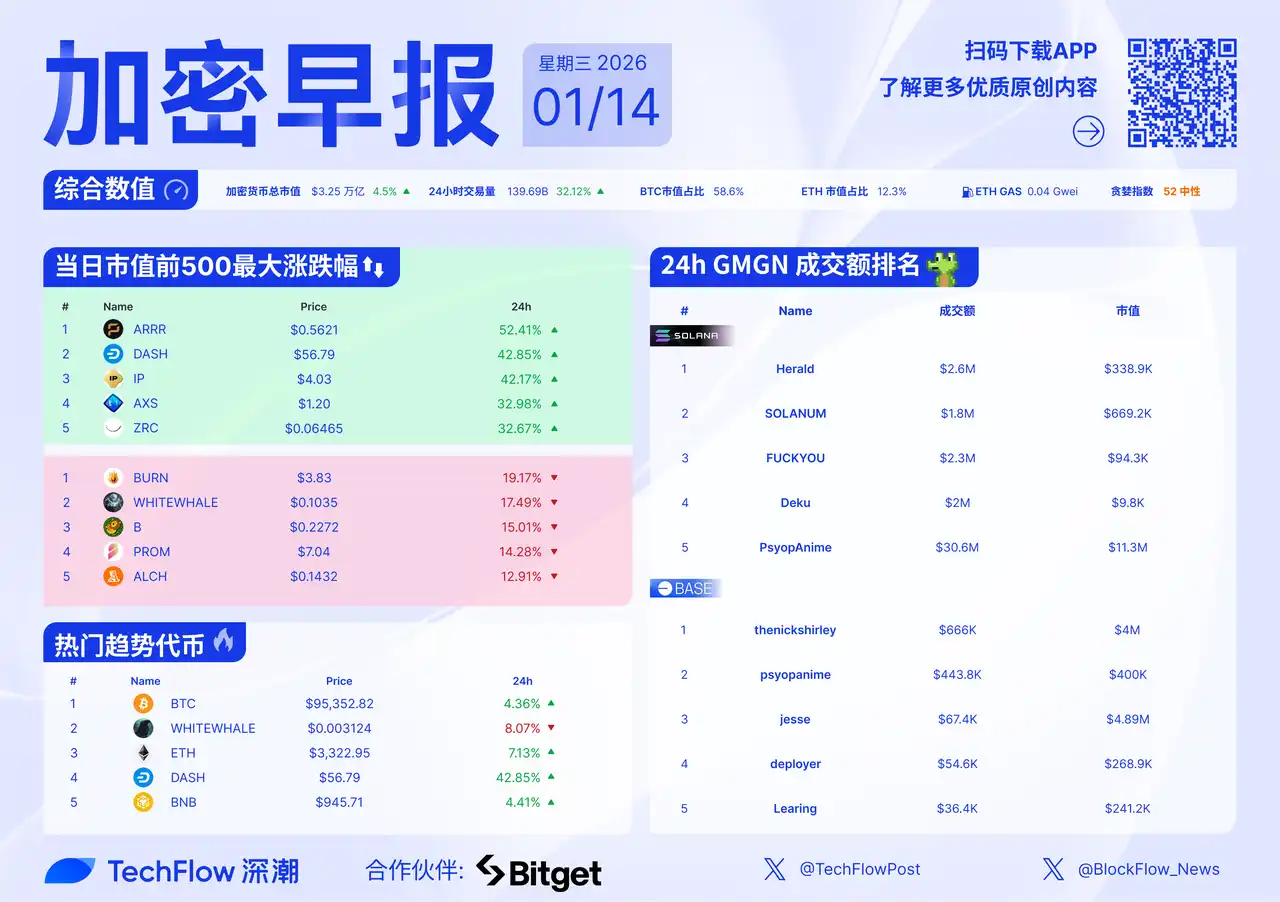
Market Trends
Recommended Reading

a16z Raised $15 Billion, Says It Will Make America Win

This article discusses a16z's completion of a $15 billion fundraising, making it a leader in the US venture capital industry. This capital will primarily invest in long-term companies, application layers, underlying technology, biomedicine, and the "American Vitality" theme, with a particular focus on the military manufacturing industry. Through its powerful resource integration capabilities and policy influence, a16z not only bets on technology cycle but also seeks opportunities in the political cycle. Despite the risks, its unique strategy and resource accumulation have earned the trust of its LPs.

Monero's Hidden Selling Pressure is Disappearing

This article provides an in-depth analysis of Monero (XMR)'s market dynamics after being delisted from major exchanges. It reveals the impact of the instant exchange industry on Monero's price and how the new platform Wagyu is breaking this negative cycle by offering fairer trading conditions, helping Monero achieve more authentic price discovery.

Frequent Pokémon Card Heists: Is On-Chaining Physical Collectibles a Risky Solution?

This article discusses the security issues, including robberies and scams, surrounding Pokémon card collectible transactions in recent years. It analyzes the limitations of traditional trading models and proposes using blockchain technology to put collectibles on-chain as a solution to enhance transaction transparency, security, and liquidity.

2026: The 'Solar Term' in the AI Circle Has Changed, How Should Entrepreneurs Fine-Tune Their 'Algorithm'?

This article explores AI entrepreneurship trends in 2026, changes in the capital environment, and how entrepreneurs should respond. Through metaphors and case studies, the article emphasizes the importance of focusing on specific scenarios, building deep supply chains, and adopting a gradual advancement strategy for entrepreneurship.

Monero, Zcash, and Canton Network: Who is the True King of Privacy?

This article discusses how privacy has become a key technological feature for connecting with real-world business as institutional players gain prominence in the blockchain space. It covers the importance of blockchain privacy and its forms, including full anonymity privacy and selective privacy, and analyzes why financial institutions prefer selective privacy. Canton Network is considered a representative privacy blockchain meeting institutional needs, while projects like Monero and Zcash have certain limitations in terms of full anonymity privacy and selective privacy.


Perguntas relacionadas

QWhat is the reported valuation at which CoinGecko is considering a sale?

ACoinGecko is considering a sale at a valuation of approximately $500 million.

QWhat is the total supply of ZAMA tokens and what percentage is being allocated for its token sale?

AThe total supply of ZAMA tokens is 11 billion, and 12% of the total supply is being allocated for its token sale.

QWhat is the new proposed maximum supply for CAKE tokens according to the PancakeSwap proposal?

AThe new proposed maximum supply for CAKE tokens is 400 million, a reduction from the previous 450 million.

QWhich two companies did Polygon Labs acquire for a combined total of over $250 million?

APolygon Labs acquired the crypto startups Coinme and Sequence for a combined total of over $250 million.

QWhat was the reported annual CPI rate for the U.S. in December, and did it meet expectations?

AThe U.S. annual CPI rate for December was 2.7%, which met the expectation of 2.70%.

Leituras Relacionadas

Podcast Notes | Conversation with GSR Asset Management Head: To Determine if This Crypto Rally is Real, Just Watch the Lending Rates on Aave

Podcast Summary: Dialogue with GSR's Head of Asset Management: To Determine if This Crypto Rally is Real, Just Check Lending Rates on Aave Andy Baehr, Managing Director of Asset Management at GSR, discusses the current crypto market, characterizing it as stuck in a state of "ambivalence" with short-lived, unsustainable rallies. He outlines a simple framework: the market moves between "ambivalence" and "conviction" (sustained upward momentum). Currently, every rally resembles a single-stage rocket booster that quickly fizzles out. Baehr identifies three key signals to watch: 1) DeFi lending rates, 2) the potential passage of the CLARITY Act, and 3) the market forming a consensus on the "Fed hawkish peak." He emphasizes that the most immediate indicator for the sustainability of the recent CPI-triggered rally is the USDC borrowing rate on Aave, currently around 3.75%—close to U.S. Treasury yields. The absence of a credit spread indicates low leverage demand and a lack of market energy. He explains that a healthy, sustained rally requires layered buying pressure. Last year's rally progressed from an ETH short squeeze to crypto-native trader influx and finally to ETF inflows. Currently, this structure is missing. Other potential structural buyers like Digital Asset Treasury (DAT) companies are absent, and ETF flows have proven transient. Baehr notes that while small-cap crypto tokens outperformed large caps in Q2—a potential sign of capitation in major assets—capital is also flowing to more exciting opportunities like AI stocks and tech IPOs, leaving crypto sidelined. Regarding DeFi, he highlights that platforms like Aave provide a clear, real-time signal of leverage demand through their supply/demand-driven interest rates. A significant, sustained rate increase would signal genuine market conviction. He also observes the quiet emergence of fixed-income-like products and vaults in DeFi. On regulation, the probability of the CLARITY Act passing before the August 7th deadline has dropped linearly from 75% to below 40% on Polymarket. Baehr suggests its passage would be treated as a bullish surprise, a potent driver for price movement. However, political hurdles, including ethical clause debates and disclosures about the First Family's crypto profits, remain significant obstacles. Ultimately, the market awaits clarity on the Fed's terminal rate under Chair Warsh. Until the "Fed Solstice"—the point where the market collectively understands the peak of hawkish policy—sustained conviction will be difficult to achieve.

marsbitHá 8m

Podcast Notes | Conversation with GSR Asset Management Head: To Determine if This Crypto Rally is Real, Just Watch the Lending Rates on Aave

marsbitHá 8m

7 Months After the Collapse of Huiwang, Southeast Asia's Escrow Platforms Undergo a Major Reshuffle

Following the collapse of Huione Pay—dubbed the "Alipay of Southeast Asia"—seven months ago, the region's underground financial guarantee platform sector is undergoing a significant reshuffle. This power vacuum has been swiftly filled by emerging platforms such as XinBi, Tiger/Navigator, JinBei (renamed JinBo), Dali/Tiancheng, and FullyLight. These platforms, operating largely via Telegram and offering services like escrow for illicit transactions, have absorbed the vast user base and markets left behind by Huione. While positioning themselves as "trust intermediaries," their primary clientele consists of networks involved in online scams, money laundering, illegal gambling, and even human trafficking. For instance, the Tiger/Navigator platform explicitly provides "escrow" services for kidnapping-for-ransom operations ("强押车交易"). Data underscores the immense scale: Huione alone processed over $103 billion in cryptocurrency payments and facilitated over $31 billion through its escrow market before its downfall, linking it to Cambodia's notorious Prince Group. Since its collapse, competitors have seen explosive growth. For example, the XinBi platform has accumulated over $1.6 billion in total USDT revenue, while platforms like NewPay, OkPay (under Dali), and FullyLight Wallet collectively processed over $4.8 billion in USDT in a single year. This ecosystem thrives in regions like Cambodia and Myanmar, where regulatory gaps allow these platforms to act as critical financial infrastructure for sprawling cybercrime industries, from scam compounds to online casinos. The article concludes that the moniker "Southeast Asian Alipay" is a misnomer, obscuring the platforms' fundamental role in enabling serious criminal enterprises rather than representing legitimate financial innovation.

Odaily星球日报Há 1h

7 Months After the Collapse of Huiwang, Southeast Asia's Escrow Platforms Undergo a Major Reshuffle

Odaily星球日报Há 1h

The Changing Landscape: What Are Crypto VCs Experiencing?

Title: The Shifting Landscape of Crypto Venture Capital The era of dedicated crypto venture capital funds is undergoing a significant transformation. Once essential for navigating the sector's complexity and high risk, these specialized funds are now facing an identity crisis as the market matures. This shift mirrors historical patterns in other specialized investment classes like cleantech and SPACs, where initial information advantages dissipate as technologies become mainstream and integrated into existing industry frameworks. The article argues that crypto is reaching a critical inflection point, transitioning from a "building phase" to an "integration phase." Major players like Stripe, BlackRock, and Visa now engage with crypto not for its novel mechanics but as a foundational financial infrastructure. Their needs—regulatory compliance, banking partnerships, distribution channels—align with traditional fintech, a domain easily understood by large, generalist funds like Sequoia and Founders Fund. This evolution creates a "barbell effect" within the VC landscape. On one end are massive, diversified platforms that can incorporate crypto as one vertical among many. On the other are small, nimble funds focused on niche, experimental projects. The middle ground—medium-sized dedicated crypto funds—is being squeezed out. Their typical fund size makes it impossible to generate sufficient returns solely from early-stage crypto bets, yet they cannot compete with giants for later-stage deals. Consequently, leading crypto-native firms like Paradigm and Framework Ventures are expanding into AI, robotics, and other sectors, driven partly by LP pressure for better returns amid a broader VC DPI crisis. Others, like Dragonfly and a16z, have narrowed their crypto focus predominantly to financial infrastructure like stablecoins, reframing the sector's core narrative. For crypto entrepreneurs, this consolidation presents challenges. While generalist funds offer larger checks and broader resources, crypto projects now compete fiercely with AI for attention and capital within these firms. Furthermore, the long-term, non-commercial foundational work that built the ecosystem—funded by dedicated crypto VCs—is less likely to attract generalist capital focused on direct returns. The conclusion is that "crypto investor" as a standalone category is becoming obsolete, akin to "internet investor." Crypto is becoming a baseline infrastructure layer. The future will see a barbell structure: large-scale growth financing handled by generalist funds, while pioneering, speculative projects are funded by small, specialized vehicles. The dedicated crypto funds of the 2017-2021 boom, which incubated core infrastructure, are giving way to this new, bifurcated reality.

Foresight NewsHá 1h

The Changing Landscape: What Are Crypto VCs Experiencing?

Foresight NewsHá 1h

Trading

Spot
活动图片




