Crypto Morning Brief: Coinbase Launches Stock Trading and Prediction Market Services, Binance Explores Relaunch of Binance.US

深潮Publicado em 2025-12-18Última atualização em 2025-12-18

Resumo

**Crypto Morning Brief** Key market movements include BTC dropping below $86,000 and ETH falling under $2,800. Federal Reserve Governor Waller signaled that the weak job market supports the case for continued interest rate cuts. Major exchange developments are a central theme. **Coinbase** significantly expanded its services, launching stock trading with zero commissions, 24/5 availability, and a partnership with prediction market provider Kalshi. It also introduced AI-driven wealth management and business services. Meanwhile, **Binance** is reportedly exploring options to restart its US operations, Binance.US, which could involve a capital restructuring to reduce founder CZ's ownership stake. In other news, **Tether** launched a peer-to-peer password manager called PearPass, emphasizing enhanced security by avoiding cloud storage. **SBI Ripple Asia** announced plans to launch an XRP-based yield product and explore real-world asset tokenization on the XRP Ledger. Binance Wallet introduced a new on-chain lending feature, and Bitcoin treasury company Metaplanet received support for its management proposals from Norway's sovereign wealth fund. On the regulatory and corporate front, crypto VC firm **Shima Capital** is shutting down following SEC fraud charges against its founder, who has agreed to a settlement. Bitcoin miner **Hut 8** signed a $7 billion data center lease agreement.

Author: Deep Tide TechFlow

Yesterday's Market Dynamics

BTC Drops Below $86,000 This Morning, ETH Falls Below $2,800

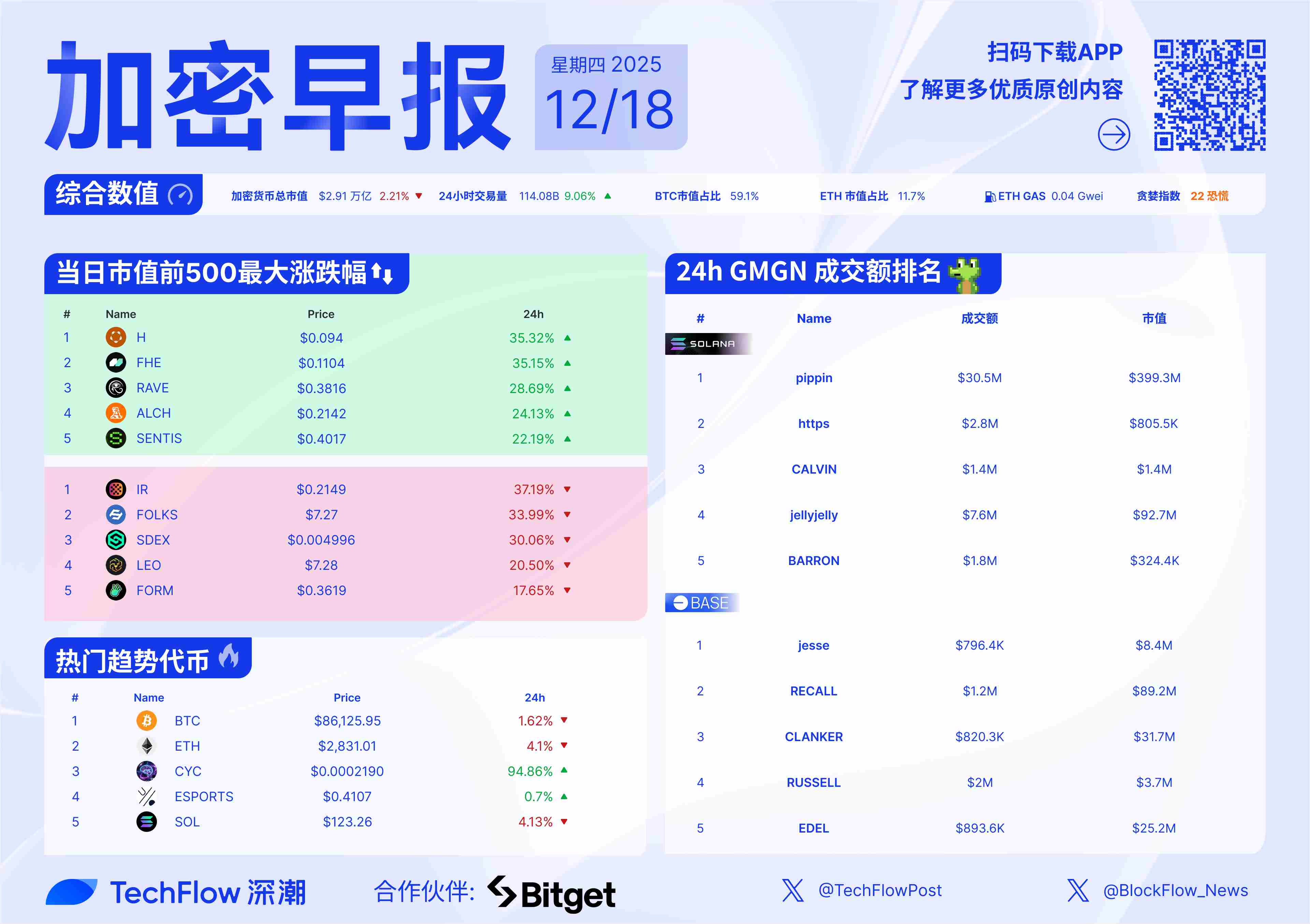
HTX market data shows that BTC dropped below $86,000 this morning and is currently trading at $86,132; ETH fell below $2,800 and is now at $2,831.

Waller: Job Market Indicates Fed Should Continue Cutting Rates

According to a report by Jinshi, Federal Reserve Governor Waller stated that inflation is above target but should decline in the coming months, and inflation expectations are well anchored. The current job market is very weak, and the existing job growth is not ideal; the job market indicates that the Fed should continue to cut interest rates.

Waller also mentioned that 2026 could be a better year for economic performance.

Coinbase Launches Stock Trading and Prediction Market Services

According to a report by CoinDesk, U.S.-listed cryptocurrency exchange Coinbase announced a major expansion of its platform's asset range during its System Update event on December 18th. The new services include stock trading, prediction markets, new cryptocurrencies, and perpetual futures, among others, aiming to solidify its market position as an "all-in-one exchange."

Coinbase will initially launch stock trading services for hundreds of stocks based on market capitalization and trading volume, with plans to add thousands more stocks and ETFs in the coming months. Users can enjoy zero-commission trading without the constraints of traditional market hours, trading 24 hours a day, five days a week. Additionally, Coinbase has partnered with prediction market provider Kalshi, valued at $11 billion, allowing users to trade on the outcomes of real-world events such as elections, sports, collectibles, and economic indicators.

Simultaneously, Coinbase also launched the AI-driven wealth management tool Coinbase Advisor and the business service Coinbase Business for startups, further expanding its business scope. Company executives stated that these new features will be supported by the Coinbase Tokenize platform, an end-to-end institutional-grade platform designed for tokenizing real-world assets.

Bloomberg: Binance Exploring Relaunch of Binance.US

According to a report by Bloomberg, Binance founder CZ is reasserting his influence in the crypto industry. As U.S. President Trump's stance on crypto assets becomes more friendly, CZ has frequently publicly affirmed related policies and signaled a positive outlook for the U.S. market.

Informed sources indicated that Binance has been exploring plans to relaunch Binance.US, including a possible recapitalization that would reduce CZ's controlling stake. The sources also mentioned that if Binance acquires part or all of CZ's shares, it could appoint new leadership, implement growth-oriented business strategies, and leverage its political connections in Washington.

Separately, informed sources revealed that Binance has been seeking closer cooperation with the world's largest asset management company, BlackRock.

Tether Launches Peer-to-Peer Password Manager PearPass

According to an official announcement, stable币 giant Tether has officially launched PearPass, a peer-to-peer (P2P) password manager designed to eliminate the risk of users' encrypted information being leaked via the cloud.

Tether stated that existing password management tools generally rely on cloud storage, and once cloud services are breached, users' sensitive data could be exposed. PearPass adopts a decentralized peer-to-peer architecture, not storing passwords in the cloud, thereby enhancing security and privacy. The official announcement noted that the product will first support mainstream browsers, with plans to expand to mobile and more platforms. This move reflects the crypto industry's continued focus on innovating user security tools.

SBI Ripple Asia to Launch XRP-Based Yield Product

According to a report by CoinDesk, Ripple's Asian venture SBI Ripple Asia announced the signing of a memorandum of understanding with Doppler Finance to launch an XRP-based yield product and explore real-world asset tokenization on the XRP Ledger. It is reported that SBI Digital Markets, regulated by the Monetary Authority of Singapore, has been designated as the institutional custodian for related products and will provide segregated custody services for client assets.

Hyper Foundation Proposes Permanent Burn of HYPE Tokens in Assistance Fund

Hyper Foundation has formally proposed a validator vote to confirm that the HYPE tokens in the Assistance Fund are considered burned, permanently removing these tokens from circulation and the total supply. The Assistance Fund, as part of the L1 execution, automatically converts transaction fees into HYPE through the system address 0xfefefefefefefefefefefefefefefefefefefefe. This address is similar to a zero address and has never had a private key; the funds within it cannot be retrieved without a hard fork.

A "Yes" vote means validators agree to treat the HYPE in the Assistance Fund as burned and commit to never authorizing any protocol upgrade that could access this address. Voting will take place on the governance forum before 04:00 UTC on December 21st. Users can stake to support validators aligned with their views before 04:00 UTC on December 24th. The final result will be based on the staking-weighted consensus as of that time.

Binance Wallet Introduces Web3 Loan On-Chain Lending Feature

According to an official announcement, Binance Wallet has launched a new Web3 Loan on-chain lending feature, allowing users to directly use existing assets as collateral within the Binance Wallet to borrow crypto assets, expanding the on-chain lending experience. This feature is implemented by integrating with the Venus protocol on the BNB Chain, enabling multi-asset collateral and borrowing. It currently supports collateral in mainstream assets including BTCB, ETH, USDT, USDC, FDUSD, WETH, and allows borrowing of USDT, USDC, and BNB. Binance Wallet stated that it will launch an exclusive Venus reward activity based on this lending feature. Users borrowing eligible assets can share a 400,000 USDT reward pool and enjoy preferential interest rates, aiming to enhance liquidity and yield potential for on-chain wealth management and lending services within the wallet.

He Yi: Offering Reward for Criminal Evidence Related to 'Listing Agent' Fraudsters

Binance Co-CEO He Yi posted a message offering a reward for criminal evidence related to fraudsters involved in 'listing agent' schemes.

Norwegian Sovereign Wealth Fund Supports All Management Proposals at Metaplanet Shareholder Meeting

According to Bitcoin Magazine citing a Bloomberg Automation summary, the Norwegian sovereign wealth fund management agency Norges Bank Investment Management (NBIM) has expressed support for several management proposals from Bitcoin treasury company Metaplanet and will exercise its voting rights at the shareholder meeting on December 22nd. Data shows that as of the end of June 2025, NBIM holds approximately 0.3% of Metaplanet's shares. The Norwegian sovereign fund's series of moves to increase its Bitcoin exposure through public market asset allocation reflects sovereign-level long-term capital's recognition of the company's strategic direction.

Informed Sources: Crypto VC Firm Shima Capital Quietly Winding Down Operations

According to informed sources disclosed by Kate Irwin, cryptocurrency venture capital firm Shima Capital is quietly winding down its business operations. Three weeks ago, the U.S. Securities and Exchange Commission (SEC) filed a lawsuit against the company and its founder, Yida Gao, accusing them of "participating in a fraudulent scheme" to deceive investors. According to an email sent to portfolio company founders, Yida Gao is resigning and closing the fund. In the email, he stated: "I deeply regret my poor decisions and apologize for letting everyone down."

Shima Capital was founded in 2021 with $200 million in capital and had invested in several crypto projects including Berachain, Monad, and Pudgy Penguins. The SEC accused Yida Gao of exaggerating investment returns in promotional materials, claiming a 90x return on an investment that actually only yielded 2.8x. Furthermore, Fortune magazine reported that Yida Gao transferred investment funds to offshore entities wholly owned by himself without disclosing this to investors.

The day after the SEC filed the lawsuit, Yida Gao agreed to pay a settlement of approximately $4 million.

Miner Hut 8 Signs $7 Billion Data Center Lease Agreement

Bitcoin miner Hut 8 announced on platform X that it has signed a 15-year data center lease agreement worth $7 billion with Fluidstack for its 245-megawatt data center at the River Bend campus. Additionally, Fluidstack can add up to an additional 1,000 megawatts of capacity in future expansion phases of the campus, with specific terms dependent on the campus's installed capacity.

Market Dynamics
Recommended Reading

On the Eve of the Bank of Japan's Rate Hike, Why Did Bitcoin Fall First?

This article analyzes the reasons behind Bitcoin's recent price drop, pointing out that expectations of a Bank of Japan rate hike have triggered a global liquidity tightening, leading to the prioritization of selling high-volatility assets like Bitcoin. The article also explores whether the narrative of Bitcoin as "digital gold" still holds and how its pricing logic has changed due to institutionalization.

Can Pump.fun Tell a New Story Next Year?

This article focuses on the current state and future development of Pump.fun as a consumer application, analyzing its creator token model, market performance, challenges faced, and potential future strategic directions. Despite uncertainties, Pump.fun has shown some resilience in the current cycle and maintains a certain dominance in the crypto space.

Crypto is Dead, Long Live Crypto

This article describes the transformation the crypto industry is undergoing, moving from a closed, self-centered ecosystem towards a more universal, mainstream-integrated technological infrastructure. The article explores the future of crypto technology, emphasizing the need to shift from serving "crypto natives" to providing value for a broader user base, while also pointing out the industry's current limitations and possible future directions.

Roundup: 11 Intersection Scenarios of Artificial Intelligence and Cryptocurrency

This article delves into the intersection points of Artificial Intelligence (AI) and crypto technology, listing 11 specific application scenarios that showcase the potential and challenges of both in the future internet. The article emphasizes the role of blockchain technology in enhancing the openness, decentralization, and credible neutrality of AI systems, providing an in-depth analysis of the potential technological changes, business model innovations, and social impacts resulting from the combination of AI and blockchain.

I Dropped Out of High School, Learned with AI, and Made a Comeback to Become an OpenAI Researcher

This article tells the comeback story of Gabriel Petersson from high school dropout to OpenAI research scientist, focusing on his unique method of self-learning through AI—recursive knowledge filling. It analyzes strategies for efficiently utilizing AI for learning while cautioning against treating AI merely as a tool, but rather as a learning aid and thinking trainer.


Criptomoedas em alta

Perguntas relacionadas

QWhat new services did Coinbase announce during its System Update event on December 18th?

ACoinbase announced the expansion of its platform to include stock trading, prediction markets, new cryptocurrencies, and perpetual futures. It will first offer hundreds of stocks for trading with zero commissions and 24/5 availability, and it partnered with prediction market provider Kalshi.

QAccording to Bloomberg, what is Binance exploring regarding its US operations?

ABinance is exploring options to restart Binance.US, which could involve a recapitalization that would reduce founder CZ's controlling stake. The company is also reportedly seeking a closer partnership with asset management giant BlackRock.

QWhat is the main security feature of Tether's new password manager, PearPass?

APearPass is a peer-to-peer (P2P) password manager that enhances security and privacy by not storing passwords in the cloud, eliminating the risk of data exposure from a breach of cloud services.

QWhat did the Hyper Foundation propose regarding the HYPE tokens in its Assistance Fund?

AThe Hyper Foundation proposed a validator vote to confirm that the HYPE tokens in the Assistance Fund should be considered permanently burned, thus removing them from circulation and the total supply forever.

QWhat significant deal did bitcoin miner Hut 8 sign, as announced on their X platform?

AHut 8 signed a 15-year, $7 billion data center leasing agreement with Fluidstack for a 245-megawatt facility, with the potential for an additional 1,000 megawatts in future expansion phases.

Leituras Relacionadas

7 Months After the Collapse of Huiwang, Southeast Asia's Escrow Platforms Undergo a Major Reshuffle

Following the collapse of Huione Pay—dubbed the "Alipay of Southeast Asia"—seven months ago, the region's underground financial guarantee platform sector is undergoing a significant reshuffle. This power vacuum has been swiftly filled by emerging platforms such as XinBi, Tiger/Navigator, JinBei (renamed JinBo), Dali/Tiancheng, and FullyLight. These platforms, operating largely via Telegram and offering services like escrow for illicit transactions, have absorbed the vast user base and markets left behind by Huione. While positioning themselves as "trust intermediaries," their primary clientele consists of networks involved in online scams, money laundering, illegal gambling, and even human trafficking. For instance, the Tiger/Navigator platform explicitly provides "escrow" services for kidnapping-for-ransom operations ("强押车交易"). Data underscores the immense scale: Huione alone processed over $103 billion in cryptocurrency payments and facilitated over $31 billion through its escrow market before its downfall, linking it to Cambodia's notorious Prince Group. Since its collapse, competitors have seen explosive growth. For example, the XinBi platform has accumulated over $1.6 billion in total USDT revenue, while platforms like NewPay, OkPay (under Dali), and FullyLight Wallet collectively processed over $4.8 billion in USDT in a single year. This ecosystem thrives in regions like Cambodia and Myanmar, where regulatory gaps allow these platforms to act as critical financial infrastructure for sprawling cybercrime industries, from scam compounds to online casinos. The article concludes that the moniker "Southeast Asian Alipay" is a misnomer, obscuring the platforms' fundamental role in enabling serious criminal enterprises rather than representing legitimate financial innovation.

Odaily星球日报Há 3m

7 Months After the Collapse of Huiwang, Southeast Asia's Escrow Platforms Undergo a Major Reshuffle

Odaily星球日报Há 3m

The Changing Landscape: What Are Crypto VCs Experiencing?

Title: The Shifting Landscape of Crypto Venture Capital The era of dedicated crypto venture capital funds is undergoing a significant transformation. Once essential for navigating the sector's complexity and high risk, these specialized funds are now facing an identity crisis as the market matures. This shift mirrors historical patterns in other specialized investment classes like cleantech and SPACs, where initial information advantages dissipate as technologies become mainstream and integrated into existing industry frameworks. The article argues that crypto is reaching a critical inflection point, transitioning from a "building phase" to an "integration phase." Major players like Stripe, BlackRock, and Visa now engage with crypto not for its novel mechanics but as a foundational financial infrastructure. Their needs—regulatory compliance, banking partnerships, distribution channels—align with traditional fintech, a domain easily understood by large, generalist funds like Sequoia and Founders Fund. This evolution creates a "barbell effect" within the VC landscape. On one end are massive, diversified platforms that can incorporate crypto as one vertical among many. On the other are small, nimble funds focused on niche, experimental projects. The middle ground—medium-sized dedicated crypto funds—is being squeezed out. Their typical fund size makes it impossible to generate sufficient returns solely from early-stage crypto bets, yet they cannot compete with giants for later-stage deals. Consequently, leading crypto-native firms like Paradigm and Framework Ventures are expanding into AI, robotics, and other sectors, driven partly by LP pressure for better returns amid a broader VC DPI crisis. Others, like Dragonfly and a16z, have narrowed their crypto focus predominantly to financial infrastructure like stablecoins, reframing the sector's core narrative. For crypto entrepreneurs, this consolidation presents challenges. While generalist funds offer larger checks and broader resources, crypto projects now compete fiercely with AI for attention and capital within these firms. Furthermore, the long-term, non-commercial foundational work that built the ecosystem—funded by dedicated crypto VCs—is less likely to attract generalist capital focused on direct returns. The conclusion is that "crypto investor" as a standalone category is becoming obsolete, akin to "internet investor." Crypto is becoming a baseline infrastructure layer. The future will see a barbell structure: large-scale growth financing handled by generalist funds, while pioneering, speculative projects are funded by small, specialized vehicles. The dedicated crypto funds of the 2017-2021 boom, which incubated core infrastructure, are giving way to this new, bifurcated reality.

Foresight NewsHá 21m

The Changing Landscape: What Are Crypto VCs Experiencing?

Foresight NewsHá 21m

As Consensus Accelerates, What Are Young Investors Betting On?

Title: As Consensus Forms Faster, What Are Young Investors Betting On? In the rapid evolution of tech investment, a new generation of young investors is navigating a landscape where AI, robotics, commercial aerospace, and quantum computing are advancing simultaneously. Traditional investment logic based on financial models is giving way to a need for deep technical understanding and the ability to act before industry consensus forms. An analysis of trends from the "WAIC FUTURE TECH" list of young investment leaders reveals key shifts in focus. The first major trend is the movement of AI from the digital screen into the physical world. Investment is shifting from large language models and chatbots towards embodied AI, robotics, AI hardware, and edge computing. While demonstrations generate excitement, the real challenge lies in achieving scalable, reliable, and cost-effective delivery in complex real-world environments like factories and logistics. Success depends not just on algorithms but on the integration of sensors, actuators, and control systems. Second, the competitive focus for large models is moving beyond raw capability toward building an "intelligence flywheel." The goal is to create self-reinforcing systems where user interaction generates data, improving the model, which in turn enhances the user experience and attracts more engagement. Companies that successfully embed AI into workflows to create these closed-loop systems can build lasting value that isn't easily erased by the next model upgrade. Third, facing a potential bottleneck in high-quality human-generated data, investors are looking at new underlying technologies. Reinforcement learning and self-play, as demonstrated by AlphaGo Zero, offer paths for AI to generate its own experience. Scientific foundation models, which aim to build general AI capabilities for fields like life sciences and materials discovery, represent a non-consensus direction that could unlock new frontiers of knowledge and data. Finally, in deep-tech areas like quantum computing, commercial aerospace, and space-based infrastructure, patient capital is essential. These fields have long, uncertain development and validation cycles involving complex engineering, supply chains, and regulations. Investment here requires a long-term view, focusing on foundational team capabilities and the eventual emergence of market demand, even if commercial returns are distant. Collectively, these trends illustrate how young investors are adapting to a new era. They are learning to make earlier, technically-informed judgments, balance hype with real-world viability, and provide the patient capital needed to build the deep-tech foundations of the future.

marsbitHá 49m

As Consensus Accelerates, What Are Young Investors Betting On?

marsbitHá 49m

Trading

Spot

Artigos em Destaque

Como comprar US

Bem-vindo à HTX.com!Tornámos a compra de Talus Network (US) simples e conveniente.Segue o nosso guia passo a passo para iniciar a tua jornada no mundo das criptos.Passo 1: cria a tua conta HTXUtiliza o teu e-mail ou número de telefone para te inscreveres numa conta gratuita na HTX.Desfruta de um processo de inscrição sem complicações e desbloqueia todas as funcionalidades.Obter a minha contaPasso 2: vai para Comprar Cripto e escolhe o teu método de pagamentoCartão de crédito/débito: usa o teu visa ou mastercard para comprar Talus Network (US) instantaneamente.Saldo: usa os fundos da tua conta HTX para transacionar sem problemas.Terceiros: adicionamos métodos de pagamento populares, como Google Pay e Apple Pay, para aumentar a conveniência.P2P: transaciona diretamente com outros utilizadores na HTX.Mercado de balcão (OTC): oferecemos serviços personalizados e taxas de câmbio competitivas para os traders.Passo 3: armazena teu Talus Network (US)Depois de comprar o teu Talus Network (US), armazena-o na tua conta HTX.Alternativamente, podes enviá-lo para outro lugar através de transferência blockchain ou usá-lo para transacionar outras criptomoedas.Passo 4: transaciona Talus Network (US)Transaciona facilmente Talus Network (US) no mercado à vista da HTX.Acede simplesmente à tua conta, seleciona o teu par de trading, executa as tuas transações e monitoriza em tempo real.Oferecemos uma experiência de fácil utilização tanto para principiantes como para traders experientes.

422 Visualizações TotaisPublicado em {updateTime}Atualizado em 2026.06.02

Como comprar US

Discussões

Bem-vindo à Comunidade HTX. Aqui, pode manter-se informado sobre os mais recentes desenvolvimentos da plataforma e obter acesso a análises profissionais de mercado. As opiniões dos utilizadores sobre o preço de US (US) são apresentadas abaixo.

活动图片












