Crypto May Be Loud Online, But Only 4% Of Voters Care: Poll

bitcoinistPublicado em 2026-05-14Última atualização em 2026-05-14

Resumo

A Politico survey reveals a stark disconnect between crypto industry lobbying and U.S. voter priorities. While crypto groups have spent over $130 million on the 2024 elections, only 4% of voters say a candidate's position on crypto would influence their vote. Affordable housing, consumer fraud protection, and lower bank fees rank as far more important issues for voters. The poll also shows public ambivalence toward digital assets. Only 27% support government efforts to make crypto mainstream, while 31% oppose it. Over half of respondents have never traded crypto and don't plan to. Among those who have traded, 7% say a candidate's stance would sway their vote. Furthermore, 45% view crypto investing as a risk not worth taking. Despite low voter interest, Congress is advancing crypto regulation. The Senate Banking Committee is set to vote on a regulatory framework bill, a version of which already passed the House in June.

A separate poll released Friday by HarrisX found that 47% of registered voters said they would consider crossing party lines to support a candidate who backed crypto regulation legislation — a figure that stands in sharp contrast to new data showing crypto barely moves the needle for most Americans when they head to the polls.

The Lobbying Machine Behind The Legislation

The Politico survey, conducted by polling firm Public First and covering 2,035 US adults, found that only 4% of respondents would factor a candidate’s position on crypto into their voting decision.

Source: Politico

Affordable housing topped the list of issues voters want Congress to address, followed by consumer fraud protection and lower bank fees. Crypto regulation came in last.

That gap between voter priorities and industry muscle is hard to ignore. Crypto lobbies spent more than $130 million during the 2024 elections — more than any other industry — and have already committed $320 million to shape the upcoming November midterms, according to data compiled by researcher Molly White.
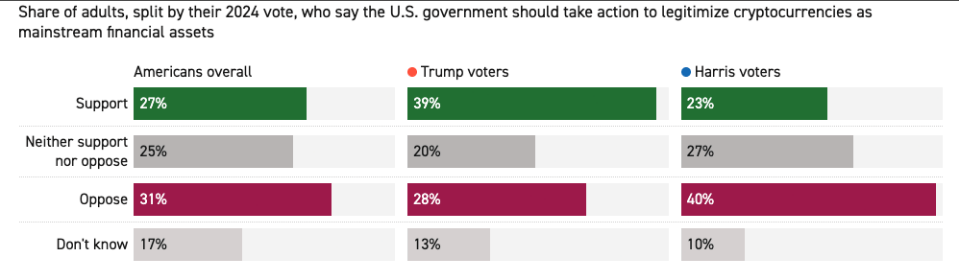
Survey results on public opinion regarding whether the US government should formally adopt crypto as a mainstream financial asset. Source: Politico.

In Illinois alone, crypto-aligned PACs have spent over $5.5 million opposing specific congressional candidates this year.

BTCUSD currently trading at $79,593. Chart: TradingView

Republican Representative Dusty Johnson acknowledged the disconnect. Most voters don’t think about digital assets, he told Politico, but those who do feel strongly about it. He described it as a high-intensity issue that is slowly growing in public awareness, even if the numbers remain small.

A Public Still Divided On Digital Assets

The survey also captured a broader wariness toward crypto among ordinary Americans. Only 27% said they support or strongly support the US government taking steps to make crypto a mainstream financial asset.

A slightly larger share — 31% — said they oppose or strongly oppose such a move. More than half of respondents said they had never traded crypto and had no plans to do so.

Image: Pexels

Among the 19% who had actually traded crypto, 7% said a candidate’s stance on the issue would influence their vote. The poll also found that 45% of respondents considered crypto investing a risk not worth taking, even with the promise of high returns. Only 25% disagreed.

Senate Moving On Crypto Regulation This Week

Meanwhile, Congress is pushing ahead. The Senate Banking Committee is set to vote on whether to advance a long-awaited bill that would establish a regulatory framework for the crypto industry.

A version of the bill — known as the Clarity Act — already cleared the House in June. Reports indicate the White House has been involved in negotiations between crypto interests and banking lobbies to shape the final version.

Featured image from Unsplash, chart from TradingView

Perguntas relacionadas

QAccording to the poll, what percentage of voters would factor a candidate's position on crypto into their voting decision?

AAccording to the Politico survey, only 4% of respondents would factor a candidate's position on crypto into their voting decision.

QWhat issue topped the list of voter priorities that they want Congress to address, as revealed in the article?

AAffordable housing topped the list of issues voters want Congress to address, according to the survey.

QHow much money did crypto lobbies spend during the 2024 elections, and how does this compare to other industries according to the data cited?

ACrypto lobbies spent more than $130 million during the 2024 elections, which was more than any other industry.

QWhat percentage of survey respondents support the US government taking steps to make crypto a mainstream financial asset?

AOnly 27% of survey respondents said they support or strongly support the US government taking steps to make crypto a mainstream financial asset.

QWhat legislative action is the Senate Banking Committee set to take regarding crypto, as mentioned in the article?

AThe Senate Banking Committee is set to vote on whether to advance a long-awaited bill, known as the Clarity Act, which would establish a regulatory framework for the crypto industry.

Leituras Relacionadas

Codex Goal Mode Usage Guide: How to Make AI Continuously Pursue a Specific Objective

"Codex Goal Mode: How to Make AI Work Continuously Toward a Specific Goal" OpenAI's Codex "goal mode" (/goal) transforms the AI from a reactive code assistant into a proactive execution agent capable of working autonomously for hours or even days to achieve a defined objective. To maximize its effectiveness, follow these key principles: 1. **Define Clear, Verifiable Exit Criteria:** The goal prompt should be a concise, measurable success condition, not a lengthy specification. Use quantifiable metrics like "reduce build time by 30%" or "achieve 100% test parity." 2. **Provide Initial Guidance and Tools:** Direct Codex toward likely problem areas and specify available tools (e.g., browsers, testing environments) to prevent it from exploring unproductive paths. 3. **Enable Progress Measurement:** Equip Codex with ways to track advancement, such as creating comparison tools for visual tasks or evaluation sets, ensuring it can gauge its own progress. 4. **Use a Realistic Execution Environment:** For tasks like performance optimization, provide access to environments that closely mimic production (e.g., similar configs, databases) to yield valid results. 5. **Be Cautious with Visual Goals:** Avoid vague "pixel-perfect" instructions. Instead, supplement visual references with functional checklists or design system specifications to prevent Codex from obsessing over minor details. 6. **Implement Progress Tracking:** For long-running tasks, have Codex commit code to draft PRs, update progress documents, or send Slack updates to maintain visibility into its work. 7. **Review and Consolidate Results:** Once the goal is met, instruct Codex to review its work, clean up ineffective experimental code, and reflect on what strategies succeeded or failed. Ultimately, using goal mode shifts the developer's role from writing prompts to managing a persistent engineering agent—defining objectives, establishing metrics, configuring environments, and conducting final reviews.

marsbitHá 38m

Codex Goal Mode Usage Guide: How to Make AI Continuously Pursue a Specific Objective

marsbitHá 38m

From Ethereum to AI's 'CROPS': What Exactly Is This 'Slow Variable' That Vitalik Has Repeatedly Emphasized?

Recently, Vitalik Buterin has frequently emphasized the concept of "CROPS," first outlined in the Ethereum Foundation's March mandate as core principles guiding its focus: Censorship Resistance, Capture Resistance, Open Source, Privacy, and Security. CROPS represents Ethereum's commitment to providing foundational capabilities for user sovereignty—enabling asset ownership, identity expression, and coordination without reliance on centralized platforms or surrendering ultimate control. This framework is gaining new urgency with the rise of AI, particularly AI agents managing digital assets and automating transactions. While AI offers convenience, it risks centralizing user data, intent, and control if dependent on opaque, centralized services. Vitalik argues for "CROPS AI"—AI that is open, privacy-preserving, secure, and capable of local execution to maintain user agency. He highlights convergence between "CROPS Ethereum access layers" and "CROPS AI," such as using zero-knowledge proofs for private remote LLM calls and Ethereum RPC reads, ensuring users can access services without exposing sensitive information. Ultimately, CROPS is not just an abstract ideal but a practical guide for Ethereum's development and AI integration. It addresses the critical long-term question: as digital systems grow more powerful, how can users retain control over their privacy, assets, and autonomy? In an AI-driven era, these principles may define Ethereum's enduring value—prioritizing verifiable, secure, and user-centric design over short-term optimizations like speed and cost alone.

marsbitHá 43m

From Ethereum to AI's 'CROPS': What Exactly Is This 'Slow Variable' That Vitalik Has Repeatedly Emphasized?

marsbitHá 43m

Trading

Spot
Futuros

Artigos em Destaque

Como comprar 4

Bem-vindo à HTX.com!Tornámos a compra de 4 (4) simples e conveniente.Segue o nosso guia passo a passo para iniciar a tua jornada no mundo das criptos.Passo 1: cria a tua conta HTXUtiliza o teu e-mail ou número de telefone para te inscreveres numa conta gratuita na HTX.Desfruta de um processo de inscrição sem complicações e desbloqueia todas as funcionalidades.Obter a minha contaPasso 2: vai para Comprar Cripto e escolhe o teu método de pagamentoCartão de crédito/débito: usa o teu visa ou mastercard para comprar 4 (4) instantaneamente.Saldo: usa os fundos da tua conta HTX para transacionar sem problemas.Terceiros: adicionamos métodos de pagamento populares, como Google Pay e Apple Pay, para aumentar a conveniência.P2P: transaciona diretamente com outros utilizadores na HTX.Mercado de balcão (OTC): oferecemos serviços personalizados e taxas de câmbio competitivas para os traders.Passo 3: armazena teu 4 (4)Depois de comprar o teu 4 (4), armazena-o na tua conta HTX.Alternativamente, podes enviá-lo para outro lugar através de transferência blockchain ou usá-lo para transacionar outras criptomoedas.Passo 4: transaciona 4 (4)Transaciona facilmente 4 (4) no mercado à vista da HTX.Acede simplesmente à tua conta, seleciona o teu par de trading, executa as tuas transações e monitoriza em tempo real.Oferecemos uma experiência de fácil utilização tanto para principiantes como para traders experientes.

618 Visualizações TotaisPublicado em {updateTime}Atualizado em 2026.06.02

Como comprar 4

Discussões

Bem-vindo à Comunidade HTX. Aqui, pode manter-se informado sobre os mais recentes desenvolvimentos da plataforma e obter acesso a análises profissionais de mercado. As opiniões dos utilizadores sobre o preço de 4 (4) são apresentadas abaixo.

活动图片