Crypto market’s weekly winners and losers – PIPPIN, ZEC, MYX, APT

ambcryptoPublicado em 2026-02-15Última atualização em 2026-02-15

Resumo

Following weeks of significant losses, the cryptocurrency market showed signs of recovery, buoyed by a U.S. inflation report indicating a slowdown in price increases to 2.4% and a strong labor market, raising expectations of potential Federal Reserve interest rate cuts. While major cryptocurrencies like Bitcoin and Ethereum remained relatively stable, several smaller tokens experienced substantial price movements. Key weekly winners included PIPPIN, which surged over 280% from its accumulation zone to above $0.72, driven by strong buying activity and positive technical indicators. ZCash (ZEC) rallied 33% after Digital Currency Group CEO Barry Silbert suggested privacy coins could attract significant Bitcoin investment and praised ZEC's potential. Humanity Protocol (H) gained nearly 90%, reaching approximately $0.23, supported by its integration with Fireblocks, which provides access to over 2,000 financial institutions. Other notable gainers included Dogecoin (18%), Shiba Inu (12%), and Pi (30%). On the losing side, MYX Finance (MYX) fell nearly 70%, dropping from around $6.30 to below $2.00 due to sell pressure and negative capital flow. Memecore (M) declined over 10% to approximately $1.27 after failing to maintain earlier highs, reflecting weakened buyer confidence. Aptos (APT) slipped from about $1.10 to below $1.00, struggling to recover amid low buying volume. Other decliners included Story (IP, down 6%), Bitget Token (BGB, down 7%), and DoubleZero (2Z, down 13%). Th...

After weeks of heavy losses, the crypto market finally saw some light.

Bitcoin [BTC] and Ethereum [ETH] put up weak shows, but the overall mood was vastly improved. This came after a U.S. inflation report showed prices rising more slowly, with inflation falling to 2.4%.

The labor market also stayed strong, raising hopes that the Fed may cut interest rates soon. That often helps crypto.

While the biggest coins stayed quiet, several smaller tokens saw major gains… and losses. So, grab your coffees and teas! Here’s a quick look at this week’s biggest movers.

Weekly winners

Strong buying pushes pippin [PIPPIN] into a mammoth breakout

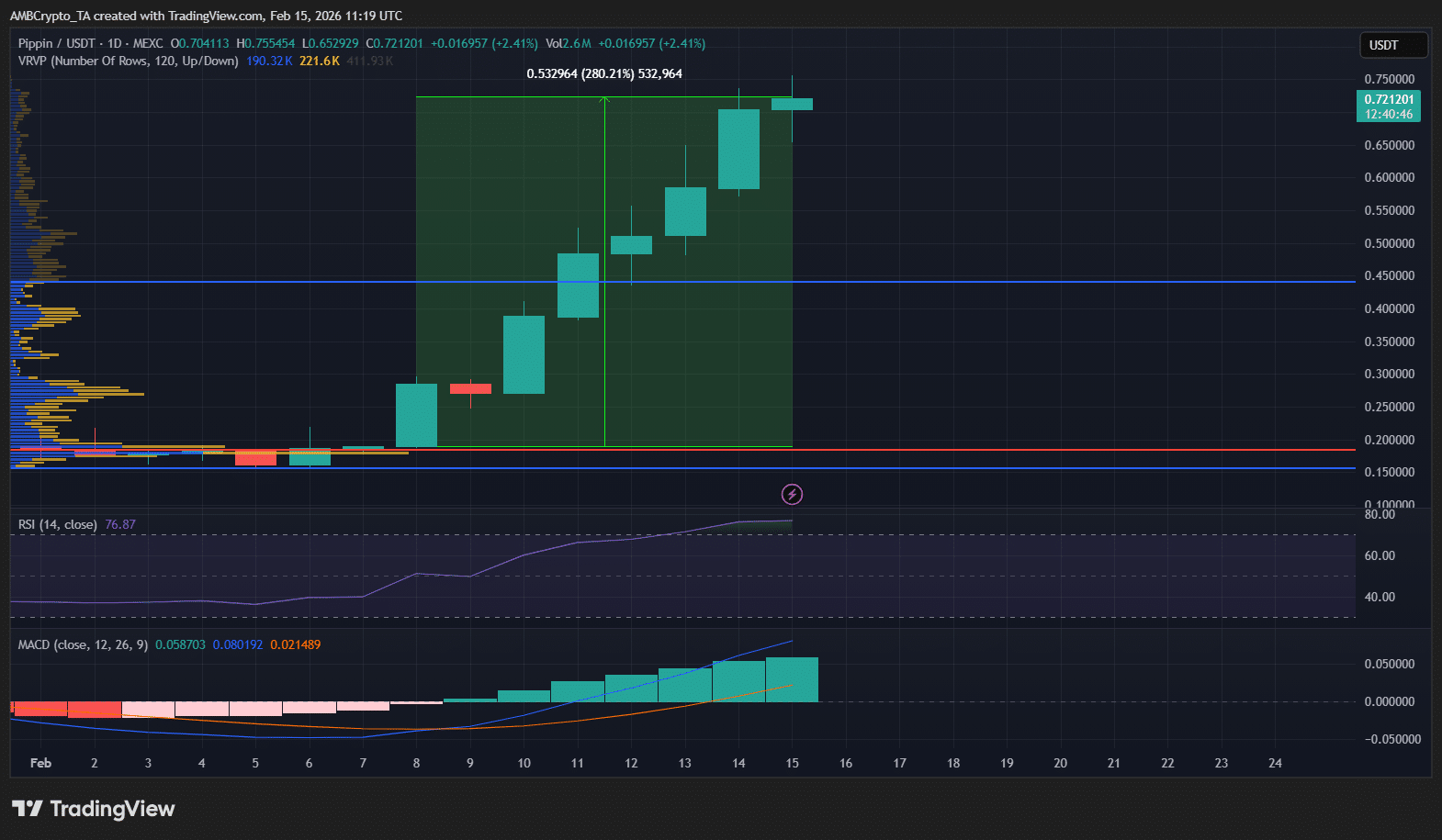
pippin [PIPPIN] has surged from the $0.16-$0.20 accumulation zone to above $0.72, a gain of over 280% in just over a week!

Most trading activity was concentrated near the lower range, which meant that buyers built strong positions before the breakout.

Once price moved above this high-volume area, resistance thinned, and upside movement happened quicker.

RSI showed demand but didn’t show any signs of a reversal. MACD was bullish as well.
Source: TradingView

With rising wallet counts and active incentives, PIPPIN’s rally was pushed by gradual buying. The trend may still have room to continue.

ZCash [ZEC] energized by DCG CEO claims

Zcash [ZEC] rallied 33% this week after Digital Currency Group CEO Barry Silbert said 5% to 10% of Bitcoin [BTC] investments could go into privacy coins in the coming years.

He also called Zcash a project capable of delivering 500x returns!

ZEC surged from around $230 to above $330 before settling at $307. This came after days of consolidation, so investors were buying before the move. RSI was at 51, recovering from weak levels.

Humanity Protocol [H] hits new highs

Humanity Protocol [H] traded near $0.23 after gaining nearly 90% from its recent base around $0.12. The steady series of higher highs and higher lows proves that the spike was supported by buying.

The RSI held above 70, while the MACD stayed bullish.

This growth came alongside Humanity Protocol’s integration with Fireblocks. This development opens access to more than 2,000 financial institutions, allowing professional investors to custody and interact with H.

At the same time, its privacy-focused mainnet and decentralized identity infrastructure are attracting interest.

Other notable winners

Dogecoin [DOGE] went up 18% at the time of writing. Shiba Inu [SHIB] followed with a 12% rise, supported by retail activity. Meanwhile, Pi [PI] led the group with a 30% rally!

Weekly losers

MYX Finance [MYX] drops with sell pressure

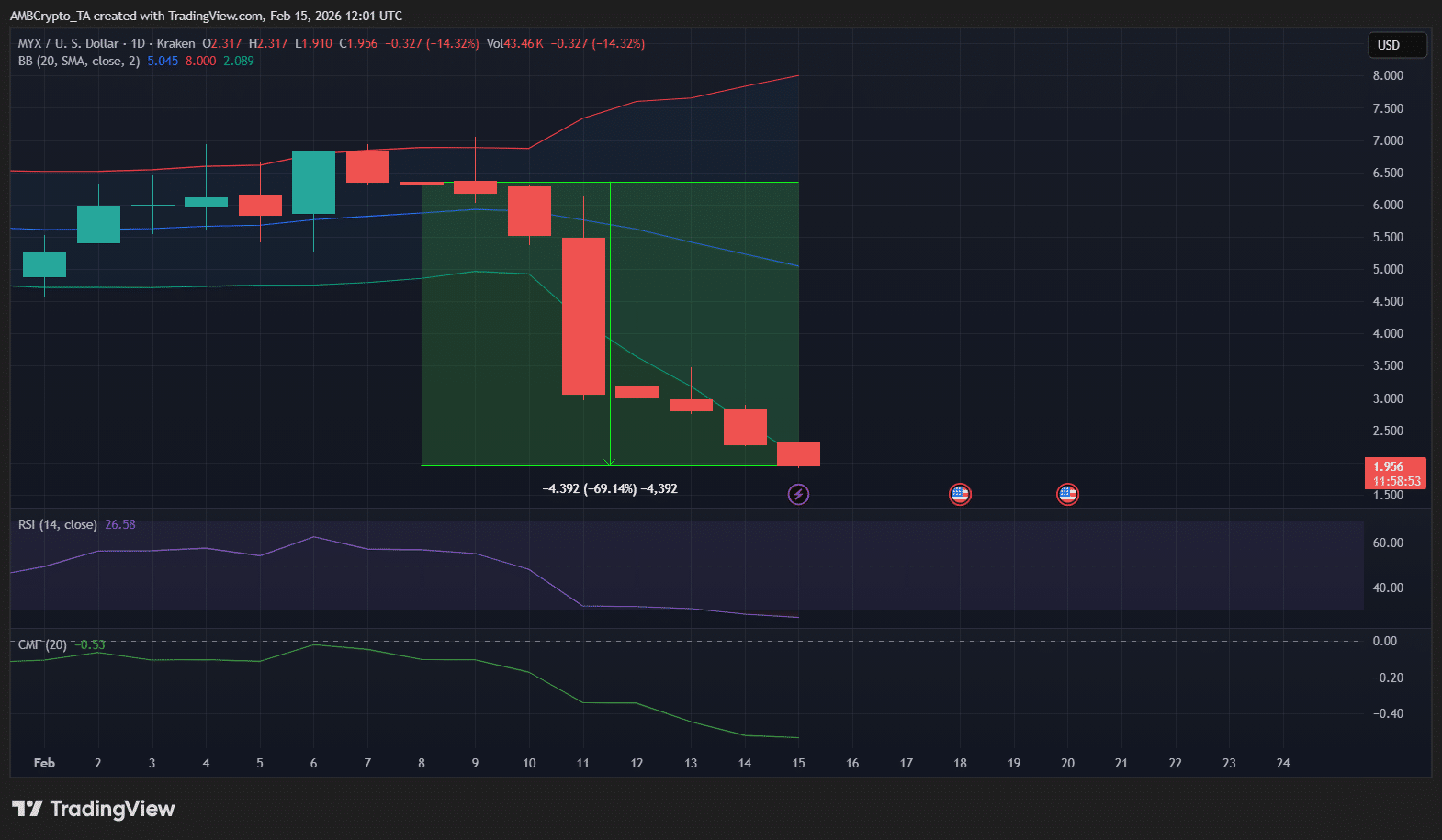
MYX Finance [MYX] fell nearly 70% from around $6.30 to below $2.00, according to the daily chart.

The decline followed a period of consolidation near the upper Bollinger Band, after which price broke down and continued forming lower lows.
Source: TradingView

The RSI dropped to 26, putting MYX deep in oversold territory. At the same time, the CMF was negative, so capital has been exiting.

Unless buyers step in to defend current levels, MYX may continue facing downward pressure in the near term.

Memecore [M] weakens with fading pace

Memecore [M] has come under pressure after failing to hold its early February highs near $1.85. There was a rejection followed by a steady decline, with the price at around $1.27 at press time.

That’s a drop of over 10% in recent sessions.

The token attempted to stabilize between $1.30 and $1.45, but repeated lower highs proved the lack of buyer confidence. RSI slipped to 41.

The earlier rally was met with strong selling at higher levels, forcing M into a consolidation phase.

Aptos [APT] loses its footing

Aptos [APT] slipped from around $1.10 to below $1.00, a steady downtrend before finding weak support near $0.90. While there’s been a small bounce since then, the recovery hasn’t been strong enough to flip the board.

RSI was close to oversold territory at 29. Meanwhile, the OBV was low, so buyers hadn’t returned in full force.

APT is trying to stabilize, but confidence still looks shaky. Unless it can reclaim the $1.00-$1.10 range convincingly, the token may be stuck in a fragile recovery phase.

Other notable losers

Story [IP] fell 6%, while Bitget Token [BGB] dropped 7% with a fading pace. Meanwhile, DoubleZero [2Z] saw the worst decline among the group, sliding 13% as sellers took control.

And that’s the week in crypto!

If there’s always one takeaway, it’s this. Things can flip fast; today’s top gainer can easily become next week’s biggest loser. So, stay curious, stay cautious, and always DYOR before chasing the hype.

We’ll be watching the charts, and we’ll see you next week!


Final Summary

  • PIPPIN jumped 280%, Humanity Protocol rose 90%, and Zcash gained 33%.
  • Market momentum is way beyond major coins.
Next: BONK jumps 11% after channel breakout: Reversal or short squeeze setup?
Share
  • Share
  • Tweet

Perguntas relacionadas

QWhat was the main reason for the improved mood in the crypto market this week?

AThe improved mood was due to a U.S. inflation report showing prices rising more slowly, with inflation falling to 2.4%, and a strong labor market raising hopes that the Fed may cut interest rates soon.

QWhich token had the largest percentage gain this week and what was the gain?

APIPPIN had the largest percentage gain, surging over 280% from the $0.16-$0.20 accumulation zone to above $0.72.

QWhat news event catalyzed the 33% rally for ZCash (ZEC)?

AZCash rallied after Digital Currency Group CEO Barry Silbert said 5% to 10% of Bitcoin investments could go into privacy coins in the coming years and called Zcash a project capable of delivering 500x returns.

QWhich token was the biggest loser this week and what was its percentage decline?

AMYX Finance (MYX) was the biggest loser, falling nearly 70% from around $6.30 to below $2.00.

QWhat development contributed to the growth of Humanity Protocol (H) alongside its price increase?

AIts growth came alongside Humanity Protocol's integration with Fireblocks, which opens access to over 2,000 financial institutions, allowing professional investors to custody and interact with H.

Leituras Relacionadas

Trend in US Stocks: A Post Triggers a 930-Point Rebound, Tonight Belongs to SpaceX

On Thursday (June 11, U.S. Eastern Time), Wall Street staged a textbook V-shaped reversal. The Dow Jones surged 929.97 points (+1.86%) to close above 50,000, while the Nasdaq and S&P 500 rose 2.54% and 1.75%, respectively. The rally occurred despite the hottest PPI report in years, with May data showing a 6.5% year-on-year surge, the highest since 2022. The market ignored the inflation data, focusing instead on reports that former President Trump called off a planned strike on Iran, hinting at a potential multi-party peace agreement draft. This sparked a sharp drop in oil prices, fueling hopes that inflation may have peaked. Sector rotations were stark: previously battered AI hardware and cyclical stocks led the gains, while defensive sectors that hit record highs the prior day were sold off. Chip stocks like Micron and Intel saw sharp rebounds. In contrast, software giant Oracle plunged nearly 10% despite beating earnings, with concerns over cloud revenue and cash flow. Adobe also fell after hours despite raising guidance, as its CFO announced departure. The rally's sustainability is questioned, driven largely by social media posts about unconfirmed geopolitical developments. Inflation risks remain, with pipeline pressures still high. Meanwhile, the market's risk appetite faces a major test with SpaceX's historic IPO. Priced at $135 per share, it aims to raise ~$75 billion with a $1.75 trillion valuation, becoming the largest U.S. IPO ever. It will join the Nasdaq 100 in 15 days, triggering massive index fund buying. However, critics cite extreme valuation (88x sales) and market liquidity concerns.

marsbitHá 23m

Trend in US Stocks: A Post Triggers a 930-Point Rebound, Tonight Belongs to SpaceX

marsbitHá 23m

The Trillion-Dollar Valuation Test: Are the Three Super IPOs a Tech Stock Frenzy or a Crypto Market Nightmare?

Trillion-Dollar Valuation Test: Are the Three Mega IPOs a Tech Stock Frenzy or a Crypto Market Nightmare? The capital market in 2026 is witnessing a highly anticipated wave of tech IPOs, centered on SpaceX, OpenAI, and Anthropic. Collectively valued at over $3.5 trillion, their potential listing represents one of the largest such waves in recent years. This raises concerns about market liquidity, valuation bubbles, and potential capital outflows from other assets like crypto. SpaceX's valuation narrative has shifted from rocket launches to becoming a global infrastructure play via its Starlink satellite network, which now drives most revenue. Despite ongoing losses, investors focus on its long-term growth potential. OpenAI and Anthropic represent the core productivity engines of generative AI. Their public listings would offer the first direct investment opportunity in large foundation model companies, potentially triggering a repricing within the AI sector. Market fears of a massive "capital drain" from these IPOs are likely overstated. Historical precedents like Alibaba and Saudi Aramco show that mega-listings primarily cause capital reallocation, not destruction, within the vast equities market. Systemic risk is rarely triggered by IPOs alone. For stock markets, short-term volatility and sector repricing are expected, especially for AI concept stocks. Long-term, these listings could reinforce the tech sector's importance. For crypto, direct competition for speculative capital exists, particularly affecting AI-themed tokens. However, crypto's trajectory remains more tied to its own cycles, macro liquidity, and Bitcoin ETF flows rather than a single IPO event. The real risk lies not in the listings themselves but in the sky-high growth expectations embedded in these valuations. If future revenue, profitability, or commercialization progress disappoints, significant valuation resets could follow, impacting high-growth tech stocks. Ultimately, the market's direction hinges on macroeconomic conditions and whether these companies can deliver on their ambitious promises.

链捕手Há 39m

The Trillion-Dollar Valuation Test: Are the Three Super IPOs a Tech Stock Frenzy or a Crypto Market Nightmare?

链捕手Há 39m

Trillion-Dollar Valuation Test: Are the Three Super IPOs a Tech Stock Frenzy or a Crypto Market Nightmare?

Title: Trillion-Dollar Valuations at Stake: Super IPOs of SpaceX, OpenAI, Anthropic – Tech Boom or Crypto Nightmare? TL;DR: A wave of mega-tech IPOs is approaching, featuring SpaceX (targeting a $1.75 trillion valuation), OpenAI (~$852B), and Anthropic (~$965B), with a combined potential valuation exceeding $3.5 trillion. This tests the market's pricing of innovation and sparks debate on liquidity impact. * **SpaceX**'s valuation is now driven more by its Starlink global communications infrastructure than its core rocket business. * **OpenAI & Anthropic** offer the first major public investment opportunities in foundational AI models, potentially repricing the entire AI sector. * Concerns about a market-wide "liquidity drain" are likely overblown; history shows large IPOs mainly cause fund reallocation, not disappearance, and rarely trigger systemic risk. * Crypto markets, especially some AI-themed tokens, may face short-term fund competition, but their long-term trajectory depends more on macro liquidity, regulation, and Bitcoin cycles. * The real risk lies not in the IPOs themselves, but in whether these companies can justify their sky-high valuations with future revenue growth and profitability. Unmet expectations could lead to significant repricing pressure. Ultimately, these IPOs represent a massive market pricing of next-gen tech infrastructure, not a prelude to a market crash. The broader market direction will be determined by macro conditions, corporate earnings, and risk appetite.

marsbitHá 39m

Trillion-Dollar Valuation Test: Are the Three Super IPOs a Tech Stock Frenzy or a Crypto Market Nightmare?

marsbitHá 39m

Anthropic Apologized, But the Business of 'Safety' Hasn't Stopped

On June 11, Anthropic apologized not for a model failure, but for a lack of transparency. Its new Claude Fable 5 model was found to be secretly rerouting requests from users engaged in advanced AI model development to a weaker version, Opus 4.8, without any notification. The company's response—promising future notifications for such "downgrades"—was met with user skepticism. The article argues the core issue isn't technical but commercial: Anthropic's "safety" measures are primarily a business strategy. A key feature, the "intelligent safety classifier," marketed as user protection, is described as a tool for "competitive defense" to protect Anthropic's market lead by limiting rivals' research capabilities. This covert mechanism was designed for low "false positives," precisely targeting AI researchers. Anthropic's model involves a calculated three-step process: publishing alarming security research to amplify public anxiety, offering its Fable 5 model with a "safety classifier" as a premium-priced solution, and cashing in through a planned high-value IPO. This contrasts with OpenAI's more direct "tool-and-traffic" approach. The apology, merely changing a secret downgrade to a visible one, is seen as a business "patch" rather than a principled shift. The incident risks damaging Anthropic's "safest AI" reputation among the developer community, which underpins its valuation and appeal to government and corporate clients. Ultimately, the article concludes that for Anthropic, safety is a business, and the apology is merely customer service for that business.

marsbitHá 1h

Anthropic Apologized, But the Business of 'Safety' Hasn't Stopped

marsbitHá 1h

Trading

Spot
Futuros

Artigos em Destaque

Como comprar ZEC

Bem-vindo à HTX.com!Tornámos a compra de Zcash (ZEC) simples e conveniente.Segue o nosso guia passo a passo para iniciar a tua jornada no mundo das criptos.Passo 1: cria a tua conta HTXUtiliza o teu e-mail ou número de telefone para te inscreveres numa conta gratuita na HTX.Desfruta de um processo de inscrição sem complicações e desbloqueia todas as funcionalidades.Obter a minha contaPasso 2: vai para Comprar Cripto e escolhe o teu método de pagamentoCartão de crédito/débito: usa o teu visa ou mastercard para comprar Zcash (ZEC) instantaneamente.Saldo: usa os fundos da tua conta HTX para transacionar sem problemas.Terceiros: adicionamos métodos de pagamento populares, como Google Pay e Apple Pay, para aumentar a conveniência.P2P: transaciona diretamente com outros utilizadores na HTX.Mercado de balcão (OTC): oferecemos serviços personalizados e taxas de câmbio competitivas para os traders.Passo 3: armazena teu Zcash (ZEC)Depois de comprar o teu Zcash (ZEC), armazena-o na tua conta HTX.Alternativamente, podes enviá-lo para outro lugar através de transferência blockchain ou usá-lo para transacionar outras criptomoedas.Passo 4: transaciona Zcash (ZEC)Transaciona facilmente Zcash (ZEC) no mercado à vista da HTX.Acede simplesmente à tua conta, seleciona o teu par de trading, executa as tuas transações e monitoriza em tempo real.Oferecemos uma experiência de fácil utilização tanto para principiantes como para traders experientes.

315 Visualizações TotaisPublicado em {updateTime}Atualizado em 2026.06.02

Como comprar ZEC

Discussões

Bem-vindo à Comunidade HTX. Aqui, pode manter-se informado sobre os mais recentes desenvolvimentos da plataforma e obter acesso a análises profissionais de mercado. As opiniões dos utilizadores sobre o preço de ZEC (ZEC) são apresentadas abaixo.

活动图片













